Your hands are tight on the wheel. You know the steps in the yard. Then the trailer starts to angle, the cones look different in the mirrors than they did a second ago, and your brain suddenly says you're either too close or nowhere near close enough. That feeling is normal.
Most students don't fail CDL parallel parking because they're careless. They struggle because backing a large vehicle by mirror takes a different kind of vision. You're turning a flat mirror image into a moving three-dimensional picture while trying not to rush, not to freeze, and not to burn one of your allowed corrections too early.
That's why good practice has to do two jobs at once. It has to teach the wheel work, and it has to teach your mind what to look for so you stay calm when the truck starts moving backward.
Is Parallel Parking Still on the CDL Test
The first question most students ask is simple. Will I even have to do parallel parking on test day?
In many places, maybe not in the classic form. In states using the modernized CDL skills test, the old parallel parking exercise has been replaced by Reverse Offset Backing, and by 2024 most states had fully implemented that updated protocol according to the FMCSA and AAMVA modernization material.

What that change actually means
This change throws people off because they hear “parallel parking is gone” and assume they don't need the skill anymore. That's the wrong takeaway.
Whether your examiner gives you the classic parallel park or reverse offset backing, the core abilities are the same:
- Mirror control: You still have to read both mirrors correctly.
- Trailer path awareness: You still have to predict where the rear is going before it gets there.
- Slow correction habits: You still have to make small changes early instead of big changes late.
- Boundary discipline: You still have to place the vehicle cleanly inside a defined space.
If you can handle CDL parallel parking well, you usually adapt faster to offset backing because the mirror habits carry over.
Why students should still practice it
Traditional parallel parking teaches clean setup, angle control, and patience. Those are not old-fashioned test tricks. They're backing fundamentals.
Practical rule: Don't study the name of the maneuver. Study the visual language of backing.
If you're checking state-specific requirements, a state-focused resource like this ultimate guide for Florida CDL can help you compare what's tested where. For a broader overview of how the exam is structured, this breakdown of what the CDL test includes is useful before you start yard practice.
What to expect in 2026
The safest approach is simple. Train as if you may still need the classic maneuver, and learn it well enough that reverse offset feels like the same language in a different sentence.
That mindset calms people down. You stop worrying about whether the cone pattern changed and start focusing on the actual job, which is backing a commercial vehicle with control. If your state still uses conventional parallel parking, you're ready. If it uses the newer format, the same mirror discipline will carry you through.
The Perfect Setup and Initial Approach
Most bad parallel parks are ruined before the truck even starts backing. Students blame the second turn, the mirrors, or nerves. Usually the actual problem is the setup.
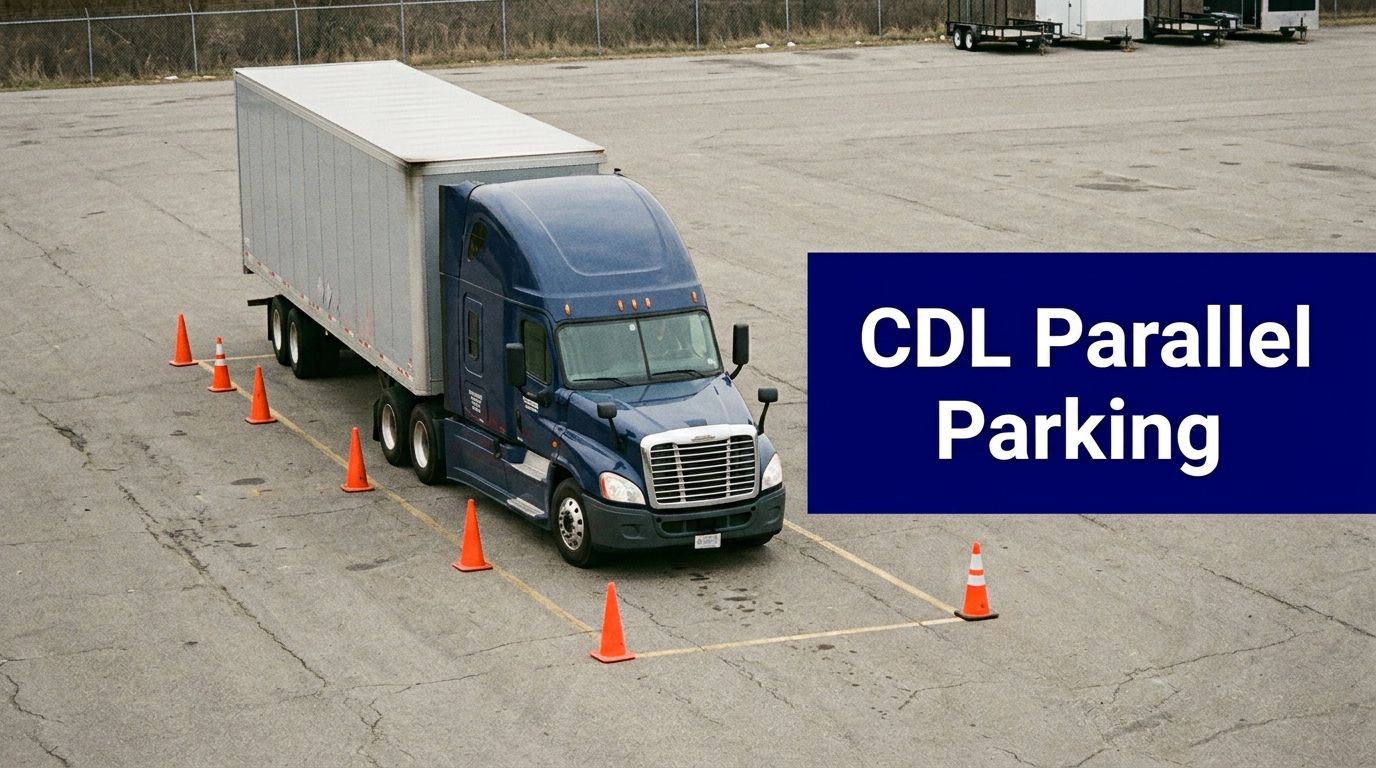
For the conventional Class B maneuver, the standard setup is about 2 to 3 feet from the cones, with the rear bumper aligned to the first cone, based on the step sequence described in this CDL skills test parallel parking guide. If your starting spot is off, every move after that becomes a rescue attempt.

Build the setup before you move
Start by getting the vehicle straight and calm. Don't creep into position while still deciding where you belong. Set it, stop it, and check the mirrors.
Use this short pre-backing routine:
- Check your lane spacing. You want enough room to create the entry angle without starting too wide.
- Align the rear bumper. Treat that bumper as your anchor reference.
- Square the steering wheel. If the wheel isn't centered before you begin, your first movement lies to you.
- Set your eyes before the truck moves. Decide which cone or box line matters first.
A lot of students improve the moment they stop “feeling it out” and start repeating the same setup every time.
Mirror position matters more than people think
If the mirrors are poorly adjusted, the maneuver feels random. You can't trust a cue you can't see clearly. Before backing practice, make sure your mirror view gives you a reliable look at the vehicle side and the cone line. This guide on adjusting wing mirrors for CDL training helps if you're still guessing at mirror position.
Set up should feel boring. If it feels rushed, improvised, or different every attempt, stop and rebuild it.
What works and what doesn't
Students often ask for a trick. There isn't one. There is a repeatable start.
What works:
- Consistent spacing from the cones
- A hard stop before backing
- One main visual reference, not five
- Starting with the wheels where you know they are
What doesn't work:
- Rolling into the maneuver while steering
- Starting too close because it “looks safer”
- Changing your setup every attempt
- Looking everywhere at once
A clean setup lowers your mental load. That matters because mirror confusion usually begins when the truck starts to angle and the student realizes they never had a stable starting picture. If the opening position is right, the rest of the maneuver stops feeling like guesswork and starts feeling like a sequence.
Executing the Backing Maneuver Step-by-Step
Once the setup is correct, the maneuver becomes a chain of visual cues. Don't back by hope. Back by what appears in the mirrors.
Here's the overall flow first.

Create the entry angle
In the conventional Class B sequence, you begin from the setup position and make a full right turn while backing to create the entry angle. The target is about 45 degrees, then you stop the turn and prepare for the next phase, as described in that earlier test guide.
Timid steering causes problems. They start backing, turn too little, and end up with a weak angle that leaves no room for the front to clear.
Your job here is simple:
- Back slowly
- Turn decisively
- Watch the rear path
- Stop once the angle is established
You're not trying to drift into the box. You're shaping the truck so the rest of the move becomes possible.
Find the mirror cue that changes the turn
The key cue in that four-stage sequence is the moment the third rear cone appears in the driver-side mirror. That's the signal to stop guessing and transition to the next steering input.
Students often change direction too early, a common mistake. They see part of the box, panic, and chase the front of the vehicle instead of following the actual cue.
When the mirror gives you the picture you trained for, trust the picture. Don't override it just because you feel late.
If you want to compare this with another backing pattern, reviewing straight-line backing fundamentals can help you understand how early mirror corrections carry over across maneuvers.
A visual walk-through can also help some students lock in the sequence:
Straighten the wheels and let the truck work
After that mirror cue appears, straighten the wheels and back under control. This is the phase many nervous students rush through, but it should feel slow and almost quiet.
You're letting the rear continue into the space while you monitor both sides. Keep checking that the vehicle is entering the box cleanly. Small corrections are enough. A big correction usually means you waited too long to make a small one.
Think of this phase as managing drift, not reinventing the maneuver.
Swing the front into the box
The final steering phase is the full left turn that brings the front into the space. In this phase, the truck finishes the job.
Your eyes should do two things here:
- Watch the front corner so it doesn't sweep too wide.
- Confirm the body stays inside the boundary area as the vehicle settles in.
Don't worry about making it look pretty before you've made it legal. On the test, containment matters more than cosmetic perfection.
A calm way to rehearse the whole move
Before you back, sit still for a moment and mentally run the picture:
- Start position fixed
- Hard right while backing
- Angle formed
- Third rear cone shows in left mirror
- Straighten
- Full left to bring the front in
- Stop and evaluate
That short internal script helps more than people think. Mirror disorientation gets worse when your brain is surprised by what it sees. Rehearsal reduces surprise.
Common Mistakes and How to Correct Them
Most CDL parallel parking mistakes fall into a small number of patterns. That's good news, because patterns can be fixed. You don't need mystery answers. You need clean diagnosis.
One frequent technical problem is failing to reach the proper 45-degree angle during the initial backing phase. When that angle is too shallow, the front swings wide and clips the front cones. Instructors commonly teach students to stop when the rear bumper is about 2 feet from the wall of cones so the geometry works before the next turn, as shown in this backing instruction video.
Common Parallel Parking Errors and Fixes
| Mistake | Why It Happens | How to Fix It |
|---|---|---|
| Front cones get hit on the way in | Initial angle was too shallow, so the front had no room to clear | Build a stronger first angle and stop at the right visual point before changing steering |
| Trailer drifts too deep or too soon | Driver stared at one mirror and ignored the whole shape of the move | Scan both mirrors with a steady rhythm and make smaller corrections earlier |
| Truck ends up outside the box | Setup was off, or the driver chased the trailer late | Reset the starting position and commit to the planned reference points |
| Student burns corrections quickly | Anxiety causes rushed decisions | Pause, breathe, and use a pull-up only when it clearly improves the final position |
| Vehicle enters crooked and stays crooked | Wheels were not managed during the straight-backing phase | After the first angle, straighten sooner and monitor drift instead of oversteering |
The mistake behind a lot of failures
The shallow angle problem is bigger than it looks. Students often believe they're protecting the truck by easing into the turn. In reality, they remove the space needed for the front end to come around cleanly.
A good correction drill is simple. Practice just the first phase and stop. Don't finish the park. Build the setup, back to the target angle, stop, pull forward, and repeat. That isolates the problem instead of mixing it with the rest of the maneuver.
When to correct and when to restart
Not every bad look needs a heroic save. Some attempts should be reset early.
Use this decision rule:
- If the setup is bad, restart the setup.
- If the angle is weak, correct before you commit deeper.
- If the mirrors show confusion, stop moving before you steer again.
For students working on the broader family of backing skills, this explanation of how to back a semi trailer helps connect parallel parking errors to the same habits that show up at docks and offsets.
Bad attempts usually announce themselves early. Listen to that early warning instead of trying to force the truck into a shape it doesn't have.
Mastering the Test Day Mindset and Rules
Skill gets you close. Control under pressure gets you across the line.
On the CDL skills test, candidates are allowed a maximum of two pull-ups during backing maneuvers, critical errors like hitting cones are scored at five points per error, and going over 12 total points results in failure, based on the test-rule summary discussed in this CDL test discussion. That same discussion also reflects something instructors see every week. Many backing failures come from mirror-based spatial disorientation, not just lack of physical practice.

Know the rules so you don't panic
Students waste mental energy because they don't know what a correction costs them. Once the rules are clear, the maneuver gets quieter in your head.
Keep these rules in mind:
- Two pull-ups are available: Use them strategically. Don't spend one just because the truck looks unfamiliar for a second.
- Cone contact is expensive: Small impatience can create a major scoring problem.
- Containment matters: The vehicle has to finish inside the boundaries.
If you're preparing for the larger skills exam, this guide to the CDL road test process helps place the backing portion in the context of the full test day.
The real enemy is mirror disorientation
This is the part many articles miss. A student can know the steps and still freeze because the mirror picture changes faster than their brain can organize it.
That's why mental rehearsal matters. Before each attempt, close the loop in your head:
- Name the first cue. “I'm starting from a clean setup.”
- Name the transition cue. “I turn until I get the picture I expect.”
- Name the recovery rule. “If the picture breaks down, I stop first.”
That last part matters. Anxious students often steer while emotionally reacting. Calm students stop, settle, and then decide.
Reset cue: Breathe in, let your shoulders drop, look left mirror, right mirror, front path in your mind, then move.
What works under pressure
Physical repetition helps. But targeted practice is what changes test-day results.
A structured program can make that easier. Patriot CDL trains students on core skills including backing maneuvers, pre-trip work, and road test preparation, which is useful when a driver needs repeated seat time with instructor feedback rather than more generic advice.
What doesn't work is mindless repetition while you're panicking. If each attempt feels like survival, you aren't building a clean visual map. Slow it down. Rehearse the mirror picture. Back with intent.
From Practice to Professional
CDL parallel parking is bigger than one box of cones. It teaches the habits that stay with you after the test. Setup discipline. Mirror trust. Small corrections made early. A calm stop when the picture stops making sense.
That's why students who finally “get” this maneuver often improve in other areas fast. They stop reacting late. They start reading vehicle movement sooner. They learn that backing isn't about wrestling the truck. It's about seeing the truck.
Keep your practice simple and repeatable:
- Start the same way each time
- Use clear mirror cues
- Fix one error at a time
- Train your breathing along with your steering
The confidence you want doesn't show up first. It comes after enough correct repetitions that the mirrors stop feeling like a puzzle.
A professional driver doesn't need every backing job to feel easy. The professional standard is more demanding. A professional knows how to stay composed, read the space, protect the equipment, and put the vehicle where it belongs without drama. That starts here.
If you're nervous, that doesn't mean you're behind. It means you care. Keep practicing until the maneuver feels familiar, then practice until it feels calm. That's the point where test skill turns into job skill.
If you want structured practice on backing, pre-trip, and the full skills exam, Patriot CDL offers hands-on CDL training designed to help students build repeatable habits in the truck, not just memorize steps on paper.