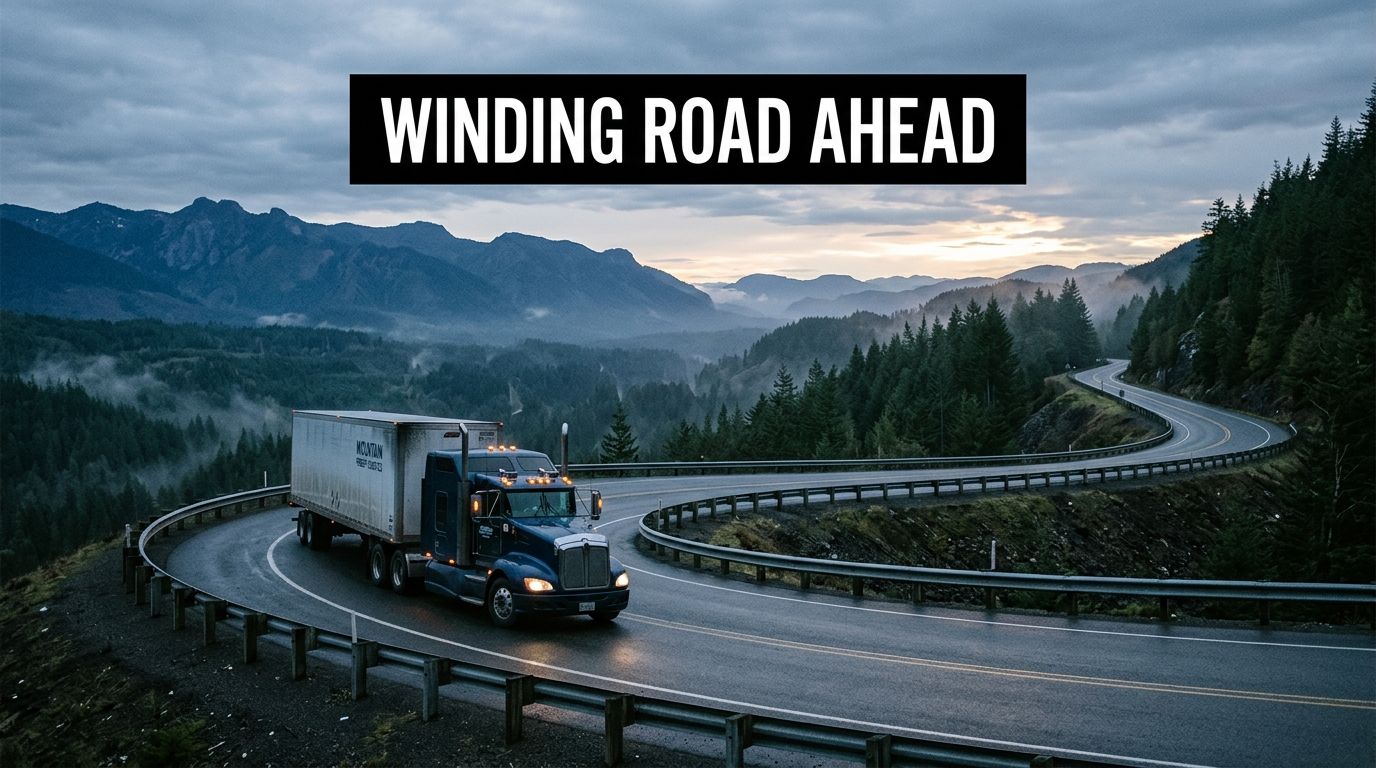
Dusk is when a winding road ahead gets honest with a new driver. The light flattens out, the tree line starts hiding the shoulder, and the grade you barely noticed on the map suddenly matters. In a car, that road can still feel manageable. In a loaded tractor-trailer, it can turn into a chain of bad decisions if you enter too fast, pick the wrong gear, or forget what your trailer is about to do.
Most rookies don't get in trouble because they can't turn a wheel. They get in trouble because they treat a mountain pass like a long highway exit ramp. A truck isn't forgiving there. The center of gravity is higher, the trailer tracks inside the tractor, air brakes don't reward late corrections, and every mistake shows up bigger and faster.
We teach this early because it's life-saving, not academic. If you're staring at a yellow warning sign right now, or thinking about your first run through hill country, the job is simple. Read early, slow early, set the truck early, and give the trailer room to do what it will do.
Your First Warning Is the Sign You Read
A new driver comes over a ridge at dusk and sees yellow signs stacked one after another. First the warning sign. Then an advisory speed plate. Then chevrons farther down the hill. The driver has two choices. Respect the road before the truck enters it, or try to negotiate with physics halfway through the bend.
In a car, people often get away with late braking and a quick steering correction. In a combination vehicle, that habit can put the tractor wide, pull the trailer inward, and load the suspension all at once. That's how a simple curve becomes a lane-control problem.
Read the road before the road reads you
The best truck drivers don't wait until they feel the curve. They build a picture from signs, tree lines, guardrails, shadows, and grade. A winding road ahead sign isn't decoration. It's advance notice that the road will keep asking questions after the first turn.
If you're still learning how to read road warnings as a system, it helps to study sign meaning outside the cab too. A simple refresher on one-way traffic sign interpretation sharpens the habit of decoding what the road is telling you before you commit the vehicle.
Practical rule: The first mistake in a curve usually happens before the curve starts.
A lot of new drivers also rely too heavily on consumer navigation. That's risky on truck routes with restricted grades, tight geometry, or roads that look passable until you arrive in a long wheelbase rig. If you're setting up your route plan, take time to compare top truck navigation tools that account for commercial vehicle needs instead of guessing like a car app does.
Why this matters more in a truck
A passenger car can change direction quickly and recover from sloppy setup more easily. We don't have that luxury. We have length, weight, delayed response, and trailer off-tracking. We also have freight that may be stable, top-heavy, liquid, or poorly balanced.
Keep these priorities in order when you see a winding road ahead:
- Read early: Identify warning signs and any advisory speed before you're committed.
- Plan lane position: You need room for both the tractor and the trailer.
- Manage speed first: Don't enter a bend hoping to fix speed with brake pressure in the middle.
- Stay smooth: Smooth steering, smooth brake release, smooth throttle. Jerky inputs create their own emergency.
A professional driver doesn't wait for a curve to become memorable. We make it boring on purpose.
Decoding the Road Ahead What Signs Really Mean
The most important sign in this discussion is the W1-5 Winding Road warning sign. The Federal Highway Administration uses it for road segments with three or more consecutive curves in opposite directions where the tangent distance separating them is less than 600 feet, and its use is associated with a 5% to 7% crash reduction according to the FHWA material on low-cost horizontal curve safety treatments in this FHWA winding road sign guidance.

What the W1-5 sign tells a truck driver
For us, that sign means more than "some curves ahead." It means the road geometry is compressed. You won't have much straight pavement between direction changes. That matters in a tractor-trailer because each transition shifts weight, changes trailer angle, and limits how much time you have to reset the vehicle between turns.
When I teach this, I tell drivers to treat the sign like an early briefing. You're not preparing for one corner. You're preparing for a sequence.
A winding road sign means your setup has to last through multiple bends, not just the first one.
The other signs that complete the picture
The W1-5 sign rarely works alone. You should read it alongside other clues:
- Advisory speed plates: These don't command the truck the way a regulatory speed limit does, but they tell you the curve was serious enough to post a recommended pace. In a truck, that deserves respect.
- Chevron alignment signs: These show the path of the curve at the edge of the road. At night or in rain, chevrons can tell you how long the turn holds after the entry point disappears.
- Guardrails and tree lines: Both can help you judge whether the curve tightens, opens, or drops away.
- Pavement markings: Centerline movement and edge line shape often reveal the bend before your headlights fully expose it.
Turn signs into a driving plan
A rookie reads signs as information. A pro reads them as instructions. That's the shift.
Build your plan in this order:
- Count the problem: One bend or a chain of bends?
- Judge recovery space: Is there enough straight road to reset speed and lane position?
- Expect off-tracking: The tighter the sequence, the less margin your trailer has.
- Commit early: Pick an entry speed and lane path before the front axle reaches the first curve.
The sign doesn't just warn you. It tells you what kind of discipline the road is about to demand.
Vehicle Prep for Curve Stability
You feel curve trouble before you see the worst of it. The tractor leans a little longer than it should. The trailer takes a beat to settle. The steering needs one more correction than usual. By then, the inspection chance is gone. We do that work in the yard.
A truck that runs fine on straight interstate can turn sloppy in winding terrain. High center of gravity, trailer off-tracking, and repeated side loading expose weak tires, lazy suspension, poor load balance, and brake issues fast. Curve stability starts with a pre-trip that matches the route.
Tires, suspension, and the contact patch
Tires carry the first load in every bend. If pressure is off, the contact patch changes, heat builds faster, and the truck feels less planted when weight transfers to the outside. Check inflation, tread wear, and sidewall condition with curve loads in mind, not just legal minimums.
Then look at how the truck sits and responds. Uneven ride height, worn shocks, loose suspension parts, or steering play all show up harder on a winding road than on a straight one. A tractor that takes too long to recover from a lane change will not improve halfway through a downhill curve.
Use a higher standard than "good enough to roll."
- Inflation and tire condition: Low or mismatched pressure changes handling and raises heat under repeated side loading.
- Tread wear pattern: Cupping, edge wear, and other irregular wear can point to alignment or suspension problems that reduce grip.
- Suspension and steering response: Excess lean, slow recovery, or free play in the wheel needs attention before a route with multiple curves.
Brakes and load security under lateral stress
Air brakes matter here, but not in the way many new drivers think. On winding roads, we need predictable application and clean release before the curve. A brake that grabs, pulls, or releases unevenly can upset the truck right when the suspension is already loaded.
Cargo setup matters just as much. A top-heavy load, shifting freight, or poor axle balance can turn an ordinary bend into a rollover setup. Review proper trailer weight distribution before you haul through roads that keep loading and unloading the suspension from side to side.
Shop-floor truth: Straight roads can hide a bad load. Curves expose it in seconds.
A targeted curve-prep routine
A disciplined inspection routine keeps drivers from rushing past the items that matter most. The DOT pre-trip guide for fleet managers is a useful reference if you want a structured process that covers more than a quick walk-around.
Before a run with known curves, put extra attention on these points:
- Brake readiness: Confirm even response, proper air build, and no warning signs that would tempt late braking.
- Cargo restraint: Check securement, load shift risk, and whether the freight raises the center of gravity more than usual.
- Steering system condition: Any looseness or hesitation gets worse once the trailer starts off-tracking through a bend.
- Chassis and fluid checks: Mechanical neglect shows up at the worst time, when the road demands a settled truck and precise inputs.
Pre-trip is part of curve control. For commercial vehicles, it is the first one.
Mastering Speed and Gear Selection Before the Turn
You crest a grade in a loaded combination, spot a curve sign, and feel the truck start to carry speed. That is not the time to decide what gear you want. By then, the truck is already asking for an answer.
Speed and gear choice decide whether the turn stays routine or turns into a fight. In a passenger car, a driver can get away with late corrections more often. In a tractor-trailer, extra weight, a higher center of gravity, longer stopping distance, and trailer off-tracking take that option away fast.
Slow before you go
Set the truck up before turn-in. Brake while the tractor and trailer are straight. Get your speed where it needs to be. Select the gear that will carry the truck through the curve without a rushed downshift, a surge of engine speed, or a stab at the brakes halfway through.
That sequence matters.
Braking in the curve shifts weight, loads the suspension unevenly, and can make the trailer push the tractor. On a downgrade, the problem grows because gravity keeps adding speed while the road is already asking the truck to hold its line.
If you need a refresher on timing the shift before the bend, review how to downshift a semi-truck and practice until gear selection becomes deliberate.
Posted advisory speed is the starting point, not the plan
Advisory speed signs are written for road conditions and geometry. Professional drivers read them as an early warning, then adjust for gross weight, load height, trailer type, pavement condition, visibility, wind, and grade.
A light day cab and an empty trailer can handle a curve differently than a loaded tanker or a dry van with high-stacked freight. The sign does not know what is in your trailer. You do.
Use this rule in the cab. If there is any doubt, enter slower. We can recover time on a straight stretch. We do not recover from a rollover.
What good curve setup looks like
- Brake early in a straight line: Let the truck settle before steering input starts.
- Choose the gear before the curve: Hold a gear that keeps the engine in a useful range without hunting between ratios.
- Manage air brakes with discipline: Repeated or heavy applications before a series of bends can heat the brakes and reduce margin when you need it later.
- Respect downgrades: Pick a speed that works for the whole curve, not just the entry.
Mistakes that put trucks on their side
- Entering too fast and planning to fix it mid-curve: That forces harder steering and harder braking at the same time.
- Late downshifts: A missed shift or delayed engagement takes attention away from lane control.
- Coasting: You give up control of the drivetrain when control matters most.
- Trusting the tractor alone: The trailer may still be accelerating, off-tracking, or loading the outside suspension harder than the driver realizes.
One hard truth helps new drivers. If the truck feels a little too fast at the point of turn-in, it was already too fast before you started the turn.
Downhill curves require earlier decisions
Downhill curves expose poor planning faster than flat ground does. The truck builds momentum before the bend, air brakes work harder, and the trailer keeps pressing forward if the driver waits too long to slow.
Pick the lower gear before the descent or before the curve sequence begins. Use engine braking only when traction and road conditions support it, and know how your truck responds. The goal is controlled speed with light, measured brake use, not a hot brake smell halfway down the hill.
Professional drivers do not enter curves hoping the truck will sort itself out. We set speed early, choose the gear early, and give the combination room to stay stable.
The Art of Steering and Trailer Management
Mid-curve is where a combination vehicle exposes every shortcut. The tractor may feel planted while the trailer is already drifting wide, cutting in, or loading the outside suspension harder than you realize. Car-driving advice misses that point. We have to manage two paths at once, with a higher center of gravity and far less room for sloppy steering.

Lane position is trailer management
A truck does not turn as one unit. The tractor starts the arc first. The trailer follows later and takes a tighter line on the inside, then may swing wider on exit depending on speed, curve shape, trailer length, and load. If you watch only the hood, you will miss what the trailer is about to do.
Set the truck up in the best legal lane position before the curve develops. On a right-hand bend, protect space for the trailer tires on the inside without letting the tractor drift carelessly. On a left-hand bend, watch the trailer's outside sweep and keep the combination centered with a purpose. Good lane position buys room for off-tracking. It also gives you a cleaner sightline through the curve.
Your hands matter here. A tense grip usually shows up as twitchy steering, and twitchy steering transfers load side to side. Review this guide to proper driving hand position if you catch yourself overcorrecting in long bends.
Late turn-in gives the trailer more room
Early turn-in is a common rookie error in trucks. It crowds the inside of the curve too soon, forces corrections, and puts the trailer where you do not want it. A patient, slightly delayed apex works better in most legal road situations because it keeps the tractor from diving at the inside line before you can see the full shape of the curve.
That extra patience matters even more with a top-heavy load. Every sharp correction adds side force. Every side force shift asks more from the suspension, tires, and cargo securement.
Watch this technique in motion:
Four steering habits that keep trucks settled
Keep the steering input slow and deliberate
Turn the wheel once, smoothly, and only as much as the curve requires. Sawing at the wheel unsettles the tractor and sends that disturbance straight back to the trailer.Check mirrors during the curve
Mirror work does not stop at turn-in. Confirm where the trailer tandems are tracking, especially on tightening right-hand curves and narrow lane mountain roads.Manage the trailer through the middle, not just the entry
Many drivers set up well, then forget the trailer once the tractor is pointed into the bend. Stay with the whole combination until the trailer clears the tightest point.Unwind the wheel at the truck's pace
Let the combination straighten itself in one controlled motion. Snapping the wheel back can start a second weight shift just as the trailer is still finishing the turn.
The tractor enters first. The trailer writes the final answer.
If traction starts to go
A skid in a commercial vehicle is rarely fixed by quick hands. It is usually made worse by them. If the road is wet, icy, gravel-covered, or contaminated with diesel, reduce pedal input, look where you need the truck to travel, and make one small correction at a time.
Keep in mind that tractor and trailer may not lose traction the same way. A tractor drive-axle slide feels different from a trailer starting to push. Air brakes add another layer. Grabbing more brake in the curve can lock weak traction into a bigger problem, especially if the trailer is already light on one side. Calm steering and disciplined inputs give you the best chance to get the combination back in line.
Handling Uphill Downhill and Emergencies

A mountain curve can punish a truck two different ways. Climbing into it, the engine can fall out of its working range and leave the tractor lugging while the trailer pulls back on the combination. Dropping into it, gravity keeps building speed after turn-in, and a high center of gravity gives you less margin than a passenger car has.
Uphill patience and downhill restraint
On an uphill curve, protect momentum before the bend, then hold a gear that lets the truck pull cleanly through it. A bad downshift in the middle of the curve can break the truck's balance, slow the tractor at the wrong moment, and let the trailer crowd the lane as the combination stretches under load.
Downhill work takes more discipline. Set speed early. Select a gear early. Use engine braking the way the truck and road conditions allow. Understanding what a Jake Brake is matters on long downgrades because service brakes alone can build heat fast, especially when one curve leads straight into the next.
Heavy trucks do not get a fresh start after each bend. Brake temperature, trailer weight transfer, and road grade carry forward into the next problem.
If you entered too fast
A rushed entry still needs a calm response. We teach drivers to follow a simple order they can remember under pressure.
- Look to the exit of the curve: The truck follows your eyes, and staring at the shoulder or guardrail usually pulls you toward it.
- Come off the throttle: Stop feeding speed into an already bad setup.
- Avoid hard brake application in the bend: Sudden braking can shift weight forward, unload part of the combination, and make a trailer push worse.
- Hold steady steering pressure: Quick sawing at the wheel can start a rollover sequence or turn a small slide into a major one.
- Use all available lane space legally: Extra room buys time for the tractor and trailer to settle.
In truck work, many emergencies start with speed and get finished by an abrupt input.
If the downgrade is steep and brake response starts to change, treat that as a warning, not an inconvenience. A soft pedal, brake smell, or fading deceleration means the truck is already telling you the plan failed. Slow the vehicle with the systems that still work, stay in your lane, and use the runaway ramp if the truck will not hold speed.
Training standards matter
Commercial drivers need training that covers vehicle systems, range exercises, and behind the wheel instruction under the federal Entry-Level Driver Training framework described by the Federal Motor Carrier Safety Administration. That standard matters on winding grades because truck emergencies are rarely just steering problems. They involve brake timing, gear choice, weight transfer, and trailer behavior all at once.
That is why mountain driving separates memorized advice from real skill. We read the sign early, set the truck up before the curve, and stay ahead of the downgrade before gravity starts making decisions for us.
If you're ready to build those habits the right way, Patriot CDL offers hands-on commercial driver training built around real driving skills, not guesswork. Learn the fundamentals, practice advanced maneuvers, and prepare for the road with instructors who understand what new drivers face in the cab.