Thinking about a career in trucking? One of the first questions on your mind is probably, "How old do I have to be?" The answer isn't a single number—it depends entirely on where you plan to drive.
The minimum age for a CDL license is 18 years old in most states, but that comes with a key restriction: you can only operate a commercial vehicle within that state’s borders. This is called intrastate driving.
To haul freight across state lines, known as interstate driving, federal law kicks in. For that, you need to be at least 21 years old.
Your Roadmap to a Commercial Driver's License
Getting your CDL is a huge step, but your age sets the roadmap. Think of it as two different career paths that eventually merge. The opportunities you have at 18 are vastly different from the ones that open up once you turn 21.
Understanding this distinction is the single most important part of planning your entry into the trucking industry.
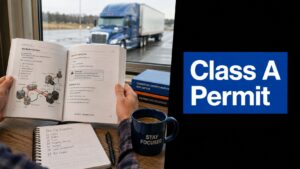
At 18 years old: You can get your Commercial Learner's Permit (CLP) and a full CDL. This is your ticket to driving big rigs, but you'll be doing local or regional work, staying strictly within your home state.
At 21 years old: This is the big milestone. Reaching 21 unlocks the ability to drive anywhere in the lower 48, opening up long-haul routes and a much wider range of job opportunities.
Key Age Milestones at a Glance
This timeline gives you a quick visual breakdown of how your driving privileges grow as you get older.
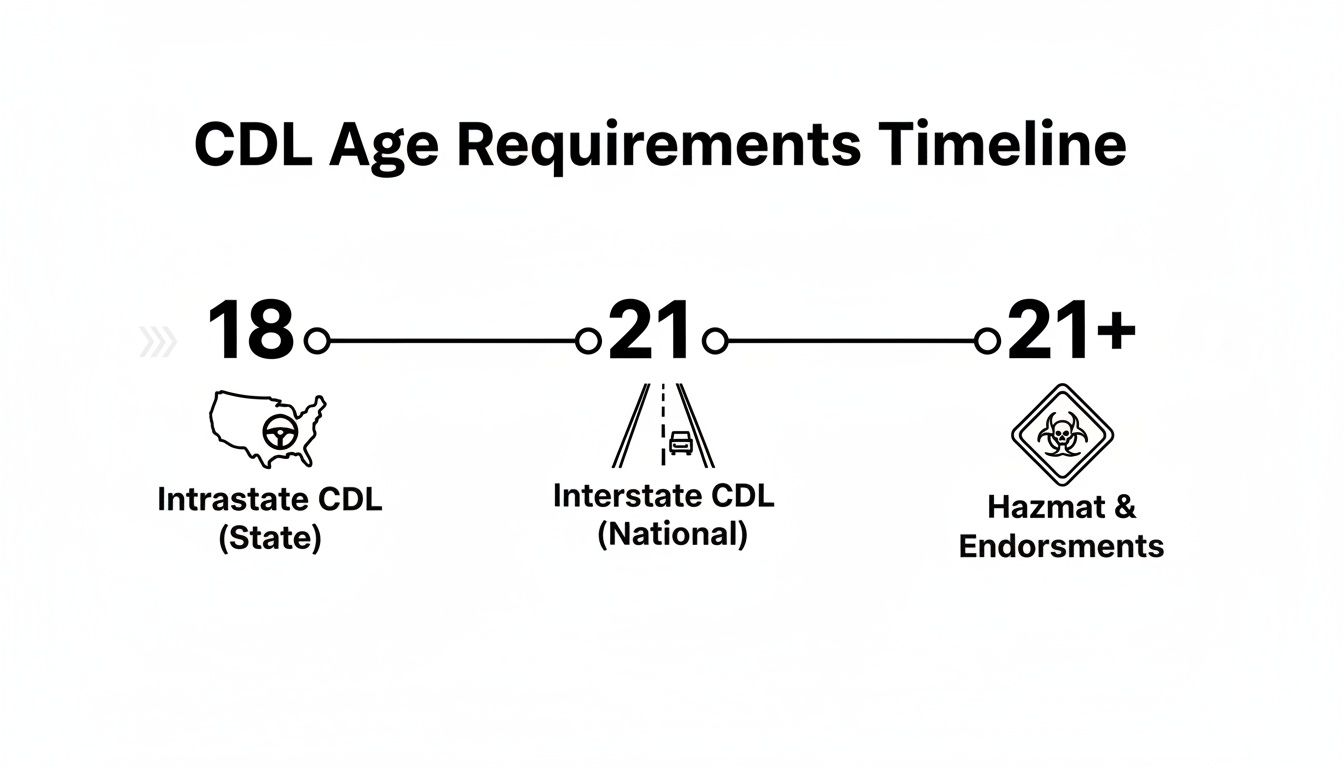
As you can see, you can start building valuable experience right at 18. But 21 is the age that unlocks full driving authority and the potential for more specialized endorsements, like hauling hazardous materials.
Of course, age is just one piece of the puzzle. To get the full picture, it’s a good idea to review all the general CDL requirements.
The bottom line is this: The age for a CDL license depends on your career goals. If you want to stay local, you can start at 18. If you dream of seeing the country from behind the wheel, 21 is the magic number.
Understanding Intrastate vs. Interstate Trucking
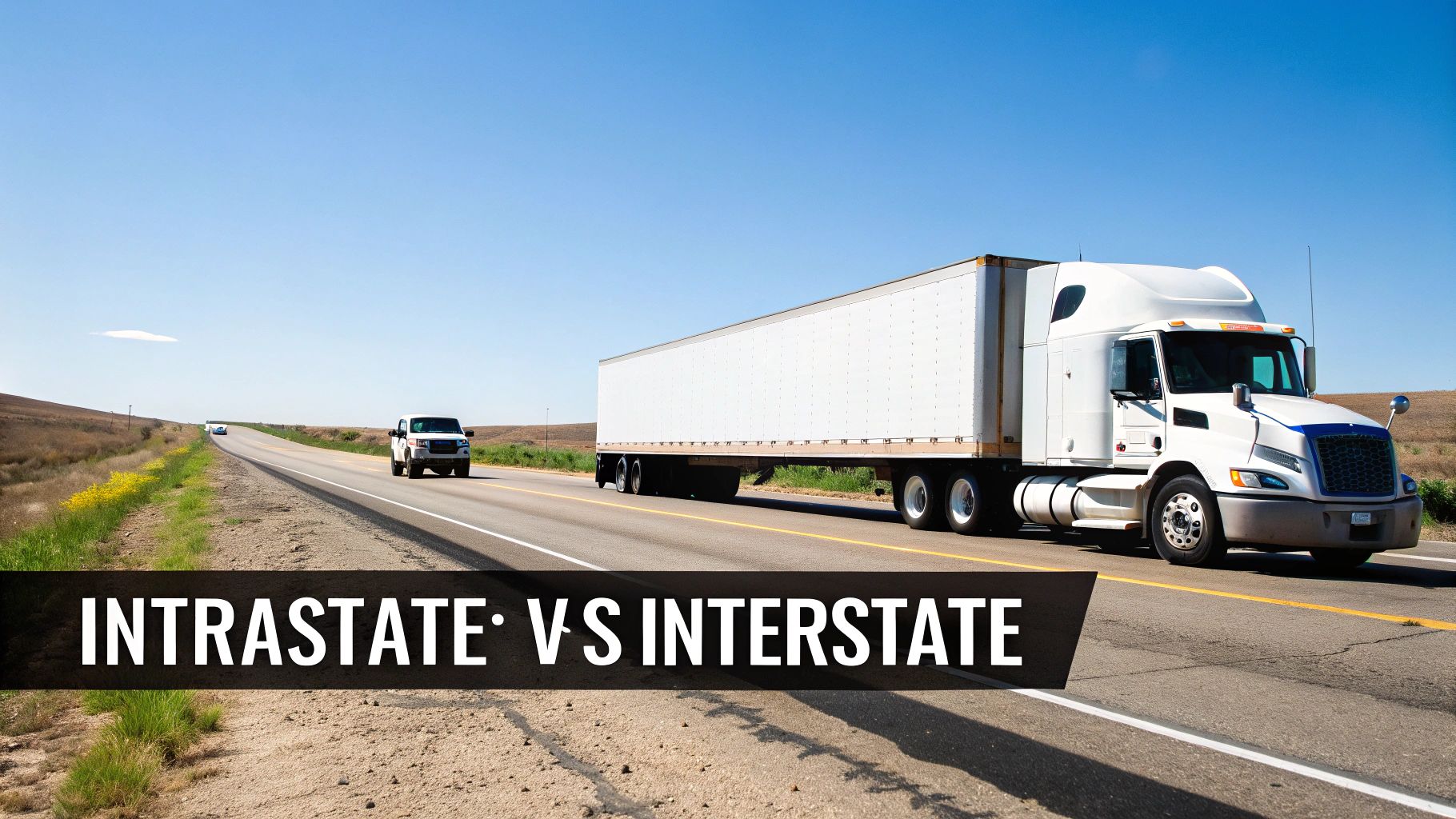
When you’re young and eager to start your trucking career, the single most important concept to wrap your head around is the difference between intrastate and interstate driving. Understanding this distinction is the key that unlocks what you can—and can't—do before you turn 21.
Think of it in simple terms. Intrastate driving means you're operating entirely within the borders of one state. You might be hauling gravel from a quarry to a construction site across the county or delivering produce from a farm to local grocery stores. The key is, your wheels never cross the state line.
Interstate driving is the long-haul stuff. You’re the one moving freight from a port in California to a warehouse in Texas. As soon as you cross a state line, you're officially an interstate trucker.
Why the Distinction Matters for Age
So, why does this matter so much? It all comes down to who makes the rules.
When goods and services cross state lines, it becomes a federal matter. The Federal Motor Carrier Safety Administration (FMCSA) steps in to regulate things for safety and consistency nationwide. And one of their biggest rules is this: you must be at least 21 years old to drive a commercial truck in interstate commerce.
That’s why the age of 21 is such a major milestone. It's the day you can finally take on those cross-country routes, opening up far more job opportunities and often, higher pay.
But what about jobs that stay within a single state? That's where the rules change in your favor.
State Rules for Intrastate Driving
Since the driving stays local, individual states get to set their own rules. And here’s the great news for younger drivers: nearly every state allows you to get your CDL and start driving commercially within their borders at just 18 years old.
This is a game-changer. It means you don’t have to sit around waiting for three years. You can get trained, get your license, and start building real-world experience—and a real paycheck—right out of high school.
Key Takeaway: Federal law governs driving between states (interstate) and sets the minimum age at 21. State law governs driving within a state (intrastate), which is why most allow you to get started at 18.
For a long time, this created a hard line in the sand. A qualified, licensed 19-year-old could drive a rig 500 miles from one end of their state to the other, but they legally couldn't drive 10 miles across a state line. This was a huge bottleneck for the trucking industry and a source of frustration for young drivers.
So, even if you live right on the border, federal law traditionally prevented you from taking a load into the neighboring state until your 21st birthday. The first step in mapping out your career is knowing the specific rules where you live, like the CDL requirements in Alabama, to build a smart path forward.
How State CDL Age Requirements Can Vary
While the federal government draws a clear line at 21 years old for driving a commercial truck across state lines, the real starting point for your trucking career is your home state. This is where things get a bit more localized.
Think of it like this: the federal government sets the rules for the interstate highway system, but each state decides the speed limits and driving laws for its own local roads. The same principle applies to CDLs.
Most states will allow you to get a Commercial Learner’s Permit (CLP) and a full CDL for intrastate driving (meaning, within that state's borders only) as young as 18. But don't assume the process is the same everywhere—that's a common rookie mistake. The little details from one state to the next can change everything about your timeline.
Where You Might See Differences
The variations are often subtle but can have a big impact. For example, some states might require you to hold your CLP for a certain number of days before you're eligible for the skills test, while others have different rules. This is why your first move should always be to check with your local DMV.
Here are a few common areas where state rules tend to differ:
- Minimum CLP Age: While 18 is the norm, some states have unique prerequisites or age nuances for getting that initial permit.
- Passenger (P) Endorsement: Driving people is a huge responsibility, so states often require you to be 21 to get a P-endorsement, even for intrastate routes.
- School Bus (S) Endorsement: Transporting kids almost universally comes with tougher rules. The minimum age for this is typically 21, no exceptions.
A great example is how the age for a CDL license can be influenced by the type of work you intend to do. An 18-year-old might be cleared to drive a dump truck within state lines but not a city bus.
Always Verify Your State's Rules
Focusing on your local regulations is absolutely essential for a smooth start. You don't want to sign up for a training program only to find out you're a few months too young for a specific endorsement you need for a job.
Taking a few minutes to understand the complete picture—from age to residency requirements—will save you a world of headaches later on. For instance, the path for a new driver can look quite different depending on where you live. You can see how one state handles the process by checking out the CDL requirements in California.
At the end of the day, your local DMV is the final authority on what it takes to get you on the road legally.
Special Endorsements and Their Age Rules
Getting your CDL is the first big step, but the real career-making moves often involve endorsements. Think of your standard CDL as a general passport to the trucking world. Endorsements are the special visas that get you into the most exclusive—and often highest-paying—jobs.
But here’s the catch: these specialized roles come with their own age requirements. Knowing what they are from the start helps you map out a clear path for your career, so you're not just spinning your wheels.
HazMat (H) Endorsement Age Requirement
The Hazardous Materials (H) endorsement is a serious qualification, and it has a firm federal age limit. If you want to haul anything classified as hazardous—think flammable liquids, corrosive chemicals, or even explosives—you absolutely must be at least 21 years old.
This isn't a rule that changes from state to state. It's a federal mandate enforced by the Transportation Security Administration (TSA). The reason is all about national security. Every HazMat driver has to pass a comprehensive background check, which makes 21 the firm, non-negotiable minimum age to even apply.
Passenger (P) and School Bus (S) Endorsements
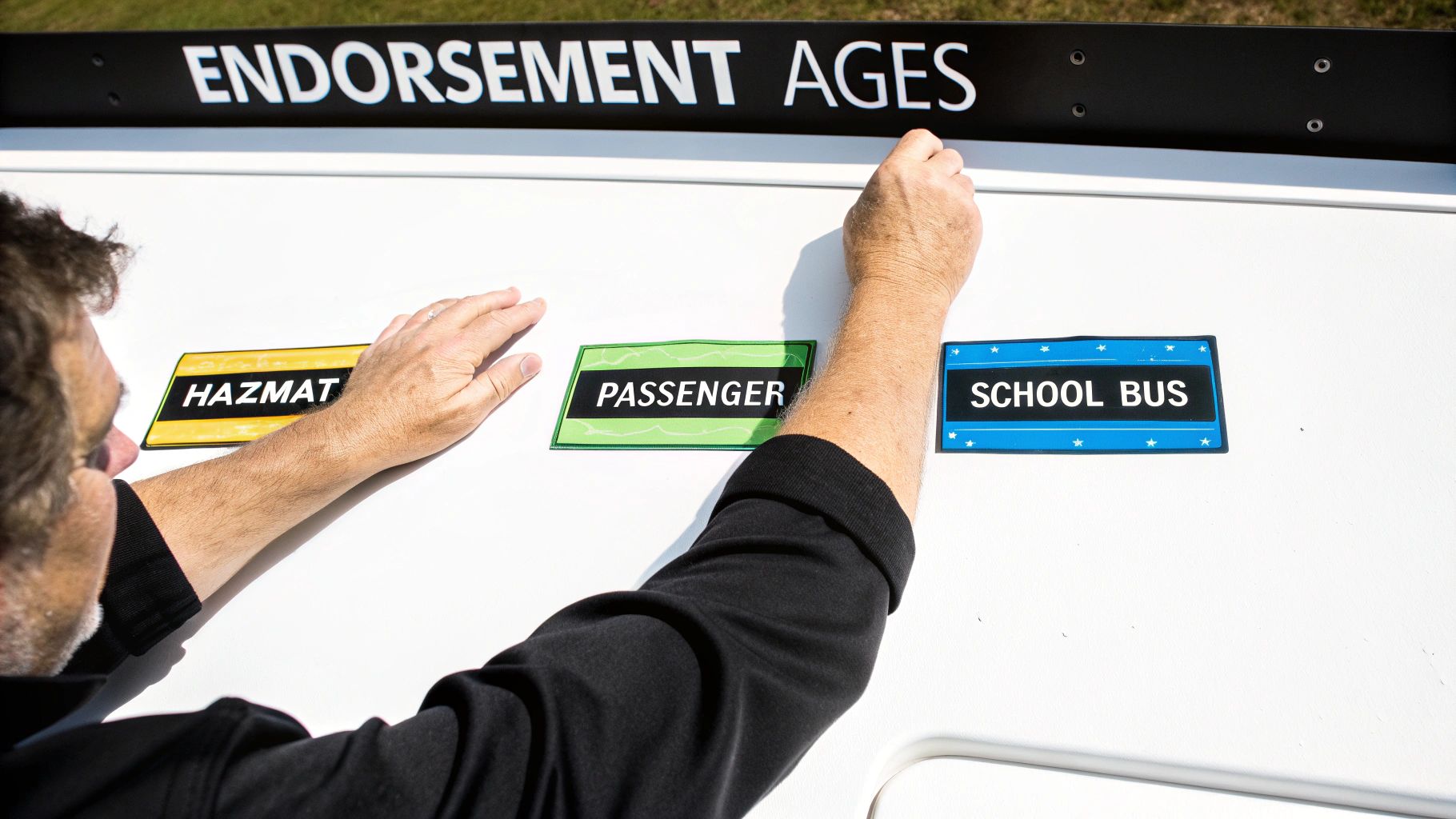
Hauling cargo is one thing; transporting people is a whole different level of responsibility. That's why the age requirements for the Passenger (P) and School Bus (S) endorsements are often higher than for a basic CDL.
Passenger (P) Endorsement: You'll need this to drive any vehicle built to carry 16 or more people (including you). Even if you're only driving within your state, most states require you to be at least 21 years old to get a P endorsement.
School Bus (S) Endorsement: This is where the safety standards are the absolute highest. Because you’re trusted with transporting children, virtually every state sets the minimum age at 21. You'll also face a more rigorous skills test and an extra background check.
It's a bit of an interesting quirk in the rules. An 18-year-old can legally drive an 80,000-pound tractor-trailer within state lines, but they can't drive a city bus or a school bus until they turn 21. It really shows how the type of "cargo"—freight versus people—shapes the regulations.
For a clearer picture, here’s a quick breakdown of common endorsements and their age rules.
Common CDL Endorsements and Minimum Age Rules
| Endorsement | Federal Minimum Age | Common State Variations |
|---|---|---|
| H – Hazardous Materials | 21 (Federal Law) | None. This is a strict federal rule. |
| P – Passenger | 21 (For interstate) | Most states also require 21 for intrastate driving, though a few rare exceptions exist for specific vehicle types. |
| S – School Bus | 21 (For interstate) | Almost universally 21 at the state level due to the high-risk nature of the job. |
| T – Double/Triple Trailers | 21 (For interstate), 18 (For intrastate) | Follows the general CDL age rules for interstate vs. intrastate driving. |
| N – Tank Vehicle | 21 (For interstate), 18 (For intrastate) | Typically follows the standard state CDL age rules. |
| X – Tank/HazMat Combo | 21 (Federal Law) | The HazMat component makes the minimum age 21 everywhere, no exceptions. |
This table highlights how federal rules for certain cargo, like hazardous materials, create a nationwide standard, while others depend more on whether you plan to cross state lines.
Other key endorsements, like Tank Vehicles (N) or Double/Triple Trailers (T), don't usually have a separate age rule beyond the basic intrastate or interstate requirement. The main hurdle there is passing the knowledge and skills tests. It pays to get familiar with the equipment, which is why practicing with something like an air brakes practice test can give you a huge advantage.
Building Your Trucking Career Under 21
Getting your CDL at 18 is one of the smartest career moves you can make. It’s a powerful head start in a field with massive long-term potential. While federal rules keep you within your state's borders until you’re 21, don't think of these first few years as a waiting game.
Think of it as a paid apprenticeship. You're building skills, racking up valuable experience, and establishing a professional reputation, all while earning a solid paycheck.
The age for a cdl license isn't a barrier—it’s a gateway to a world of local opportunities that are critical to our economy. Plenty of industries need skilled intrastate drivers to keep things running, and that's where you come in.
Thriving in Intrastate Driving
Before you can tackle cross-country hauls, you need to nail the fundamentals. Intrastate jobs are the perfect place to do just that. You'll master vehicle handling, pre-trip inspections, and navigating local routes like the back of your hand. Most importantly, you’ll build a spotless driving record that will open doors later on.
Here are some of the most common intrastate jobs perfect for drivers under 21:
- Local Delivery: Think of it as the final link in the supply chain. You'll be moving goods from distribution centers to local stores, warehouses, and businesses.
- Construction: This is where you get to operate the heavy-hitters like dump trucks and cement mixers on local job sites.
- Agriculture: You'll be the one hauling crops, livestock feed, and essential farming equipment within your state.
- Waste Management: Driving garbage or recycling trucks on municipal routes is steady, reliable work that’s always in demand.
This isn't just busy work; it's hands-on proof that you can handle the responsibility of a commercial vehicle. When you turn 21, employers won't just see a new driver—they'll see a professional with a proven track record of safety and reliability.
Getting an early start is more important than ever. Drivers under age 30 are significantly underrepresented in the CDL population, with those aged 21-25 making up only 2.6% of all license holders. This aging workforce highlights a huge opportunity for young, ambitious drivers to fill a critical industry need.
New Pathways for Young Talent
The trucking industry gets it. They know they need to bring in fresh talent, and fast. That's why new initiatives are popping up to create clear, structured career paths for drivers under 21. A perfect example is the Safe Driver Apprenticeship Pilot Program, a federal program that lets 18-to-20-year-olds drive interstate routes, but only under strict, professional supervision.
Programs like this are a game-changer. They bridge the gap between local and long-haul driving by combining on-the-job training with tough safety standards. It’s a major shift in thinking, officially acknowledging that with the right training, young drivers can be every bit as safe and capable as seasoned veterans. The first step toward qualifying for these exciting new opportunities is completing all the required training under the ELDT mandate.
Your CDL Age Questions, Answered
Figuring out the rules for getting your CDL at a certain age can feel like navigating a maze. But don't worry, the answers are actually pretty straightforward. We’ve rounded up the questions we hear most often from aspiring drivers to help you get on the right track.
What Is the Minimum Age for a Commercial Learner's Permit (CLP)?
In almost every state, you can get your Commercial Learner's Permit (CLP) as soon as you turn 18 years old. This permit is your golden ticket to start training. It lets you legally drive a commercial truck on public roads, provided you have a licensed CDL holder sitting right there with you in the passenger seat.
Think of it just like a regular driver's permit. The CLP is your hands-on learning phase, where you get comfortable behind the wheel and build the core skills you'll need to pass your CDL road test.
Is a High School Diploma Required to Get a CDL?
Nope. There is no federal rule from the Federal Motor Carrier Safety Administration (FMCSA) that says you need a high school diploma or a GED to get your CDL. This makes a career in trucking one of the most accessible paths out there for anyone ready to work hard.
That said, keep in mind that some trucking companies might have their own internal hiring policies that prefer a diploma. It’s not a legal roadblock to getting licensed, but it's something to be aware of when you start looking for a job.
At the end of the day, what really matters is your ability to pass the written exams and the hands-on skills test. Proving you're a safe, competent driver is the only qualification that counts.
Can You Cross State Lines with a CDL at 18?
This is a big one: no, you cannot drive a commercial truck across state lines until you are 21 years old. This is a firm federal regulation for anyone involved in interstate commerce. You can earn your CDL at 18, but your work will be limited to intrastate driving—meaning you have to stay inside the borders of your home state.
The second your wheels cross into another state, you’re operating under federal rules, and the 21-and-up requirement kicks in. This is designed to give drivers a few years of real-world experience before they take on the challenges of long-haul, interstate routes.
Ready to start your journey, no matter your age? Patriot CDL offers accelerated training programs that get you on the road fast, whether you're 18 and starting local or 21 and ready for the open highway. Learn more and enroll today at https://patriotcdl.com.