Typing "CDL Class A training near me" into a search bar is more than just a few words—it's the first real step toward a new life on the open road. It’s how you connect with the local schools that will give you the hands-on skills for a stable, in-demand career that literally keeps our country moving.
Your Search For A Trucking Career Starts Here
Deciding to become a professional truck driver is a big deal. It’s a move that offers real independence and incredible job security, especially right now. Trucking is the lifeblood of the American economy, and the need for qualified, safe drivers has never been more urgent.
For a lot of folks, this is a major career change. Before you dive in, it’s always a good idea to get solid advice on changing your career to make sure you're setting yourself up for success from day one.
Think of this guide as your personal roadmap. We'll walk you through everything, from that initial search to confidently enrolling in a top-notch program that’s worth your time and money.
Understanding The Opportunity
The driver shortage you hear about is very real. According to the Bureau of Labor Statistics, the demand for heavy and tractor-trailer truck drivers is expected to grow by 5% between 2023 and 2033. That translates to roughly 240,300 job openings every single year, driven by a constant need to move record amounts of freight.
While the trucking industry already employs over 3.55 million professional drivers, it's still playing catch-up. This persistent shortage creates a fantastic opportunity for new drivers to land a good-paying job almost immediately after getting their license.
This isn't just about finding a job; it's about building a secure future with strong earning potential from the moment you graduate.
The Path From Search To Enrollment
Finding the right CDL school isn't something you want to rush. The best approach is a simple, three-part process: first, you search for schools in your area, then you carefully evaluate your top choices, and finally, you enroll.
This infographic breaks down the basic journey you're about to take.
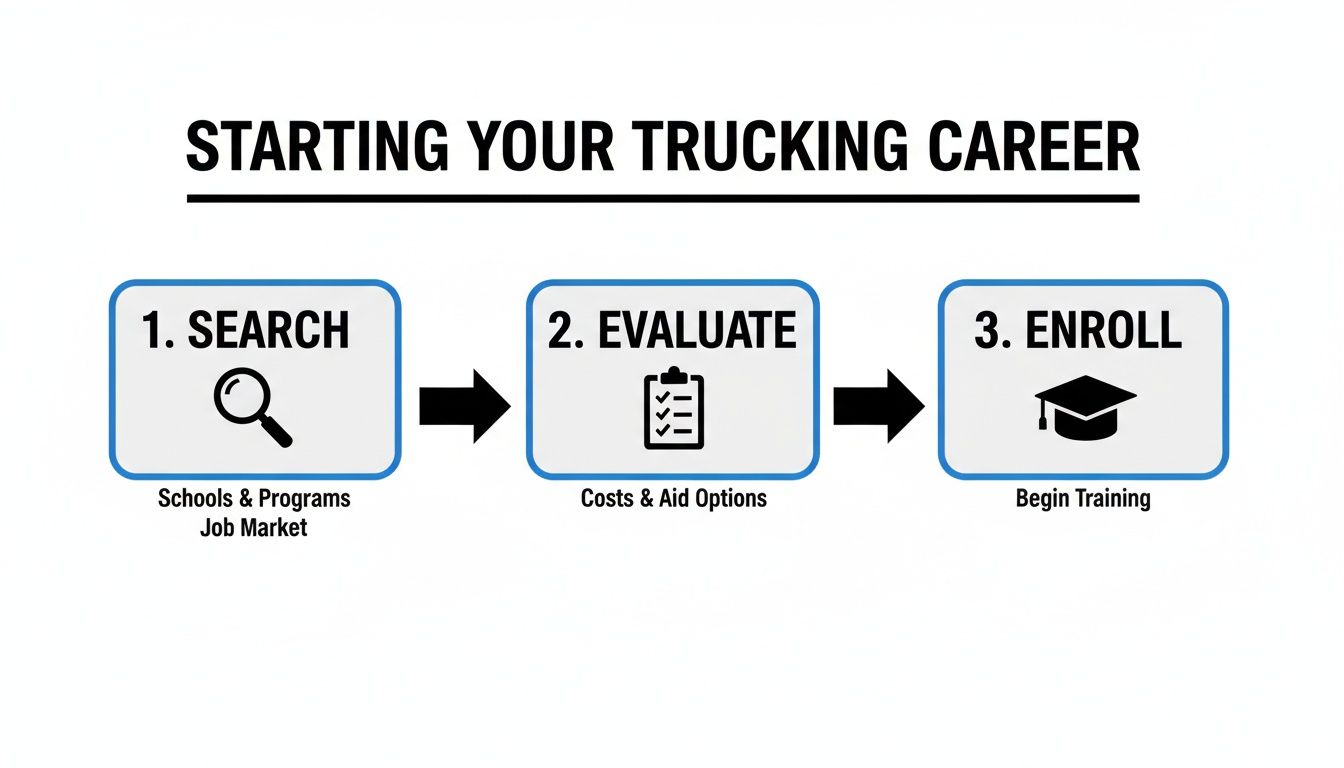
Following these stages helps you make a decision based on facts, not just on which school showed up first online. Each step logically flows into the next, guiding you toward a program that fits your goals. To get a head start, you can see what a comprehensive training program should cover.
Now, let's break down each of these phases so you know exactly what to do.
How to Find and Vet Local CDL Schools
The first step to a successful trucking career is finding the right school. But let’s be honest, a quick search for "CDL Class A training near me" will throw a ton of options at you, and not all of them are created equal. It's on you to tell the difference between a top-tier training academy and a "CDL mill" that just wants your money.
Your journey starts with separating the legitimate schools from the rest.
The single most important tool for this is the official Training Provider Registry (TPR), which is managed by the Federal Motor Carrier Safety Administration (FMCSA). This isn't just a suggestion; it's a hard requirement. If a school isn’t on this list, they cannot legally train you for your ELDT (Entry-Level Driver Training) certificate. It's a simple, non-negotiable check that will instantly clean up your search results.
Kicking Off Your Research
With a list of TPR-approved schools in hand, it's time to put on your detective hat and start digging. The school's website is your first clue. A professional, detailed website is often a good sign of a well-run program.
Here's what you should be looking for as you browse:
- Honest Program Details: Can you easily find info on the curriculum, total training hours (classroom vs. behind-the-wheel), and the complete cost? Vagueness is a huge red flag.
- Real-World Equipment Photos: Look past the shiny stock photos. Do they show you the actual trucks and training grounds you'll be using? Pay attention to the condition of the equipment in those pictures.
- Instructor Experience: The best schools are proud of their team. They'll tell you about their instructors' years on the road and their teaching credentials.
- A Real Physical Address: This sounds basic, but you'd be surprised. If you can't easily find their physical location, phone number, and email, be very cautious.
This online groundwork alone can save you a ton of time. If a school's website feels sparse or unprofessional, you have to wonder if their training is any different.
Picking Up the Phone and Asking the Tough Questions
Once you’ve narrowed down your list, it’s time to make some calls. Remember, an admissions advisor is a salesperson. Your job is to cut through the sales pitch and get real answers. This is where you can truly gauge the quality of the school.
Don't be shy. Instead of a soft question like "Do you help with jobs?" get specific. Ask, "What is your verifiable job placement rate for the last six months, and can you tell me which carriers have hired your recent graduates?"
A quality school will have this data ready and be happy to share it. If they become defensive or vague, that tells you everything you need to know about their post-graduation support.
Another critical question is about their student-to-instructor ratio for behind-the-wheel training. A low ratio, maybe 3-to-1 or 4-to-1, is what you want. That means more time driving for you and less time sitting in the back seat waiting your turn. Finding out what's standard for CDL training in California or your specific state can give you a good benchmark for what to expect.
The In-Person Visit: Your Final Check
I can't stress this enough: never, ever enroll in a school without visiting it first. A website can promise the world, but seeing the operation with your own eyes tells the real story.
When you're on-site, here's your inspection checklist:
- Get Up Close with the Trucks: Are they clean and maintained, or are they beat-up rust buckets? The state of their equipment is a direct reflection of their commitment to safety and quality training.
- Watch a Live Class: Ask if you can observe a yard skills or road training session for a few minutes. Are the instructors engaged and patient? Are the students actively learning, or just standing around?
- Check Out the Training Yard: Is there enough space for students to practice backing, docking, and other essential maneuvers without being on top of each other? A cramped yard limits what you can learn.
This visit is your chance to get a feel for the place. A great school feels professional, organized, and focused on student success. A CDL mill often feels disorganized and neglected. Trust your gut—if something feels off, it probably is. This decision sets the tone for your entire career, so take the time to get it right.
Evaluating a School's Curriculum and Job Placement Rate
Alright, you've got a short list of potential schools. Now comes the most important part: digging past the shiny brochures and friendly sales pitches. A fancy website doesn't mean a thing if the training is subpar and graduates are left spinning their wheels trying to find a job.
The real value of any CDL school comes down to two things: what you actually learn behind the wheel and what happens after you pass your test. This is where you need to put your investigator hat on.
What to Look for in a Curriculum
A solid curriculum is a mix of classroom theory and, more importantly, a ton of hands-on practice. Just meeting the bare-minimum federal requirements isn't enough. A great school ensures you're not just licensed but truly confident and road-ready.
When you're talking to a school, get specific. Here’s what you need to zero in on:
- Behind-the-Wheel Hours: This is the big one. Ask them for a number—how many hours will you personally spend driving the truck on actual roads? More drive time is always better.
- Yard Skills Practice: A huge chunk of your CDL exam is backing, docking, and other tight maneuvers. You need a school that gives you plenty of time to practice these skills until they feel like second nature.
- Transmission Training: Even with more automatic trucks on the road, learning on a manual is non-negotiable. If you test in an automatic, you’ll get an "E" restriction on your license, which can seriously limit your job options. A school that only offers automatics is cutting corners, period.
- Comprehensive Theory: The classroom stuff matters, too. They should cover regulations, logbooks, and safety protocols inside and out. A huge piece of this is the vehicle inspection. Our guide on the CDL pre-trip inspection shows just how critical this knowledge is for passing your test and for your safety every single day on the job.
This isn't just about finding a good school; it's about avoiding a bad one. The U.S. Transportation Department has been cracking down on "CDL mills," targeting nearly 44% of 16,000 programs for everything from falsified records to shoddy training. Now more than ever, you have to do your homework.
Do They Actually Help You Get a Job?
Every school will toss around the phrase “job placement assistance,” but that can mean anything from handing you a flyer to having recruiters waiting to hire you on graduation day. Your job is to find out which one it is. A high job placement rate is the best proof that trucking companies respect the school's training.
You need to ask for proof, not just promises.
Don't settle for vague answers. A school that’s proud of its results will be transparent. Ask them this directly: "Can you show me what percentage of last quarter's graduates received job offers within 30 days of finishing the program?"
A question that specific forces a real answer. If they have strong relationships with carriers, they won't blink. If they get defensive or try to change the subject, that’s a major red flag.
What Real Career Support Looks Like
Good job placement is more than just a statistic. The best schools offer support that helps you get your career off the ground and keep it moving.
Here’s what a school that’s truly invested in your success will offer:
| Support Feature | Why It Matters |
|---|---|
| On-Site Recruiting Events | This is huge. It puts you face-to-face with hiring managers from real companies looking for drivers right now. |
| Resume and Interview Help | They’ll help you build a professional resume and coach you on how to answer the questions you'll get in a trucking interview. |
| Active Carrier Partnerships | A school with deep industry connections can help match you with companies that fit what you're looking for in a career. |
| Alumni Network Access | Being able to connect with former students gives you a network for advice, job leads, and mentorship from day one. |
Choosing a school based on its curriculum and proven ability to place graduates isn't just about getting your CDL—it's about launching a real, long-term career. It's the difference between just getting a license and getting a solid start in an industry that’s always looking for skilled drivers.
Getting Your Ducks in a Row: Enrollment and Permit Prep
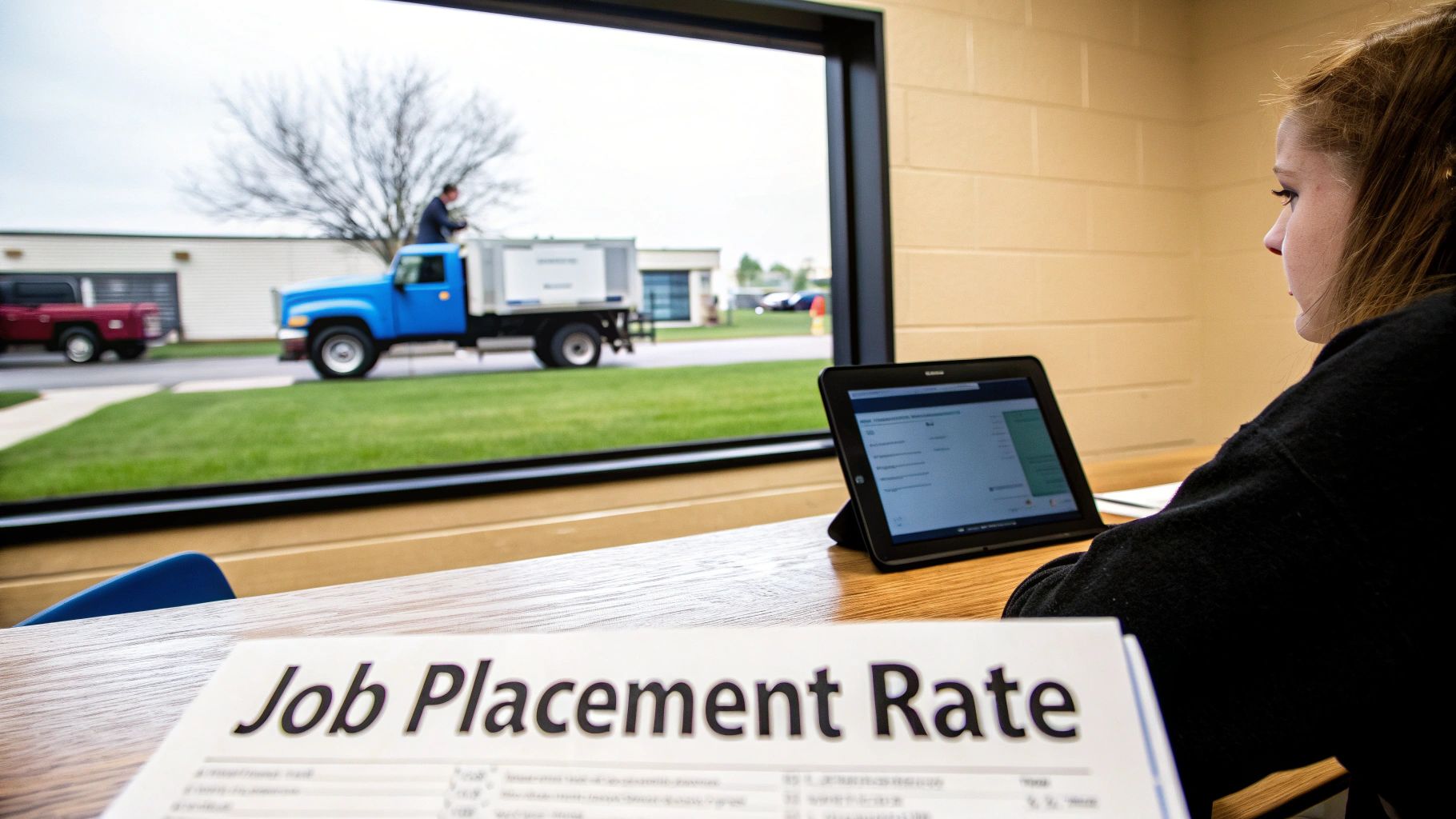
Before you ever climb into the cab of a big rig, you’ve got to tackle the paperwork. This is where the rubber meets the road, administratively speaking. Getting everything in order now is the first real test, and handling it smoothly sets the stage for your entire career.
Think of it as your pre-flight check. Every single step, from proving you’re eligible to passing the initial tests, is there to make sure you’re legally and physically ready for the job. It can feel like a lot of hoops to jump through, but they all exist for one reason: safety.
The Basic Admission Standards
Every federally regulated CDL school works from the same playbook when it comes to admission. While a few minor details might differ, the core requirements are standardized to meet Department of Transportation (DOT) and state-level rules.
Here’s what you’ll need to have squared away before a school will move forward with your application:
- Age Verification: You have to be at least 18 years old for an intrastate CDL (driving within your state). For interstate trucking, the minimum age is 21.
- Valid Driver's License: You’ll need a current, valid non-commercial driver's license from the state you live in.
- Proof of Residency: Be ready with documents that prove you live in the state where you're applying. A utility bill or lease agreement usually does the trick.
- Clean Driving Record: The school will pull your Motor Vehicle Report (MVR). A minor speeding ticket from years ago probably won't be an issue, but serious violations like a DUI or reckless driving can be a major roadblock.
My advice? Gather your documents—birth certificate, social security card, proof of address—before you even walk in the door. It just makes the whole process faster. Getting a clear picture of all the CDL requirements upfront will save you from any last-minute surprises.
The DOT Physical and Drug Screening
This one is non-negotiable. Every aspiring commercial driver has to pass a physical exam from a DOT-certified medical examiner. This isn’t your typical check-up; it’s a specific evaluation to confirm you’re fit for the demands of the job.
The exam looks at your vision, hearing, blood pressure, and overall health to rule out any condition that could make operating a massive vehicle unsafe. A mandatory drug screening is also done at the same time. Most CDL schools have a list of approved local clinics, so just ask your admissions advisor for a recommendation to keep things simple.
Passing the DOT physical is your official green light. Without this medical card, you can't get your learner's permit, which stops your training cold before it even starts.
Mastering Your Commercial Learner's Permit (CLP)
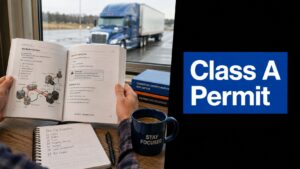
The Commercial Learner's Permit (CLP) is what allows you to actually start training behind the wheel. To get it, you have to pass a series of written tests at your local DMV. For a Class A license, that means acing three key exams.
Don't take these tests lightly. Your state’s CDL manual is your bible here. I’ve seen countless students succeed by hammering online practice tests and using flashcards to drill key stats and rules. Put in the study time now, and you’ll pass on the first go, saving yourself both time and money.
Your CLP Written Test Breakdown
| Test Section | What It Covers | Why It's Critical |
|---|---|---|
| General Knowledge | This is the big one. It covers everything from safety rules and vehicle control to spotting hazards and handling emergencies. | This is the foundation of all your trucking knowledge. |
| Combination Vehicles | This test is all about the unique physics of driving a tractor-trailer—coupling, uncoupling, and avoiding the "crack-the-whip" effect. | This is what makes you a Class A driver. You have to understand how to handle a combination rig. |
| Air Brakes | You'll dive deep into the components of an air brake system, how to do a proper inspection, and how to use them correctly to prevent failure. | Air brakes are incredibly powerful but also complex. Knowing them inside and out is a non-negotiable safety skill. |
Making Sense of CDL Training Costs and Financial Aid
Deciding to get your Class A CDL isn't just a career change; it's a direct investment in your future. And like any smart investment, you need to understand the costs upfront to appreciate the long-term payoff. While the price tag for training can look steep at first, it's a short-term hurdle for a stable, high-demand career.
When you start searching for CDL Class A training near me, you'll quickly notice prices vary a lot, typically from $3,000 to over $10,000. It's tempting to just go with the cheapest option, but I’ve seen that backfire more times than I can count. A rock-bottom price can be a red flag, often hiding extra fees or skimping on the critical behind-the-wheel time that actually makes you a competent driver.
A quality program's price covers a lot more than just classroom time. It pays for well-maintained trucks, fuel, insurance, and the expertise of seasoned instructors. You're paying for a complete package designed to make you a safe, employable driver, not just someone who can squeak by the test.
What's the Real, All-In Cost?
The sticker price is almost never the full story. A good, honest school will give you a clear, itemized breakdown of every single expense so there are no nasty surprises later. This lets you budget properly and see exactly where your money is going.
Beyond the base tuition, here’s a look at the other costs you should be prepared for:
- DOT Physical & Drug Screen: This is non-negotiable and usually runs between $75 and $150.
- Commercial Learner's Permit (CLP) Fees: Your local DMV will charge you for the written tests and permit issuance, typically around $50 to $100.
- CDL Licensing & Endorsement Fees: After you pass your road test, the state charges final fees to issue your official license, which can tack on another $100 to $200.
- Training Materials: Some schools roll books and supplies into the tuition, but others bill for them separately. Always ask.
When you add it all up, that "cheap" school might not be so cheap after all. Before you sign anything, demand a complete cost sheet.
How to Actually Pay for Your Training
Here's the good news: very few students pay the full tuition out of pocket. There are plenty of ways to fund your new career. Your mission is to find the one that fits your situation.
A very common path is company-sponsored training. This is where a trucking company covers your school costs in exchange for you agreeing to drive for them for a set time, usually about a year. It's an incredible deal—you start your career with zero upfront cost and have a job waiting for you the day you graduate.
But if you value the freedom to pick your first employer, other options give you that flexibility. Many schools have their own in-house payment plans, letting you spread out the cost over several months.
The best way to look at tuition is not as a roadblock, but as a problem to solve. A quick chat with a school's financial aid advisor can open up paths you never knew existed. There's almost always a way to make it work.
Tapping into Grants, Scholarships, and Veteran Benefits
Beyond company sponsorships and payment plans, don't overlook other resources that can slash your tuition bill. These options can dramatically lower your costs, sometimes to zero, without locking you into a contract.
Make sure you look into these powerful funding sources:
- Government Grants: The Workforce Innovation and Opportunity Act (WIOA) is a federal program designed to get people into high-demand jobs. Your local career center is the place to start to see if you qualify.
- Trucking Scholarships: You'd be surprised how many industry groups and individual carriers offer scholarships just for CDL students. A few minutes of searching online can uncover dozens of them.
- Veteran Benefits: If you're a veteran, your GI Bill® benefits are a massive asset. Many top-tier CDL schools are approved to accept this funding, letting you use your well-earned benefits to launch a rewarding civilian career.
The investment pays off, and it pays off fast. With the current driver shortage, wages for new Class A drivers are on the rise. The Bureau of Labor Statistics projects a 2025 median annual pay of over $55,000—hitting $57,440 or $27.62 per hour.
For folks searching for 'CDL Class A training near me,' this translates into a seriously lucrative career path. Graduates from schools with strong reputations often have job offers lined up before they even finish the program, putting them on track to a new career in about a month without a mountain of college debt.
Answering Your Top Questions About Local CDL Training
As you start seriously thinking about a trucking career, the questions naturally start to pop up. That’s a good thing—it means you’re doing your homework. I've put together some straightforward answers to the questions I hear most often from people searching for "CDL Class A training near me."
Let's cut through the noise and get right to what you really need to know as you start comparing schools and getting ready for this big step.
How Long Does Local CDL Training Actually Take?
This is usually the first thing people ask. The honest answer is that it really hinges on the kind of program you sign up for and how much time you can dedicate to it.
If you can go all-in, a full-time, intensive program is your fastest path. These are typically set up like a Monday-to-Friday job. You can expect to knock out your training and be prepped for your CDL test in as little as three to four weeks.
But what if you need to keep your current job while you learn? Many schools get that and offer part-time schedules. These evening or weekend classes give you flexibility but, as you'd expect, stretch out the timeline. A part-time route could take anywhere from six weeks to a few months, all depending on the specific class schedule.
What Is the Real Difference Between Class A and Class B?
Getting this right is crucial because it sets the entire course for your future career. A Class A license is the top-tier commercial license, the one that lets you operate the big rigs—the combination vehicles like tractor-trailers. This is your key to the highest-paying over-the-road, regional, and even local trucking jobs.
A Class B license, on the other hand, is for single, heavy vehicles like dump trucks, box trucks, or buses. These are solid jobs, no doubt. But here's the kicker: a Class A driver is automatically qualified to operate Class B vehicles. The reverse isn't true. By starting with a Class A program, you give yourself maximum career flexibility and a much higher earning potential right out of the gate.
Think of it this way: a Class A license is like an all-access pass to the trucking industry. A Class B is a ticket to a specific show. For the most opportunity, the all-access pass is the clear winner.
Will a School Help Me Get a Job After Graduation?
The short answer is yes, but the quality of that help can be night and day. "Job placement assistance" is a broad term. For some schools, it means a dusty bulletin board with job postings. For others, it's a full-blown career services department.
The best schools have spent years building solid relationships with local, regional, and national trucking companies. They don't just point you to a website; they bring recruiters from these companies right to campus, letting you meet face-to-face with hiring managers. A great school will also help you polish your resume for the industry and run you through mock interviews so you know what to expect.
Just remember, while they can open the door and make introductions, you're the one who has to walk through it. Your professionalism, a clean driving record, and how you performed in training are what ultimately land you the job. A top-tier school provides the opportunity; your hard work gets you hired.
Do I Really Need to Learn on a Manual Truck?
With so many fleets switching to automatics, this question comes up a lot. My advice? Absolutely. Learning to drive a manual is one of the smartest career moves you can make.
If you take your CDL skills test in an automatic truck, your license will come with an "E" restriction. That little letter legally bars you from ever operating a commercial vehicle with a manual transmission.
Here’s why that's a huge deal:
- It Limits Your Options: A surprising number of local, construction, and specialized hauling jobs still depend on manual trucks. An E restriction slams that door shut before you even get started.
- It Shows a Higher Skill Level: Carriers see a driver who can handle a 10-speed as having a deeper command of the vehicle. It makes you a more skilled and valuable candidate from day one.
- It Prepares You for Anything: You never know what kind of truck you'll be put in, especially when you're the new guy. An unrestricted license means you can climb into any cab and get the job done.
Learning on a manual is about keeping every possible career door wide open. Of course, you have to pass your written exams first. Our guide on passing the CDL general knowledge test is a great resource to get you started on the right foot before you even think about getting behind the wheel.
Ready to stop searching and start driving? At Patriot CDL, we provide the focused, hands-on training you need to launch a successful trucking career in just a few weeks. Find out how we can help you get on the road to a better future at https://patriotcdl.com.