A good CDL knowledge practice test is probably the single best tool you can have in your corner for nailing the written exam on your first try. It’s the difference between just memorizing facts and actually understanding how to apply them, which is what the real test is all about. This is where you find out what you really know about critical safety rules and vehicle operations.
Why Your CDL Practice Test Strategy Matters
Getting your Commercial Driver's License starts with passing that written knowledge test, and how you prepare can make or break your chances. Too many people think they can just skim the official CDL manual and be fine. I've seen it time and again—that passive approach just doesn't hold up under the pressure of the actual exam.
What you really need is a solid plan built around a high-quality CDL knowledge practice test.
This approach stops you from just guessing what to study and turns your prep into a focused mission. You’re not just reading rules anymore; you're actively using them to solve the kind of problems you’ll see on the test and, eventually, on the road.
The Real Cost of Being Unprepared
Let's be clear: failing the knowledge test isn't just a bummer. It costs you time, money for retesting, and pushes back the start of your career. Historically, pass rates for the CDL General Knowledge Test have been around 75-80%, which means a lot of folks don't make it on their first go. In some states, data has shown that about 22% of applicants fail their initial test, usually because they just didn't grasp the core concepts.
A failed test isn't bad luck; it's almost always a sign of a bad study plan. Relying only on the manual without testing yourself is like learning to swim by reading a book about it. You might know the theory, but you have no idea if you can actually stay afloat.
Practice tests bridge that gap. They build the mental muscle you need to recall information instantly and confidently when the clock is ticking.
Building Confidence Through Simulation
A well-designed practice test does so much more than just quiz you—it gets you ready for the real testing environment. By answering questions under a timer, again and again, you build the kind of confidence that keeps you calm and focused when it counts.
Here’s what that practice actually does for you:
- Finds Your Weak Spots: You'll quickly see which areas—like air brakes, hazmat, or combination vehicles—need more of your attention.
- Decodes the Questions: You get used to the specific ways questions are phrased on the official exam, so you don't get tripped up by tricky wording.
- Speeds Up Your Recall: You train your brain to pull up the right information fast, which is a huge advantage in a timed test.
Taking the time to understand effective adult learning principles can also make your study sessions more powerful. This isn't just about passing a permit test; it's about building a solid foundation for a long and successful career as a professional driver.
Know What You're Up Against: The CDL Knowledge Test Format
Before you can even think about acing the test, you have to know exactly what you’re walking into. Heading to the DMV blind is a surefire way to get tripped up by nerves and unfamiliar questions. The CDL knowledge test isn't just one massive exam; it's actually a series of tests, each zeroing in on a critical piece of commercial driving.
Every question on that test is designed to see if you truly grasp the safety rules set by the Federal Motor Carrier Safety Administration (FMCSA). When you know the format, you can make your CDL knowledge practice test sessions feel just like the real thing. It's about working smarter, not just harder.
The Core Tests Everyone Faces
No matter what you plan to drive, the General Knowledge test is your starting point. It’s the foundation for everything else and covers the universal rules of the road for all commercial drivers, from handling your vehicle to spotting hazards before they become a problem.
From there, you’ll tackle endorsement tests specific to your rig. The two most common ones are:
- Air Brakes: If your truck has air brakes—and most Class A and many Class B vehicles do—this test is non-negotiable.
- Combination Vehicles: This one is a must for getting your Class A license. It's all about mastering the skills needed to safely handle a tractor-trailer.
Thinking of these as separate tests helps you break down your studying into smaller, more manageable goals. For a deeper dive, you can learn more about what to expect on the General Knowledge Test in our dedicated guide.
Understanding the Numbers Game
While the FMCSA sets the baseline, the exact number of questions can vary slightly by state. To give you a clear picture, here's a quick breakdown of what you can generally expect.
Standard CDL Knowledge Test Breakdown
| Test or Endorsement | Typical Number of Questions | Required Passing Score |
|---|---|---|
| General Knowledge | 50 | 80% (40 correct) |
| Air Brakes | 25 | 80% (20 correct) |
| Combination Vehicles | 20 | 80% (16 correct) |
Seeing it laid out like this makes one thing crystal clear: you have very little room for error. An 80% passing score is the standard, which means you have to be on top of your game.
The bottom line is that the bar is set high for a reason. You can't just be "mostly right" and expect to walk out with a permit. You have to prove you have a solid command of the material. This is where practice tests become invaluable.
A quality CDL knowledge practice test doesn't just throw random questions at you. It's designed to simulate the real exam's structure, from the number of questions to that strict 80% passing threshold. This gives you an honest look at where you stand and what you need to do to get ready for test day.
Finding and Using High-Quality Practice Tests
Let's be clear: not every online quiz qualifies as a real CDL knowledge practice test. The internet is a minefield of outdated, poorly made tests that can give you a false sense of security. Relying on those is like trying to navigate with a crumpled, old map—you'll waste your time and end up completely lost.
A truly high-quality practice test is your best training partner. It should accurately reflect the content and difficulty you'll face on the real exam. Since the Commercial Motor Vehicle Safety Act of 1986, the CDL exam has evolved, and the official manual is updated every few years to match new safety standards. Using a practice test based on an old manual means you're learning outdated information, and that's a risk you just can't take.
What Makes a Practice Test Great
A top-tier practice test doesn’t just quiz you; it teaches you. It should feel just like the official exam you’ll take at the DMV, both in structure and challenge. When you're looking around for study tools, keep an eye out for these key features.
Here’s what to look for:
- Current Questions: The test must be based on the latest version of your state's official CDL manual. No exceptions.
- Detailed Explanations: This is huge. A great test explains why an answer is right and, just as important, why the other choices are wrong. This is how you turn a mistake into a lesson learned.
- Performance Tracking: You need to see your progress. Look for tools that track your scores over time and break them down by topic so you know exactly where to focus your efforts.
The goal isn't just to memorize answers but to understand the logic behind them. A practice test that only gives you a final score without any feedback is practically useless for targeted study.
Spotting Low-Quality Quizzes
Unfortunately, a lot of free tests you'll find online are just simple quizzes. They might have questions that are way too easy, confusingly worded, or totally irrelevant to the current CDL exam. These can build a dangerous and completely misleading sense of confidence.
A huge red flag is a site that lacks endorsement-specific tests. If a resource only offers one generic "knowledge test," it's not going to cut it. For example, you absolutely need a dedicated practice exam for something as critical as the air brakes test. To see what a focused, high-quality quiz should look like, take a look at our specialized Air Brakes Test—use it as a benchmark for what to expect.
As you search for study materials, it's worth exploring well-regarded and up-to-date free online drivers training resources with practice tests. Taking a little extra time to find a reliable and accurate CDL knowledge practice test is the first real step toward walking into the DMV prepared, confident, and ready to pass on your first try.
Mastering the Material Through Smart Practice
Look, just blindly clicking through one CDL knowledge practice test after another isn't real studying. That’s just busywork. If you want to walk into the DMV and ace that test, you need a smarter approach—one that turns every practice session into a serious learning opportunity. This is how you go from guessing to knowing the material cold.
First thing's first: treat every practice test like it's the real deal. You're not just answering questions; you're building the muscle memory for exam day. That means you need to mimic the testing environment as best you can.
Set a timer. Put your phone on silent and stick it in another room. Close all those extra browser tabs. Whatever you do, don't you dare peek at your notes or the CDL manual. This builds the focus and mental discipline you'll need when the clock is ticking for real.
Turning Mistakes into Lessons
The most important part of practicing isn't taking the test—it's what you do after. Getting an 85% is great, but the real gold is in that 15% you missed. A detailed review of your results is where the magic happens.
Don't just glance at the right answer and move on. You need to dig in and figure out why you got a question wrong.
- Did you flat-out misread the question?
- Was there a specific term or regulation you weren't sure about?
- Or did you just rush through it and make a simple mistake?
Being honest with yourself here is crucial. It helps you pinpoint exactly where your knowledge is thin. Maybe you’re solid on air brakes but keep stumbling over questions about hazardous materials placards. That's incredibly valuable information.
The point of a practice test isn't just to chase a high score. It's to find your weaknesses so you can turn them into strengths before you sit for the official exam. Every wrong answer is a roadmap showing you exactly what to study next.
Creating a Targeted Study Plan
Once you've identified those trouble spots, you can build a study plan that actually works. Instead of wasting time rereading the entire CDL manual from cover to cover, you can zoom in on the specific sections that are tripping you up. It's a much more efficient way to spend your time.
For instance, if you keep missing questions about vehicle inspections, make that your focus for the next study session. Devote your time to mastering the step-by-step process of a proper pre-trip inspection, making sure you understand the "why" behind every single check.
This focused approach does more than just help you memorize answers for the CDL knowledge practice test. It builds a genuine understanding of the concepts. That's what will give you the confidence to handle any question the DMV throws at you—and more importantly, what will keep you safe on the road for your entire career.
From Practice Permit to Professional Driver
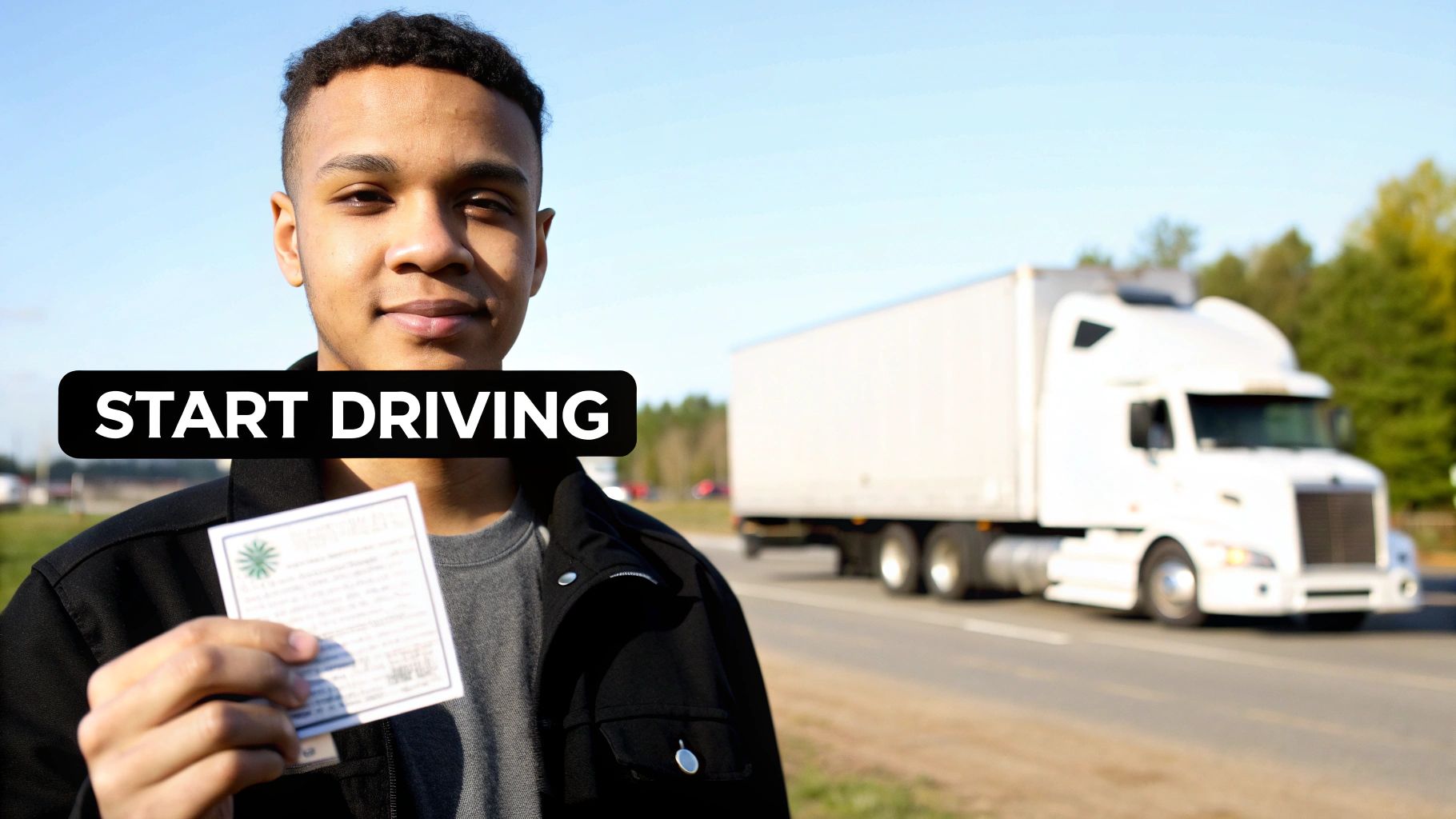
Passing your CDL knowledge tests and finally getting that Commercial Learner's Permit (CLP) in your hand is a huge milestone. It’s the moment the rubber really starts to meet the road, signaling your shift from the classroom to the driver's seat. All that time you spent grinding through each cdl knowledge practice test is about to pay off in a big way.
But remember, the CLP is your ticket to the main event, not the finish line itself. Now comes the critical part: taking all that book smarts and turning it into real-world skill behind the wheel. This is where a top-notch training school makes all the difference. The foundation you just built studying for the written exams is what your hands-on training will be built upon.
Connecting Knowledge to In-Cab Skills
Every single concept you memorized for that permit test shows up inside the truck. Think back to all those questions about air brake systems. Once you’re in the cab, knowing the theory makes learning the hands-on, pre-trip air brake check so much easier. It just clicks.
When your instructor starts talking about checking for air leaks or testing the low-pressure warning alarm, it won’t be the first time you’ve heard those terms. That familiarity is a massive advantage. It lets you focus on the how instead of the what, speeding up your learning curve dramatically.
The knowledge you gain from practice tests isn't just about passing a test; it's the language of a professional driver. When you understand safe operating procedures before you even turn the key, you become a safer, more confident student right from the start.
This head start helps you get a handle on complex driving maneuvers much more quickly than someone who just crammed to pass.
The Next Step: Your Commercial Learner's Permit
With that CLP secured, you're officially ready for the next phase. Choosing the right training program is absolutely essential to keep your momentum going. A great school will take the theoretical knowledge you've proven you have and show you how to apply it in real driving situations—from navigating busy city streets to backing into a tight dock on a dark night.
If you’re wondering what comes next, our detailed guide on the Commercial Learner’s Permit is a great resource. It breaks down the entire transition from written exams to hands-on training, helping you cross that final bridge between passing the test and launching your career.
Got Questions About CDL Practice Tests? We've Got Answers
Even the best study plan can leave you with a few lingering questions. It’s totally normal. Let's tackle some of the most common things we hear from folks gearing up for their CDL knowledge test.
How Many Practice Tests Should I Really Take?
Honestly, there isn't a magic number here. What matters is how you use them.
You’re far better off taking 5-10 high-quality practice tests and really digging into the results than just blasting through 20 of them without a second thought. The real goal isn't just to get a passing score on a practice run; it's to find exactly where your knowledge is thin so you can fix it.
Can I Get By With Just Practice Tests?
It’s tempting to think you can, but I wouldn’t recommend it. Practice tests are fantastic tools, but they work best as a partner to the official CDL manual, not a replacement for it.
Think of it this way: use the practice tests to pinpoint your weak spots. Did you bomb the section on air brakes? Great. Now you know exactly what chapter to go back and study in the manual. Simply memorizing answers won't help you when the real test throws you a question worded slightly differently. You need to understand the why behind the rules.
The manual is your textbook, building the foundation. The practice test is like a final exam review, showing you where the cracks are. You absolutely need both to walk into the DMV with confidence.
Before diving too deep, make sure you've got all your ducks in a row. You can double-check the latest official CDL requirements to ensure you meet all the state-specific criteria.
Ready to stop practicing and start your professional driving career? Patriot CDL provides the hands-on training and expert guidance you need to get your license and get on the road. Learn more at https://patriotcdl.com.