Let's be honest, the secret to acing your CDL knowledge test practice isn't about finding a magic bullet app or a shortcut. It all comes down to building a rock-solid foundation of knowledge first. Before you even think about practice quizzes, you need to get intimately familiar with your state's official CDL manual. Skipping this step is the single biggest reason people fail on their first try.
Building Your Foundation for CDL Test Success
I see it all the time—eager future drivers jumping straight into practice tests. It feels productive, but it’s like trying to build a house without a blueprint. That official state CDL manual? That’s your blueprint. It contains every single rule, regulation, and safety procedure the test will throw at you.
The Federal Motor Carrier Safety Administration (FMCSA) makes it clear: passing the knowledge test is the non-negotiable first step to getting your Commercial Learner's Permit (CLP). A surprising number of applicants stumble right out of the gate because they underestimate just how detailed the test is. The goal isn't to just memorize answers to pass a test; it's to truly understand the principles of safe commercial driving that will keep you and everyone else safe on the road.
Understanding the Test Components
Your road to a CDL starts with the General Knowledge test—everyone has to take this one. It's a broad exam covering everything from basic vehicle control and pre-trip inspections to handling hazards and communicating effectively in traffic.
Once you’ve got that down, you’ll likely need to tackle additional tests for specific endorsements, depending on what you want to drive. Knowing what these are ahead of time lets you focus your study efforts where they count.
Before you get too far, it's a good idea to create a quick reference for the core sections and common endorsements. This will help you map out your study plan.
Core Sections of the CDL Knowledge Test
| Test Section / Endorsement | What It Covers | Why It's Important |
|---|---|---|
| General Knowledge | Vehicle control, inspections, traffic laws, and basic safety. | The mandatory foundation for all CDL classes. |
| Air Brakes | Components, inspection, and proper use of air brake systems. | Critical for safely operating most heavy commercial vehicles. |
| Combination Vehicles | Coupling/uncoupling, turning, and controlling articulated vehicles. | A must-have for driving any tractor-trailer setup. |
| Hazardous Materials (HazMat) | Placarding, loading, and emergency protocols for dangerous goods. | Required for transporting regulated hazardous materials. |
| Tanker (N Endorsement) | Handling liquid surges, bulkheads, and unique driving dynamics. | Essential for driving tankers carrying liquids or gases. |
| Doubles/Triples (T Endorsement) | Connecting multiple trailers and managing the "crack-the-whip" effect. | Allows you to operate longer combination vehicles (LCVs). |
This table isn't exhaustive, but it covers the main endorsements you'll encounter. Always check your local https://patriotcdl.com/cdl-requirements/ to see exactly what you’ll need for the job you want.
Your Most Important Study Tool
Your state's official CDL manual is the ultimate source of truth. Seriously. Every single question on the exam comes directly from the information in that book. You can almost always find a free PDF of it right on your state's DMV website.
The biggest mistake you can make is relying only on third-party apps or websites. Those are great for quizzing yourself, but the official manual must be your primary study guide. Treat it as the definitive resource for your success, because that's exactly what it is.
How to Study Smarter, Not Harder
Just reading the CDL manual cover to cover is one of the most common mistakes I see people make. It's a surefire way to get frustrated and feel like you're not getting anywhere. Real learning—the kind that sticks—comes from actively engaging with the material. You have to force your brain to work with the information, not just passively scan it.
This is how you move from just memorizing facts to actually understanding the principles of commercial driving.
Think about it this way: instead of just highlighting a section, try explaining the entire air brake system out loud, in your own words. If you get stuck or can't explain a part clearly, you’ve just found a weak spot. Now you know exactly what to go back and review.
This simple trick forces you to process the information deeply. It's the difference between knowing a definition and understanding how that concept plays out on the road.
Create Targeted Study Tools
Flashcards are an old-school classic for a reason, but the secret is in how you use them. Don't waste your time making cards for stuff you already know cold. Your focus should be on the critical details that are easy to mix up but absolutely essential for passing the test.
Here’s what your flashcard deck should be filled with:
- Specific Numbers: Stopping distances at 55 mph, legal BAC limits, and minimum tire tread depths. These are easy points to lose if you don't have them down pat.
- Procedural Steps: The exact sequence for a pre-trip inspection, the steps for coupling and uncoupling, or the process for testing your air brakes.
- Key Definitions: Nail down terms like "off-tracking," "hydroplaning," and the different classes of fires and which extinguisher to use for each.
Running through these cards for just 15-20 minutes a day builds the muscle memory you need for instant recall. When you're sitting for the test and the clock is ticking, you'll be glad you did. It's so much more effective than just re-reading the same chapter over and over again.
Grasp the Why Behind the Rules
The CDL knowledge test isn’t just a trivia game; it’s designed to see if you understand how to operate safely. That's why simply memorizing rules isn't enough. You have to get the "why" behind them. Historically, the introduction of mandatory knowledge tests like the CDL exam has dramatically improved road safety, proving that this foundation of knowledge is crucial for weeding out unprepared drivers.
Understanding why a regulation exists—like the hours-of-service rules—turns it from a random number into a life-saving tool designed to prevent accidents caused by fatigue. This deeper level of comprehension is your best defense against the tricky situational questions the test will throw at you.
Ultimately, studying smart is all about connecting the dots. For example, you should be able to link the concept of Gross Vehicle Weight Rating (GVWR) directly to the rules for securing your load and the physics of braking distances. It all fits together.
A good training course is invaluable for helping you build these connections. For anyone looking at their options, learning about the components of a quality CDL program is a great place to start. When you focus on these active learning techniques, you’re not just preparing to pass an exam—you’re preparing to be a safe, competent, and professional driver from your very first day on the job.
Using Practice Tests as a Strategic Tool
Think of your CDL knowledge test practice as more than just a pass/fail quiz. The smartest way to study is to use each practice test as a diagnostic tool. They’re hands-down the best way to find and patch up any holes in your knowledge before you sit for the real thing. Shifting your mindset from just checking answers to a more strategic review is what separates drivers who pass on the first try from those who end up retesting.
The real magic happens when you use practice tests to mimic the actual exam environment. That means setting a timer, silencing your phone, and finding a quiet spot where you can focus without distractions. Building up this mental stamina is just as critical as memorizing the material—it trains you to stay cool and perform when the pressure is on.
This approach helps you move from just knowing the concepts to applying them with confidence.
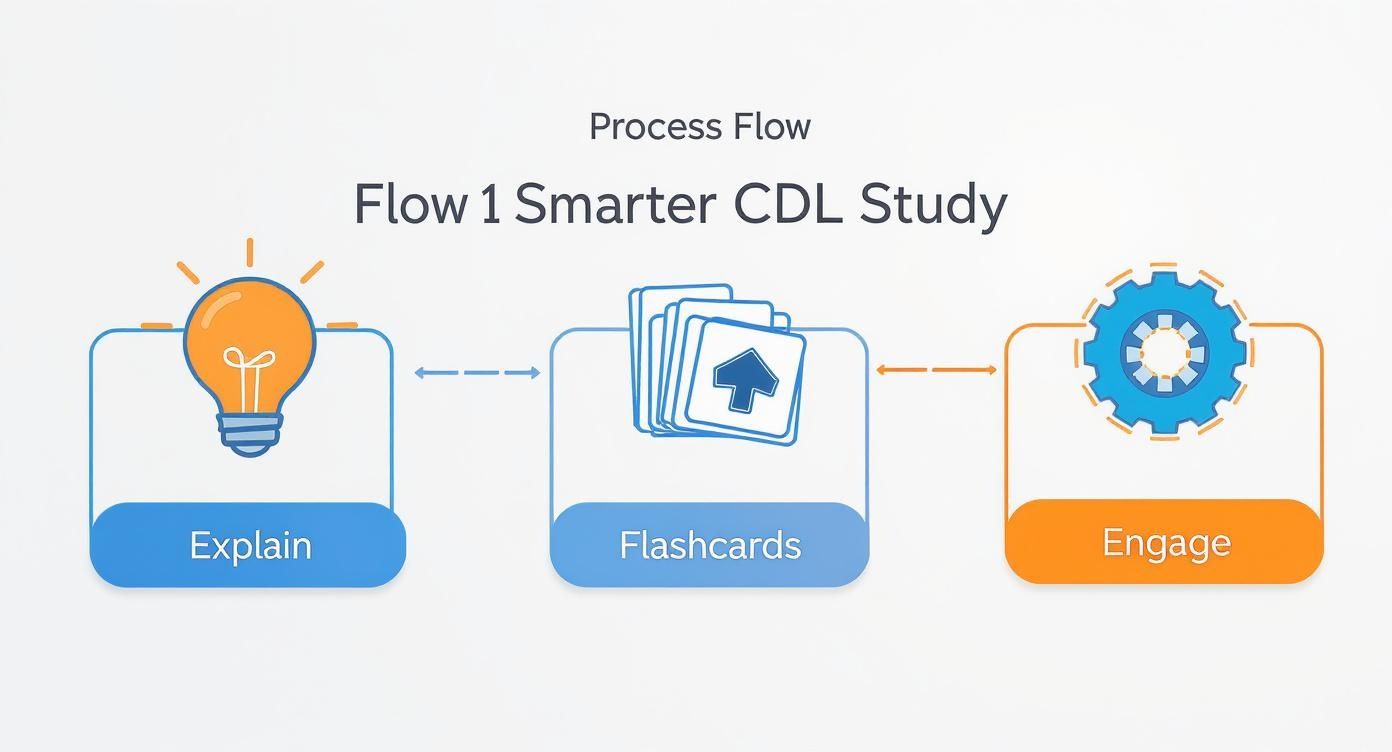
The big takeaway? Practice tests are the final piece of the learning puzzle, not where you should start.
A Phased Approach to Practice
Your study plan needs to adapt as your test day gets closer. It makes no sense to jump into full-blown timed exams if you're still getting tripped up by the basic rules of the road.
First, start with untimed tests. Your only goal here is to get a feel for the question formats and the kind of information you'll be tested on. Concentrate on understanding why an answer is correct and, just as importantly, why the other choices are wrong.
Once your scores on untimed quizzes are consistently solid, it's time to add the clock. Moving to timed sessions will help you build both speed and accuracy. This really helps cut down on the test-day jitters that cause people to make silly mistakes. You want the real test to feel like just another practice session you've done a dozen times before.
Choosing the Right Practice Resources
You can find a ton of CDL practice tests online, but be warned: not all of them are built the same. While free quizzes are great for a quick review, they often skip the detailed answer explanations you need to actually learn from your errors. This is a classic example of the strategic use of practice tests where quality trumps quantity.
Paid programs, on the other hand, usually offer much more, with comprehensive feedback and tools that track your progress and pinpoint your weak spots.
A good practice test won’t just tell you you’re wrong. It will walk you through the concept from the CDL manual so you understand the logic. That feedback is what turns a simple mistake into a lesson that sticks.
Finding the right resources for your study style is key. Here’s a quick breakdown to help you decide what might work best for you.
CDL Practice Test Resource Comparison
| Resource Type | Pros | Cons | Best For |
|---|---|---|---|
| Free Online Quizzes | No cost, easily accessible | Often have outdated questions, ads, and lack detailed explanations | Quick, casual review sessions or checking basic knowledge |
| CDL Manual PDFs | The official source, completely free | No interactive quiz format, can be dry and dense | Foundational learning and understanding the core material |
| Mobile Apps | Convenient, can study anywhere | Quality varies wildly, some have intrusive ads or hidden fees | On-the-go practice and fitting study into a busy schedule |
| Paid Online Programs | Up-to-date questions, detailed feedback, progress tracking | Requires a financial investment | Serious, structured study and identifying specific weak areas |
Ultimately, the best choice is the one that keeps you engaged and provides clear, actionable feedback to help you improve.
Interestingly, the difficulty of these tests varies a lot around the world. In China, for example, the theory test is one of the toughest, demanding a 90% pass mark on 100 questions pulled from a massive bank of over 1,000. It just goes to show how different places tailor their exams to meet specific road safety goals.
For more targeted prep tips, you can check out our in-depth guide to the CDL general knowledge test.
Turning Your Mistakes into Rapid Progress
Look, nobody likes getting answers wrong. But on your cdl knowledge test practice, every incorrect answer is a gift. Seriously. It’s not a failure—it's a bright, flashing arrow pointing right at a topic you need to shore up. If you can get your head around that idea, you’ll stop wasting time and start making real progress.
The whole point is to quit drilling stuff you already know by heart. Instead, you can pour all that energy into fixing the specific gaps that your wrong answers reveal. This is how you move the needle.
Diagnose Every Single Error
Finishing a practice test is just the beginning of the real work. Don't just peek at the right answer and click "next." For every single question you missed, you need to put on your detective hat and figure out precisely what went wrong.
This goes way beyond just memorizing the correct option. You have to find the root cause. Did you just misread the question? Make a wild guess because you were rushing? Or do you genuinely not understand a key concept?
The most powerful question you can ask is: "Why did I choose the wrong answer?" Being honest with yourself here exposes your thought process and the exact misconception you need to correct.
When you dig into the "why," you stop yourself from making that same mistake again. That kind of self-correction is way more valuable than just taking another practice test and hoping for a better score.
Categorize and Track Your Mistakes
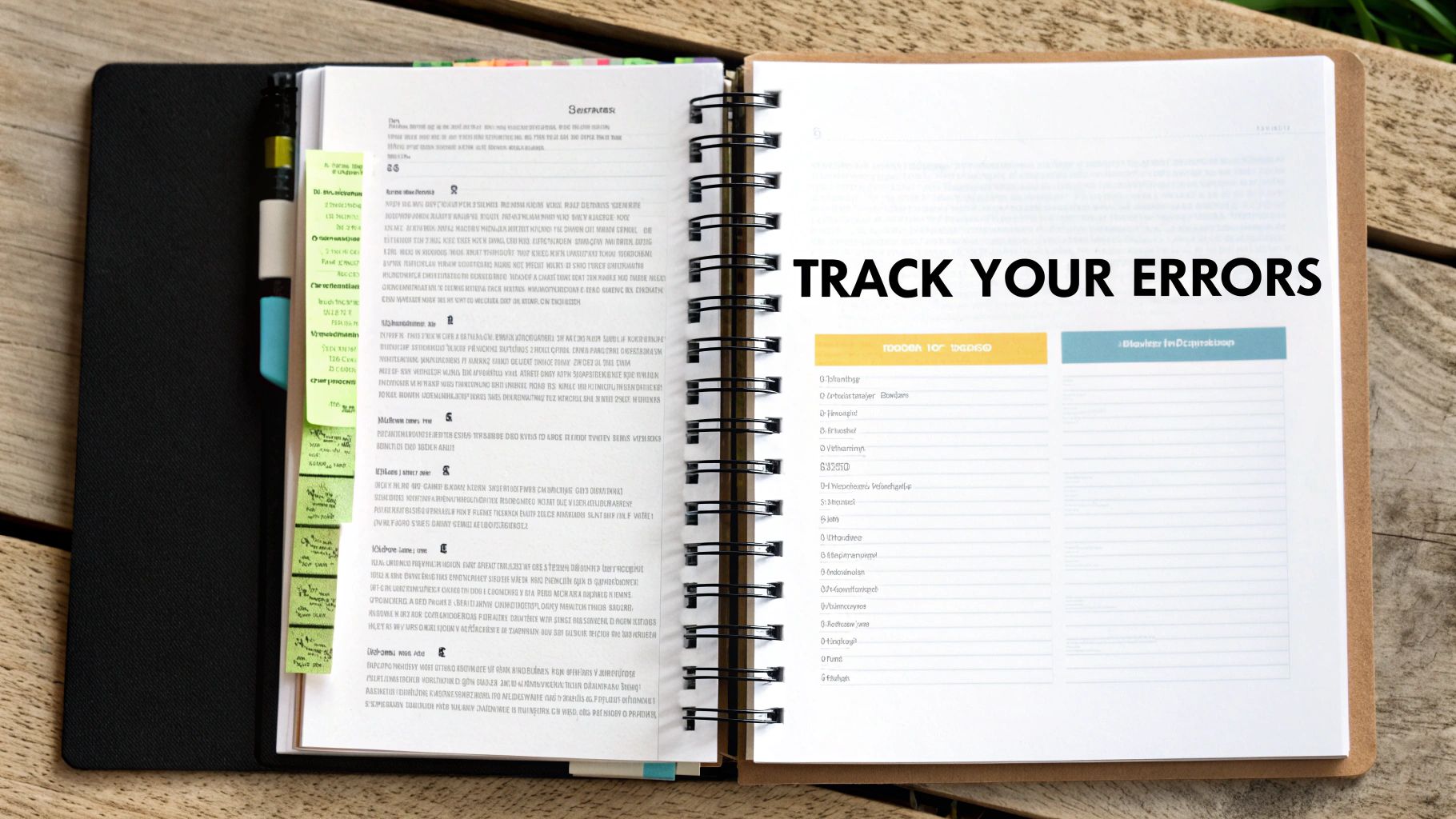
As you go through your practice tests, start a simple log. A basic notebook or spreadsheet is perfect. You just need a few columns to track where you're slipping up, which will make your study time laser-focused.
Here's what I recommend tracking for each mistake:
- Topic Area: What was the question about? (e.g., Air Brakes, Combination Vehicles, Pre-Trip Inspection).
- Reason for Error: Be specific. Why did you miss it? (e.g., "Confused slack adjuster rules," "Forgot stopping distance formula," "Rushed and misread the question").
- Manual Reference: Flip open your state's CDL manual, find the topic, and jot down the page or section number. This makes it super easy to find later.
This simple habit quickly reveals your patterns. If you notice you're consistently missing questions on the air brake system, that’s your sign to hit that section hard. To really hammer it home, find a specialized practice test for air brakes and drill down on just those questions. This way, you know every minute you spend studying is having the biggest possible impact on your score.
Crafting a Realistic CDL Study Schedule
https://www.youtube.com/embed/7NXwNwKNqfs
It’s one thing to have the best study materials, but it’s another thing entirely to actually use them effectively. The real secret to walking into your test with confidence is a solid, realistic study plan. We're not talking about those exhausting, all-night cram sessions that just lead to burnout. This is about building a consistent routine that genuinely helps you remember the material for the long haul.
Forget trying to power through a four-hour study marathon after a long day. Your brain simply wasn't built for that. You’ll get way more out of shorter, focused study blocks. Try to carve out 45-60 minutes of dedicated time each day. This method is backed by science—it's called spaced repetition, and it's the most effective way to transfer what you're learning from short-term to long-term memory. That’s exactly what you need to pass.
Designing Your Timeline
Your schedule needs to be flexible, depending on how much time you have before your test day. Whether you’ve got a couple of weeks or a couple of months, the goal is the same: build momentum. Start with the core concepts and gradually layer in the more complex topics.
For example, if you have a month to get ready, you could dedicate the entire first week to mastering the General Knowledge section. The second week could be all about endorsements like Air Brakes or Combination Vehicles. Then, you'd spend the third week running through timed practice exams, leaving the final week for a targeted review of any areas where you're still struggling.
Here are a couple of practical frameworks you can steal and make your own:
The Two-Week Sprint:
- Week 1: Spend the first four days absorbing the General Knowledge manual. Use days 5-7 to take untimed practice tests—the goal here is just to see where your knowledge gaps are.
- Week 2: For days 8-10, go hard on your weakest endorsement topics. The next three days are for daily timed practice exams to get used to the pressure. Take the day before the test for a light review and, most importantly, rest.
The Four-Week Pace:
- Week 1: Take a deep dive into the General Knowledge section. Don't move on until you feel you have a good grip on it.
- Week 2: Zero in on the specific endorsements you need, like Air Brakes or HazMat.
- Week 3: Begin mixing in timed cdl knowledge test practice sessions to build your speed and confidence.
- Week 4: By now, you should have a good idea of your weak spots. Spend this final week analyzing your test results and drilling down on those subjects exclusively.
Pro Tip: Make sure you schedule at least one full day off per week. Your brain does some of its best work consolidating information while you rest. Taking a break isn't slacking—it's a smart strategy to stay sharp and avoid hitting a wall.
Layering Your Learning for Maximum Impact
A truly effective study plan builds on itself. When you're just starting out, your main goal is simply to understand the foundational material in your state's CDL manual. Once you start feeling comfortable with that, you can begin adding more specialized topics into the mix.
For instance, after you’ve nailed the basics of a standard vehicle inspection, you can then tackle a more complex topic, like the detailed inspection process for combination vehicles. The closer you get to your test date, the more your schedule should shift toward timed practice exams. This is absolutely critical for getting used to the clock and the feel of the real test, so when the big day arrives, it feels like just another practice run.
Common Questions About Acing Your CDL Test
When you're grinding through your cdl knowledge test practice, questions are bound to come up. It's totally normal. Getting them answered helps you cut through the noise and focus on what really matters. Let's dig into some of the questions I hear most often from new drivers.
How Many Times Can I Fail the CDL Knowledge Test?
This is the big one, and the honest answer is: it depends on your state. There's no single rule for the whole country.
Most states will give you a few shots at it. Some might let you come back the very next day, while others will make you wait a week or longer, especially if you fail a few times in a row. The key is to check the rules directly with your state's DMV or licensing agency. Don't rely on word of mouth—go straight to the source to find out their exact policy on retakes and any fees involved.
Are Online CDL Practice Tests Accurate?
For the most part, yes. A good, well-designed online practice test is an incredible tool. They’re built using the official CDL manual, so they do a great job of mimicking the real thing. You’ll get a feel for the question style and the types of situations they'll ask you about.
But here’s the thing: they are a supplement to the official state handbook, not a replacement. The manual is your bible. It's the source material for every single question on that test.
Think of it this way: The CDL manual is the textbook you study for the final exam. Practice tests are the pop quizzes that show you what you've learned and where you still need to hit the books.
What Is the Hardest Part of the CDL Test?
This really comes down to the individual, but I see a lot of people get tripped up by the same two sections: Air Brakes and Combination Vehicles. It makes sense—they're incredibly technical and require you to know mechanical systems inside and out. You can't just guess your way through those.
The General Knowledge section can also be a beast, but for a different reason. It’s not necessarily complex, but the sheer amount of information is huge. It covers everything from vehicle inspections to federal rules of the road. Your personal "hardest part" will be whatever you find most challenging, so that's where you need to double down on your study time.
How Long Should I Study for the Permit Test?
There's no golden rule here, but from what I've seen, cramming for a couple of nights before the test rarely works. You're trying to build real, lasting knowledge, not just memorize answers for a day.
Most drivers who pass on their first try spend about two to four weeks preparing. They put in a solid one to two hours a day, mixing up their study methods. One day they'll read a chapter from the manual, the next they'll work on flashcards, and they'll take practice tests regularly to check their progress. It's all about consistency.
At Patriot CDL, we provide the hands-on training and expert guidance you need to pass your CDL knowledge test with confidence and launch a successful career. Learn more about our accelerated programs by visiting us online.