


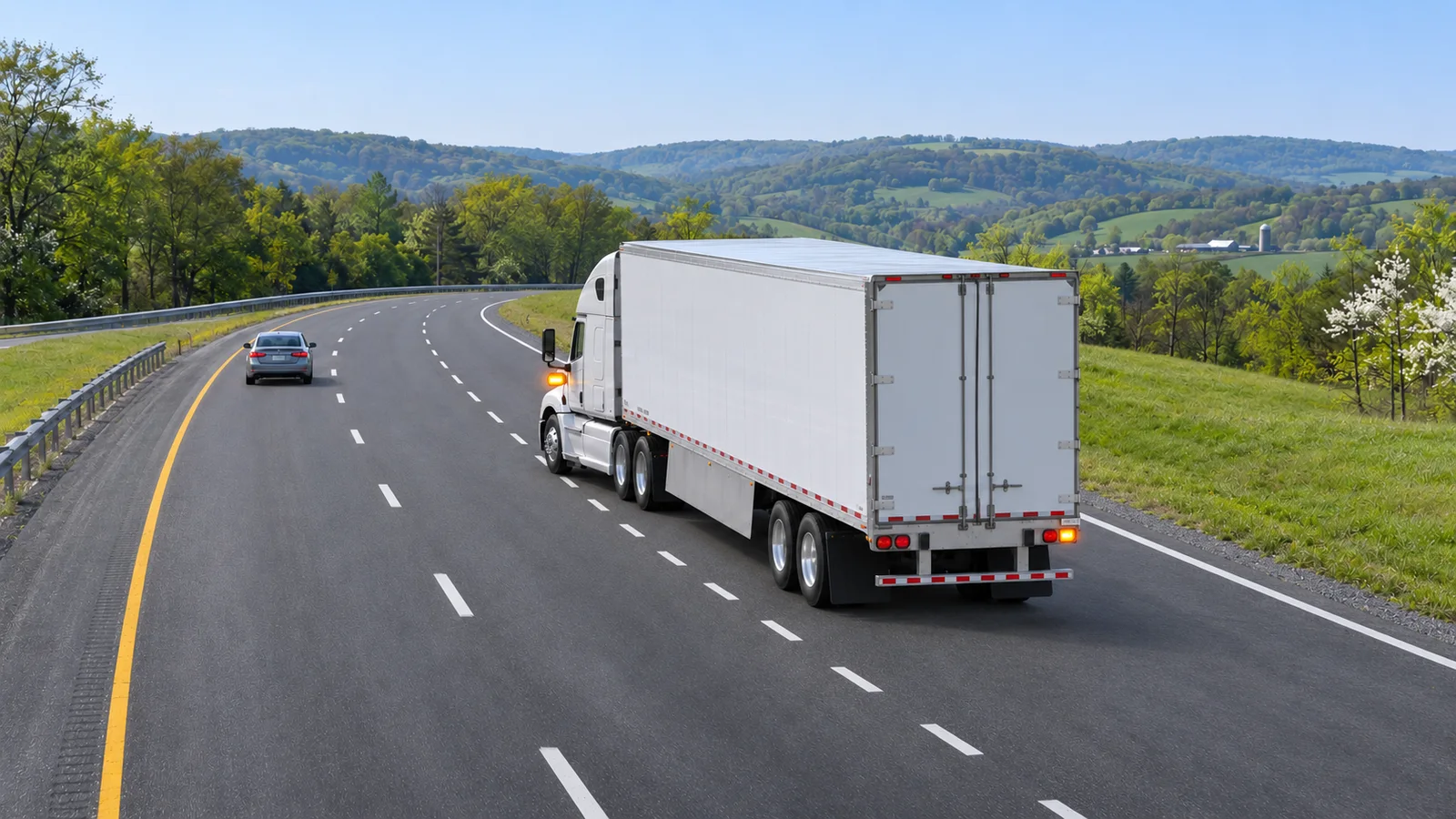
A commercial-truck lane change is not a quick steering movement. It is a planned transfer of a long vehicle into space already used by other drivers. The tractor may fit while the trailer is still beside another vehicle, a car can disappear from one mirror view, and a gap that looked adequate can close before the maneuver begins. Safe lane management therefore starts well before the truck reaches the lane line.
This guide presents a practical observation-signal-space routine for CDL students. It applies the current Pennsylvania Commercial Driver's Manual, FMCSA driver guidance, and federal operating rules without pretending that one fixed count or distance suits every truck and every road. Vehicle length, acceleration, traffic speed, grade, weather, visibility, lane restrictions, and local law all affect the decision. The central habit is simple: create time to see, communicate, verify, move smoothly, and cancel when the space is no longer reliable.
Know the rule and test baseline
requires every commercial motor vehicle to be operated according to the laws, ordinances, and regulations of the jurisdiction where it is being driven, unless an applicable FMCSA rule imposes a higher standard of care. That means lane markings, right-of-way rules, truck-lane restrictions, posted signs, and state traffic law are not optional details around a federal driving routine. They define whether the maneuver is permitted.
PennDOT's current describes the on-road lane-change expectation in direct terms: make the necessary traffic checks, use proper signals, and change lanes smoothly when it is safe. For expressway entry, the manual calls for checking traffic, signaling, and merging smoothly into the proper lane. Those are performance principles, not permission to force a gap.
A lane change and a merge share a sequence, not identical conditions
A lane change usually begins with the truck established in one through lane and considering another. A highway merge begins on an entrance ramp or acceleration lane that may end. The observation and communication sequence is similar, but the merge adds ramp curvature, limited lane length, acceleration demands, yield responsibilities, and traffic already on the highway. Treating a merge as an ordinary lane change can delay the decision until the taper.
The passing decision comes before the lane-change decision
Do not begin merely because the vehicle ahead is slower. Ask whether passing is permitted, useful, and sustainable. Check signs, lane restrictions, exits, grades, curves, work zones, and the speed you can legally maintain. Do not move left for a pass the truck cannot complete safely and lawfully.
Plan before the lane change becomes urgent
Early planning turns a lane change from a reaction into a choice. Look far enough ahead to identify lane endings, entrance ramps, disabled vehicles, construction shifts, slow traffic, and the lane needed for the route. FMCSA's recommend scanning roughly 15 seconds ahead and checking mirrors every 8 to 10 seconds. Additional checks are still needed before a maneuver.
Read the road beyond the immediate gap
A clear adjacent lane beside the cab is not enough. Look for traffic compressing near a curve, ramp traffic, brake lights ahead, an exit-only lane, or a work-zone shift. Avoid moving into space that will require another immediate lane change.
Route knowledge reduces surprise. Review exits and major interchanges before driving, using commercial-vehicle information appropriate to the route. If you miss an exit, continue to a safe legal alternative. A sudden multi-lane correction is not rescued by turning on the signal. The safer plan is to accept the delay and keep the truck stable.
Stabilize the truck before adding a maneuver
Before changing lanes, establish a suitable speed, stable lane position, and a manageable following gap. Finish unnecessary control adjustments and keep attention on driving. If the truck is already braking hard, accelerating unpredictably, or correcting within its lane, postpone the lane change. One controlled task at a time preserves observation capacity.
The following-distance and space-cushion plan explains how usable front space buys decision time. That space also gives the driver somewhere to remain if the target lane becomes unavailable.
Build an accurate traffic picture
Mirrors show portions of the traffic environment, not a complete uninterrupted view. Begin with the road ahead, then scan the appropriate mirrors in a practiced sequence. Identify vehicles approaching from behind, vehicles pacing beside the trailer, motorcycles, and cars moving between lanes. Return attention forward between quick mirror checks so conditions ahead do not disappear while you study one mirror.
Track movement, not just presence
A single glance may show a car behind the trailer, but the important question is whether it is gaining, falling back, or holding position. Compare successive views. If a vehicle becomes larger quickly in the mirror, treat it as closing traffic. If it leaves one mirror view without appearing where expected, assume it may be alongside until the traffic picture confirms otherwise.
FMCSA's warns that looking is not the same as seeing. A driver can look toward an adjacent lane yet fail to recognize a vehicle. Naming the traffic mentally—“car approaching left rear,” “motorcycle beside trailer,” “ramp vehicle ahead”—can help turn a glance into an interpreted picture during training.
Use every installed view correctly
Flat mirrors, convex mirrors, and approved camera systems provide different perspectives. They do not make blind areas vanish, and convex images can make vehicles appear farther away. Mirrors and monitoring devices should be clean and adjusted before driving. Address a blocked or inoperative view through the defect process.
Choose and protect a usable gap
A target gap needs room for the entire combination, not only the tractor. It should support a stable following distance after the maneuver and leave reasonable space for the vehicle behind. The gap must also remain usable at the speed the truck can maintain. Entering a small opening and immediately braking can transfer the problem to following traffic.
Evaluate the front boundary
Identify the vehicle that would be ahead after the move. Is it traveling steadily? Are its brake lights active? Is it approaching a queue, ramp, curve, or lane ending? Compare its speed with yours. The goal is not simply to place the bumper in front of another vehicle; it is to finish with a safe working cushion.
Evaluate the rear boundary
Identify the vehicle that would be behind the trailer. Watch its closing rate and behavior. A driver flashing headlights, accelerating into the opening, or moving unpredictably may make the gap unreliable. A signal communicates intention but does not freeze surrounding traffic. Keep checking until the trailer has cleared and the truck is established.
Do not solve a poor gap with aggressive acceleration
Acceleration can support a merge when the road, vehicle, load, speed limit, and available lane make it appropriate. It should not become a demand that other traffic move. Large vehicles accelerate differently depending on grade and weight. If the truck cannot match a suitable gap without excessive speed or abrupt control input, choose another gap or delay the maneuver.
Communicate intent without demanding space
Signal early enough to be noticed before lateral movement begins. PennDOT expects proper signals for lane changes and highway entry, and FMCSA advises drivers to signal early so others have time to recognize intent. Keep the signal active through the maneuver and cancel it after the truck is fully established, following the vehicle's control design and local law.
A signal is information, not right of way
Turning on a signal does not require another driver to open a gap and does not prove that the lane is clear. Continue the mirror scan after signaling. Some drivers will slow, some will accelerate, and some may not react. Base the decision on observed space, not an assumption about courtesy.
Move the entire vehicle smoothly
When the gap is confirmed, steer gradually across the lane line while maintaining a stable speed appropriate to conditions. Avoid a sharp input followed by an opposite correction. The trailer will follow the tractor's path with a delay, so keep monitoring the target lane, trailer position, and traffic ahead.
Keep the cab and trailer inside the planned path
Cross one lane at a time. Do not drift across a second lane because the steering input continues too long. Center the vehicle in the destination lane with enough clearance on both sides. If the roadway curves, separate the curve-tracking task from unnecessary lane movement when possible.
Finish the maneuver after the trailer clears
The maneuver is not complete when the tractor reaches the new lane. Confirm in the mirrors that the trailer has cleared the lane line and the rear boundary vehicle. Then cancel the signal, restore a balanced scan, and reassess following distance. If the truck passed another vehicle, do not return right until the complete combination has sufficient clearance.
Trailer tracking matters in turns as well as lane changes. The truck-turn planning guide explains how tractor and trailer paths differ during larger directional changes.
Apply the routine on an entrance ramp
Use the ramp to develop an early traffic picture. Check the highway through mirrors and available sight lines, identify one primary gap and a backup, signal, and adjust speed within the legal and safe capability of the truck. Keep steering smooth through the ramp curve; excessive speed on a curved ramp can create rollover risk before the merge begins.
Use the acceleration lane as decision space
Do not stare only at the lane ending. Alternate between the path ahead and traffic on the highway. The acceleration lane lets the driver align speed and position, but it does not guarantee that highway traffic will move. Respect yield requirements and roadway markings. Never cross a painted gore, shoulder, or solid prohibited area to rescue a late decision.
Preserve a backup plan
A primary gap can disappear when a car changes speed. Identify whether another gap is developing and how much usable acceleration lane remains. Do not commit to a speed that removes every alternative. If a safe merge cannot be completed, follow the current road rules and instructor or carrier procedure; never invent a last-second escape onto the shoulder.
After entering, establish a proper following cushion before considering another lane change. The objective is stable integration with traffic, not reaching a preferred lane immediately.
Know when to wait, pause, or cancel
A safe driver is willing to abandon a maneuver. Cancel when a vehicle moves into the target gap, the rear boundary accelerates, the front boundary brakes, a motorcycle disappears from view, a signal or mirror problem develops, or road markings no longer permit the move. Continue in the current lane if it remains safe and lawful, cancel the signal when appropriate, and rebuild the traffic picture.
Do not combine hesitation with lateral drift
If the truck has not crossed the lane line, keep it centered while deciding. A signal plus wandering tires creates uncertainty for others. If the truck has begun moving and the gap changes, the safest response depends on actual position and surrounding traffic. Use the controlled response taught by the instructor for that situation; abrupt swerving can create a second conflict.
Accept the missed opportunity
Missing a passing gap, merge opening, or exit is less serious than forcing a maneuver. Continue to a safe legal alternative. Professional judgment includes accepting delay without transferring urgency to the steering wheel.
Adjust for weather, work zones, and heavy traffic
Rain, fog, snow, ice, dust, and smoke reduce visibility or traction and may obscure lane markings. requires extreme caution and reduced speed when hazardous conditions adversely affect visibility or traction; operation must stop when conditions become sufficiently dangerous. Fewer lane changes may be the safer choice.
Increase observation time and following space, reduce control inputs, and avoid placing the truck beside another vehicle longer than necessary. In fog or low visibility, use the low-visibility decision plan. In a work zone, follow temporary signs and markings, watch for lane shifts and workers, and do not rely on the normal roadway layout.
Heavy traffic requires patience, not smaller standards
Dense traffic may offer fewer large gaps, but it does not shorten the truck. Signal early, remain predictable, and wait for a reliable opening. Plan earlier for exits instead of crossing multiple lanes late.
Lane-change action table
| Observation | Risk or meaning | Controlled response |
|---|---|---|
| Target lane is clear beside the cab, but a car is gaining behind the trailer | The opening may close before the combination clears | Wait and track the car through successive mirror views |
| Signal is on and another driver accelerates into the gap | The signal did not reserve the space | Remain centered, cancel or delay, and select another gap |
| Front vehicle in the target lane begins braking | Finishing the move may leave inadequate following space | Postpone the maneuver and reassess traffic ahead |
| Truck is on a curved entrance ramp with limited sight distance | Speed and traffic information are incomplete | Control ramp speed, look early, and avoid committing before the gap is reliable |
| Motorcycle leaves one mirror and does not reappear | It may be in a blind area | Do not move laterally until its location is confirmed |
| Lane becomes exit-only shortly after the planned move | The maneuver creates another immediate conflict | Choose a lane that supports the route or stay put |
| Rain obscures markings and traffic spray reduces visibility | Traction and lane-position information are degraded | Reduce speed, increase space, and avoid unnecessary lane changes |
Worked training scenario
A student is driving a supervised tractor-trailer on a three-lane highway. A slower vehicle is ahead in the right lane, the truck has a stable following cushion, and the route continues straight for several miles. The student considers moving to the center lane. An early mirror scan shows a sedan far behind in the center lane and no vehicle beside the trailer.
Build the picture before signaling
The student checks the road ahead, confirms passing is permitted, and compares two mirror views. The sedan is gaining quickly. Instead of signaling and beginning the move, the student maintains lane position and lets the sedan pass. A motorcycle then appears behind the sedan, so the student continues the scan until both vehicles are clearly ahead and moving away.
Select a new gap and execute once
A larger opening develops. The student confirms front and rear boundaries, activates the signal, and checks again. No one accelerates into the gap. She steers gradually into the center lane, keeps a stable lawful speed, and monitors the trailer until it clears the lane line. After centering, she cancels the signal and restores a safe following cushion.
Respond to a changed condition without forcing the return
After passing, the student prepares to return right. Before moving, she sees a car entering the highway into the space beside the trailer. She keeps the truck centered in the current lane and delays the return. Only after the entering car is clearly ahead, the right lane offers sufficient front and rear space, and the full combination can clear does she signal and return smoothly. The successful lesson is not speed; it is two decisions to wait.
Practical lane-change and merge checklist
- Confirm the maneuver is permitted by signs, markings, lane restrictions, and local law.
- Ask whether the lane change is necessary and useful for the route.
- Scan well ahead for queues, ramps, curves, work zones, and lane endings.
- Stabilize speed, lane position, and following space before moving laterally.
- Check the relevant flat and convex mirrors in the vehicle's taught sequence.
- Track whether nearby vehicles are gaining, falling back, or pacing the trailer.
- Account for motorcycles and vehicles that disappear between mirror views.
- Identify both the front and rear boundaries of the target gap.
- Make sure the gap will fit the entire combination with usable space afterward.
- Signal before lateral movement and continue checking traffic.
- Remember that the signal communicates intent but does not create right of way.
- Steer gradually across one lane line while maintaining a suitable speed.
- Monitor the trailer and the road ahead throughout the movement.
- Center the full vehicle in the destination lane before finishing the routine.
- Confirm trailer clearance, cancel the signal, and reestablish following space.
- On a ramp, control curve speed and use the acceleration lane for early planning.
- Never cross a gore, prohibited solid marking, or shoulder to save a late merge.
- Cancel or delay when the traffic picture becomes uncertain.
- Reduce lane changes and increase caution when visibility or traction is poor.
- Accept a missed exit or passing opportunity and choose a safe legal alternative.
Official sources and training method
Use the current PennDOT manual for Pennsylvania test expectations, the current eCFR for federal operating rules, and FMCSA safety material for scanning and blind-spot guidance. Confirm state traffic law and posted restrictions for the actual road. A training routine helps organize decisions; it does not override an examiner, instructor, carrier policy, or traffic-control device.
Practice first by narrating traffic from the passenger seat: identify the target lane, front and rear gap boundaries, closing vehicles, and a reason to cancel. Then practice under instructor control on a suitable route. Review whether each decision was early enough, not merely whether the truck eventually reached the lane.
Patriot CDL students can practice supervised lane observation, signaling, and highway integration at 7800 Bristol Pike, Levittown, PA 19057. Call to discuss CDL training and practical road instruction.
Frequently asked questions
What should a CDL driver check before changing lanes?
Check that the maneuver is legal and useful, scan the road ahead, inspect the target lane through the appropriate mirrors, track vehicles approaching from behind or pacing the trailer, and identify enough front and rear space for the entire combination. Signal before moving and verify the gap again.
How should a commercial truck merge onto a highway?
Control speed on the ramp, observe highway traffic early, select a primary and backup gap, signal, and use the acceleration lane to align speed when safe and lawful. Yield as required, merge smoothly only when the entire combination has space, and never cross a gore or shoulder to rescue a late decision.
What should a truck driver do if a vehicle enters the planned gap?
If the truck has not begun moving laterally, remain centered, delay or cancel the maneuver, and rebuild the traffic picture. If movement has started, use the controlled response appropriate to the truck's position and surrounding traffic; avoid an abrupt swerve and follow instructor or carrier guidance.
Do turn signals give a truck the right of way?
No. A turn signal communicates intent; it does not reserve a lane or require another driver to yield. The truck driver must continue observing traffic and move only when the maneuver is permitted and a reliable gap exists.