
Thinking about a career in trucking? The very first question to tackle is how old you need to be. It's a simple question with a two-part answer that shapes the first few years of your entire career.
Your Quick Guide To CDL Age Requirements
Let's get straight to it: the federal rule is you must be at least 18 years old to drive a commercial truck within your state's borders (intrastate) and 21 years old to cross state lines (interstate). This isn't just a technicality; it’s the rule that defines your job opportunities right out of the gate.
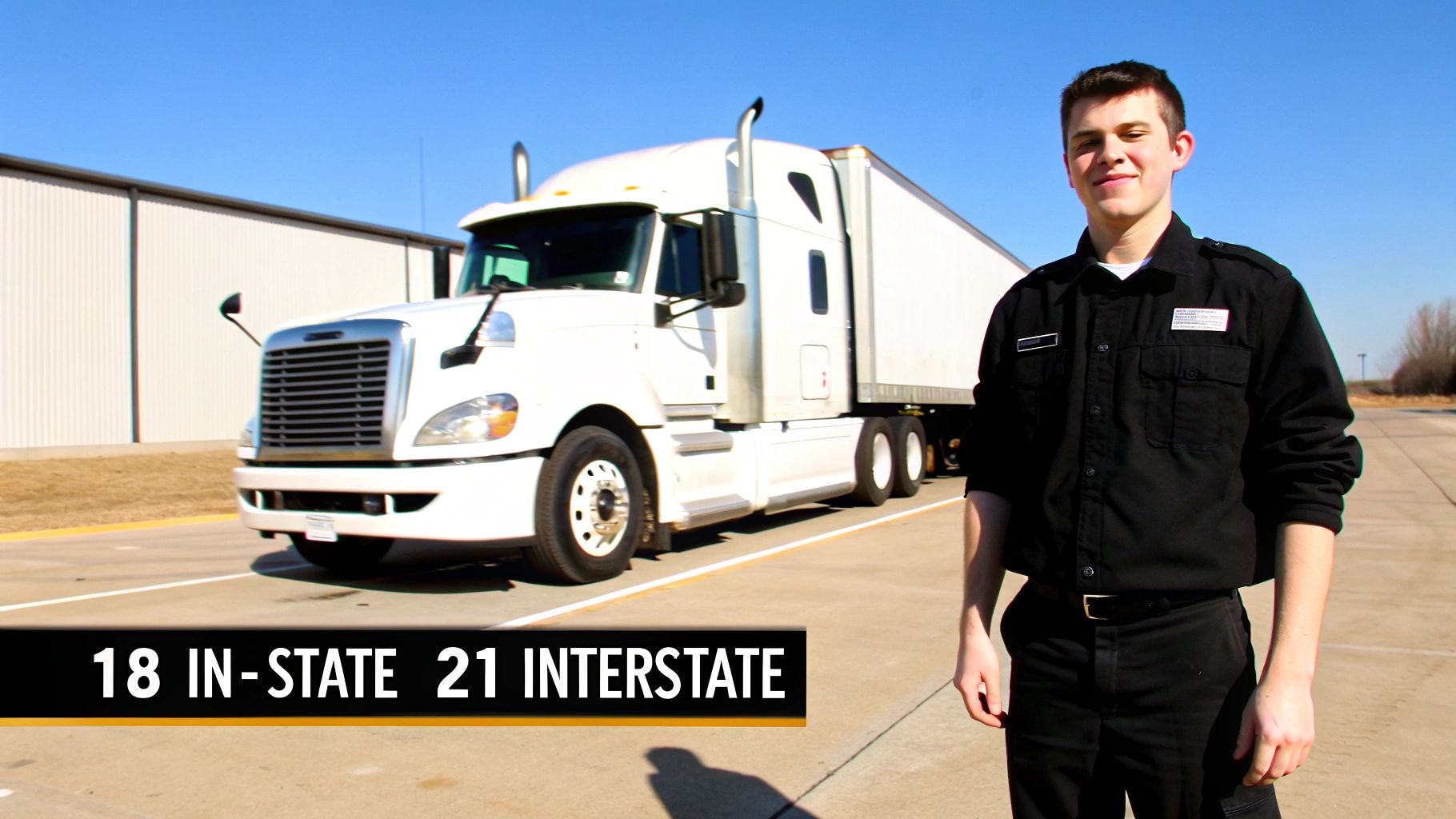
Think of it as a built-in career ladder. At 18, you can get your CDL and start working right away, hauling goods from one end of your state to the other. You’re operating the same powerful rigs and gaining that critical "seat time" that every great driver needs.
The catch? You can't take a load that crosses a state line. A young driver in Dallas could legally haul freight all the way to El Paso, but they couldn't make the much shorter drive over to Shreveport, Louisiana, until they hit 21. It’s that simple.
Building Your Foundation (Ages 18-20)
This age-based system is actually a huge advantage if you use it wisely. Getting your CDL at 18 means you can jump into local and regional jobs, earning a solid income while others are still figuring out what they want to do. It’s your chance to build a professional reputation.
This distinction is crucial for aspiring drivers looking at fast-track training programs, like the ones we offer at Patriot CDL School. We can get you trained for a Class A or B license and ready for the road in as little as three weeks, so you can start capitalizing on those in-state opportunities immediately.
The 18-20 age window is the perfect time to build a rock-solid foundation. You can master your driving skills, establish a clean safety record, and earn a great income—all while preparing for the higher-paying interstate jobs that open up at 21.
So, What Can You Do Before 21?
Don't think of the under-21 years as a waiting period. It's a training ground. The demand for in-state commercial drivers is massive, and companies are always looking for qualified, reliable people.
Here's a quick look at what this really means for you:
- Start Earning Now: You can enroll in CDL school, get licensed, and be on the road earning a professional wage right at age 18.
- Get Invaluable Experience: Those first few years of local driving give you hands-on experience that top-tier companies love to see when you turn 21.
- Explore Diverse Jobs: Intrastate work is far from boring. It includes everything from local package delivery and construction hauling to agriculture and waste management.
To make it even clearer, here’s a quick table breaking down the baseline age rules.
Minimum CDL Age At a Glance
This table summarizes the core federal requirements and the types of jobs that fall into each category.
| Driving Type | Minimum Federal Age | Common Job Examples |
|---|---|---|
| Intrastate Driving | 18 years old | Local delivery driver, dump truck operator, agricultural hauler, regional freight within state lines. |
| Interstate Driving | 21 years old | Long-haul (OTR) trucking, regional routes that cross state lines, coast-to-coast freight. |
| Hazardous Materials | 21 years old | Fuel tanker driver, chemical transport, any job requiring a HazMat (H) endorsement. |
| School Bus/Passengers | 21 years old | School bus driver, city bus operator, tour bus driver, any job requiring a Passenger (P) endorsement. |
These are the foundational rules that every aspiring trucker needs to know. From here, you can start mapping out your path, from getting your permit to choosing the right endorsements for the career you want.
Intrastate vs. Interstate Driving: The Critical Age Divide
When you're looking at getting your CDL, one distinction stands above all others: are you driving intrastate or interstate? This single factor is the key to understanding your career path, especially in your first few years. It dictates where you can drive, the jobs you'll qualify for, and how quickly you can advance.

Think of it this way. Intrastate driving is like being a star player for your hometown team—you're a professional, but all your games are within your state's borders. On the other hand, interstate driving is when you get drafted to the major leagues, traveling across the country to compete.
This one difference, enforced by the Federal Motor Carrier Safety Administration (FMCSA), is precisely why the minimum age for crossing state lines in a commercial vehicle is 21.
The World of Intrastate Driving for Ages 18-20
For drivers between 18 and 20, the road is wide open… as long as it doesn't cross a state line. This isn't the minor leagues by any stretch. It's a massive field of opportunity where you can build an incredible career foundation right after earning your license.
Once you have that CDL in hand, you’re legally cleared to operate the same Class A and Class B trucks as a driver with 20 years of experience. You can haul heavy loads for construction companies, drive dump trucks, or run local delivery routes. The experience you'll rack up is invaluable.
This period is your time to master the craft in a more familiar setting. You'll learn to handle your rig in all kinds of weather, build a spotless driving record, and prove to employers you’re a reliable professional—all while making a great living. You can see how this fits into the full list of CDL requirements you’ll need to meet.
Why the Federal Rules Exist
So, why the wait until 21 for interstate travel? The FMCSA's rules are all about safety. Interstate commerce often means long-haul trips, which come with more nighttime driving, more hours behind the wheel, and the challenge of navigating unfamiliar roads across the country.
The higher age requirement is a direct response to data on driver maturity and accident risk.
The core idea behind the 21-and-up rule for interstate travel is all about managing risk. By having younger drivers gain crucial real-world experience on intrastate routes first, federal regulations create a safer pathway to the more demanding conditions of long-haul trucking.
This creates a natural, logical career progression. It gives new drivers a chance to really prove themselves on local and regional jobs before they graduate to the national stage.
Unlocking Your Career Potential at 21
For a trucker who started at 18, your 21st birthday isn't just a celebration—it's a major career milestone. On that day, the state borders effectively vanish. Your job opportunities multiply, and your earning potential can jump significantly.
Here’s what changes overnight:
- Long-Haul (OTR) Jobs: You’re now eligible for those cross-country, over-the-road positions.
- Regional Interstate Routes: You can take on routes that weave through multiple states in your corner of the country.
- Higher Paying Opportunities: Many of the most lucrative trucking jobs are tied to interstate commerce, opening up a whole new level of income.
The best part? That experience you built from age 18 to 20 makes you a top-tier candidate. Employers won't see you as a rookie; they'll see a driver with a proven, multi-year track record. This gives you a serious leg up in a competitive market, turning your intrastate years into the solid foundation for a long and successful career on the open road.
How Your Age Shapes Your CDL Training and Career Path
Your age isn't just a number on your driver's license—it's a key factor that shapes your training journey and the kinds of specialized cargo you can haul. While the fundamental skills of handling a big rig are the same for every student, understanding the age-based rules is crucial for mapping out a successful career from day one.
Here's the good news: an 18-year-old can enroll in the exact same high-quality Class A training program as a 28-year-old. You’ll master everything from meticulous pre-trip inspections and complex backing maneuvers to navigating busy city streets. The education you receive is identical.
The real difference shows up after graduation. It's not about the skills you have, but where you're allowed to use them. Think of it this way: your training gives you the keys to a powerful machine, but your first jobs will be on local roads. Once you turn 21, you get access to the entire national highway system.
Training for a Career, Not Just Your First Job
Imagine your CDL training is like building a high-performance engine. At 18, that engine is fully built and ready to go, but you're restricted to driving it on state and local highways. When you turn 21, the federal government essentially opens the gates to the interstate, letting you unleash that same powerful engine to its full potential across the country.
The skills never change, but your operational range expands dramatically. It’s a common myth that drivers under 21 get a "junior" version of training. That’s simply not true. Top-tier schools like ours teach to a single, high standard to make sure every graduate is ready for the long haul.
Every new driver, regardless of age, must meet the federal Entry-Level Driver Training (ELDT) standards. This mandate ensures everyone gets a consistent, high-quality education focused on safety and proficiency. You can get the full rundown on how the ELDT mandate affects new truck drivers and sets the foundation for modern training.
Age Restrictions on Key CDL Endorsements
Endorsements are special certifications that let you haul specific types of cargo, like liquids in a tanker or hazardous materials. While you can get several valuable endorsements at 18, some of the most specialized—and often highest-paying—are reserved for drivers who are 21 or older.
Here’s a quick breakdown of how age affects the most common endorsements:
- Tank Vehicle (N): You can earn this at 18, which is perfect for hauling non-hazardous bulk liquids like milk or juice within your state.
- Doubles/Triples (T): Also available at 18 for intrastate work, this one qualifies you to pull multiple trailers.
- School Bus (S) & Passenger (P): Federal law requires drivers to be at least 21 to transport passengers across state lines, and most states adopt this same minimum age for in-state driving.
- Hazardous Materials (H): This has a strict federal minimum age of 21. No exceptions.
The Hazardous Materials (HazMat) endorsement is a special case. It requires a thorough security threat assessment from the Transportation Security Administration (TSA). Because of the sensitive nature of the cargo and federal security rules, you must be at least 21 years old to even begin the application process.
This means that while an 18-year-old can become a fantastic truck driver right out of school, certain career paths like hauling fuel or industrial chemicals are off the table until they turn 21. It’s a tiered system designed to let young drivers build a solid foundation with general freight before moving into more specialized, higher-risk sectors.
Trucking Industry Demographics and Career Opportunities
Getting a handle on the CDL age rules is just one piece of the puzzle. The other, much bigger piece is understanding the massive opportunity staring you right in the face. The trucking industry isn’t just looking for another warm body in a driver's seat; it's a career field with incredible demand, and your age can be a real leg up.
There's a major demographic shift happening in trucking right now. A huge chunk of the current workforce is heading toward retirement, leaving a serious gap that needs to be filled. New, qualified drivers are essential to keeping the country’s supply chain from grinding to a halt, which translates to serious job security for anyone getting into the field today.
A Growing Demand for New Drivers
This isn’t just talk—the numbers tell the story. Data from the Federal Motor Carrier Safety Administration (FMCSA) reveals that the commercial driving workforce is a lot older than the average U.S. labor force. Think about this: drivers 55 and over make up more than 30% of all CDL holders.
On the flip side, younger drivers are practically nowhere to be found. Only 2.6% of CDL drivers are in the 20-24 age group. That’s a stark contrast to the 11.1% they represent in the broader U.S. workforce. This gap is a wide-open door for young people to build a stable, long-lasting career.
Your Age Is an Asset
Don’t look at the 18-20 age window as a restriction. Think of it as a paid apprenticeship. During these critical years, you’re not just biding your time until you turn 21; you’re actively laying the groundwork for your entire professional life.
This two-to-three-year window is your chance to gain priceless hands-on experience, establish a perfect safety record, and earn a substantial income. You are essentially getting paid to become an expert driver, positioning yourself as a top candidate for the best interstate jobs the moment you become eligible.
This is the kind of practical experience a four-year college degree simply can't touch. While your peers are racking up student loan debt, you can be earning a great wage and building a solid reputation in an industry that’s desperate for your skills.
Earning Potential and Career Stability
Even before you can legally cross state lines, the money in local and regional trucking is excellent. Industries like construction, agriculture, and local freight delivery are always on the lookout for skilled drivers. Plus, these gigs often come with predictable schedules, meaning more time at home.
Beyond the paycheck, a career in trucking offers a level of stability that’s tough to find anywhere else. As long as people need things—from their groceries to the materials that build their homes—there will always be a need for truck drivers. Of course, a big part of being a professional is also understanding key responsibilities like commercial auto insurance.
The bottom line is simple: the industry needs new blood. By starting your training at 18, you’re getting on a clear career path with guaranteed demand and the real potential for a six-figure income—all without the time and debt of a traditional university degree.
State-Specific Rules and Pilot Programs: The Exceptions to the Rule
While federal laws set the foundation for CDL age requirements across the country, they're not the whole story. Think of the federal rules as the interstate highway—they connect everything, but individual states can build their own local roads and scenic routes. These state-specific regulations and new pilot programs create some fascinating exceptions to the standard CDL license age.
It's absolutely critical to check with your local DMV or equivalent agency because some states do things a little differently. For example, in Texas, you might hear about a "Class A Restricted" license for drivers as young as 17, but it’s strictly for specific agricultural work. It’s not a full-blown CDL, but it’s a perfect example of how states can tailor rules to fit their local economies.
Getting a handle on the rules in your backyard is the first step in mapping out your career. For instance, anyone looking to drive in the Golden State needs to know the specific CDL requirements in California, which have their own nuances on everything from medical cards to vehicle classifications.
Military Service and CDL Waivers
One of the best-established pathways for younger drivers comes directly from military service. Both the federal government and state agencies recognize a simple truth: the training military personnel get behind the wheel of a heavy vehicle is often just as good, if not better, than civilian training.
Thanks to the "Military Skills Test Waiver Program," service members and recent veterans (within one year of discharge) can often skip the hands-on skills test for their CDL. This is a huge advantage. It can put a qualified veteran who is at least 18 years old on the fast track to getting an intrastate CDL. It’s a smart way to honor their service and put their valuable skills to work in high-demand civilian jobs.
The New Under-21 Interstate Pilot Programs
Perhaps the most exciting shift in the industry is the emergence of federal pilot programs designed to directly address the driver shortage. The big one right now is the Safe Driver Apprenticeship Pilot (SDAP) Program, which was created by the Bipartisan Infrastructure Law.
This program is a massive deal. It establishes a carefully structured and intensely monitored pathway for drivers between 18 and 20 years old to drive big rigs across state lines. For decades, that was impossible, making this a truly groundbreaking exception to the 21-and-over interstate rule.
The Safe Driver Apprenticeship Pilot Program is a potential game-changer. It’s not just throwing young drivers the keys; it’s about letting them gain real-world interstate experience under the watchful eye of a seasoned mentor, blending on-the-job training with strict safety rules to get them ready for the realities of long-haul trucking.
Getting into one of these programs isn’t easy, as the standards are incredibly high. Here's a look at what they typically demand:
- A Squeaky-Clean Driving Record: No moving violations, no at-fault accidents. Zero tolerance.
- A Rigorous Apprenticeship: The driver must complete a 400-hour probationary period, which includes 240 hours of driving with an experienced co-driver in the passenger seat.
- High-Tech Safety Gear: The trucks must be outfitted with the latest safety equipment, including active braking systems and forward-facing cameras.
These pilot programs are not a shortcut. They represent a responsible, safety-first strategy for developing the next generation of interstate truck drivers. They prove that while the standard CDL license age is still the law of the land, the industry is actively finding safe, innovative ways to bring new talent into the workforce.
Your Roadmap to Getting a CDL at Any Age
Alright, you've got a handle on the rules. Now, let’s get down to brass tacks and build your action plan. It doesn't matter if you're 18 or 48; the road to becoming a professional truck driver follows the same clear path. Put in the work with the right training, and a solid, rewarding career is right around the corner.
This roadmap will break the whole process down into simple, concrete steps. The main thing to remember is this: you can kickstart your career driving within your state's borders at 18, and the entire country opens up to you at 21.
Step 1: Confirm Your Eligibility and Medical Fitness
Before you crack open a single study guide, your first stop is the Department of Transportation (DOT) medical exam. This physical is mandatory and ensures you're medically fit to handle a commercial vehicle safely. Think of it as the first gate you have to pass through—every single aspiring driver has to clear it.
While you're at it, start gathering your documents. You'll need your driver's license, proof you live in the state, and your Social Security card. Getting all your ducks in a row now will save you a ton of headaches later.
Step 2: Secure Your Commercial Learner’s Permit
The Commercial Learner’s Permit (CLP) is your green light to start training behind the wheel. To get one, you'll have to pass a few written knowledge tests at your local DMV. These tests cover the essentials: general knowledge, air brakes, and combination vehicles.
Don't wing it. Your state’s official CDL manual should become your new best friend, and practice exams are a fantastic way to prepare. For more expert tips, check out our guide to preparing for the permit test.
This chart helps visualize the two main routes for drivers who are between 18 and 20 years old.
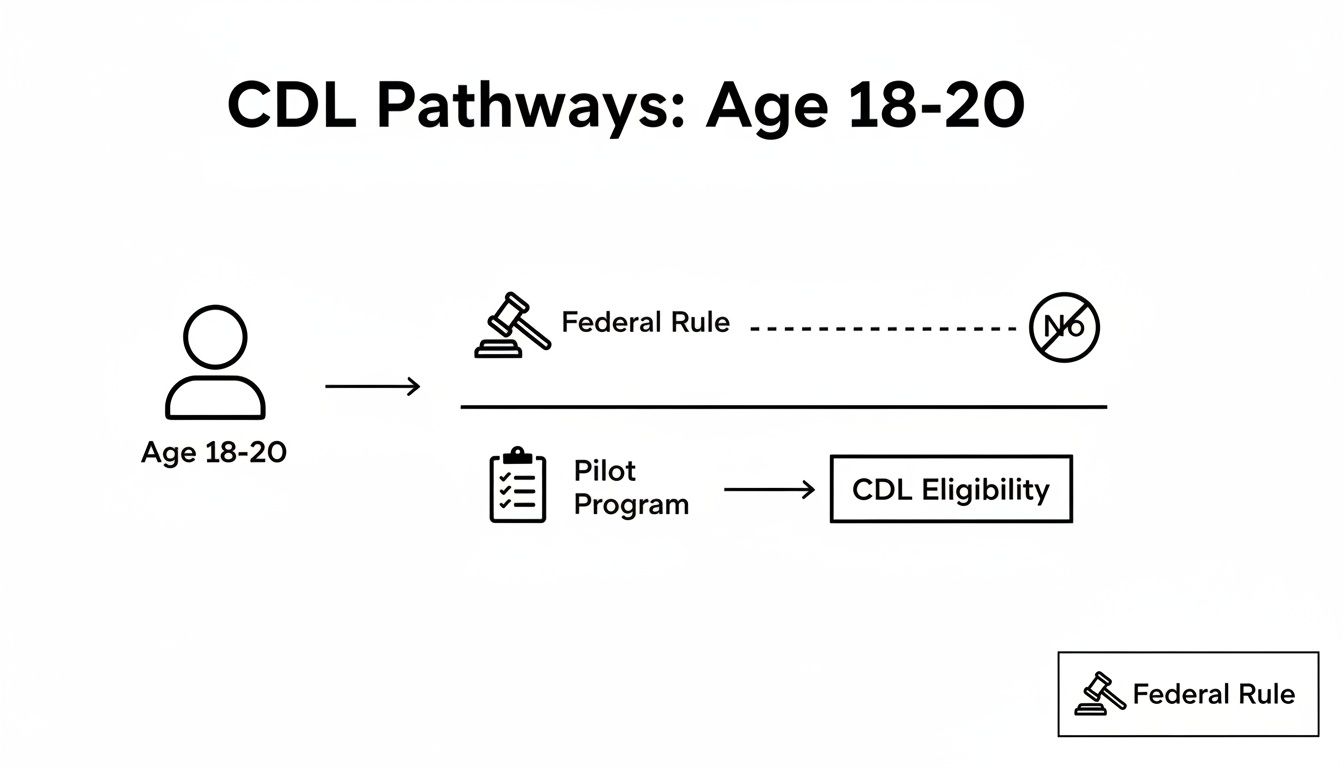
As you can see, the standard federal rule keeps younger drivers in-state. However, some newer pilot programs are creating structured pathways for them to drive interstate, which is a big deal.
Step 3: Enroll in a Reputable CDL School
Once that CLP is in your hand, it’s time to get some real-world, hands-on training. A good CDL school is invaluable. It’s where you get the expert instruction and crucial behind-the-wheel time to not only pass your skills test but to start your career with confidence. You’ll learn everything from pre-trip inspections and tricky backing maneuvers to navigating the open road.
The final step is simple: take the skills test. After you've completed your training, you'll be tested on three things: a full pre-trip inspection, basic vehicle control skills, and an on-road driving test. Pass it, and you've officially earned your Commercial Driver's License.
These age requirements aren't just a U.S. thing; they're pretty standard across North America. Both Canada and Mexico have similar rules, with 18 being the typical minimum for a basic commercial license and 21 for crossing borders. This consistency is what allows a CDL from any of the three countries to be recognized across the continent, keeping international trade flowing without a hitch.
Your Top Questions About CDL Age Answered
When you're looking to start a career in trucking, it's easy to get tangled up in the rules, especially when it comes to age. Let's clear up some of the most common questions aspiring drivers have about getting their CDL.
Can I Get My Commercial Learner's Permit Before Turning 18?
The short answer is no. You must be at least 18 years old to be issued a Commercial Learner’s Permit (CLP). Federal rules are very clear on this one, and for good reason—a CLP is your ticket to start practicing on public roads, and you need a licensed CDL holder sitting right next to you.
But that doesn't mean you have to sit on your hands. You can get a huge head start by grabbing your state's CDL manual and hitting the books. Knowing that material inside and out will make passing your written exams a breeze the day you're finally eligible.
Do I Have to Wait Until I'm 21 to Go to CDL School?
This is one of the biggest myths out there. You absolutely do not have to wait. You can enroll in a CDL training school, graduate, and get your CDL license as soon as you turn 18. This training is where you'll build the foundational skills to pass your road test and handle a big rig safely.
Once you have that CDL in hand, you can immediately start working in great-paying intrastate trucking jobs. This lets you rack up a few years of incredible, real-world experience, making you a prime candidate for the best interstate jobs the moment you turn 21.
Think of it as a paid apprenticeship. By starting your training and career at 18, you're not waiting—you're building a professional foundation and earning a great income while preparing for the next stage of your career.
Are There Specific Trucks an 18-Year-Old Can't Drive In-State?
For the most part, it’s not about the truck itself but what you’re hauling and where you’re going. With a Class A or B license, an 18-year-old can drive the same semi-trucks, dump trucks, or straight trucks as a seasoned veteran, provided you stay within your home state.
The real limitations come down to endorsements.
- Passenger (P) and School Bus (S) Endorsements: The federal rule says you have to be 21 to transport passengers, and nearly every state follows suit.
- Hazardous Materials (H) Endorsement: This one is a hard 21 minimum, no exceptions. It’s a federal requirement that involves a full TSA security threat assessment.
So, you can get endorsements like Tanker (N) or Doubles/Triples (T) at 18 for in-state driving. But hauling specialized cargo like gasoline or certain industrial chemicals is off-limits until you're 21. Before you try for any endorsement, it’s always a good idea to brush up on the essentials, and you can learn more about what to expect on the CDL general knowledge test to make sure you're ready.
Ready to start your journey on the open road? At Patriot CDL, we provide the expert, hands-on training you need to get your license and launch a successful trucking career in as little as three weeks. https://patriotcdl.com