When you start looking into getting your CDL, one of the first questions on your mind is probably, "How much is this going to cost me?" The short answer is that the total CDL license cost can run anywhere from $3,000 to over $10,000.
This initial investment covers your school tuition, various state fees, and all the other necessary steps to get you on the road. The final number really depends on the school you pick and what kind of trucking career you're aiming for, which dictates the specific endorsements you'll need.
Decoding the True CDL License Cost
Thinking about the full cost of a CDL is a lot like planning a big road trip. Your school tuition is the vehicle—it's the biggest, most important purchase. But you can't forget about the "fuel" and "tolls" along the way, like exam fees and medical screenings. These smaller, mandatory costs are just as crucial for a successful journey.
CDL training costs aren't the same everywhere; they can change quite a bit from one state to another. A comprehensive program from a dedicated school like Patriot CDL will often wrap in some of these extra costs, but it’s smart to know what each piece of the puzzle is.
The Major Cost Components
To really get a handle on your budget, you need to break down the total cost into its main parts. Each one is a non-negotiable step on the path from student to licensed professional driver.
Here’s what you should expect to pay for:
- Training School Tuition: This is the big one. It covers your classroom learning and, most importantly, the hands-on, behind-the-wheel training that builds real-world skill.
- State Licensing and Permit Fees: You’ll pay these directly to your state's DMV. They cover the application for your learner's permit, the skills test, and the physical license itself.
- Medical and Drug Screening: Federal law requires a DOT physical and a drug test to make sure you're fit for the job. You can find more details in our guide on the full list of CDL requirements.
- Endorsement Fees: Need to haul hazardous materials (Hazmat) or drive a tanker? You'll need to pay for additional tests to get those specialized endorsements on your license.
The single biggest factor that will influence your total cost is the truck driving school you choose. Think of it as an investment in your safety, your confidence, and your long-term earning potential. A great school sets you up for success.
To give you a clearer picture, let's lay out the typical costs you can expect.
Estimated Breakdown Of CDL License Costs
This table summarizes the common expenses and their typical price ranges, so you can see how everything adds up.
| Expense Category | Typical Cost Range (USD) | Description |
|---|---|---|
| CDL School Tuition | $2,500 – $8,000+ | Covers all classroom instruction and behind-the-wheel training. This is the largest and most variable expense. |
| Commercial Learner's Permit | $50 – $150 | A state-issued fee to get your initial learner's permit, allowing you to practice driving with a supervisor. |
| CDL Skills Test Fee | $100 – $350 | The fee for the official three-part road test, which includes a pre-trip inspection, backing skills, and a road test. |
| CDL License Issuance Fee | $75 – $200 | The final fee paid to the state to print and issue your official Commercial Driver's License. |
| DOT Medical Exam | $50 – $150 | A mandatory physical exam conducted by a certified medical examiner to ensure you are medically fit to drive. |
| Endorsement Fees | $20 – $100 per test | Additional fees for specialized endorsements like Hazmat, Tanker, or Doubles/Triples. |
Keep in mind that these are general estimates. The exact figures can vary based on your state and the specific providers you use for services like the medical exam.
This chart helps visualize where your money goes, showing just how much of the budget is dedicated to quality training.
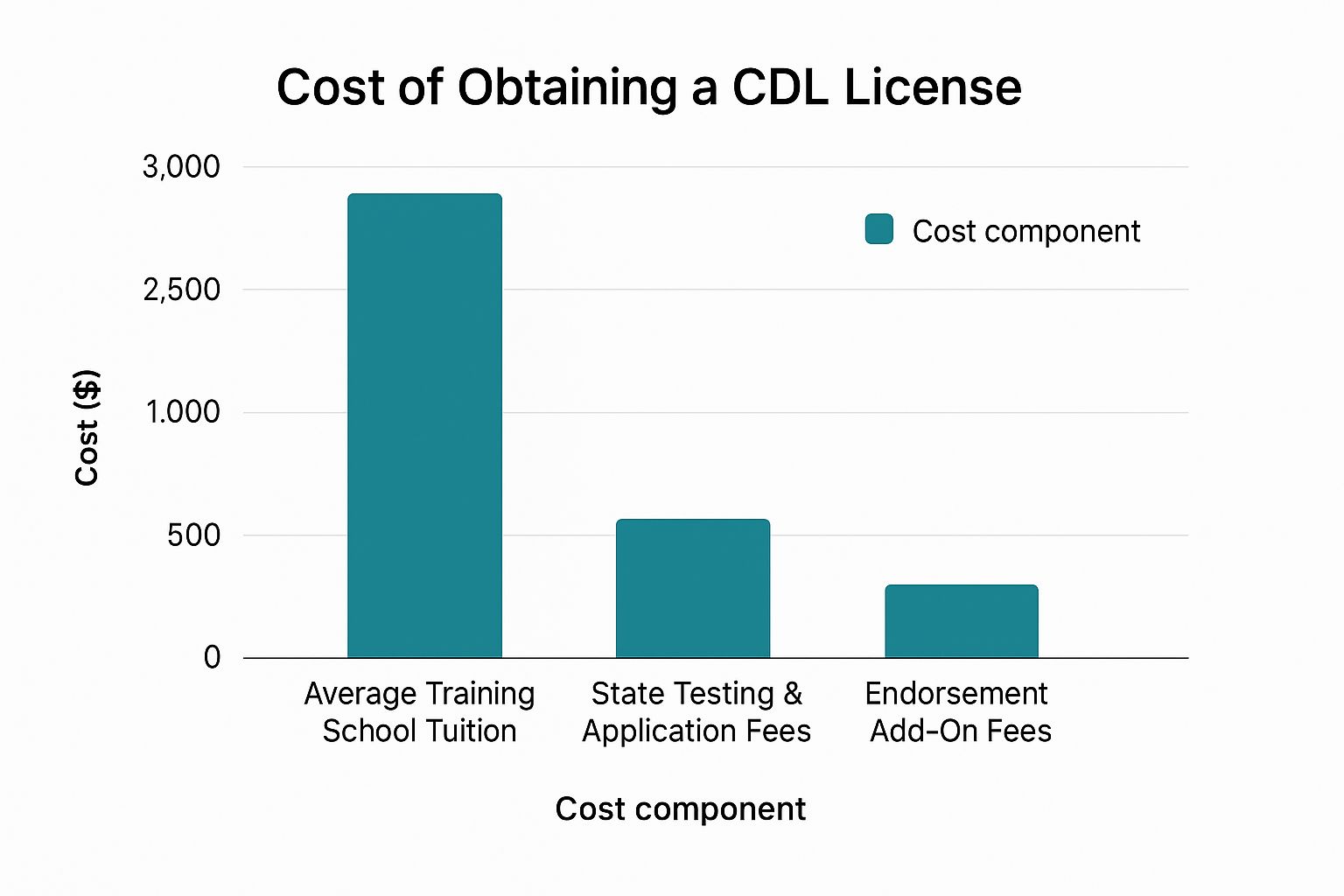
As you can see, tuition is by far the most significant piece of the pie. The other fees are smaller but absolutely essential to factor into your total financial plan.
Breaking Down Truck Driving School Tuition
The biggest line item on your list of expenses will almost always be the truck driving school tuition. This is the real investment in your career. It’s what pays for the classroom time learning the rules of the road and, most importantly, the hands-on hours you'll spend behind the wheel of a big rig.
You’ll see a pretty wide range of prices out there, and it’s important to understand what’s behind those numbers. Think of it like this: you can learn to work on a car from a book, or you can go to a top-tier mechanic's shop where an expert guides you with professional tools. CDL schools are no different. The tuition is a direct reflection of the quality of the training and equipment you'll get.
What Goes Into the Price of Tuition
So, what are you actually paying for? A few key things really drive the cost of a good CDL program. These factors are what separate a school that just gets you a license from one that prepares you for a real career.
- Program Length and Hours: This is a big one. A full Class A CDL course is going to involve a lot more time and training than a Class B program. More hours in the classroom and, crucially, more time in the truck practicing backing maneuvers and driving on real roads will naturally cost more.
- Instructor-to-Student Ratio: You want personal attention. A school with a low student-to-instructor ratio means your instructor isn’t spread thin. You get more direct feedback and coaching, which is invaluable when you're learning to handle an 80,000-pound vehicle. It might cost more, but the focused training is worth it.
- Quality of Equipment: Learning on old, beat-up equipment that barely runs doesn't do you any favors. You want a school that invests in a modern, well-maintained fleet of trucks—the kind you’ll actually be driving when you get a job. That investment is factored into the tuition.
Your investment in a quality CDL school pays off. The U.S. truck driving school industry is valued at nearly $509.8 million for a reason: the demand for well-trained, professional drivers never stops. Picking the right school is your ticket to tapping into that opportunity.
Comparing Different Ways to Get Trained
Not every path to a CDL looks the same. There are a few different models out there, and each one comes with its own price tag and pros and cons. Knowing the difference is crucial for figuring out your financial plan.
Private CDL Schools
This is the route most people take. Schools like Patriot CDL offer intensive, focused programs that can get you from zero to licensed and ready for a job in a matter of weeks. The upfront cost can seem like a lot, but you’re paying for a fast, efficient, expert-led curriculum designed for one thing: your success. You can see how we structure our CDL training program for exactly that.
Community College Programs
You might find CDL training offered at a local community college, and sometimes the price is lower. The trade-off is usually time. These programs often follow a standard college semester, so it could take you several months to get your license instead of just a few weeks.
Company-Sponsored Training
You’ve probably seen the ads for "free" CDL training. This is where a trucking company covers your school costs, but there's a catch. In return, you have to sign a contract to drive for them for a year or two. While it gets rid of the upfront cost, it also takes away your freedom to pick your first job. If you decide to leave before the contract is up, you’ll likely find yourself on the hook for the full tuition bill.
Navigating Mandatory State and Exam Fees
While your truck driving school tuition is the biggest part of the investment, it's not the last stop on your financial journey. The total cdl license cost also includes a handful of mandatory fees you'll pay directly to your state’s Department of Motor Vehicles (DMV) and other certified examiners.
Think of these as the official processing costs—the non-negotiables required to get that license in your hand. They aren't wrapped into your school's tuition because the money goes straight to government agencies. Knowing about these fees upfront helps you build a realistic budget without any last-minute surprises.
Your Checklist for Official Licensing Costs
Before you can legally get behind the wheel of a big rig, you’ll need to cover several key items. The exact dollar amounts can vary from state to state, but the categories are pretty much the same everywhere. Here’s a rundown of what to expect on your path from student to professional driver.
- Commercial Learner’s Permit (CLP) Application: This is your first official step. The CLP fee, usually between $50 and $150, gives you the green light to practice driving a commercial truck on public roads with a licensed instructor beside you.
- DOT Medical Exam & Drug Screening: Federal law says every commercial driver needs to pass a physical exam and a drug test. This is done by a certified medical examiner and typically costs anywhere from $50 to $150.
- CDL Skills Test Fee: This is the fee for the big one—your final driving exam. It can run from $100 to $350 and covers all three parts: the pre-trip inspection, basic control skills, and the on-road driving test.
- License Issuance Fee: Once you've passed everything, this is the final administrative cost to print your physical CDL. This fee is generally between $75 and $200.
It's good to remember that these fees are paid at different times. You’ll handle the CLP and medical exam right at the beginning, while the skills test and issuance fees pop up at the end of your training.
How These Fees Add Up: A Real-World Example
So, what does this look like in practice? Let's walk through an example for a student in Texas getting their CDL. Their state-mandated fees might break down like this:
- CLP Application Fee: They'll start by paying the state $97 to take their written exams and get their learner’s permit. You can get a head start on this first major hurdle by studying what's on the general knowledge test.
- DOT Medical Exam: Next up, they head to a certified clinic and pay $125 for their physical and to get that all-important medical card.
- Skills Test Fee: After finishing their training at Patriot CDL, it's time for the road test. They schedule it with a third-party examiner for a $250 fee.
- License Issuance Fee: After passing with flying colors, they go back to the DMV and pay a final $61 to have their official Class A CDL printed.
In this scenario, the student’s mandatory state and exam fees come out to a total of $533. This amount is completely separate from their school tuition, but it's a critical piece of the financial puzzle. Budgeting for these definite expenses is a smart way to manage your total cdl license cost from start to finish.
What About the "Hidden" Costs of Getting Your CDL?
When you’re looking at CDL schools, the big numbers—tuition and state fees—are what usually stand out. But just like buying a car, the sticker price isn't the whole story. To really get on the road, you have to account for gas, insurance, and maintenance. CDL training is no different.
There are a handful of smaller, day-to-day expenses that can sneak up on you if you’re not prepared. These are the costs that don’t show up on a school’s brochure, but they're just as real. Planning for them from the get-go means no surprises, letting you focus entirely on your training.
Let's pull back the curtain on these often-overlooked expenses so you can build a truly realistic budget.
Your Daily Training Expenses
Think about the practicalities of just showing up and being ready to learn every single day. You have to get there, you have to eat, and you need the right gear to stay safe and comfortable.
Here are a few common costs you’ll want to bake into your budget:
- Transportation: This is a big one. Whether you’re filling up your gas tank for the daily commute or paying for a bus pass, getting to and from the training yard costs money.
- Meals: Long days of classroom instruction and behind-the-wheel practice work up an appetite. You'll need to budget for lunches, coffee, and snacks to keep your energy up.
- Work Gear: A solid pair of work boots isn't just a suggestion—it's essential for safety. You might also want a good pair of gloves or other personal gear.
- Study Materials: While we provide the core curriculum, some students like to buy extra study guides or flashcards. It’s all about what helps you feel confident for the exam.
These little things can add up quickly over a few weeks. The best way to handle them is to set aside a small weekly budget just for these incidentals. That way, you’re in control and never caught short.
The Financial Hit of Exam Retakes
Here’s a cost that everyone hopes to avoid but should still plan for: re-testing fees. Nobody wants to fail a portion of their CDL skills test, but it happens. Having a little cash set aside "just in case" can take a lot of the pressure off.
If you need to retake a section—whether it's the pre-trip inspection, the backing skills, or the road test—you'll likely have to pay the exam fee again. Depending on your state, this could be anywhere from $50 to $250 or more per attempt. This is exactly why solid preparation is your best friend; it saves you time and money.
It’s also worth noting that sometimes a license restriction, like the one for testing in an automatic truck, requires more training and fees to get removed later. You can see how that works by checking out our specific course for the E-Restriction removal process.
And this isn't just a U.S. thing. Over in Poland, for instance, getting a Category C and C+E license can cost between PLN 3,000 and PLN 6,500. That total includes separate fees for medical exams and the state tests, proving that training is a multi-part investment no matter where you are.
How to Fund Your CDL Training and Find Aid
Seeing the total cdl license cost can feel a bit like looking up at a steep hill. But it’s a hill you don't have to climb alone. Thankfully, there are several paths to take that make funding your new career much more manageable.
Think of these options as different routes on a map, all leading to the same destination: getting your CDL and hitting the road. Let's break down the most common ways to pay for your training.
School-Based Financing and Payment Plans
The most straightforward route is often right through the school you choose. Many schools, including us here at Patriot CDL, know that paying everything at once isn't realistic for most people. That's why we offer financing options that break the total cost into smaller, predictable monthly payments.
This way, you can get started on your training right away and begin paying it off once you're on your way to earning a steady income. It’s a practical approach designed to get you behind the wheel without the upfront financial burden.
At Patriot CDL, we sit down with students to figure out a financial game plan that actually works for them. To explore your options, sign up to connect with our team and we can walk you through the process.
Tapping into Government and Military Benefits
Beyond school-based help, there are some fantastic government programs out there designed specifically to get people into high-demand jobs like trucking. These aren't loans you have to pay back; they're grants and earned benefits that can seriously slash—or even completely cover—your out-of-pocket expenses.
A huge one to look into is the Workforce Innovation and Opportunity Act (WIOA). This is a federal program that gives grants to people for job training. Each state runs its own WIOA program, so your first step is to get in touch with your local workforce development board to check your eligibility.
For veterans, your past service can pave the way for your future career. The GI Bill® is an incredible benefit that can cover the full cost of CDL training, including tuition and fees. It's a benefit you earned, and it's there to help you transition into a great civilian career.
Exploring Industry Scholarships and Grants
Finally, don't forget about scholarships. The trucking industry is full of organizations and companies that want to help new drivers succeed. They offer financial awards that are essentially free money—no payback required.
It takes a little digging, but the effort can pay off big time. Here are a few places to start your search:
- Industry Associations: Groups like the American Trucking Associations (ATA) and other state-level organizations often have scholarship funds.
- Trucking Companies: Many of the big carriers offer their own scholarships to help train the next generation of drivers.
- Non-Profit Organizations: Look for foundations dedicated to supporting students in vocational and trade schools.
A single scholarship could be the key to making your CDL training completely affordable. By combining different funding sources, you can smartly manage the cdl license cost and get on the road to a rewarding new career without the financial stress.
Common Questions About CDL License Costs
When you start looking into getting your CDL, the money side of things is naturally one of the first things on your mind. Sorting out the details of the CDL license cost isn't just about a number; it's about confidently planning your next career move. Let's break down some of the most common questions we hear from drivers just starting out.
Does the Type of CDL Affect the Cost?
You bet it does. The class of CDL you're aiming for is probably the single biggest factor that will shape your total training cost. Think about it: a Class A license is the key to driving the biggest rigs on the road, like a full tractor-trailer. That requires a lot more training.
Because a Class A program needs more hours behind the wheel and teaches more complicated maneuvers, it’s going to have a higher price tag. On the other hand, a Class B license, which is for single vehicles like dump trucks or school buses, usually involves a shorter program. That makes it a more budget-friendly choice right at the start.
Here’s a good way to look at it: a Class A license is like an all-access pass to the trucking world. The upfront investment is bigger, but it unlocks the most job opportunities and the highest paychecks. A Class B is more like a specific ticket for certain local jobs—still great, but with more defined boundaries.
Is Company-Sponsored Training Really Free?
You’ve probably seen the ads from big carriers promising "free" or "no-cost" CDL training. It sounds like a fantastic deal, but it's crucial to read the fine print and understand what you're really agreeing to.
This kind of training isn't free—it's an exchange. The company pays for your school, and in return, you sign a contract promising to drive for them for a specific amount of time, usually one to two years. If you decide to leave before that contract is up, you'll almost certainly have to pay back the full tuition. While it gets you in the door with no money down, it does mean you're tied to one employer from day one.
Can You Get a CDL Without School?
Technically, federal rules don't force you into a specific school. But here's the catch: every single new driver has to pass the same tough knowledge and skills tests, no exceptions. Trying to pass those comprehensive exams without any professional guidance is an uphill battle, to say the least.
The practical reality is that most employers—and even the state DMV—will expect you to have graduated from a recognized training program. A school like Patriot CDL gives you the structured curriculum, the modern trucks to practice on, and the experienced instructors you need to truly master everything from pre-trip inspections to tricky backing maneuvers. Going through a professional program is simply the most dependable and straightforward way to get licensed and start your career safely.
The path to earning your CDL is a serious investment in your future. Getting a clear picture of every part of the CDL license cost is what allows you to make the right call for your own goals.
Ready to invest in a career with freedom and stability? Patriot CDL offers transparent pricing and expert training to get you on the road fast. Learn more about our programs and start your journey today.