


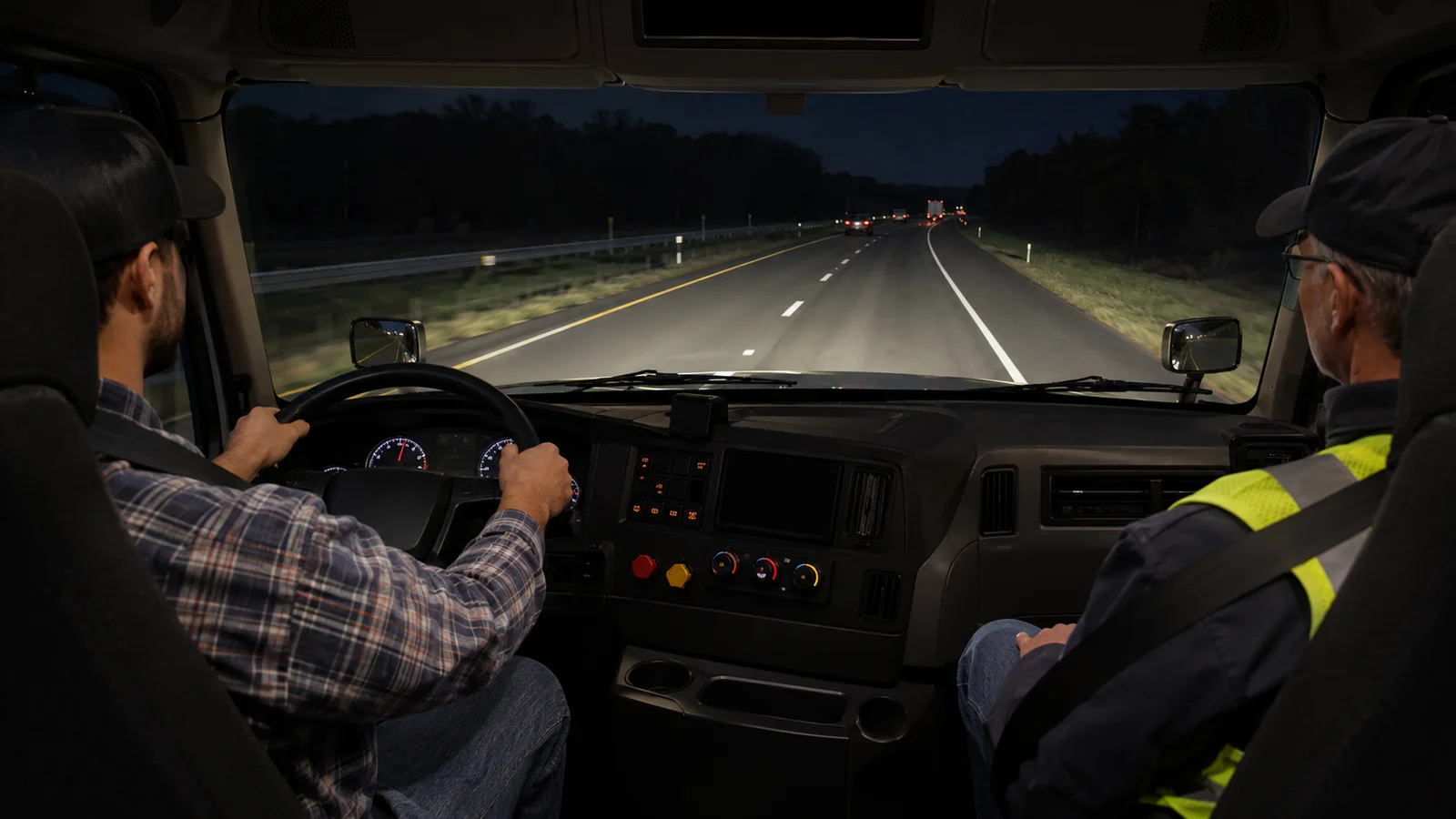
Night driving changes the information available to a commercial driver. Headlights reveal only part of the road, unlit road users appear later, glare can hide lane edges, and fatigue can weaken judgment before a driver realizes performance has changed. The truck is still long, heavy, and slow to stop, but the useful visual picture is smaller. A safe night routine must therefore control speed, space, light, and alertness together.
This guide gives CDL students a repeatable prepare-see-decide routine for night operation. It uses current PennDOT guidance, FMCSA driver-safety material, and federal operating rules. It does not supply one universal night speed or substitute caffeine, music, or willpower for rest. The correct decision depends on the road, vehicle, load, weather, traffic, visibility, legal limits, and the driver's actual fitness to continue.
Start with the legal and safety baseline
Night operation does not create a separate permission to drive beyond the conditions. prohibits a driver from operating, and a motor carrier from requiring or permitting operation, when the driver's ability or alertness is so impaired or likely to become impaired by fatigue, illness, or another cause that beginning or continuing would be unsafe. The narrow grave-emergency language in that section is not a scheduling exception.
also requires operation in accordance with the laws and regulations of the jurisdiction where the truck is driven, unless an applicable FMCSA regulation imposes a higher standard of care. Headlight use, high-beam rules, posted speeds, work-zone requirements, and traffic-control devices therefore remain part of the night plan.
Hours compliance does not prove present alertness
A driver may be within hours-of-service limits and still be too tired, ill, or affected by another cause to operate safely. Conversely, feeling energetic does not authorize driving beyond applicable hours or other limits. Treat regulatory time records and real-time fitness as separate gates; both must support operation.
Night conditions can require a slower lawful speed
A posted limit is a ceiling under favorable conditions, not a command. PennDOT's tells drivers to drive slowly enough to stop within the distance they can see. Darkness, curves, glare, wet pavement, traffic, and limited shoulder information may require a lower speed.
Prepare the driver and truck before darkness
Night readiness begins before the truck moves. Review the route, forecast, construction, planned stops, and safe parking options. Identify rural darkness, steep grades, wildlife areas, complex interchanges, or overnight work. A plan made early is easier to evaluate than one created after fatigue appears.
Begin rested, not merely awake
PennDOT advises drivers to be rested and alert before night operation and to sleep before driving when drowsy. FMCSA's emphasizes adequate sleep and notes that most people are less alert at night, especially after midnight. Personal experience does not cancel the body's normal low-alertness periods.
Before departure, make an honest baseline check: Was sleep adequate? Is illness developing? Does any prescribed or over-the-counter medication affect alertness? Is there unusual difficulty focusing, remembering the plan, or keeping the eyes open? When the answer raises doubt, report it and do not begin simply because the load or lesson is scheduled.
Inspect the night-visibility system
Complete the required vehicle inspection, with added attention to headlights, high and low beams, marker and clearance lights, identification lights, taillights, brake lights, turn signals, reflectors, windshield, mirrors, wipers, washers, and defroster. Clean lenses and reflective surfaces that can be reached safely. The lights and reflectors inspection plan provides a component-by-component routine.
Confirm that headlight aim and condition do not create an obvious problem. Adjustment and repair belong to qualified personnel, not roadside guesswork. If required lights are inoperative or the windshield view is unacceptable, use the inspection and defect process before departure. Darkness is not the time to discover that a daytime-only workaround fails.
Prepare eyeglasses, glass, and mirrors
Clean prescription lenses and use only corrective lenses required for driving. PennDOT warns not to wear sunglasses at night. Clean the windshield inside as well as outside; film on the interior can bloom around headlights. Clean and adjust mirrors before moving. The clear-view inspection guide connects glass, wipers, washers, and defrosting to the decision to drive.
Keep stopping needs inside visible distance
A driver should never assume the road remains clear beyond the headlight beam. The visible area must be long enough to recognize a hazard, decide, react, and stop or otherwise respond safely. PennDOT describes the basic principle as driving slowly enough to stop within headlight range. Exact stopping distance varies with speed, vehicle condition, brake condition, weight, grade, surface, and driver response.
Use the shortest reliable view
The road may be illuminated far ahead on a straight segment, then visibility can shrink at a crest, curve, tree line, or change from street lighting to darkness. Set speed for the shortest reliable view developing ahead, not the brightest moment behind. On a curve, headlights may point partly outside the future path, so the drivable lane can become visible later.
Expect hazards without their own lights
Pedestrians, cyclists, animals, disabled vehicles, cargo debris, and unlit trailers can blend into the background. Reflective signs may appear before the hazard they describe. Scan for motion, silhouettes, interrupted lane markings, changing shadows, dust, and unusual reflections. Do not fixate on one bright object and miss a darker object beside it.
Use headlights and cab lighting correctly
Headlights help the driver see and help others see the truck. Use the required lights from sunset to sunrise and whenever law or conditions require them. Daytime running lamps may not illuminate every required rear lamp. Confirm the actual lighting position rather than assuming an automatic system selected the correct mode.
Use high beams only when safe and legal
High beams can extend the visible area on an unlit road, but they can blind oncoming drivers or reflect into the mirrors of traffic ahead. Dim them before causing glare and follow current state law. Do not answer another driver's high beams by leaving your own bright lights on. Mutual glare removes information from both drivers.
High beams are also a poor choice in fog, heavy rain, snow, or dust because reflected light can reduce the driver's view. Use lighting appropriate to conditions; more light is not always more usable vision.
Keep the cab dark enough to see outside
Reduce instrument brightness to the lowest level that still permits safe reading. Turn off unnecessary interior lighting and avoid bright screens. A glowing device or dome light can create windshield reflections and make the outside scene seem darker. Configure navigation and required controls while stopped whenever possible.
Control glare without losing lane position
Oncoming headlights can temporarily reduce detail and contrast. Do not stare at the light source. PennDOT recommends looking slightly toward the right lane or edge marking while maintaining awareness of the travel path. Keep both hands controlling the truck and avoid a sudden steering correction toward the edge.
Prepare before the vehicle arrives
When bright lights approach, reduce speed if needed, increase attention to lane boundaries, and identify the right edge or lane marking before the strongest glare reaches the cab. Use quick mirror checks without looking at one reflected light for too long. After the vehicle passes, allow vision to recover before adding a complex maneuver.
Remove glare sources inside the cab
Windshield film, dirty mirrors, reflective paperwork, bright displays, and light-colored objects on the dashboard can create secondary glare. Keep the dashboard clear. If glare from following traffic appears in a mirror, use only the mirror's designed adjustment or approved night setting; do not move mirrors into a position that destroys necessary rear observation.
Build a night-specific scanning routine
FMCSA's recommend checking mirrors every 8 to 10 seconds and scanning about 15 seconds ahead. At night, the pattern must include the illuminated road, lane edges, mirrors, gauges, and areas where hazards may emerge. These are awareness intervals, not a reason to delay an extra check before a lane change, turn, or merge.
Scan near, middle, and far zones
The near zone confirms immediate lane position. The middle zone reveals developing brake lights, merging vehicles, and road-surface changes. The far zone shows curves, overhead signs, clusters of lights, and traffic compression. Move attention among zones instead of staring at the end of the beam.
Use roadside markers and lane lines as references, not targets. A shifting reflector pattern may signal a curve or lane change. Slow down when the pattern becomes uncertain.
Interpret light patterns
Two steady red lights may be a vehicle; red lights moving sideways may indicate a turn or lane change; amber lights can identify service or work activity; a single distant light may be a motorcycle. Do not classify a light from color alone. Compare its position and movement across several observations while keeping the truck centered.
Protect following and side space
Night reduces the time available to interpret the road, so space becomes more valuable. Keep enough following distance to see around the vehicle ahead and respond without abrupt braking. Avoid staying beside another vehicle, especially where glare, spray, or blind spots make its position harder to track. The space-cushion timing plan explains how to build a gap rather than chase a fixed number.
Do not follow another vehicle's taillights blindly
Taillights can help reveal the road, but the vehicle ahead may brake late or drive beyond safe sight distance. Continue scanning the road itself and increase the gap when the lead vehicle blocks pavement or traffic conditions.
Protect an escape option
Know whether the adjacent lane, shoulder, or roadside is actually usable before treating it as an escape path. At night, a shoulder may contain a disabled vehicle, drop-off, pedestrian, or debris that is not yet visible. The first defense is early speed and space management, not an assumed swerve route.
Recognize fatigue and stop safely
Fatigue can appear as repeated yawning, heavy eyelids, frequent blinking, wandering thoughts, missed signs, forgotten miles, speed variation, lane drift, delayed mirror checks, or difficulty remembering the last decision. A driver should not wait for all signs. One meaningful sign combined with uncertainty is enough to reassess fitness.
Use a stop decision, not a debate
If alertness is impaired or likely to become impaired enough to make driving unsafe, stop operating in accordance with the rule and use a safe legal location. Communicate through the carrier's procedure after the truck is secured. Do not bargain for “one more exit” when a safe stopping option already exists, and do not stop in a live lane merely because fatigue needs attention.
Plan parking before the low-alertness period. A legal stopping place may be farther away than expected or full. If symptoms develop, use the safest available lawful option and request help when needed. The secure-shutdown routine helps leave the vehicle controlled after stopping.
Know what does not cure fatigue
Opening a window, increasing music volume, talking, chewing gum, or using cold air may create a brief sensation of activity, but they do not replace sleep. Caffeine can affect people differently and does not guarantee fitness. The durable response to drowsiness is safe rest and, when necessary, medical evaluation or schedule adjustment.
Adjust for rain, fog, work zones, and rural roads
Darkness becomes more demanding when rain or fog reflects light, pavement markings disappear under water, or spray covers mirrors. Reduce speed, increase space, use appropriate low beams, and keep wipers and defrosters working. If visibility or traction becomes hazardous, apply the current requirements of 49 CFR 392.14 and discontinue operation when conditions become sufficiently dangerous.
The fog and low-visibility guide addresses the decision to slow, pull off, or stop. Do not use high beams in fog merely because the road is dark; reflected light can make the view worse.
Expect work-zone patterns to change
At night, work-zone signs, arrow boards, temporary barriers, workers, and equipment may compete for attention. Slow before the lane shift, obey flaggers and temporary controls, and watch for uneven pavement. Do not follow the truck ahead through a pattern without reading the signs yourself.
Rural darkness changes hazard timing
On rural roads, expect animals, farm equipment, narrow shoulders, driveways, and unlit intersections. A reflective animal eye or dust cloud may appear before the full hazard. Reduce speed before crests and curves where the headlight beam cannot reveal the complete stopping path.
Night-driving action table
| Observation | What it may mean | Controlled response |
|---|---|---|
| Headlight range ends before the truck's comfortable stopping path | The vehicle is overdriving available sight distance | Reduce speed smoothly and rebuild following space |
| Oncoming high beams create strong glare | Lane detail and contrast are temporarily reduced | Look toward the right edge reference, avoid staring, and slow if needed |
| Windshield halos appear around every light | Interior film, moisture, or glass condition may be degrading the view | Stop safely and restore a clear windshield before continuing |
| Repeated yawning and missed signs begin | Alertness may be impaired | Use a safe legal stopping location and rest; report through policy |
| Brake lights cluster beyond a curve | Traffic may be slowing before the full queue is visible | Ease off early, increase space, and prepare for a stop |
| Rain spray hides lane lines and mirrors | Visibility and traction are both reduced | Slow, increase space, use proper lights, and stop if conditions become unsafe |
| A bright cab display reflects in the windshield | Interior light is competing with outside vision | Dim or secure it when safe; configure devices while stopped |
Worked training scenario
A CDL student begins a supervised evening lesson after reporting adequate sleep. The truck passes its inspection, including low and high beams, marker lights, windshield, mirrors, wipers, and defroster. The route includes a well-lit business area followed by a dark two-lane segment. The student drives comfortably under streetlights but keeps the same speed after the lighting ends.
First correction: fit speed to the new visible distance
The instructor asks how far ahead the student can identify lane edges and a stopped object. The student realizes the clear view has shortened. She eases off smoothly, increases following space, dims the instrument panel, and begins scanning the right edge, center path, mirrors, and far headlight boundary. The truck remains centered without abrupt braking.
Second correction: manage glare before it arrives
An oncoming vehicle approaches with bright lights. The student identifies the right edge line before the glare peaks, avoids looking at the lamps, and maintains controlled steering. After it passes, she waits for vision to recover before considering a lane-position adjustment. A dark shape near the shoulder becomes visible as a mailbox, but the reduced speed leaves time to confirm it.
Final decision: treat fatigue evidence honestly
Later, the student yawns repeatedly and misses an instructor prompt. She reports that concentration is fading. Rather than increasing music or rushing back, she follows directions to a safe legal stopping location, secures the truck, and ends the driving portion. The lesson is successful because she identifies both a visibility limit and a human-performance limit before either becomes a loss of control.
Practical night-driving checklist
- Review the route, forecast, work zones, grades, and safe stopping options.
- Confirm adequate rest and honestly assess illness, medication, and alertness.
- Complete the required inspection before departure.
- Check low and high beams, marker lights, clearance lights, identification lights, and taillights.
- Check brake lights, turn signals, reflectors, and hazard flashers.
- Clean reachable lamp lenses and reflective surfaces.
- Clean the windshield inside and outside and prepare the defroster and wipers.
- Clean and adjust mirrors and required monitoring devices.
- Keep eyeglasses clean and do not wear sunglasses at night.
- Dim gauges and screens while keeping required information readable.
- Keep unnecessary interior lights off and the dashboard clear.
- Set speed so the truck can respond within the reliable visible distance.
- Slow before curves, crests, glare, lane shifts, or the end of street lighting.
- Scan near, middle, and far zones instead of staring at one bright object.
- Check mirrors regularly and again before every maneuver.
- Maintain extra following space and avoid traveling beside other vehicles.
- Use high beams only when safe and legal, and dim them before causing glare.
- Use low beams in fog, heavy rain, snow, or dust as conditions require.
- Watch for unlit road users, animals, debris, disabled vehicles, and work activity.
- Recognize yawning, heavy eyes, missed signs, lane drift, and memory gaps as warnings.
- Stop at a safe legal location when alertness is impaired or likely to become unsafe.
- Do not rely on music, open windows, or caffeine as a substitute for sleep.
Official sources and training method
Use the current PennDOT Commercial Driver's Manual for Pennsylvania CDL study, current eCFR text for federal operating duties, and FMCSA safety material for fatigue and scanning guidance. Confirm current state lighting laws for the route rather than copying a distance or procedure from an undated study card.
Practice night concepts first in daylight: identify lamp controls, clean glass, set mirror positions, explain glare response, and name fatigue warnings. Then use supervised night instruction on an appropriate route. Debrief what became visible late, when speed should have changed, and whether the student reported uncertainty early.
Patriot CDL students can discuss supervised visibility, space-management, and night-operation practice at 7800 Bristol Pike, Levittown, PA 19057. Call to discuss CDL training and practical road instruction.
Frequently asked questions
How fast should a commercial truck drive at night?
There is no single safe night speed for every truck and road. Stay within the posted limit and reduce speed as needed so stopping and response needs fit the distance the driver can reliably see. Curves, glare, rain, traffic, vehicle condition, grade, and load can require a lower speed.
When should a CDL driver stop because of fatigue?
Stop when fatigue, illness, or another cause impairs or is likely to impair ability or alertness enough to make continued operation unsafe. Use a safe legal stopping location, secure the truck, and follow carrier communication procedures. Hours remaining do not prove the driver is fit to continue.
Should a truck driver use high beams at night?
Use high beams only when they are safe and legal and will not create glare for approaching or followed traffic. Dim them as required. In fog, heavy rain, snow, or dust, reflected high-beam light can reduce visibility, so appropriate low beams are generally the safer choice.
How can a commercial driver reduce nighttime glare?
Keep the windshield, mirrors, and eyeglasses clean; dim dashboard and screen lighting; avoid staring at oncoming headlights; identify the right edge marking before glare peaks; and reduce speed when detail is lost. Do not wear sunglasses at night or retaliate with high beams.