


A roadside inspection is easier to handle when the driver treats readiness as part of the trip rather than a last-minute search for documents at the scale house. The practical goal is not to memorize a performance for an inspector. It is to operate a safe vehicle, keep required records accurate and accessible, follow instructions calmly, and know exactly what to do with the inspection report afterward.
This guide explains the common North American Standard inspection levels, a driver-focused preparation routine, safe conduct in an inspection lane, and the federal follow-up process for a Driver Vehicle Examination Report or an out-of-service notice. Requirements can differ with the vehicle, cargo, jurisdiction, and type of operation. Current regulations, the inspection report, and the authorized inspector’s directions control.
What a roadside inspection is designed to check
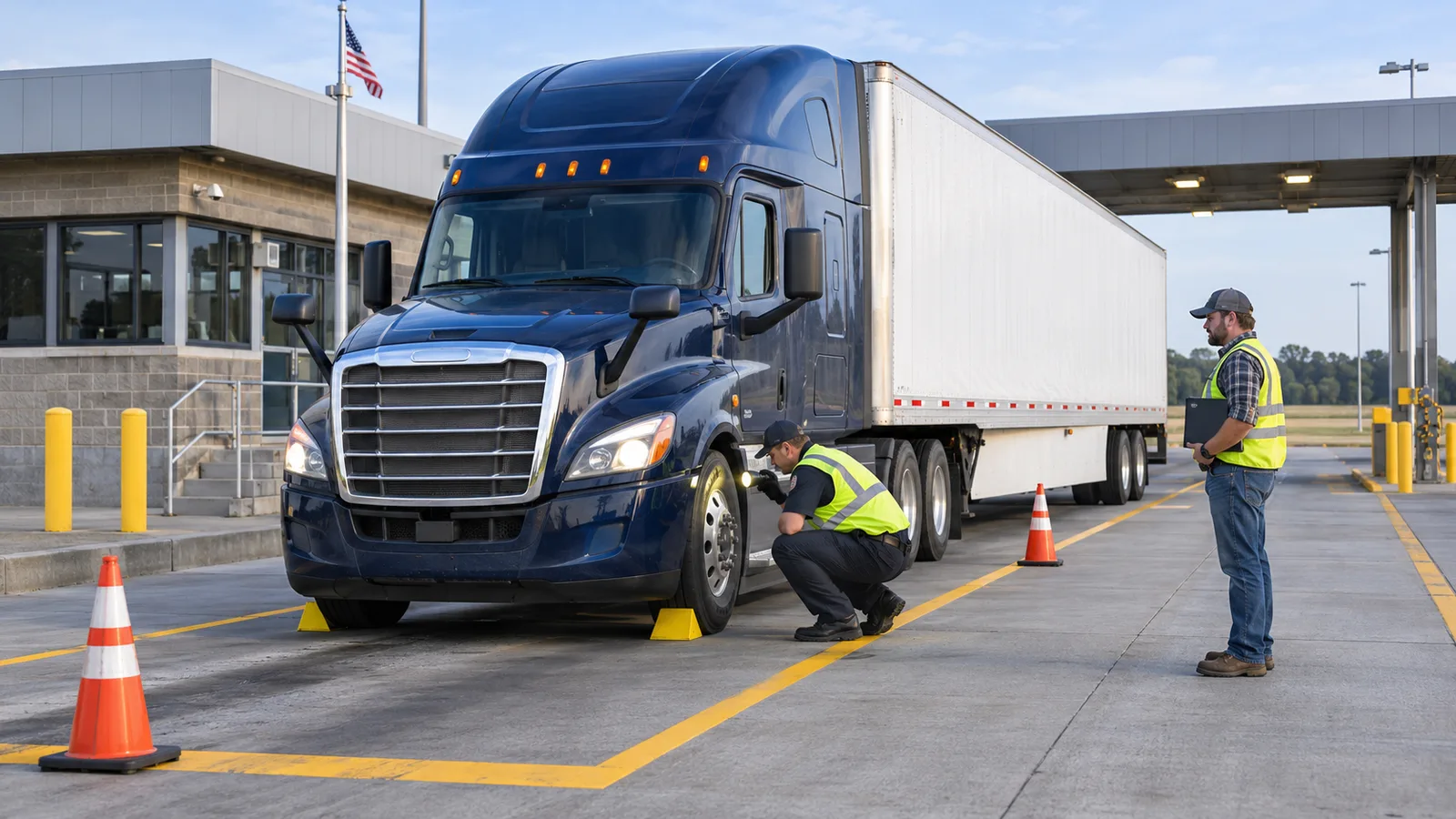
FMCSA describes a roadside inspection as an examination of a commercial motor vehicle, its driver, or both at a fixed or roadside facility. The review can address hours of service, CDL requirements, operating authority, financial responsibility, maintenance, hazardous materials, and other required records. The purpose is compliance and safety—not a coaching session or an opportunity to repair known defects after being selected.
A traffic stop and a roadside inspection are not identical
A commercial vehicle may be contacted for a traffic violation without receiving a full North American Standard inspection, and an inspection may occur at a weigh station without a separate traffic citation. The driver should not guess the scope. Listen to the inspector’s instructions, ask a concise clarifying question when necessary, and respond to what is actually requested.
Readiness is broader than a clean cab
A tidy work area helps the driver locate documents and operate controls, but it cannot replace inspection, maintenance, accurate duty records, or proper cargo securement. An organized truck with an unsafe tire remains unsafe. A mechanically sound truck with a false log remains a compliance problem. Preparation has three equal parts: driver status, vehicle condition, and operation-specific records.
Understand the common inspection levels
The Commercial Vehicle Safety Alliance publishes the North American Standard inspection procedures used across participating jurisdictions. The term “DOT inspection” is often used casually, but different levels cover different combinations of credentials, records, and vehicle components.
Level I: detailed driver and vehicle examination
A Level I North American Standard Inspection includes driver credentials and hours-of-service items when applicable, plus an examination of many vehicle systems. The published list includes brakes, cargo securement, coupling devices, driveline, exhaust, frame, fuel system, lighting, steering, suspension, tires, wheels and rims, windshield wipers, and other items appropriate to the vehicle or cargo.
This does not mean a driver should start operating switches or releasing brakes without direction. The inspector follows an established procedure. The driver’s role is to secure the vehicle, listen, provide requested information, and operate controls only when instructed and when it is safe to do so.
Level II: walk-around driver and vehicle examination
A Level II inspection covers driver and vehicle items that can generally be examined without the same under-vehicle component of Level I. It can still include credentials, duty status, brakes, securement, coupling, tires, lighting, steering, suspension, fuel and exhaust systems, and other visible or testable items. “Walk-around” should not be mistaken for a cosmetic glance.
Level III: driver, credential, and administrative examination
A Level III inspection focuses on items such as the driver’s license, medical or Skill Performance Evaluation documentation when applicable, record of duty status, hours of service, seat belt, applicable vehicle inspection reports, and carrier identification or status. Mechanical items specific to Level I or II are outside the minimum Level III scope, though a visible safety problem can affect what happens next.
CVSA also defines additional levels for specialized purposes. A driver does not choose the level and should not argue that one level is “supposed” to apply. Prepare for the operation as a whole.
Prepare before the truck enters service
Know which documents apply to this trip
Create a carrier-approved document routine rather than carrying an uncontrolled stack of expired copies. Depending on the operation, the driver may need immediate access to a valid CDL, duty-status records, shipping documents, permits, periodic-inspection evidence, lease or rental information, and hazardous-materials documents. A Medical Examiner’s Certificate is not presented in the same way for every driver because certification information may be tied to the licensing record; carry separate documentation when the rules or a specific status require it.
Confirm that names, vehicle identifiers, carrier information, dates, and document versions match the actual movement. Do not alter a record to make it look current. If a required document is missing or inconsistent, contact the carrier before departure and resolve the issue through the proper process.
Review the record of duty status before movement
The driver should know the current duty status, remaining applicable hours, whether records have been certified as required, and how to display or transfer ELD information using the device and carrier procedure. An inspector may ask about recent duty activity. A clear answer should come from an accurate record, not from reconstructing the week at the inspection window. Our property-carrying hours-of-service planning guide explains how the 11-hour, 14-hour, break, and rolling-cycle limits work together.
Perform a real vehicle inspection
requires the driver, before driving, to be satisfied that the vehicle is in safe operating condition and to review the previous report when required. That responsibility is more important than predicting which component an inspector may examine.
Use a consistent walk-around and cab routine. Check brakes and air-system indicators, tires, wheels, lights, reflectors, steering, suspension, coupling, frame, fuel and exhaust areas, mirrors, wipers, emergency equipment, cargo, and securement as applicable. The component-focused articles on commercial-truck tires, foundation brakes, and lights and reflectors can support that broader routine.
Resolve defects instead of rehearsing explanations
Drivers sometimes focus on what they will say if a known problem is noticed. The safer question is whether the vehicle should move at all. Federal rules prohibit operating a commercial vehicle in a condition likely to cause an accident or breakdown. Report defects promptly and use the carrier’s maintenance process. A verbal promise that a repair is scheduled does not make an unsafe condition safe.
Handle the inspection stop safely and professionally
Enter the facility without creating a new hazard
Watch signs, lane-control signals, overhead indications, speed limits, personnel, and other trucks. Choose the directed lane early, maintain space, and stop at the marked point. Do not reverse, cross a closed lane, or make a sudden turn because a window or sign was noticed late. If a direction is unclear, stop in a safe position and request clarification.
Secure the vehicle and wait for instructions
Set the parking brakes, place the transmission as appropriate, and follow facility or inspector directions regarding engine shutdown, wheel positioning, lights, and remaining in the cab. Keep hands visible and avoid reaching into compartments without explaining what you are retrieving. Professional cooperation means being calm and direct; it does not mean guessing, volunteering invented information, or admitting to something the driver does not understand.
Give concise, accurate answers
Provide requested documents and explain the actual operation. If the inspector asks about the carrier, cargo, route, duty record, or recent inspection, answer truthfully. If a term or instruction is unclear, ask for it to be repeated. Do not create a story to fill a gap. An accurate “I need to check the document” is better than a confident but false answer.
Keep the phone away unless it is being used with permission to display an electronic document or contact the carrier. The distracted-driving setup in our mobile-phone and safe-stop plan also applies inside a busy inspection facility.
Support the vehicle examination without interfering
Operate controls only when directed
The inspector may ask the driver to activate lights, apply or release brakes, turn the steering wheel, sound the horn, or perform air-brake system steps. Listen for the exact command and confirm it when necessary. Do not release parking brakes while someone is under or near the vehicle unless the inspection procedure and inspector’s direct instruction require it and all safety conditions are satisfied.
Do not conceal, move, or repair items during the examination
Attempting to hide a defect, changing the ELD record, tightening securement without permission, or removing an out-of-service sticker creates more serious problems. If the inspector identifies a condition, let the examination finish and follow the resulting instructions. Repairs should be performed by a qualified person in the authorized manner and location.
Understand that inspection items are connected
A lighting problem may relate to wiring or a trailer connection. Uneven tire wear may point toward suspension, alignment, inflation, or loading. Air loss may involve a hose, chamber, connection, or valve. The driver should report observations precisely and avoid diagnosing beyond training. The objective is a verified correction, not the fastest explanation.
Respond correctly to the inspection report or out-of-service order
Transmit the report promptly
The current text of requires a driver who receives an inspection report to deliver a copy to the operating motor carrier upon arrival at the next terminal or facility. If the driver is not scheduled to arrive at such a location within 24 hours, the report must be transmitted immediately by mail, fax, or another method. Carrier policy may require immediate electronic notification in every case.
Keep a readable copy or image according to company procedure and record whom you notified. The carrier must examine the report, correct violations or defects as required, complete the certification within 15 days, return it to the issuing state agency if requested, and retain a copy for 12 months. Those carrier deadlines do not authorize the driver to postpone reporting.
Do not move an out-of-service vehicle
Authorized personnel may declare and mark a vehicle out of service when its mechanical condition or loading would likely cause an accident or breakdown. The regulation prohibits operation until all repairs required by the notice are satisfactorily completed. It also limits towing: the definition of operation includes towing except for the specified crane-or-hoist method and conditions in the rule.
Follow the notice and inspector’s directions exactly. Do not remove the out-of-service sticker, drive “just across the lot,” or accept a dispatch instruction to move the vehicle. Coordinate repair, towing, cargo handling, and driver availability through the carrier while keeping the vehicle secured.
Separate a violation from an out-of-service condition
Not every documented violation places the driver or vehicle out of service. Conversely, a vehicle can be prohibited from movement even when the defect seems small to an untrained observer because the applicable out-of-service criteria control. Read the report carefully. Ask the inspector to clarify the operational restriction if it is not understood, then communicate the exact wording to the carrier.
Worked scenario: a Level II inspection at a weigh station
A driver operating a tractor and dry van sees the weigh-station sign open. Before the trip, the driver completed the vehicle inspection, verified current duty status, organized shipping papers, and confirmed that the periodic-inspection documentation and carrier information matched the combination.
Entering and stopping
The driver reduces speed, selects the directed lane, leaves space behind another truck, and stops at the marked point. An inspector directs the combination into an inspection bay and explains that a walk-around driver-and-vehicle inspection will be performed. The driver sets the parking brakes, keeps the vehicle secured, and provides the requested license, duty-status display, shipping papers, and applicable vehicle documents.
During the examination
The inspector walks around the combination and directs the driver through light and brake-control checks. The driver repeats one unclear instruction rather than guessing. A lamp does not illuminate during the test. The driver does not climb out or begin repairing it while the inspection is active. The inspector completes the process and records the finding on the report.
The correct follow-up
In this example, the inspector does not declare the vehicle out of service and explains the permitted next step. The driver photographs the complete report using the carrier’s approved process, sends it to the safety or maintenance contact immediately, and confirms receipt. The carrier arranges correction and handles certification and retention requirements.
If the report had declared the vehicle out of service, the response would be different: secure it, do not operate it, notify the carrier, and wait for authorized repair or compliant towing arrangements. The driver would not substitute personal judgment for the notice. The readiness advantage is not “passing quickly”; it is knowing how to protect safety and preserve an accurate compliance record regardless of the result.
Roadside-inspection readiness table
| Stage | What to verify | Driver action |
|---|---|---|
| Before dispatch | License status, applicable medical status, duty records, vehicle condition, cargo, and trip documents | Correct missing or inconsistent items before movement. |
| Approaching facility | Open/closed signals, lane directions, speed, clearance, and traffic | Slow early, select the instructed lane, and preserve space. |
| Initial contact | Inspector’s directions and requested scope | Secure the truck, listen, and provide concise accurate responses. |
| Document review | Correct current record for the actual driver, carrier, vehicle, cargo, and trip | Present the requested item without editing or substituting records. |
| Vehicle examination | Safe position of people and vehicle | Operate controls only when directed; do not interfere with the examination. |
| Report issued | Violations, restrictions, required repairs, and issuing instructions | Read the full report and transmit it to the carrier promptly. |
| Out-of-service order | Exact conditions and repair requirements on the notice | Do not operate or remove the sticker; coordinate compliant repair or towing. |
| After correction | Repair documentation, carrier certification, return request, and retention | Follow carrier procedures and preserve a complete auditable record. |
Driver roadside-inspection checklist
- Confirm that the CDL is valid and appropriate for the vehicle and operation.
- Verify medical and SPE status or documentation when applicable.
- Review current duty status, recent records, certifications, and available hours.
- Know how to display and transfer ELD information under the approved procedure.
- Check shipping papers, permits, lease or rental papers, and hazardous-materials documents as applicable.
- Confirm carrier identity and vehicle markings match the operating arrangement.
- Verify current periodic-inspection evidence for each required unit.
- Complete a genuine cab, vehicle, trailer, cargo, and securement inspection.
- Report and correct defects before operation when required.
- Enter inspection facilities at the posted speed and in the directed lane.
- Set parking brakes and secure the vehicle before handling documents.
- Listen to each instruction and ask for clarification instead of guessing.
- Operate lights, brakes, steering, and other controls only when directed.
- Do not conceal defects, alter records, or begin repairs during the examination.
- Read every page of the report and identify any operating restriction.
- Transmit the report to the carrier using the required process and confirm receipt.
- Never move a vehicle declared out of service until required repairs are completed.
- Keep repair, certification, and follow-up records through the carrier’s compliance process.
Frequently asked questions
What documents may be reviewed during a commercial-vehicle roadside inspection?
Depending on the inspection level and operation, an inspector may review the driver’s license, Medical Examiner’s Certificate or Skill Performance Evaluation Certificate when applicable, record of duty status and hours-of-service information, vehicle inspection reports when applicable, periodic-inspection documentation, carrier identification, shipping papers, permits, and hazardous-materials documents. The exact requirements depend on the driver, vehicle, cargo, and operation.
Does every roadside stop use the same inspection level?
No. The North American Standard Inspection Program has multiple inspection levels. A Level I inspection is a detailed driver-and-vehicle examination, Level II is generally a walk-around driver-and-vehicle examination, and Level III focuses on driver credentials and administrative requirements. The inspector determines the scope that applies.
Can a driver move a truck after it has been declared out of service?
No. A vehicle declared and marked out of service may not be operated until all repairs required by the out-of-service notice have been satisfactorily completed. The regulation treats towing as operation except for the specific towing method and conditions stated in 49 CFR 396.9. The driver and carrier must follow the notice and inspector’s directions.
When must a driver transmit a roadside inspection report to the carrier?
Under 49 CFR 396.9, the driver must deliver the report upon arrival at the next terminal or facility. If the driver is not scheduled to arrive at a carrier terminal or facility within 24 hours, the driver must immediately mail, fax, or otherwise transmit the report to the carrier. Carrier procedures may require an even faster notification.
Practice the routine before the inspection lane
Roadside-inspection readiness is the visible result of daily habits: accurate records, a repeatable pre-trip, early defect reporting, organized documents, and calm communication. Students should practice locating records and operating inspection controls while the vehicle is safely secured, but the deeper objective is understanding why each item matters.
For structured CDL training in Levittown, explore CDL training near you and contact Patriot CDL at . The school is located at 7800 Bristol Pike, Levittown, PA 19057. Training can build inspection and communication habits; the driver and carrier must still verify the current requirements for each real operation.