


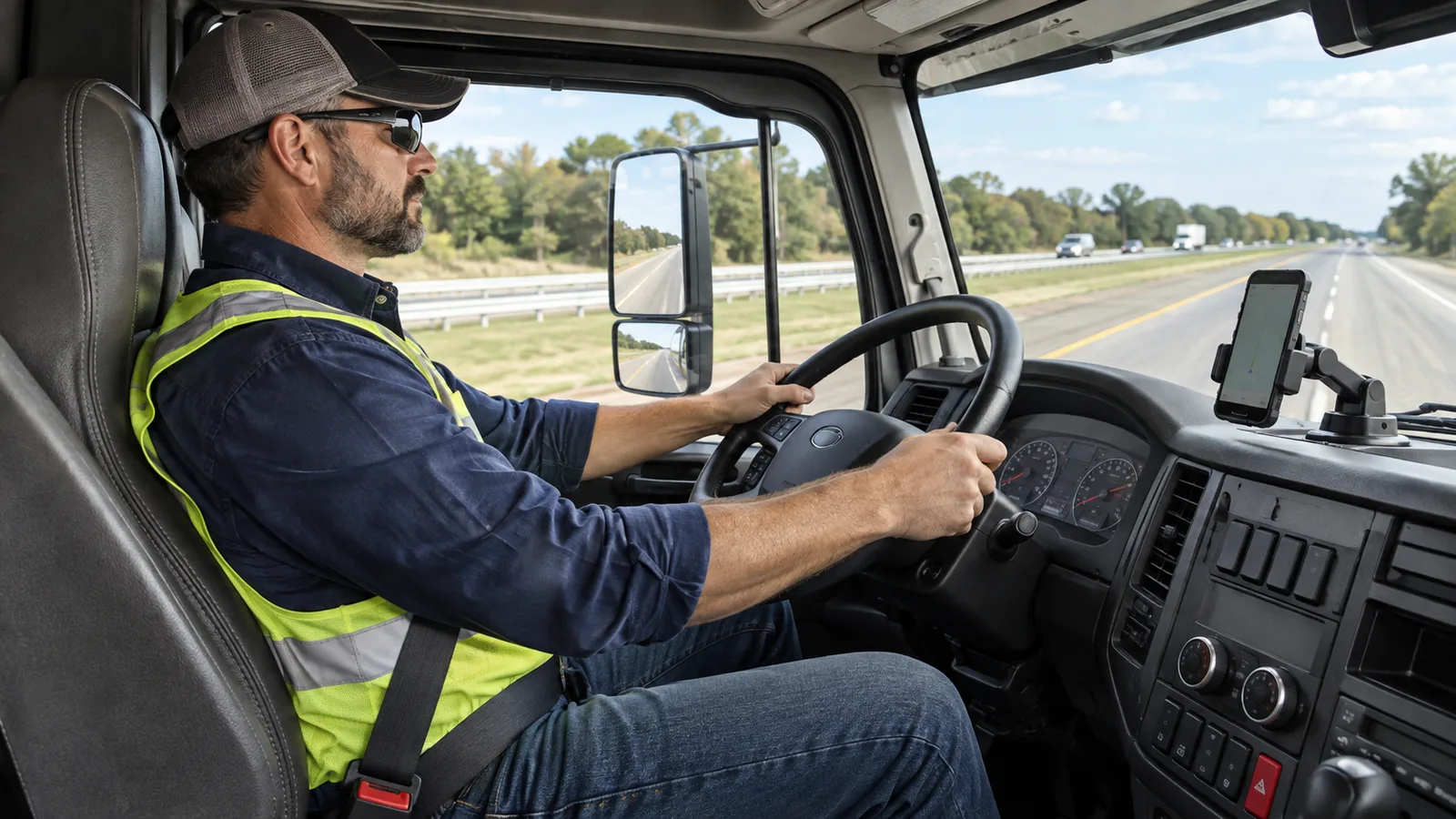
Distracted driving in a commercial vehicle is not limited to typing a text. It can begin when a driver reaches for a ringing phone, studies a route change, searches for paperwork, adjusts a device, opens food, or continues an emotional conversation after attention has left the road. A tractor-trailer can travel through several changing traffic situations during a few seconds of divided attention, so the strongest defense is a cab and communication routine that prevents the decision from arising while the vehicle is moving.
This guide connects the federal mobile-phone rules, Pennsylvania's hands-free law, and the Pennsylvania Commercial Driver's Manual to a practical CDL plan. It explains what “driving” includes, what hands-free operation does and does not solve, how to set up the cab before departure, and how to exit traffic safely when a message or task truly requires attention. It is training information, not legal advice, and drivers must also follow current carrier policies and rules in every jurisdiction they enter.
1. Know the two federal rules before touching a device
says that no driver may engage in texting while driving and that a motor carrier may not allow or require its drivers to do so. Texting is broader than composing a short message. FMCSA explains that it includes manually entering or reading electronic text, such as email, instant messaging, a request to access a webpage, and other electronic text retrieval or entry for communication.
separately prohibits a driver from using a hand-held mobile telephone while driving a CMV. The carrier may not allow or require that conduct. FMCSA's official mobile-phone guidance describes prohibited hand-held use as holding a phone to make a call, pressing more than one button to dial, or reaching in a way that takes the driver out of the seated driving position while restrained by the seat belt.
Texting and hand-held calls are separate problems
A driver can violate the texting rule without making a call, and can violate the hand-held telephone rule without sending a text. Reading a dispatch message, typing into a mapping application, scrolling a contact list, holding the phone during a conversation, or leaning away from the belt to retrieve it can create different compliance and safety problems. Treat the device as unavailable whenever the necessary action exceeds a permitted, prepared hands-free function.
The emergency exceptions are narrow
Both federal sections contain an exception when the communication is necessary with law enforcement officials or other emergency services. That is not a general exception for a late appointment, a missed exit, ordinary dispatch instructions, or a personal matter. If there is no immediate emergency-service need, use the safe stop process described below.
2. Understand why a red light or traffic queue still counts as driving
The federal definitions close a common loophole. Under §392.80, “driving” includes operating a CMV with the motor running while temporarily stationary because of traffic, a traffic-control device, or another momentary delay. Section 392.82 likewise includes temporary stops caused by traffic, signals, and momentary delays. A driver is still part of the traffic stream at a red light, stop sign, railroad crossing queue, toll queue, or congested merge.
A parking brake does not turn a traffic lane into a safe phone zone
Setting a brake at a long light or while traffic is stopped does not change the location. The vehicle may need to move without warning, pedestrians or cyclists may enter the scene, and surrounding traffic can change while the driver's attention is down. The rule's safe-location exclusion applies when the driver has moved to the side of or off the highway and halted where the vehicle can safely remain stationary.
That wording requires more than simply stopping. A narrow shoulder, ramp gore, blind curve, bridge, grade, or lane used by moving traffic may create a new hazard. Plan actual truck-sized stopping options rather than assuming that any place with enough pavement is acceptable.
3. Add Pennsylvania's hands-free law to the federal CMV baseline
explains that Pennsylvania's Paul Miller's Law took effect June 5, 2025. It prohibits a driver from using an interactive mobile device while driving and makes the conduct a primary offense. The state definition of driving includes temporary stops caused by traffic, traffic-control devices, and other momentary delays.
Pennsylvania defines device use to include holding or supporting the device with a hand or another body part, pressing more than a single button to dial or answer, or reaching in a way that takes the driver out of the seated position while restrained. As of June 5, 2026, the warning period has ended and the statutory summary-offense provision applies. This state rule does not replace the federal CMV rules; a commercial driver must comply with all applicable requirements.
Do not rely on a remembered rule from another state
Drivers cross jurisdictions, and definitions, exceptions, and penalties can differ. Carrier policy may also be stricter than the minimum law—for example, prohibiting any call while the vehicle is moving. Review the current route and policy before departure. If two rules overlap, choose the practice that keeps the device out of the driving task and remains compliant with both.
4. Build a distraction-resistant cab before the wheels move
The , recommends learning in-vehicle electronics before driving, planning the route, adjusting mirrors, clearing unnecessary objects, and avoiding reading or writing behind the wheel. This turns distracted-driving prevention into a pre-departure task rather than a test of willpower in traffic.
Configure communications before departure
- Place the phone in an approved mount close enough for any permitted one-button action while properly belted.
- Connect an approved hands-free system and test its volume before moving.
- Enter the destination and review the first route segment while parked.
- Silence nonessential alerts and use a driving or focus mode when available.
- Tell dispatch and family when you will next be available to respond.
- Store paperwork, food, drinks, charging cables, and loose objects where they cannot fall near the pedals or tempt a reach.
Include this setup in a repeatable safe-start cab routine. The phone mount should not block the windshield, mirrors, instruments, controls, or required view. A mount is not automatically compliant just because it attaches firmly; location, reach, carrier policy, and applicable vehicle rules still matter.
Pre-plan the communication window
Before departure, identify the next service plaza, terminal, customer staging area, or lawful truck-parking location. Agree on a check-in point instead of responding to every alert. When dispatch knows the driver will reply from a planned stop, an incoming message is less likely to become an urgent-looking demand in motion.
5. Hands-free compliance does not make a conversation attention-free
says a compliant hands-free setup allows the driver to initiate, answer, or end a call with one button while remaining seated and properly restrained. Voice activation, an earpiece, or speaker function may support that setup. The phone must be located close enough that the driver does not reach unsafely.
Those mechanical conditions address hand-held use; they do not guarantee the conversation is safe. A complicated dispatch change, argument, customer problem, medical discussion, or unfamiliar instruction can take the driver's mind away from traffic even when both hands remain available. The CDL manual warns that mental activity can distract a driver whose eyes still appear to face the roadway.
Use a simple interruption rule
If the call requires notes, calculations, route entry, document review, repeated screen checks, or an emotionally charged decision, end it and stop safely. A useful phrase is: “I am driving. I will respond from the next safe parking location.” Do not solve a routing problem by combining a phone call, navigation change, mirror scan, and lane change at the same time.
6. Control the distractions that are not phones
The official CDL manual lists many non-phone distractions: adjusting controls, eating, drinking, reading maps, retrieving a fallen object, watching roadside events, talking with passengers, using telematics, and becoming absorbed in thoughts. A legal phone setup does not protect a driver who is opening food, searching a bag, reading a shipping document, or staring at a crash scene.
Navigation and dispatch screens
Do not type a new address or read a long message while driving. If the route changes, continue on a safe legal path until a suitable stop is available. A missed exit is an inconvenience; a sudden lane change while looking at a screen is a safety event. Consumer navigation may also omit CMV height, weight, hazardous-material, or road restrictions, so route decisions need appropriate commercial information before movement.
Food, paperwork, and dropped objects
Open packages and arrange water before starting, or use a stop. If an object falls, leave it unless it interferes with a pedal or another control; if it creates an immediate control hazard, stop as safely as conditions allow. Shipping papers and permits should be accessible for the proper inspection or emergency purpose, but not positioned where the driver is tempted to read them in motion.
Passengers and emotional load
A passenger or instructor should protect the driving task, not compete with it. Keep coaching concise in traffic and save detailed feedback for a safe stop. If stress, anger, or a difficult conversation is consuming attention, acknowledge it and pause the discussion. The goal is not to pretend the distraction is absent; it is to remove it from the moving vehicle.
7. Use a safe stop plan when a task cannot wait
“Pull over” is incomplete advice for a commercial vehicle. A tractor-trailer needs enough length, surface strength, overhead and side clearance, legal access, and a safe reentry path. The driver's plan should name actual locations before the message arrives.
Step 1: keep driving the truck
Ignore the alert. Keep eyes up, hands controlling the vehicle, and the existing lane and speed plan stable. Do not make a sudden movement toward an exit. Scan mirrors and traffic, then decide whether the next planned stop remains appropriate. The lane-change and merging plan is useful when reaching a safe exit requires several deliberate steps.
Step 2: select a lawful truck-sized location
Prefer a service plaza, truck stop, terminal, approved customer area, or another legal location designed to hold the vehicle. Avoid stopping on a shoulder merely for convenience. Shoulders are exposed to traffic and may be soft, narrow, sloped, occupied, or reserved for emergencies. If conditions create a genuine emergency, follow the emergency procedure, carrier policy, and applicable warning-device rules.
Step 3: secure first, communicate second
Park fully in the chosen space, set the parking brakes, place the transmission and vehicle controls in the correct secured condition, and confirm the vehicle can remain stationary. Only then retrieve or operate the device. Finish the task, restore the phone to its mount or storage location, review the route, and complete a mirror and traffic scan before reentering.
8. Recognize distracted drivers and preserve space
The CDL manual tells drivers to watch for vehicles drifting within or across lanes, varying speed without a clear reason, or showing a driver preoccupied with a phone, food, maps, passengers, or other objects. Treat those movements as an active hazard, not as a reason to confront the driver.
Increase following space, avoid lingering beside the vehicle, and be cautious when passing because the other driver may not know the truck is present. Do not use the horn as punishment, gesture, or attempt to record the behavior. The practical response is space and predictability. Review the following-distance plan and adjust early.
At night, screen glow and reduced visibility can make divided attention harder to detect and manage. Combine the distraction plan with the night-driving visibility and alertness routine.
9. Worked scenario: a dispatch message before an unfamiliar interchange
A student and instructor are operating a tractor-trailer on a daylight interstate training route. The phone is mounted, notifications are muted, and the route was entered before departure. Dispatch sends a message that the delivery entrance has changed and includes a new gate address. The alert appears two miles before an unfamiliar multi-lane interchange.
The wrong response
The student looks down, touches the message, and begins reading while traffic is compressing near the exit. Realizing the new gate may require the right-hand branch, the student considers a late lane change. Even if the phone remained in its mount, reading the message and entering an address would divide visual and mental attention during a high-workload road segment.
The controlled response
The instructor tells the student to leave the device alone and continue on the planned route. The student holds the lane, manages following distance, passes the uncertain branch, and uses signs to reach the next service plaza identified in the pre-trip plan. After parking and securing the truck, the student reads the full message, calls dispatch, confirms that the new entrance is legal for the combination, and updates the commercial route.
Before leaving, the student returns the phone to the mount, previews the first turns, checks mirrors and traffic, and rejoins the highway. The stop costs time, but it separates four tasks—driving, reading, calling, and routing—that should not be performed together. It also demonstrates that schedule pressure does not change the federal definition of driving at a traffic light or in a queue.
10. Distracted-driving decision table
| Situation | Do while moving | Do after a safe stop |
|---|---|---|
| A text or dispatch message arrives | Leave it unread and maintain the driving plan | Park, secure the CMV, then read and respond |
| The destination changes | Continue on a safe legal route; avoid a late maneuver | Confirm CMV restrictions and enter the new route |
| A permitted hands-free call becomes complex | End the call with the prepared one-button or voice function | Return the call where the vehicle can safely remain stationary |
| An object falls in the cab | Leave it unless it immediately interferes with control | Retrieve and secure it before continuing |
| A passenger starts an emotional discussion | Pause the discussion and keep attention on traffic | Discuss the issue when parked |
| Another driver is drifting while using a device | Create space and avoid remaining beside the vehicle | Report only through an appropriate safe process if necessary |
11. Practical distraction-prevention checklist
Before departure
- Review current federal, state, and carrier device rules.
- Enter and review the CMV-appropriate route while parked.
- Mount the phone without blocking the view, mirrors, instruments, or controls.
- Confirm any permitted one-button, voice, earpiece, or speaker setup while belted.
- Silence nonessential alerts and activate driving or focus mode.
- Store paperwork, cables, food, drinks, and loose objects securely.
- Identify the next lawful truck-parking and communication point.
- Tell dispatch when you will be available to respond.
While driving
- Do not read, enter, or send electronic text.
- Do not hold the phone, press multiple buttons, or reach away from the belted position.
- Treat red lights, stop signs, railroad queues, and congestion as driving.
- End a hands-free call when its mental demand increases.
- Do not type into navigation or dispatch equipment.
- Do not retrieve fallen objects, eat, read paperwork, or adjust equipment in traffic.
- Create space around drivers who drift or vary speed unpredictably.
- Use the next safe, legal truck-sized stop for every task that needs attention.
Before reentry
- Finish the message, call, route entry, or document review while parked.
- Return devices and loose items to secure positions.
- Preview the first route segment and put the screen back in its driving state.
- Check the seat belt, mirrors, surroundings, signal, and traffic gap before moving.
12. Frequently asked questions
Can a CDL driver text while stopped at a red light?
No. Under 49 CFR §392.80, driving includes operating a commercial motor vehicle with the motor running while temporarily stationary because of traffic, a traffic-control device, or another momentary delay. A red light is not a safe parked location, so the driver must not read or enter a text there.
Can a commercial driver use a hands-free phone while driving?
Federal guidance permits a properly positioned hands-free phone that can be initiated, answered, or ended with one button while the driver remains seated and restrained. That does not make a conversation distraction-free, and a carrier may impose a stricter rule. If the call demands attention, the safer practice is to stop in a safe, legal place.
Where should a truck driver stop before using a phone?
Move to the side of or off the highway and halt where the commercial vehicle can safely remain stationary. A lawful truck-parking space, service plaza, terminal, or approved customer location is usually more appropriate than a narrow shoulder, ramp, curve, bridge, or other exposed area.
Does Pennsylvania's hands-free law apply to commercial drivers?
Yes. Pennsylvania's law applies to drivers of motor vehicles, while federal CMV rules separately prohibit texting and hand-held mobile-telephone use while driving. A commercial driver must follow every applicable federal, state, local, carrier, and vehicle-specific requirement, using the stricter safe practice when rules overlap.
Practice the routine before the next alert
A strong student can explain the rule, prepare the cab, ignore an alert, name the next safe stop, secure the vehicle, and return to traffic without rushing. Practice that sequence during supervised training so it becomes automatic before schedule pressure appears. For a broader look at program structure and hands-on preparation, read the CDL training guide.
Ready to discuss CDL training? Contact Patriot CDL at or visit 7800 Bristol Pike, Levittown, PA 19057.
Official sources
- , Section 2.9