Transitioning out of the military can feel like you're searching for your next mission. For a lot of veterans, the trucking industry isn't just a job—it's a clear, rewarding path forward where the skills you already have are in high demand.
This guide is designed to walk you through the process of getting your Commercial Driver’s License (CDL), showing you exactly how to use your military benefits and experience to your advantage.
Your Next Mission: The Open Road
Leaving the service comes with its own set of hurdles, but it also gives you a serious edge. The discipline, logistical know-how, and experience handling heavy equipment you gained in the military are exactly what trucking companies are looking for. They actively recruit veterans because they know you're reliable and have a work ethic that's second to none.
This isn't just a theory; it's a well-worn path. Veterans are a huge part of the U.S. trucking workforce. In fact, some stats show that roughly one in four veterans find work as truck drivers, proving just how well those military skills line up with the job.
Think of it this way: your time in the service has already laid the groundwork. Getting your CDL isn't about starting from zero; it's about adding a specialized certification to the solid foundation you've already built.
Why a CDL is a Smart Move for Veterans
Getting your CDL makes a lot of sense, especially when you're looking for stability after your service. The demand for qualified drivers is always high, which means you’re walking into a field with much more job security than many others.
Here's why it's such a good fit:
- A Clear Path Forward: The steps to get licensed are straightforward, giving you a defined objective—just like a mission.
- Quick Turnaround: Forget a four-year degree. You can complete CDL training for veterans in just a few weeks and start earning a good living right away.
- Your Skills are Valued: Employers get it. They know veterans understand safety, the importance of being on time, and how to maintain their equipment.
Consider this guide your roadmap. We’ll cover everything from using your VA benefits to pay for school, to picking the right training program, and finally, using your background to land a great job with a company that truly values your service.
How to Fund Your CDL Training with Veteran Benefits
Figuring out how to pay for your CDL education shouldn't be a roadblock on your path to a new career. As a veteran, you've earned some powerful benefits that can cover the costs of top-notch training, making your shift into the trucking industry a whole lot smoother.
These programs aren't just about paying tuition; they're designed to provide a complete support system. Many veterans use their GI Bill benefits or other VA programs to cover tuition, supplies, and even help with housing costs while they're in school. It's a fantastic way to get quality training without racking up student debt.
Understanding Your Key Funding Options
The main VA benefits you'll likely be looking at are the Post-9/11 GI Bill, the Montgomery GI Bill, and Veteran Readiness & Employment (VR&E). Each one has its own strengths, and the right one for you really depends on your service history and current situation.
Post-9/11 GI Bill (Chapter 33): For many, this is the most comprehensive option. It can cover 100% of your tuition at a VA-approved school, give you a stipend for books, and even includes a Monthly Housing Allowance (MHA) based on the school's location.
Montgomery GI Bill (MGIB): This benefit is a bit different. It sends a set monthly payment straight to you, and you use that money to pay the school. The amount is fixed, so it doesn’t change depending on how expensive the program is.
Veteran Readiness & Employment (VR&E, Chapter 31): If you have a service-connected disability, VR&E is an incredible resource. The program’s goal is to help you find a great job, and it will often cover all your training expenses, right down to the specific gear you might need.
Before you can do anything else, you need to get your Certificate of Eligibility (COE) from the VA. This is the official document that proves what benefits you're entitled to, and every VA-approved school will need to see it before you can enroll.
Now, let's break down how these benefits compare in a real-world scenario.
Comparing Veteran Benefits for CDL School
Choosing the right benefit can feel complicated, but this table gives you a side-by-side look at what each program offers and who it's generally best for.
| Benefit Program | What It Typically Covers | Best Suited For |
|---|---|---|
| Post-9/11 GI Bill (Chapter 33) | Up to 100% of tuition and fees, Monthly Housing Allowance (MHA), and a stipend for books/supplies. | Veterans with recent service who want a comprehensive package that covers nearly all costs, especially in higher-cost areas. |
| Montgomery GI Bill (MGIB) | A fixed monthly payment sent directly to the veteran to be used for tuition and other educational expenses. | Veterans who enrolled in this program during service and are attending a lower-cost school, allowing them to pocket the difference. |
| Veteran Readiness & Employment (VR&E) | All training-related costs, including tuition, fees, supplies, and necessary equipment. Focused on an employment outcome. | Veterans with a service-connected disability rating who need dedicated support and funding to enter a suitable new career field. |
Ultimately, the best choice depends on your specific eligibility and financial needs. The Post-9/11 GI Bill is often the most valuable, but VR&E is unmatched if you qualify.
The length of your training program can also play a big role, especially in how your benefits, like the housing allowance, are paid out.
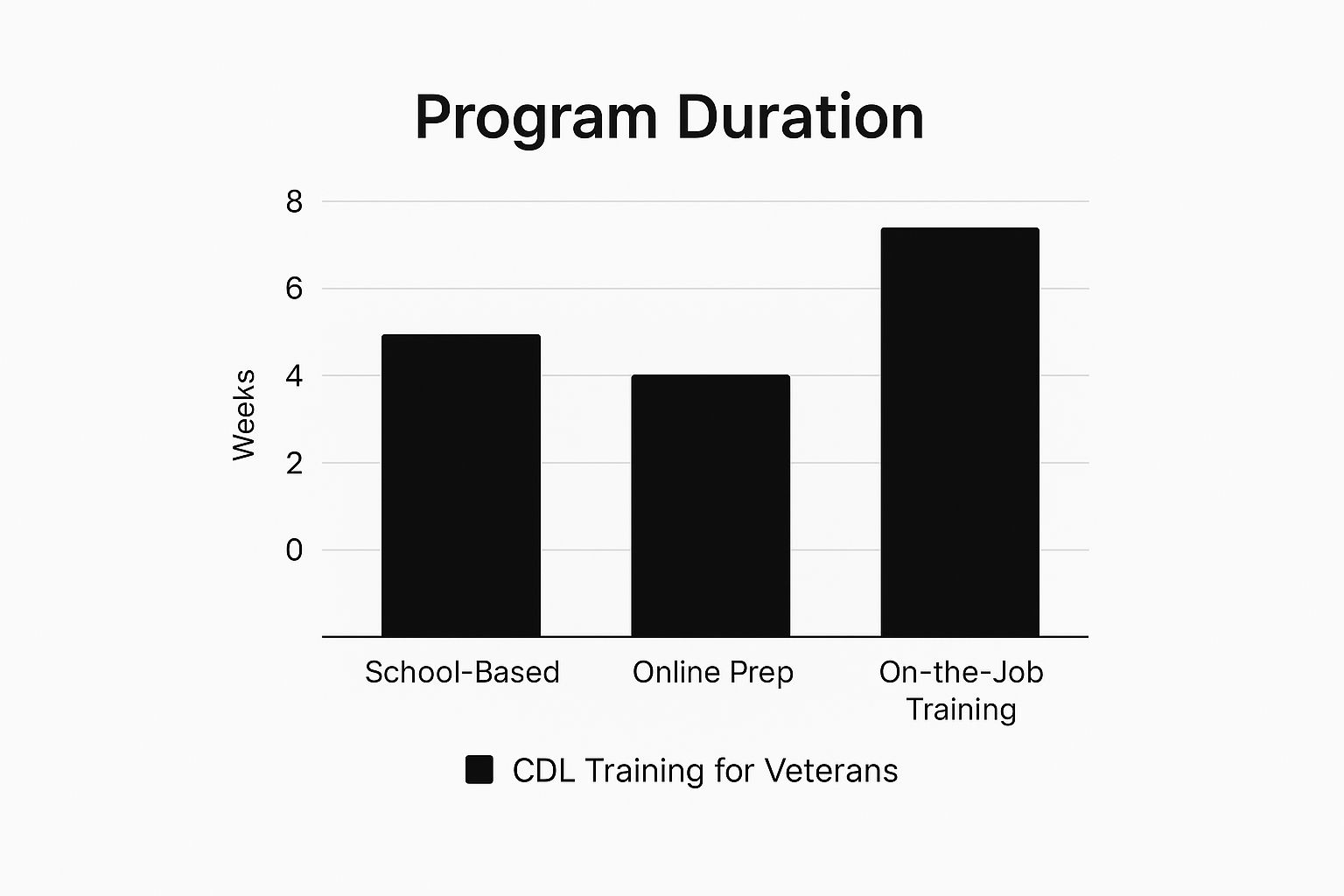
As you can see, on-the-job training formats can stretch out longer, which might maximize the monthly stipends you receive. On the other hand, traditional school-based programs get you licensed and on the road much faster.
Of course, all the funding in the world won't matter until you pass your written exams. You can get a jump on that by checking out our guide on the CDL permit.
Finding the Right Veteran-Friendly Trucking School

Let's be clear: not every CDL school gets what it's like to be a veteran. A truly veteran-friendly program does more than just take your GI Bill funds—it’s built to help you navigate the shift from military service to a civilian career.
Your first move, before anything else, is to confirm the school is officially approved by the Department of Veterans Affairs (VA). If it’s not, you can't use your benefits, plain and simple. That means you'd be stuck paying for everything out of pocket. You can check any school's status right on the VA's official website.
Once you’ve confirmed a school is VA-approved, the real digging begins. You’re not just looking for a place to get a license; you’re looking for a partner in your new career. The quality of the training you receive here will set the stage for your success on the road.
Key Questions to Ask Admissions Advisors
Think of your conversation with an admissions advisor like a recon mission. The answers they give—or don't give—will tell you everything you need to know about their commitment to their students, especially veterans.
Here are the critical questions I'd be asking:
- Instructor-to-Student Ratio: What's the real ratio when we're actually behind the wheel? You're looking for low numbers here. 1-on-1 is the gold standard, but 2-on-1 can work. Anything more, and you're just a passenger.
- Job Placement Success: Don't just ask if they help with job placement. Ask for the hard numbers. What percentage of your veteran grads get hired, and which specific carriers are hiring them?
- Hands-On Driving Time: How much time will I actually spend driving on real roads—highways, city streets, backing—not just circling cones in a parking lot?
- VA Paperwork Support: Is there someone on staff whose job is to handle VA benefits? You want an expert who can navigate the paperwork, not someone who's just figuring it out.
If an advisor gives you vague answers or can’t provide specific data, that’s a huge red flag. A quality school will be proud of its numbers and happy to share them. They should be selling you on their results, not just a dream.
The whole point is to find a program that’s truly invested in your future. That means modern trucks, instructors who know how to work with vets, and career services that start helping you on day one. As you get all your ducks in a row, it’s a good idea to get familiar with all the specific documentation and qualifications you'll need. You can review a complete list of CDL requirements to make sure you're fully prepared.
Picking the right school isn’t just a small step—it’s the foundation of your entire trucking career.
Passing Your CDL Exams with Confidence
Earning your CDL really comes down to two major hurdles: the written knowledge tests and the practical, hands-on road test. With the right prep, you can walk into both feeling ready to ace them on the first try.
The written exams are your first gate to pass. Think of it less as a single test and more as a series of quizzes covering everything a professional driver needs to know. You'll have to get comfortable with the details of air brakes, combination vehicles, and how to conduct a thorough pre-trip inspection.
I’ve seen a lot of folks get overwhelmed trying to cram it all in at once. The best approach? Break it down. Master one section—really understand it—before you even think about moving on to the next.
Mastering the Written and Road Tests
The written tests cover a ton of ground, but a solid study plan is your best friend here. Beyond the basics, you might also need to study for specific endorsements like Hazmat or Tanker, depending on the kind of driving job you’re after. Many vets I’ve talked to swear by old-school flashcards or practice test apps to really drill the information into their heads.
If you want a head start, check out our in-depth guide on the general knowledge test. It’s a great primer for the foundational topics you'll absolutely see on the exam.
I can't stress this enough: the pre-trip inspection is where most people lose points on the road test. It's not just about pointing at parts. You have to explain what you're checking and why it matters for safety. Practice it out loud until you can do it in your sleep.
When you get behind the wheel for the road test, the examiner is looking at three key things:
- The Pre-Trip Inspection: This is your show-and-tell. You’ll walk the examiner around the truck, pointing out critical components and explaining how you know they're safe and ready for the road.
- Backing Maneuvers: Get ready to prove your skills. You’ll likely have to perform several backing maneuvers, like straight-line backing, offset backing, and the classic alley dock.
- On-Road Driving: This is where it all comes together. The examiner will watch how you handle the truck in actual traffic—making turns, changing lanes, and safely navigating intersections.
Your military background gives you a serious edge here. The discipline and meticulous attention to detail that were drilled into you are exactly what's needed to nail the pre-trip inspection and maintain total situational awareness on the road. Don't forget that—it’s one of the most powerful tools you have.
How to Land Your First Trucking Job
You’ve got that brand-new CDL in your hand. Now, let’s get you paid. The great news is you’re walking into an industry that’s hungry for good drivers, which puts you in a much stronger position than most people starting a new career.
Your military background isn't just a part of your past—it's one of your most valuable assets right now. Trucking companies actively recruit veterans because they know you already have the discipline, reliability, and cool-headed problem-solving skills they need on their team.
Highlighting Your Military Experience
When you sit down to write your resume, think beyond just listing your service dates and rank. Your real mission is to translate your military duties into the language of the trucking world.
What did you really do?
- Operate and maintain heavy vehicles or complex machinery?
- Handle logistics, plan convoy routes, or manage supply chains?
- Execute tasks under pressure while following strict safety protocols?
These aren't just military skills; they are the bedrock of a successful trucking career. Frame your experience this way, and you'll show employers you're not just a rookie driver but a seasoned professional who’s ready to roll.
Your DD-214 is more than just a piece of paper—it’s solid proof of your training and work ethic. Keep a copy handy, because veteran-friendly companies will often ask for it and might even offer you a signing bonus.
Finding Companies That Value Veterans
It’s not hard to find carriers with veteran hiring programs. Many of the big national and regional companies have them, often complete with structured training, mentorship from fellow vets, and clear career paths. Don’t forget to lean on your CDL school’s job placement services; they’ve built relationships with these exact companies.
The trucking industry has a serious driver shortage. Back in 2022, there were an estimated 55,500 job openings, and companies are still scrambling to find qualified drivers to fill those seats. This has pushed many to offer specialized programs, including free CDL training for veterans, because they recognize your potential.
Your goal is to find a company that doesn't just hire you but truly invests in your transition. When you’re ready to take that first step with a school that gets it, contact our team for direct assistance. We're here to help you get started on the right road.
Your Top Questions About Veteran CDL Programs, Answered
If you're thinking about using your military benefits to start a trucking career, you've probably got some questions. Let's cut through the noise and get you the clear, straightforward answers you need to move forward.
Can I Use My GI Bill at Any CDL School?
That's a common misconception, and it's a critical one to get right. The short answer is no. You absolutely must choose a school that is officially approved by the Department of Veterans Affairs (VA).
Before you even think about enrolling, your first step should be to verify the school’s status on the VA’s official list of approved institutions. If you pick a non-approved school, your benefits won't cover the tuition, and you'll be on the hook for the entire cost. Always check first.
How Long Does CDL Training for Veterans Usually Take?
The timeline can vary quite a bit. A standard, bare-bones CDL course might only take three to four weeks.
However, many programs designed specifically for veterans are more comprehensive. These often run from five to eight weeks because they're structured to help you get the most out of your GI Bill benefits. The upside is these longer courses almost always give you more time behind the wheel, which is where real confidence is built.
Pro Tip for Vets: Don't forget about the Military Skills Test Waiver from the FMCSA. If you have experience driving heavy military vehicles within the last year of your service, you might be able to bypass the hands-on road test completely. You'll still need to ace the written exams, but it's a huge head start.
Keep in mind that some licenses come with limitations. For example, if you test in an automatic, you'll get an E restriction on your license, locking you out of manual transmission trucks. If a job requires you to drive a stick shift down the road, you'll need more training. You can explore what it takes to get that lifted by looking into an E restriction removal course.
At Patriot CDL, we're dedicated to helping veterans transition into successful trucking careers. To see how our VA-approved programs can get you on the road fast, visit us at our website.