A Commercial Driver License (CDL) isn't just an upgraded version of the license in your wallet. It's a professional credential, federally mandated for anyone operating large, heavy, or specialized vehicles on public roads. It signifies a much higher level of skill, knowledge, and responsibility.
What a Commercial Driver License Really Means
Think about it this way: your standard driver's license lets you operate a family car. A CDL, on the other hand, is the key to piloting a complex machine that can weigh up to 80,000 pounds, like a fully-loaded tractor-trailer. It’s a professional certification showing you’ve mastered the rigorous federal and state standards designed to keep our highways safe.
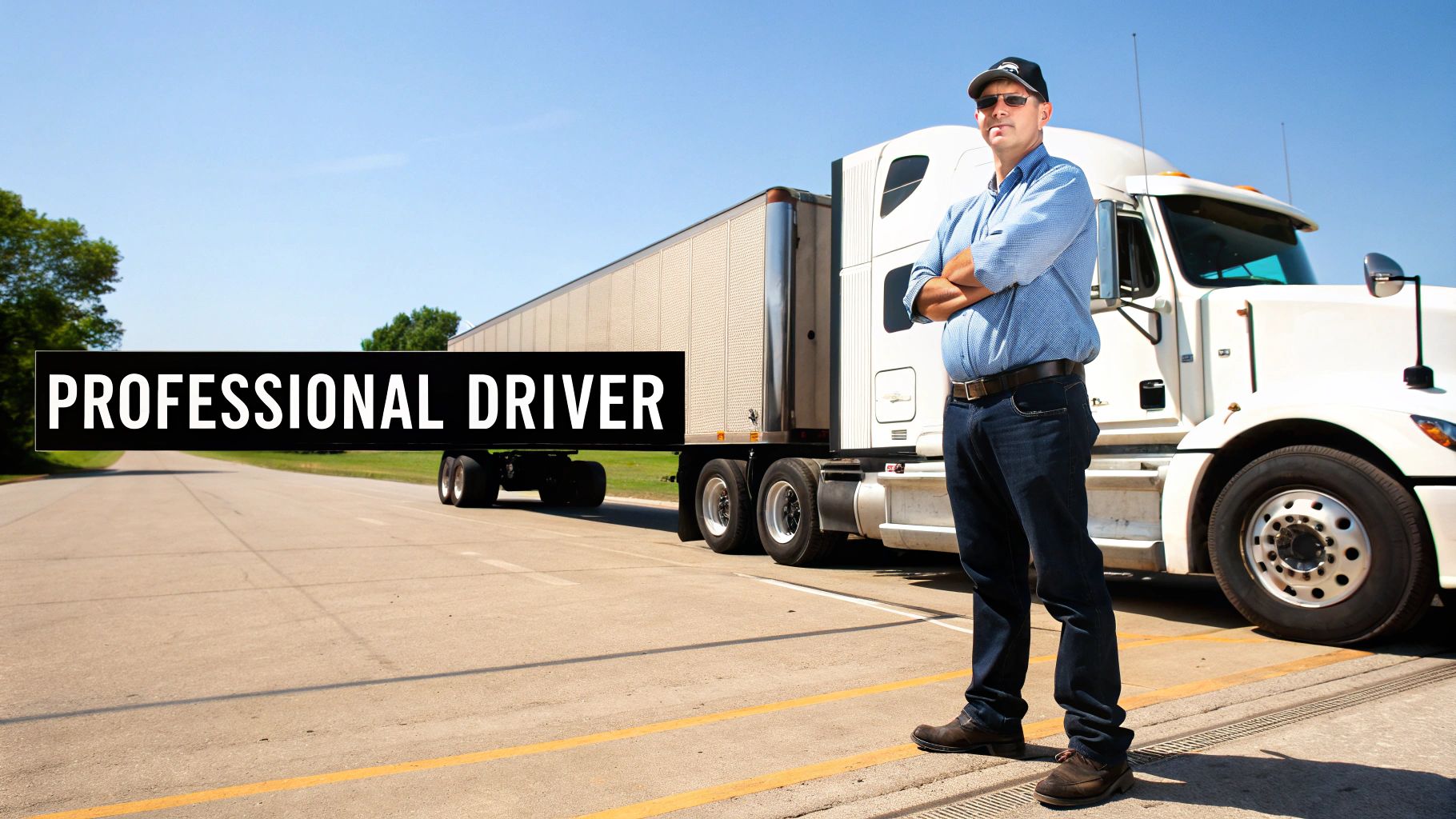
This is a crucial distinction. Handling a Commercial Motor Vehicle (CMV) requires a completely different skill set than driving your personal vehicle. You have to master complex pre-trip inspections, understand intricate air brake systems, navigate tight city corners, and execute perfect backing maneuvers that would be impossible in a car. The responsibility is immense, directly impacting public safety and the entire supply chain.
The Higher Standard for Professional Drivers
Because the stakes are so high, earning and keeping a CDL is a tightly regulated process. These regulations are always evolving to enhance safety on the road. For example, recent changes like the implementation of the Drug & Alcohol Clearinghouse have reshaped the industry, ensuring only qualified, safe drivers get behind the wheel.
Holding a CDL means you operate under a microscope. You're held to a higher standard, with a sharp focus on:
- Advanced Vehicle Control: You must master the unique handling characteristics of vehicles with massive weight, length, and blind spots.
- Regulatory Compliance: This means strictly following rules for hours-of-service, cargo securement, and vehicle weight limits.
- Safety Protocols: Conducting meticulous inspections and knowing exactly how to respond to on-road emergencies is non-negotiable.
This commitment to a higher standard is what separates a professional driver from a regular motorist. It’s about a deep understanding of the machine, the law, and the profound trust the public places in you.
More Than Just Driving a Truck
At the end of the day, a CDL is your ticket to a real career, not just another job. It's a testament to your dedication to safety, precision, and reliability. The requirements are tough because the role is absolutely vital—professional drivers are the lifeblood of our economy, moving the goods we all rely on every single day.
If you feel ready to meet that standard, the journey starts with understanding the specific qualifications. You can get a detailed breakdown of what it takes by reviewing the full CDL requirements.
Match Your CDL and Endorsements to Your Career Goals
The very first decision you make on your trucking journey is also the most important: choosing the right Commercial Driver's License (CDL). This isn't just a generic license. It’s a specialized credential broken down into different classes and endorsements that dictate exactly what you can drive and what kind of work you can do.
Think of it this way: your CDL class is your main qualification, while endorsements are your specializations. Getting this right from the start puts you on the fast track to the career you really want. The whole system, managed by the Federal Motor Carrier Safety Administration (FMCSA), is based on a vehicle’s Gross Vehicle Weight Rating (GVWR)—basically, the total loaded weight it’s designed to handle.
Breaking Down the Three Main CDL Classes
Your CDL class directly determines the size and type of commercial vehicle you're legally allowed to get behind the wheel of. Each one opens up a different set of doors in the industry.
Class A CDL: This is the king of the road. It’s the most versatile license you can get, allowing you to operate any combination of vehicles with a total weight of 26,001 pounds or more, as long as the trailer you’re pulling is over 10,000 pounds. This is your ticket to driving the big rigs—tractor-trailers, flatbeds, and tankers—that keep our country moving.
Class B CDL: This license is for driving a single large vehicle weighing 26,001 pounds or more, or one that’s towing a small trailer under 10,000 pounds. You’ll see Class B drivers operating straight trucks, dump trucks, large city buses, and garbage trucks. It's a fantastic option for good-paying local or regional jobs where you’re home more often.
Class C CDL: This is a more specialized class. It’s for vehicles that don’t fit into A or B but are either designed to carry 16 or more passengers (including you) or used to transport placarded hazardous materials. Think airport shuttles, large passenger vans, and smaller HazMat vehicles.
To make it even clearer, here’s a quick breakdown of what you can drive with each license.
CDL Classes at a Glance
| CDL Class | Vehicle Type (GVWR) | Common Vehicles | Typical Jobs |
|---|---|---|---|
| Class A | Combination vehicles over 26,001 lbs (trailer > 10,000 lbs) | Tractor-trailers, Flatbeds, Tankers | Long-haul (OTR) Trucking, Regional Freight Hauling, Heavy Equipment Transport |
| Class B | Single vehicles over 26,001 lbs (trailer < 10,000 lbs) | Straight Trucks, Dump Trucks, City Buses | Local Delivery Driver, Construction, Public Transit, Waste Management |
| Class C | Vehicles carrying 16+ passengers or placarded HazMat | Shuttles, Large Vans, Small HazMat Trucks | Airport Shuttle Driver, Tour Bus Operator, HazMat Transport Specialist |
Choosing the right class is the foundation, but endorsements are what will really make your career take off.
Power Up Your License with Endorsements
If your CDL class is your degree, endorsements are your professional certifications. They prove you have the specialized knowledge to handle specific cargo or vehicle types, and they almost always lead to better pay and more interesting work.
Think of an endorsement as a stamp of expertise. It tells an employer you’ve gone the extra mile to master a specific skill, whether that’s safely hauling sensitive materials or maneuvering double trailers.
Here are the key endorsements you can add to your license:
- T – Double/Triple Trailers: Lets you pull two or three trailers at once.
- P – Passenger: A must-have for driving any vehicle designed for 16 or more people.
- N – Tank Vehicle: Required for hauling liquids or gasses in a tank.
- H – Hazardous Materials (HazMat): Allows you to transport materials classified as hazardous.
- X – Combination Tank & HazMat: A powerful combo endorsement that covers both N and H.
- S – School Bus: A specialized endorsement for driving a school bus, with unique safety rules.
A driver with a Class A license and both the T and X endorsements is one of the most capable and in-demand professionals on the road today. They can handle just about any rig and any type of freight, giving them incredible flexibility and earning power. To get there, you have to put in the work. For Class A hopefuls, studying for the combination vehicles test is a critical first step.
Ultimately, the right combination of a CDL class and endorsements puts you squarely in the driver's seat of your own career.
Your Step-By-Step Roadmap to Earning a CDL
Getting your CDL might feel like a mountain to climb, but it’s really just a series of manageable steps. Think of it less like a sprint and more like a well-marked trail. By breaking the journey down, you can focus on one milestone at a time, from the first piece of paperwork to the final road test.
First things first, let's make sure you're eligible. On a federal level, you have to be at least 18 years old to drive a commercial truck within your state (that's called "intrastate" driving). To cross state lines ("interstate") or haul hazardous materials, you must be 21 years old. You'll also need to have a standard, valid driver's license from your home state to get started.
Once you’ve checked those boxes, it’s time to get rolling.
Step 1: Pass the DOT Medical Exam
Before you can even think about getting behind the wheel, you need to prove you're medically fit to drive. This means passing a Department of Transportation (DOT) physical exam.
This isn't just any check-up. It has to be done by a certified medical examiner who is listed on the FMCSA National Registry. They'll check your vision, hearing, blood pressure, and overall health to ensure you can safely handle the demands of operating a large commercial vehicle.
Once you pass, you'll be issued a DOT Medical Card. This little card is your golden ticket to the next step, and you'll need to have it on you anytime you're driving commercially.
Step 2: Secure Your Commercial Learner’s Permit
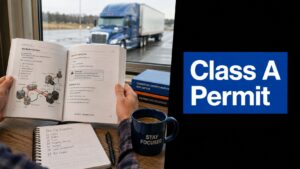
With your medical card in hand, your next mission is to get your Commercial Learner's Permit (CLP). The CLP is basically a "student driver" license for the big rigs. It’s what allows you to start practicing on public roads, as long as you have a licensed CDL holder in the passenger seat.
To earn your CLP, you’ll head to your local DMV and take a few written knowledge tests. The core tests usually cover:
- General Knowledge: The foundation for everything, covering basic safety rules, vehicle control, and inspections.
- Combination Vehicles: A must-pass if you're aiming for a Class A CDL.
- Air Brakes: Essential for nearly all Class A and Class B trucks, which rely on these powerful braking systems.
If you’re planning on getting special endorsements, like for hauling tankers (N) or hazardous materials (H), you can often take those written tests at this time, too.
Step 3: Complete Mandatory Entry-Level Driver Training
This is a big one. As of February 2022, the federal government requires all new drivers to complete Entry-Level Driver Training (ELDT). You can't just study a book and take the test anymore; you have to get formal training from a provider on the FMCSA's official Training Provider Registry.
This rule ensures every new driver gets a solid, consistent foundation of both classroom theory and hands-on, behind-the-wheel instruction. You can't even schedule your final CDL skills test until your school officially certifies that you've completed the training. For a closer look at what this involves, check out the full breakdown of the ELDT mandate.
This is where you truly learn how to handle a truck.
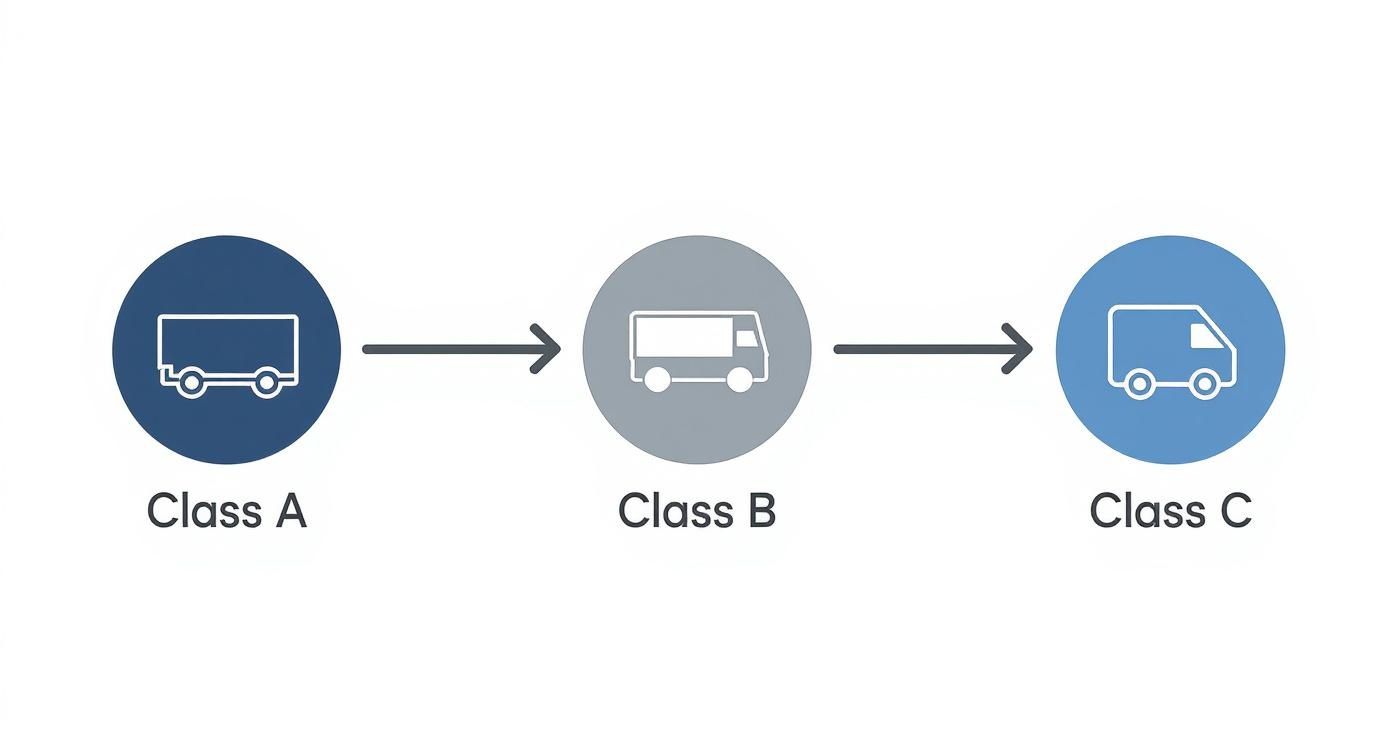
As you can see, the higher the class, the bigger and more complex the vehicle you're qualified to operate.
Step 4: Ace the Final CDL Skills Test
This is the grand finale—the final boss battle. After you’ve held your CLP for at least 14 days and successfully completed your ELDT course, you’re ready to take the three-part CDL skills test. It's crucial to take this test in the same type of vehicle you intend to drive for your career.
The test is broken down into three distinct sections:
- Vehicle Inspection: You'll walk the examiner around the truck and prove you know it inside and out. This isn't just pointing at parts; you have to explain what you're checking and why it's important for safety.
- Basic Control Skills: This part happens in a closed-off area, away from traffic. You’ll be tested on your ability to handle the truck in tight spots with maneuvers like straight-line backing, offset backing, and parallel parking.
- On-Road Driving: The final piece of the puzzle. You'll take the truck out onto public streets and prove you can safely navigate real-world traffic, turns, intersections, and highways.
Passing this test is the culmination of all your hard work. It proves you have the knowledge, skill, and composure required to be a safe, professional commercial driver.
Once you pass all three parts, congratulations are in order! You'll be issued your official Commercial Driver License, and you’ll be legally qualified to start your new career on the open road.
How to Choose the Right CDL Training Program
Picking a CDL training program is probably the most important investment you’ll make in your new career. This isn't just about passing a test; it’s about getting the real-world skills and confidence you need to handle an 80,000-pound rig safely and efficiently. The right school builds the foundation for your entire future on the road. The wrong one can be a fast track to frustration and wasted money.
This decision is more important than ever. With roughly 3.6 million truck drivers on the road, the demand for qualified professionals is still climbing. In fact, the U.S. Bureau of Labor Statistics expects jobs for heavy and tractor-trailer drivers to grow by 5% through 2033. That translates to an average of 240,300 driver openings every year, a massive opportunity for anyone ready to get behind the wheel.
Comparing Your Training Options
Not all paths to a CDL are the same. Each route offers a different mix of speed, cost, and teaching style, so you need to find the one that fits your budget, timeline, and how you learn best.
- Accelerated Private Schools: These programs are all about speed and efficiency. They are laser-focused on getting you licensed and ready for a job in just a few weeks with intensive, hands-on training. This is the perfect choice if your main goal is to start earning a paycheck as quickly as possible.
- Community College Programs: These courses take a bit longer, often lasting a full semester. While the pace is slower, they might go deeper into classroom theory and can sometimes be covered by traditional financial aid. This path is a good fit for learners who prefer a more academic, structured environment.
- Company-Sponsored Training: Some of the big trucking companies will pay for your training, but there's a catch: you have to commit to driving for them for a set period, usually one or two years. This "paid CDL training" can be a fantastic low-cost option, but it locks you into one employer and gives you less flexibility right out of the gate.
A Practical Checklist for Vetting Schools
Once you know which route you want to take, it’s time to look at specific schools. A good program will be transparent and happy to answer all your questions. Use this checklist to dig in and steer clear of predatory schools that promise the world but fail to deliver.
The best CDL schools focus on one thing: creating safe, competent, and employable drivers. Look for a program that prioritizes behind-the-wheel time, small class sizes, and has strong connections with local and national employers.
Make sure to ask any potential school these questions:
- Instructor-to-Student Ratio: How many students are in the truck with one instructor? You want a low ratio, like 4:1 or better. That means more personal attention and, most importantly, more time for you to actually drive.
- Quality of Equipment: Are their trucks and trailers modern and well-maintained? You should be learning on the same kind of equipment you'll be expected to operate in your first job.
- Job Placement Assistance: What’s their documented job placement rate? Do they have people on staff whose job is to help you find work? Ask which companies actively recruit their graduates.
- Transparent Pricing: Is the total cost laid out clearly from the start? Ask for a complete breakdown covering tuition, permit fees, drug screening, your DOT physical, and testing fees. This helps you avoid any nasty hidden charges. You can see a clear example by exploring the transparent tuition for our accelerated CDL program.
Key Questions to Ask an Admissions Advisor
When you get on the phone with a school representative, have a list of questions ready. How they answer will tell you a lot about the quality of their program and whether they truly care about their students' success.
- What is the total number of behind-the-wheel hours I will personally get?
- Are your instructors former professional drivers with years of real-world industry experience?
- Do you train on a manual transmission, or only on automatics?
- What is your pass rate for the state CDL skills test on the first try?
- Can I talk to some recent graduates about their experience at your school?
Choosing your training program is the first real turn you'll make on your journey to earning a CDL. By doing your homework and asking the right questions, you can find a school that not only gets you past the test but launches you into a long and successful career.
What Can I Earn? Career Paths and Salary with a CDL
Getting your Commercial Driver's License is more than just a piece of plastic in your wallet—it’s your ticket into a massive industry with dozens of different career paths. It’s not about one single job; it’s about finding the role that fits the life you want to live, whether that means being home for dinner every night or seeing the country from the driver's seat.
One thing is for sure: skilled drivers are in high demand. The freight trucking market is a cornerstone of the global economy, and in the U.S. alone, it's an industry that pulls in over $906 billion a year. With steady growth projected, the need for new, qualified drivers has never been greater.
Finding Your Lane: Local, Regional, or OTR
Once you’ve earned that CDL, you have options. The three main paths for new drivers are local, regional, and over-the-road (OTR), and each one offers a completely different lifestyle.
Local Driving: Think of this as your "home every night" gig. Local drivers usually work within a 150-mile radius, handling jobs like local deliveries, construction hauling, or working for a utility company. It often involves more stops and physical work, but the payoff is a predictable schedule and seeing your own bed at the end of the day.
Regional Driving: This is the middle ground. Regional drivers stick to a specific slice of the country—maybe the Midwest or the Northeast—and are usually out for a few days up to a week. It’s a fantastic way to log serious miles and see new places without being gone for weeks on end.
Over-the-Road (OTR): This is what most people picture when they think of trucking. OTR, or long-haul, drivers are the pros crossing state lines, hauling freight coast-to-coast. They are often on the road for several weeks at a time, which makes it the fastest way to gain experience and rack up miles.
The choice between local, regional, and OTR really comes down to your priorities. Do you value daily home time above all else, or are you chasing the freedom of the open road? Answering that question will point you toward the right first job.
What to Expect for Pay
Your paycheck as a professional driver isn't a simple, flat rate. It depends on your experience, the company you drive for, what you're hauling, and the endorsements on your license.
Right out of the gate, most new drivers can expect to make somewhere in the $55,000 to $70,000 range in their first year. Many start with OTR jobs because it's the quickest way to build that critical first year of experience.
But that’s just the starting line. Once you have a couple of years under your belt and a solid safety record, your earning potential shoots up. It’s not uncommon for experienced drivers to earn $80,000, $90,000, or even break into six figures, especially if they get into specialized hauling.
How to Boost Your Paycheck
Your base pay is just the beginning. The most successful drivers are always looking for ways to become more valuable. Here are a few proven strategies to increase your income:
- Get Key Endorsements: Earning your HazMat (H), Tanker (N), or the combination (X) endorsement immediately makes you eligible for higher-paying, specialized loads that other drivers can't touch.
- Haul Specialized Freight: Things that need extra care—like refrigerated goods, oversized loads, or hazardous materials—almost always pay more per mile.
- Keep Your Record Squeaky Clean: Your safety record is your number one asset. A clean driving history opens doors to the best companies and the highest-paying freight.
- Consider Team Driving: Partnering up with another driver means the truck is moving nearly 24/7. That doubles the miles and leads to bigger paychecks for both of you.
As you start exploring these opportunities, staying organized is crucial. When you're applying to different companies, it helps to keep everything in one place. You can Master Your Job Search with a Job Application Tracker to keep tabs on your applications and follow-ups.
Your Final Checklist: Let's Get You on the Road
Alright, you've got the roadmap, and now it's time to put the key in the ignition. This isn't just a list; it's your step-by-step launchpad to turn what you've learned into a real, paying career.
Think of this as your personal guide to stay on track. Each step you check off is another milestone passed, bringing you that much closer to holding your CDL and locking down a solid, rewarding job.
Your Pre-Training To-Do List
Before you ever climb into a truck, you need to handle some essential groundwork. Getting these things squared away first makes everything that follows run a whole lot smoother.
- Confirm You're Good to Go: First things first, double-check that you meet the basic requirements. You need to be 18+ to drive within your state (intrastate) and 21+ to cross state lines (interstate). You’ll also need your standard driver's license.
- Get Your DOT Medical Card: This is a non-negotiable first step. You'll need to find a certified medical examiner and pass your Department of Transportation physical.
- Hit the Books for Your Permit: It’s time to study. You’ll need to master the material for the General Knowledge, Combination Vehicles (if you're going for Class A), and Air Brakes written tests.
Training and Testing Milestones
Permit in hand? Great. Now the real fun begins. This is where you'll build the hands-on skills that separate the pros from everyone else.
- Enroll in a Great School: Do your homework and pick a registered ELDT provider that aligns with your timeline and goals.
- Master Your Behind-the-Wheel Skills: This is all about seat time. You need to get comfortable with everything from backing into a tight spot to navigating city traffic. Practice is everything.
- Nail Your Pre-Trip Inspection: This is a massive part of your final exam and a critical daily habit for any driver. You need to know that truck inside and out. To really get ahead, dive deep into what makes a great pre-trip inspection.
- Schedule and Ace Your Skills Test: Once your training is done, it's showtime. You'll have to prove to the examiner you can handle the vehicle inspection, perform basic control maneuvers, and drive safely on the road.
Follow this checklist, take it one step at a time, and you'll be well on your way to launching a successful career as a professional driver.
Got Questions About Getting a CDL? We’ve Got Answers.
When you're thinking about a career change as big as trucking, you’re bound to have questions. It’s a big step! We've heard them all over the years, so let's tackle some of the most common ones that come up for aspiring drivers.
How Long Does It Take to Get a CDL?
This is probably the number one question we get, and the honest answer is: it depends on the path you take. There’s no single timeline that fits everyone.
- Accelerated Programs: This is the fast track. If you can commit to a full-time, intensive program like ours, you could be fully licensed and ready to hit the road in as little as three to four weeks.
- Community College Courses: Taking the college route usually means following a traditional semester schedule. You're looking at a longer timeframe, typically somewhere between eight and sixteen weeks.
- Company-Sponsored Training: Timelines here can be all over the map. It really just depends on the company's specific training structure and how they run their program.
What’s the Average Cost of CDL School?
Putting yourself through a quality CDL school is an investment in your future. You can expect to see costs ranging anywhere from $3,000 to $10,000. The final price tag usually comes down to the school's reputation, how long the course is, and—most importantly—how much actual driving time you get behind the wheel.
Many students use personal loans to cover the cost, while some schools might offer their own payment plans. It's also worth noting that many trucking companies offer tuition reimbursement. This is a fantastic deal where they'll help pay back your school loans after you've been driving with them for a certain amount of time.
Can I Get a CDL with a Criminal Record?
A criminal record doesn’t have to be a roadblock, but it can make things a bit more complicated. It really boils down to what the offense was and how long ago it happened.
Some serious felonies, particularly any that involved using a commercial vehicle, can lead to a lifetime ban. On the other hand, many lesser offenses won't stop you from getting your CDL, though they might narrow your job options with companies that have very strict hiring standards. The best advice is to be completely honest throughout the application process.
How Hard Is the CDL Test, Really?
Let’s be straight: the CDL test is tough for a reason. But it's absolutely not impossible. The goal isn't to trick you; it's to make sure you have the core skills needed to handle a massive vehicle safely on public roads.
The test is split into three main parts: the vehicle inspection, basic control skills (think backing up), and the road test. The written exams for your permit just require hitting the books. The skills test, however, is all about hands-on practice. Most people find the backing maneuvers to be the biggest hurdle, but a good training program will give you all the repetition you need to build the confidence and muscle memory to nail it.
Ready to stop wondering and start driving? At Patriot CDL, our accelerated programs are built to get you skilled, licensed, and on the road with confidence. Find out more and start your journey with us today.