


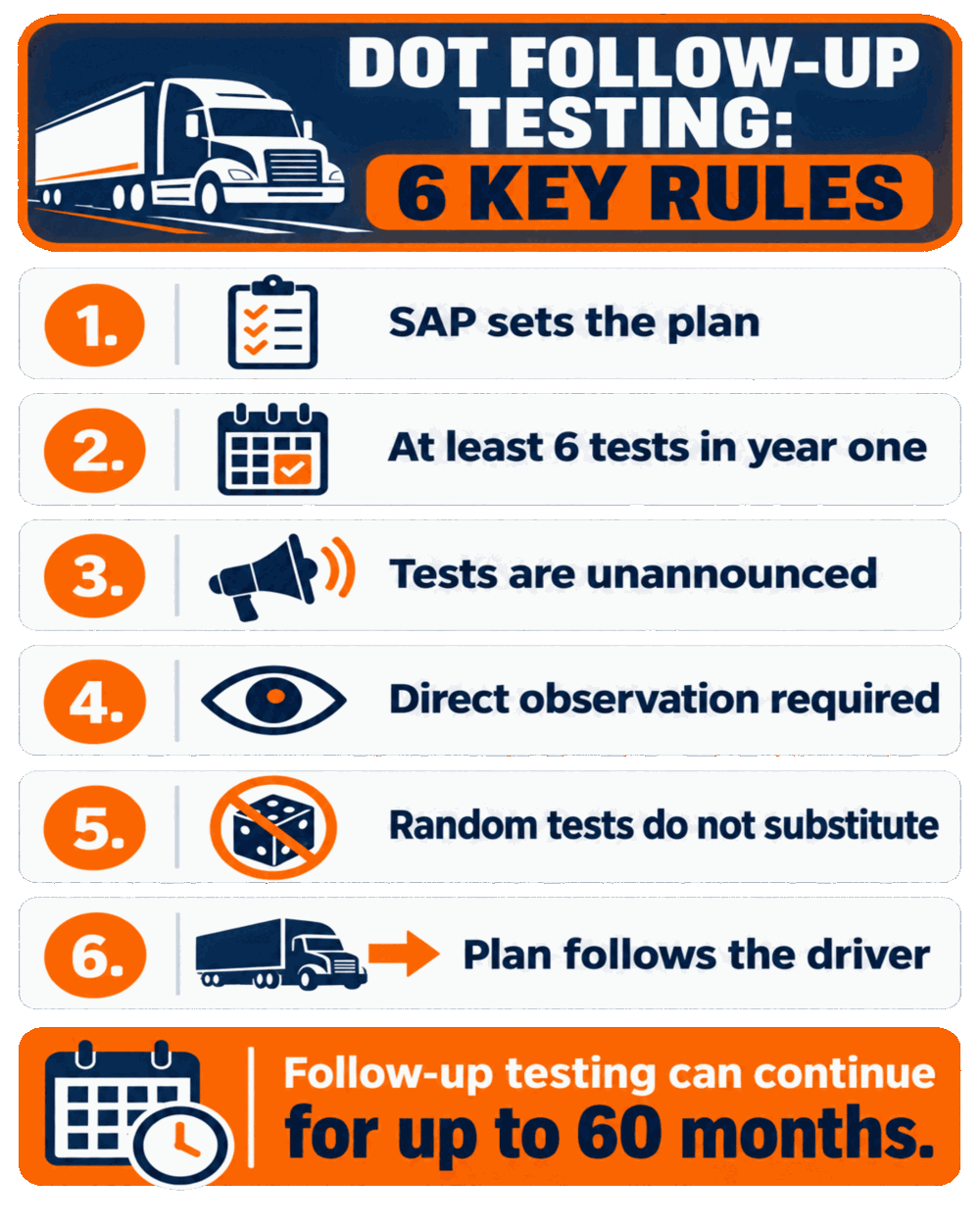
DOT follow-up testing begins after a CDL driver completes the Substance Abuse Professional process, receives a negative return-to-duty test, and resumes safety-sensitive work. The SAP—not the driver or carrier—sets the testing plan. Federal rules require at least six unannounced follow-up tests during the first 12 months of safety-sensitive duty, and the plan may continue for as long as 60 months.
This guide focuses on the stage after return to work: who controls the plan, how the 12-month clock works, why random tests cannot replace follow-up tests, what happens when a driver changes employers, and how the plan is completed.

DOT Follow-Up Testing at a Glance
Under , a qualified SAP creates a written follow-up testing plan after determining that the driver successfully complied with the SAP's education or treatment recommendations. The SAP sends the plan directly to the designated employer representative. The driver does not receive the test schedule, frequency, or duration.
| Rule | Federal requirement | Practical meaning |
|---|---|---|
| Minimum testing | At least 6 follow-up tests in the first 12 months of safety-sensitive duty | Six is the floor, not a guaranteed total |
| Maximum duration | Testing may continue during the following 48 months | The total plan may extend to 60 months of safety-sensitive duty |
| Notice | Tests must be unannounced with no discernible pattern | The driver cannot receive a calendar or predictable cadence |
| Drug collection | Follow-up drug tests are directly observed | The collection site must use the applicable observed procedure |
| Substitution | Random and other tests cannot replace follow-up tests | Each test must be ordered under the correct reason |
| Employment change | The plan follows the employee | A subsequent covered employer must continue the remaining plan |
Key distinction: the return-to-duty test is a one-time eligibility checkpoint before covered work resumes. Follow-up testing is the continuing, unannounced plan after the driver returns.
Drivers who are still working through the earlier SAP evaluation, education or treatment, and observed RTD test can use the separate DOT return-to-duty process guide. A negative RTD test alone does not complete the follow-up plan.
Who Must Complete a DOT Follow-Up Testing Plan?
Follow-up testing applies when a driver committed a DOT drug or alcohol program violation, completed the SAP's required process, obtained the required negative RTD result, and returned to FMCSA-regulated safety-sensitive functions. Covered functions include operating a commercial motor vehicle that requires a CDL, along with the other on-duty functions defined by the FMCSA rules.
A driver who remains in a prohibited status cannot perform those functions. Follow-up testing does not begin merely because the driver met with a SAP or completed a course. It becomes an active employer responsibility when the driver returns to covered safety-sensitive work after the regulated RTD steps.
The plan may address drugs, alcohol, or both. It does not have to match only the substance involved in the original violation. The SAP may identify a need for both types of testing based on the professional evaluation and information from treatment or education providers.
What the SAP Decides—and What the Employer Decides
The SAP is the sole decision-maker for the number and frequency of follow-up tests and whether the plan covers drugs, alcohol, or both, subject to applicable DOT agency rules. The SAP does not choose the actual calendar dates. The employer selects those dates and must preserve the plan's unpredictability.
| Participant | What that participant controls | What that participant must not do |
|---|---|---|
| Substance Abuse Professional | Written plan, number, frequency, duration, and drug/alcohol coverage | Set the actual testing dates or reduce the six-test first-year minimum |
| Employer or DER | Unannounced dates, correct test orders, coordination, and completion records | Create a predictable pattern, give advance notice, or substitute a random test |
| Collector or alcohol technician | Perform the ordered test under Part 40 procedures | Change the test reason or disclose confidential schedule information |
| Driver | Report promptly, cooperate, keep contact information current, and complete every directed test | Demand the schedule, delay without a valid reason, leave early, or treat another test as a replacement |
Can an employer add more DOT follow-up tests?
The employer must carry out the SAP's directions. Part 40 says the employer may not impose additional testing requirements under company authority that go beyond the SAP's follow-up plan and label them as DOT follow-up tests. A company may have a lawful separate non-DOT policy, but it must keep that testing clearly separate from federal forms, records, and reporting.
Can the SAP change the plan?
The SAP may modify follow-up determinations. After the first year, the SAP may terminate a longer plan. The SAP cannot reduce the rule requiring at least six follow-up tests during the first 12 months of safety-sensitive duty. Any valid modification should pass through the regulated SAP-to-employer communication channel rather than an informal request from the driver.
Frequency, Duration, and the 12-Month Clock
“Six tests in 12 months” does not mean one test every other month. requires unannounced timing with no discernible pattern. Depending on the SAP's plan, the employer could schedule more than six tests in year one, place tests closer together, or vary the intervals. The driver should be ready to report whenever properly directed.
The clock is based on months of safety-sensitive duty, not simply pages turning on the calendar. A break from covered work can pause the practical completion period. It does not erase the outstanding tests or automatically convert a partially completed plan into a finished one.
| Example | What happens to the plan | Why |
|---|---|---|
| Driver completes 2 tests in 3 months, then changes carriers | The remaining plan continues with the new covered employer | The requirement follows the employee |
| Driver is laid off after 4 months of covered duty and returns 3 months later | The safety-sensitive duty clock resumes; the break does not satisfy the remaining period | The plan follows the driver through breaks in service |
| Driver receives a random test during the plan | The random test satisfies only the random selection | Another test cannot substitute for a follow-up test |
| A scheduled follow-up test is cancelled under Part 40 | It does not count and must be recollected | Only a completed valid follow-up test satisfies the plan |
| SAP prescribed testing beyond year one | The plan may continue up to 48 additional months unless the SAP later terminates it | Part 40 permits a maximum 60-month follow-up period |
Why there is no personal test calendar
Part 40 prohibits the employer, SAP, and service agents from giving the employee a copy of the follow-up testing schedule or disclosing its frequency or duration. That restriction preserves deterrence and prevents a driver from timing behavior around known dates. The driver can know the general federal rules but not the confidential individual calendar.
Employer Responsibilities for Scheduling and Documentation
The employer must carry out the SAP's plan and may not permit continued safety-sensitive work unless follow-up testing occurs as directed. The DER should securely retain the plan, choose genuinely unannounced dates, issue each test with the correct reason, coordinate with qualified service agents, and track valid completions without exposing the schedule.
Random testing remains a separate obligation. A driver can be selected for a random test and later directed to a follow-up test, even close together. The carrier may not call one test both “random” and “follow-up” or count it twice. The practical differences between the two programs are explained in the DOT random testing guide.
Cancelled, missed, and delayed tests
A cancelled follow-up test does not count toward the plan. The employer must arrange a recollection. A driver should not assume the cancelled event fills one of the required slots or that no further direction will arrive.
A late arrival or missed test raises a different issue. Failure to appear within a reasonable time after notification can become a refusal depending on the facts and applicable rules. Drivers should proceed immediately, communicate unavoidable emergencies through the employer's designated channel, preserve neutral documentation, and never decide on their own to test the next day instead.
Direct Observation and Proper Test Procedures
Under , return-to-duty and follow-up drug tests require direct observation. The employer directs the observed collection, and the collector follows the Part 40 procedure. Declining a required directly observed collection is a refusal to test.
Direct observation for drug testing should not be confused with alcohol-test procedures. Alcohol testing uses a screening test and, when required, a confirmation test conducted by qualified personnel with approved equipment. The SAP's written plan determines whether follow-up testing covers drugs, alcohol, or both; the ordered test must follow the procedure for its type.
| Situation | Correct handling | Common mistake to avoid |
|---|---|---|
| Follow-up drug test | Order and conduct it as a directly observed DOT collection | Using a standard unobserved collection |
| Follow-up alcohol test | Use the Part 40 alcohol-testing process and qualified personnel | Assuming “direct observation” means the urine procedure applies |
| Wrong test reason on paperwork | Contact the DER or service agent promptly for compliant correction | Ignoring the error or relabeling records informally |
| Cancelled result | Arrange recollection and track the new valid completion | Counting the cancelled test toward the SAP total |
| Non-DOT company test | Keep it separate from DOT forms and records | Using it to satisfy the federal follow-up plan |
FMCSA's confirms that follow-up tests are prescribed after a driver completes the SAP and RTD process and that the federal minimum is six directly observed tests in 12 months, with the possibility of four additional years.
Changing Employers, Owner-Operator Status, or Taking a Break
The plan follows the driver to a subsequent employer. A new carrier learns about outstanding requirements through the required drug-and-alcohol history investigation and Clearinghouse information. The new employer is responsible for obtaining the necessary plan information through permitted channels and ensuring the remaining follow-up tests occur.
A driver should disclose the continuing obligation accurately during onboarding and promptly connect the prospective employer with the appropriate records source. Hiding the plan, supplying an unofficial calendar, or assuming that a new USDOT number resets the process can delay lawful return to covered work and create additional compliance problems.
An owner-operator subject to Part 382 must work through a consortium/third-party administrator for required drug-and-alcohol program functions, but the individual cannot simply choose personal testing dates. The follow-up plan still requires compliant employer-side administration, confidential scheduling, correct test reasons, and the regulated reporting chain.
What a break in service does—and does not do
A period outside DOT safety-sensitive work may interrupt the accumulation of safety-sensitive duty months. It does not cancel the plan, reduce the SAP's required number of tests, or allow a private self-ordered test to fill a missing slot. When covered work resumes, the employer must continue the outstanding plan.
When Is Follow-Up Testing Complete?
Completion requires all testing prescribed by the SAP, including the mandatory first-year minimum, to be validly conducted over the applicable safety-sensitive duty period. A driver should not declare the plan complete based only on the number of collection-site visits. Cancelled tests do not count, other DOT test types do not substitute, and the SAP may have prescribed more than six tests or additional years.
The FMCSA Clearinghouse contains the violation, RTD status information, and completion of the follow-up testing plan. It does not serve as a personal calendar showing the confidential schedule. The FMCSA Clearinghouse guide explains driver records, queries, and prohibited status in more detail.
The employer or C/TPA reports follow-up plan completion when the requirements are actually satisfied. A driver should review the personal Clearinghouse record after expected completion and use the official correction process if the displayed information is inaccurate. A status change does not erase the historical violation record under the federal retention rules.
DOT Follow-Up Testing Checklist for CDL Drivers
- □ I completed the SAP's education or treatment recommendations and follow-up evaluation
- □ I received a negative DOT return-to-duty result before resuming safety-sensitive work
- □ My employer or DER has the SAP's written follow-up plan through the proper channel
- □ I understand that six tests in the first 12 months is a minimum, not necessarily my total
- □ I will not ask the SAP, employer, or service agent to reveal my schedule
- □ I keep my phone number and reporting instructions current with my employer
- □ When notified, I report immediately and avoid unnecessary stops or delay
- □ I remain at the collection site until the testing process is complete
- □ I understand that follow-up drug tests require direct observation
- □ I know a random test does not replace a follow-up test
- □ I know a cancelled test does not count and requires recollection
- □ Before changing carriers, I plan for secure transfer of the continuing requirement
- □ I understand that a break from covered work does not erase the plan
- □ After expected completion, I verify my Clearinghouse record for accuracy
Build Job-Ready CDL Skills While You Stay Compliant
A testing plan addresses regulatory compliance; it does not replace vehicle knowledge, inspection habits, backing practice, or safe decision-making. Patriot CDL provides focused, hands-on instruction for eligible students preparing to build practical commercial-driving skills. Contact Patriot CDL to discuss training and enrollment. Drivers must be legally eligible to train and perform the applicable safety-sensitive activities.
Frequently Asked Questions
How many DOT follow-up tests must a CDL driver take?
The federal minimum is six unannounced follow-up tests during the first 12 months of safety-sensitive duty. The SAP may require more tests in year one and may extend testing through the next 48 months.
Can a random test count as a follow-up test?
No. Part 40 prohibits substituting a random or other test for a required follow-up test. Each test must use the correct reason and satisfy its own program requirement.
Does the follow-up testing plan reset when a driver changes employers?
No. The plan follows the employee to subsequent employers and through breaks in service. The new covered employer must continue the remaining requirements.
Are DOT follow-up drug tests directly observed?
Yes. Part 40 requires return-to-duty and follow-up drug collections to be directly observed. Refusing the required observation is a refusal to test.
Educational information only, not legal, medical, or employment advice. Individual SAP plans, employer procedures, and applicable regulations can vary or change. Official U.S. DOT, FMCSA, and Clearinghouse sources reviewed August 21, 2026.