

A DOT drug or alcohol violation does not permanently end a commercial driving career, but a CDL driver cannot simply wait a few days, take a private test, or ask a carrier to clear the record. Before performing any DOT safety-sensitive function again, the driver must complete the federal return-to-duty process with a qualified Substance Abuse Professional, comply with the SAP’s recommendations, and receive the required negative return-to-duty test result.
This guide explains the process in the order a driver actually encounters it: prohibited status, SAP designation, the initial evaluation, education or treatment, the follow-up evaluation, the directly observed RTD test, Clearinghouse reporting, and the continuing follow-up testing plan.

What Is the DOT Return-to-Duty Process?
The return-to-duty process is the federal sequence required after a DOT drug or alcohol program violation. Under , a person who has violated a DOT rule may not perform DOT safety-sensitive duties for any regulated employer until completing the SAP evaluation, referral, and education or treatment process. For an FMCSA-covered CDL or CLP holder, unresolved violations also produce a “prohibited” status in the Drug and Alcohol Clearinghouse.
Completing the SAP’s recommendations makes the driver eligible for the RTD test; it does not itself authorize driving. The employer or properly designated C/TPA must order the DOT RTD test. Before safety-sensitive work resumes, the controlled-substances result must be negative and/or the alcohol concentration must be below 0.02. Even then, the employer makes the separate hiring or reinstatement decision.
| Milestone | What it means | What it does not mean |
|---|---|---|
| SAP designated | The qualified professional can begin the regulated evaluation process | The violation has not been cleared |
| Initial SAP evaluation complete | The SAP has prescribed education, treatment, or both | The driver is not eligible to test unless the SAP later finds successful compliance |
| SAP marks eligible for RTD testing | The follow-up evaluation supports moving to the test | The driver still may not perform safety-sensitive work |
| Negative RTD result reported | Clearinghouse status can change to “not prohibited” | No employer is required to hire or reinstate the driver |
| Follow-up plan completed | All SAP-prescribed follow-up testing has been completed | Normal random and other required testing do not end |
Which CDL Violations Trigger Return-to-Duty?
A verified positive DOT controlled-substances result, a DOT alcohol result of 0.04 or greater, a refusal to test, or another violation of the applicable DOT drug and alcohol prohibitions triggers the return-to-duty requirements. A refusal can involve conduct—such as failing to appear, leaving a collection prematurely, not cooperating, or adulterating or substituting a specimen—not only saying “I refuse.”
The triggering test may have been pre-employment, random, post-accident, reasonable suspicion, return-to-duty, or follow-up. If the violation followed a supervisor’s observation-based decision, the separate reasonable-suspicion testing guide explains that earlier stage. The RTD process begins after a qualifying violation is established; it does not decide whether the original test should have been ordered.
A non-DOT result is not automatically a DOT violation
DOT and non-DOT tests must be kept separate. Company policy, state law, or an employment agreement may impose consequences for a non-DOT result, but a company cannot simply relabel a non-DOT collection as a federal test. Drivers should identify the employer, DOT agency, test reason, and form associated with the event before deciding which process applies.
The Six Steps in the CDL Return-to-Duty Process
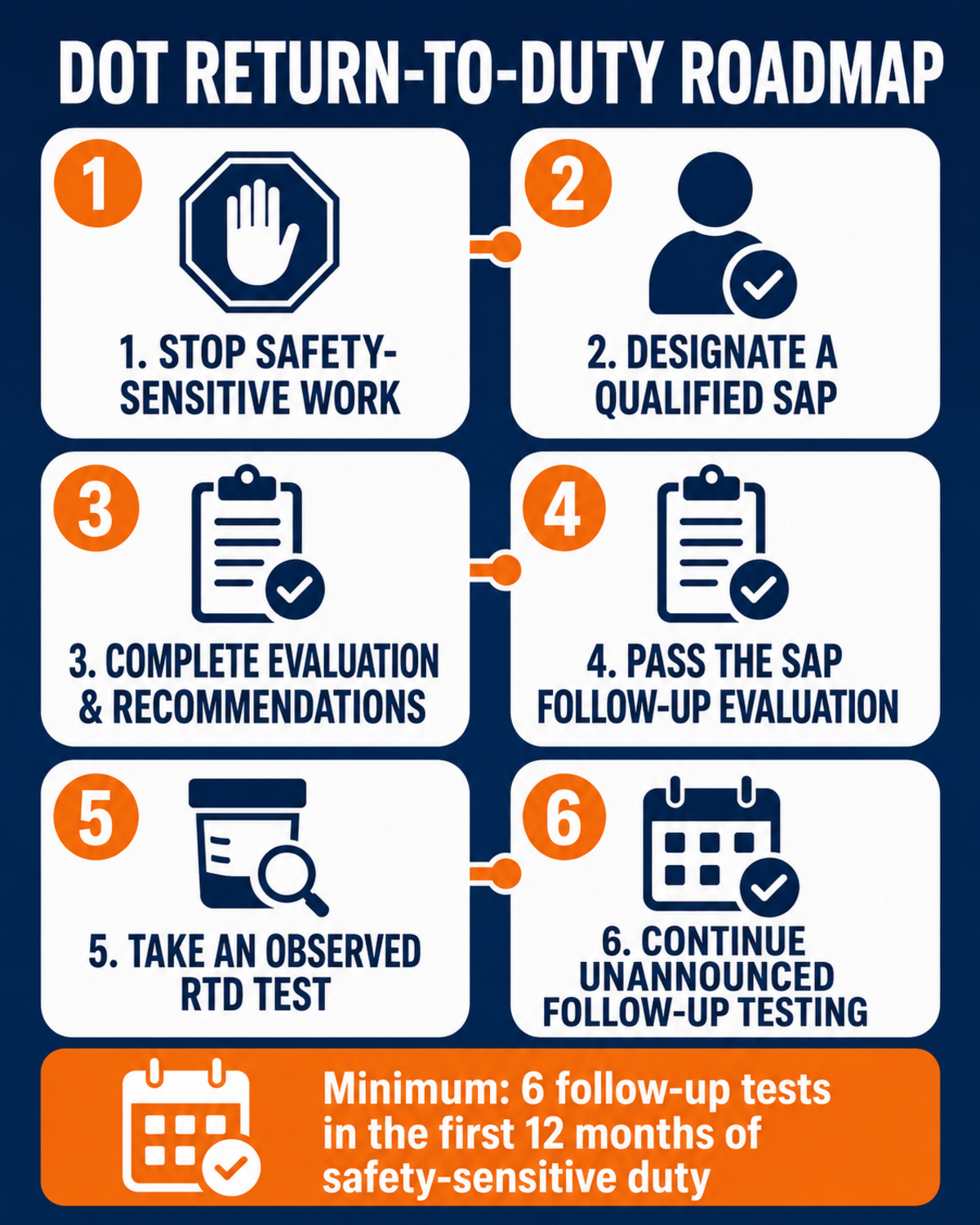
| Step | Primary actor | Required outcome |
|---|---|---|
| 1. Stop safety-sensitive work | Driver and employer | No CMV operation or other covered duty while prohibited |
| 2. Designate a qualified SAP | Driver | The SAP accepts the Clearinghouse designation |
| 3. Initial evaluation and recommendations | SAP | Individualized education, treatment, or both are prescribed |
| 4. Follow-up SAP evaluation | Driver and SAP | The SAP determines whether the driver demonstrated successful compliance |
| 5. Observed RTD test | Employer or authorized C/TPA | Negative drug result and/or alcohol result below 0.02 |
| 6. Follow-up testing | Employer | Unannounced tests completed exactly as the SAP directs |
Step 1: stop every covered safety-sensitive function
Once the employer receives a verified violation or determines a refusal under the governing rule, the driver must be removed from DOT safety-sensitive functions. For a commercial driver, that includes operating a CMV and can include other covered activities connected to operation. Changing carriers, moving to part-time work, or allowing a CDL to expire does not complete the RTD process.
Step 2: select and designate a qualified SAP
The employer must provide information about qualified SAP services, even if the driver is terminated. The driver chooses a qualified SAP and, for an FMCSA-covered violation, designates that SAP in the Clearinghouse. A counselor, coach, clinic, or testing service is not a DOT SAP merely because it uses that label in an advertisement.
Step 3: complete the initial evaluation and recommendations
The SAP conducts an individual clinical evaluation and recommends education, treatment, or both. The recommendation must fit the driver’s circumstances; DOT warns against “cookie cutter” plans. The SAP is a safety gatekeeper—not the driver’s advocate, the employer’s advocate, or a person who sells an instant clearance.
The driver must complete the prescribed work and keep attendance, payment, completion, and provider records. The amount of education or treatment is not a federal flat number of classes or days. It depends on the SAP’s professional assessment and the driver’s documented progress.
Step 4: return to the SAP for a follow-up evaluation
Under , the SAP reviews information from the education or treatment provider and conducts a follow-up clinical interview. If the driver has demonstrated successful compliance, the SAP sends a written report to the designated employer representative and records RTD eligibility in the Clearinghouse. If compliance is not successful, the driver cannot proceed to safety-sensitive work and may need additional steps.
Step 5: take the employer-ordered return-to-duty test
The driver does not order a personal laboratory test and upload it. A current or prospective employer subject to Part 382 orders the DOT RTD test after the SAP records eligibility. The collection must use the RTD test reason and follow DOT procedures, including direct observation. The required negative result is then reported to the Clearinghouse by the responsible employer or C/TPA.
Step 6: complete the SAP’s follow-up testing plan
Return to safety-sensitive work starts the continuing follow-up period. The employer schedules the tests without advance notice and with no discernible pattern. The driver must remain compliant even after changing employers or returning from a break in service.
How to Choose and Work With a Qualified DOT SAP
A qualified SAP must hold an eligible professional credential, complete DOT qualification training and an examination, maintain current knowledge, and complete at least 12 professional-development hours during each three-year period. Remote evaluations are permitted, but the SAP must remain within the geographic limits of the professional credential.
Before paying, ask the SAP to confirm the credential, DOT qualification, ability to accept an FMCSA Clearinghouse designation, evaluation format, fee structure, and how reports are transmitted to the DER. Do not send CDL numbers, birth dates, Login.gov credentials, or money to someone whose identity and qualifications have not been independently verified.
| Verify before starting | Good evidence | Red flag |
|---|---|---|
| Professional credential | Current license or recognized certification that meets 40.281 | Only a marketing title or unverified badge |
| DOT SAP qualification | Documented training, exam, and continuing education | Promises to “clear” any violation immediately |
| Clearinghouse participation | SAP accepts the driver’s formal designation | Requests the driver’s password or offers to impersonate the driver |
| Evaluation | Individual interview and documented recommendations | Fixed plan sold before any evaluation |
| Reports | Sent directly to the employer’s DER as the rule requires | Offers to sell a negative test or a false entry |
Can a driver shop for a more favorable second SAP?
Not simply because the driver dislikes the first recommendation. Part 40 does not permit the employee or employer to seek a second SAP evaluation to change the initial SAP’s decision. If the original SAP becomes genuinely unavailable, the employer should follow the federal rules for transferring the process rather than informally starting over.
What Happens During the Return-to-Duty Test?
Once the SAP determines successful compliance, requires an employer that wants to permit a return to covered work to ensure the driver takes the RTD test. The controlled-substances result must be negative and/or the alcohol result must be below 0.02 before the driver resumes safety-sensitive functions.
The collection is directly observed
DOT return-to-duty drug testing uses direct-observation procedures. The collection site must follow Part 40 privacy, observer, form, and chain-of-custody requirements. The driver should bring appropriate identification, verify that the test reason is “Return to Duty,” follow the collector’s instructions, and keep the employee copy. Refusal or tampering can create another violation.
A negative result creates eligibility, not a job guarantee
The employer may return a compliant driver to safety-sensitive functions, but Part 40 does not require the employer to rehire, reinstate, or assign the driver. The carrier still applies its safety, qualification, insurance, and employment standards. Drivers re-entering the hiring process can also review the separate DOT pre-employment testing checklist, because a prospective carrier’s onboarding obligations remain distinct from the RTD test.
Clearinghouse Status and Commercial Driving Privileges
For FMCSA-regulated drivers, the SAP records the initial assessment date and the date the driver becomes eligible for RTD testing. The employer or authorized C/TPA reports the negative RTD result. That result changes the driver’s Clearinghouse status from “prohibited” to “not prohibited,” subject to accurate reporting and processing.
Since November 18, 2024, state licensing agencies must use Clearinghouse status in specified CDL and CLP transactions and downgrade commercial driving privileges for drivers who remain prohibited. After a negative RTD result changes the federal status, a driver may still need to complete separate state reinstatement requirements before operating. The broader FMCSA Clearinghouse guide explains queries, consent, reporting, prohibited status, and state downgrade interaction.
What if the driver does not currently have an employer?
FMCSA’s driver FAQ describes a limited route for a driver without a current or prospective Part 382 employer. The driver may register in the Clearinghouse as an owner-operator and designate a C/TPA for the limited purpose of directing the RTD test and reporting the negative result. FMCSA specifically says the driver should not apply for a USDOT number merely to use this option. When the driver later resumes safety-sensitive employment, the employer—not that limited-purpose arrangement—must administer the continuing follow-up plan.
A normal driver registration alone does not authorize someone to self-order an RTD test or self-report a negative result. The driver must use a current or prospective regulated employer, or follow FMCSA’s limited owner-operator/C/TPA instructions exactly.
Follow-Up Testing After the Driver Returns
Under , the SAP alone determines whether follow-up testing covers drugs, alcohol, or both, and sets the number and frequency. The minimum is six unannounced tests during the first 12 months of safety-sensitive duty. The SAP may require more tests in that first year and may extend testing through the next 48 months—for a maximum potential period of 60 months.
| Follow-up rule | Driver impact | Employer responsibility |
|---|---|---|
| At least 6 tests in first 12 months | Every required test must be completed while in safety-sensitive duty | Schedule all required tests |
| Unannounced, no discernible pattern | The driver does not receive a test calendar | Choose unpredictable dates and provide no advance notice |
| Direct observation | Collection follows observed procedures | Order the correct follow-up test reason |
| Plan follows the employee | Changing employers or taking a break does not erase remaining tests | Obtain and continue the plan when required |
| No substitution | A random or other test does not count as a follow-up test | Do not replace or double-count tests |
| Cancelled test | The obligation remains | Arrange recollection; do not count the cancellation |
The employee must not receive the follow-up schedule or be told its frequency and duration. The plan follows the driver between employers, while time is measured in safety-sensitive duty. A break from covered work can pause the practical testing period rather than erase it. The Clearinghouse records completion of the plan, but it does not display the confidential schedule itself.
How Long Does Return-to-Duty Take, and Who Pays?
Federal rules do not promise a fixed number of days or a flat price. Timing depends on SAP availability, the individual evaluation, the recommended education or treatment, how quickly the driver completes it, the follow-up evaluation, employer or C/TPA coordination, collection scheduling, laboratory processing, and accurate Clearinghouse reporting. A provider advertising guaranteed same-day clearance before evaluating the driver is not describing the regulated process.
Part 40 does not require an employer to pay for SAP services, education, treatment, or testing, and it does not require an employer to hold a position open. Payment may depend on employer policy, a collective bargaining agreement, insurance, an employee-assistance program, or state law. Get written estimates and ask which services are included, but do not select a provider solely because it promises the fastest or cheapest outcome.
Common Mistakes and Return-to-Duty Scams
- Taking a private “clean” test: only the properly ordered DOT RTD test completes the testing milestone.
- Driving after SAP eligibility: eligibility to test is not permission to resume safety-sensitive work.
- Using an unqualified counselor: the professional must meet all DOT SAP qualifications and accept the formal designation.
- Buying a Clearinghouse entry: no legitimate service can lawfully sell a negative result or fabricated completion record.
- Sharing Login.gov credentials: the driver should control the account and never give a password or one-time code to a “helper.”
- Assuming a new carrier resets the plan: follow-up testing follows the employee.
- Counting a random test as follow-up: federal rules prohibit that substitution.
- Ignoring state licensing status: “not prohibited” in the Clearinghouse may not by itself complete the state restoration process.
FMCSA warned drivers in January 2026 about scammers who seek CDL numbers and personal data, promise false RTD or follow-up entries, and later use the information for extortion or fraudulent violations. Verify every SAP, employer, and C/TPA independently. Report suspected Clearinghouse fraud through FMCSA’s official channels.
DOT Return-to-Duty Checklist for CDL Drivers
- □ I have stopped every DOT safety-sensitive function while prohibited
- □ I reviewed my Clearinghouse record and confirmed the reported violation
- □ I obtained SAP information from the employer or another reliable source
- □ I verified the SAP’s credential, DOT qualification, and identity before paying
- □ I personally designated the SAP in the Clearinghouse
- □ I attended the complete initial evaluation and answered accurately
- □ I received and completed the prescribed education or treatment
- □ I kept provider, attendance, payment, and completion records
- □ I returned to the SAP for the required follow-up evaluation
- □ I confirmed that the SAP recorded my eligibility for RTD testing
- □ A current or prospective employer, or authorized C/TPA, ordered my DOT RTD test
- □ I verified the “Return to Duty” test reason and kept my employee copy
- □ I confirmed that the negative RTD result was reported correctly
- □ I verified both Clearinghouse and state CDL status before operating a CMV
- □ I understand that follow-up testing continues after I return to covered work
- □ I will not ask for or accept advance notice of follow-up test dates
Frequently Asked Questions
Can I complete the DOT return-to-duty process without an employer?
FMCSA provides a limited option for a driver without a current or prospective Part 382 employer to register as an owner-operator and designate a C/TPA solely to direct the RTD test and report the negative result. The future employer must administer the continuing follow-up testing plan when safety-sensitive work resumes.
How many follow-up tests are required after a return-to-duty test?
The federal minimum is six unannounced tests during the first 12 months of safety-sensitive duty. The SAP may require more in that period and may extend testing for up to another 48 months.
Can a negative private drug test clear a CDL driver’s prohibited status?
No. The required RTD test must be ordered through the regulated process after the qualified SAP determines successful compliance. A personal or non-DOT test does not replace it.
Does a negative RTD test require the previous employer to rehire the driver?
No. A qualifying negative result permits a return to safety-sensitive functions from the federal testing perspective, but the employer retains the separate personnel decision, subject to other applicable law or agreements.
Educational information only, not legal, medical, clinical, or employment advice. Individual SAP recommendations, employer policies, state restoration steps, and federal guidance can change. Official U.S. DOT and FMCSA sources reviewed August 19, 2026; the U.S. DOT Part 40 index was updated May 15, 2026.