

A DOT pre-employment drug test is a hiring checkpoint for many CDL driving jobs—but it is not the same as a DOT physical, a criminal-background check, or an FMCSA Clearinghouse query. For a driver covered by 49 CFR Part 382, the employer generally must receive a verified negative controlled-substances test result before allowing the driver to perform a safety-sensitive function, unless the employer documents a narrow regulatory exception.
This guide explains when the test is required, how the collection and Medical Review Officer process work, what a driver should bring, why a pending result is not clearance to drive, and which employer checks remain separate.

Quick Answer: When Must a CDL Driver Take a Pre-Employment Drug Test?
Under , a covered driver must undergo a controlled-substances test before first performing a safety-sensitive function for an employer. The employer may not allow the driver to begin that work until it has received a verified negative result from the Medical Review Officer, or MRO, or the consortium/third-party administrator.
For a typical motor carrier, safety-sensitive functions include driving a commercial motor vehicle that requires a CDL and the on-duty work immediately connected with operating, inspecting, servicing, loading, unloading, or attending that vehicle. Orientation, paperwork, classroom instruction, or other non-safety-sensitive tasks may occur while a result is pending if the employer permits them. The driver still may not perform a covered safety-sensitive function until the federal pre-employment condition is satisfied.
| Hiring stage | What the driver may do | What the employer needs before covered driving |
|---|---|---|
| Application and interview | Complete forms, discuss experience, provide requested history | No safety-sensitive work yet |
| Conditional offer or onboarding | Attend non-driving orientation or training if the employer permits | Schedule the DOT test and complete separate qualification checks |
| Result pending | Remain available and respond promptly if the MRO contacts you | A pending test is not a verified negative result |
| Verified negative received | Begin assigned work only after the employer confirms clearance | Employer must also satisfy Clearinghouse and other qualification requirements |
Drug Test vs. DOT Physical, Clearinghouse Query, and Background Review
Several pre-hire steps can happen close together, which makes them easy to confuse. Each serves a different purpose and one does not automatically complete another.
| Requirement | What it evaluates | Typical output | Does it replace the drug test? |
|---|---|---|---|
| DOT pre-employment drug test | A specimen tested under DOT procedures for the federally regulated drug panel | Verified result reported through the employer's testing program | No—it is the test itself |
| FMCSA Clearinghouse pre-employment query | Whether the driver has a drug-and-alcohol program record that prohibits safety-sensitive work | Full-query response after the driver provides electronic consent | No; it is a records query, not a new specimen test |
| DOT physical | Medical qualification under applicable physical-qualification standards | Medical certification status and examination documentation | No; it is a medical exam |
| MVR and qualification review | License status, driving record, work history, and other driver-qualification evidence | Carrier qualification records and hiring decision | No |
| Company background check | Information permitted by law and employer policy | Consumer report or other employer review | No |
The pre-employment Clearinghouse query is a full query requiring the driver's specific electronic consent. prohibits an employer from assigning safety-sensitive work before conducting it and confirming that the driver's record does not show a current prohibition. Our FMCSA Clearinghouse guide for new CDL drivers explains registration, consent, query results, and prohibited status in more detail.
The employer also integrates testing evidence with its broader CDL driver qualification file process. A negative drug test does not prove that a CDL is valid, a medical status is current, an MVR is acceptable, or an application is complete.
Who Is Covered and When Does Testing Happen?
Part 382 generally covers drivers who operate commercial motor vehicles that require a CDL in commerce. Coverage depends on the vehicle, operation, and applicable federal definitions—not only on the job title. Motor carriers must determine whether an operation falls under Part 382 and whether a specific exception applies.
New hire entering a CDL driving position
A carrier hiring a driver for covered safety-sensitive functions normally directs that person to a collection site before the first covered assignment. The employer, not the driver, initiates the DOT test through its testing program and supplies the collection information required by Part 40.
Current employee transferring into covered driving
The rule can apply when an existing employee moves from a non-covered role into a covered driving position. A negative non-DOT company test does not substitute for a federally compliant DOT test. DOT and non-DOT tests must be identified and processed under their respective rules.
Owner-operators and small carriers
An owner-operator subject to Part 382 does not bypass testing by being self-employed. Owner-operators generally participate in a consortium/third-party administrator that manages random-selection and other testing-program functions. Before dispatching covered work, the applicable pre-employment conditions still must be met.
School bus and other intrastate CDL operations
Part 382 coverage can extend to CDL-required commercial driving in intrastate commerce. State or local rules and employer policies may add requirements. Drivers should follow the hiring motor carrier's instructions and avoid assuming that a local route, government contract, or passenger operation is automatically outside federal testing rules.
The Narrow Exception for a Recent Compliant Testing Program
Section 382.301(b) allows an employer to skip a new pre-employment controlled-substances test only when every condition in the exception is satisfied and verified. This is an employer compliance decision—not a waiver a driver can claim merely by showing an old negative result.
| Required condition | Regulatory time window | What the employer must establish |
|---|---|---|
| Recent participation | Within the previous 30 days | The driver participated in a controlled-substances testing program meeting Part 382 requirements |
| Testing or random-program history | Tested within the past 6 months, or participated in the random program for the previous 12 months | One of the two alternatives is documented |
| No known recent violation record | Previous 6 months | No known prior employer has a record of a Part 382 or other DOT-agency controlled-substances violation for the driver |
| Program verification | Before relying on the exception | The employer contacts the program and obtains the information specified by 382.301(c) |
The verification includes the program's name and address, confirmation that the driver participated, confirmation that the program conformed to Part 40, qualification and refusal information, the last test date, and results or violations within the relevant period. If the employer cannot verify compliant participation, the rule directs the employer to conduct a pre-employment test.
A wallet card, laboratory printout, screenshot, or statement that “I was tested at my last job” is not enough by itself. Keep prior-employer and testing-program contact details available, but let the new carrier make and document the regulatory determination.
Is a Pre-Employment Alcohol Test Required?
Federal Part 382 rules do not universally require a pre-employment alcohol test. Section 382.301(d) says an employer may conduct one. If the employer chooses that option, it must apply the practice consistently to covered employees, conduct it after a contingent offer or transfer, use Part 40 procedures, and receive a result below 0.04 before the person performs safety-sensitive functions.
This distinction matters: the mandatory federal pre-employment requirement is generally the controlled-substances test, subject to the documented exception described above. A carrier may also have lawful company policies, contractual requirements, or non-DOT testing for positions or circumstances outside the federal mandate. The paperwork should identify whether a collection is a DOT test or a non-DOT test.
What Happens During the DOT Testing Process?
establishes the procedures used across DOT-regulated workplace testing programs. The employer, collection site, laboratory, MRO, and designated employer representative each have defined roles. The driver should focus on identity verification, following collector instructions, reviewing the form, and remaining reachable.
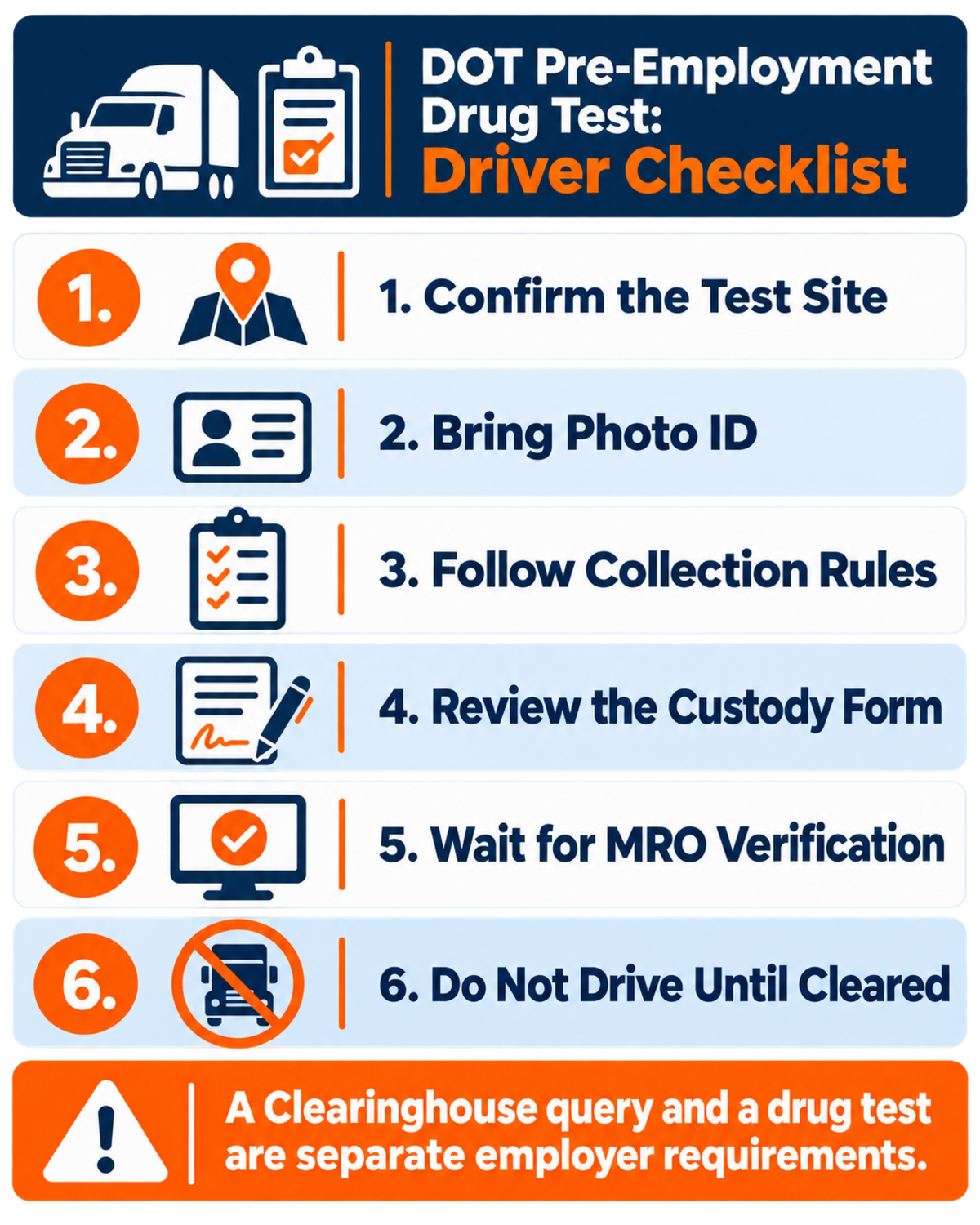
1. Employer schedules or authorizes the test
The carrier or its service agent provides the required employer and testing information. Confirm the collection-site address, hours, deadline, and whether an appointment is required. Do not substitute a home test, retail instant test, or a test you arrange independently unless the employer explicitly confirms that it is the authorized DOT collection.
2. Collector verifies identity and begins the federal form
Bring a current government-issued photo ID. Part 40 allows identity to be established through acceptable photo identification or, in limited circumstances, positive identification by an employer representative. The collector completes the applicable portions of the Federal Drug Testing Custody and Control Form and explains the collection steps.
3. Driver follows the collection instructions
Cooperate with instructions designed to protect specimen security and integrity. Do not bring unauthorized items into the collection area, tamper with materials, leave before the process is complete, or refuse a required step. Direct observation is not automatic in every pre-employment collection; it is used only when Part 40 authorizes or requires it.
4. Specimen is sealed and documented
Before signing, check that your identifying information is accurate and observe the collector complete the required sealing and labeling steps. The custody-and-control documentation links the specimen to the correct donor while limiting unnecessary disclosure of medical information.
5. Laboratory tests and the MRO verifies
A laboratory result is reviewed through the MRO process. The MRO is a licensed physician with specific responsibilities under Part 40. When a laboratory reports a non-negative result or another issue requiring review, the MRO may contact the driver to discuss legitimate medical explanations and request supporting information. A collector or recruiter does not make that medical verification decision.
6. Employer receives the verified result
The driver should not treat a collection-site receipt as clearance. The carrier must receive the verified result through its testing program and must complete its other required checks. Wait for the employer's explicit confirmation before performing any covered safety-sensitive duty.
Negative, Pending, Non-Negative, and Refusal Outcomes
| Status | What it means for the driver | Practical next step |
|---|---|---|
| Verified negative | The pre-employment drug-test condition is satisfied for that employer, subject to all other hiring requirements | Wait for the carrier to confirm full clearance and assignment |
| Pending or delayed | The employer has not yet received a verified negative result | Remain reachable; do not perform covered safety-sensitive work |
| MRO contact requested | The verification process needs driver input | Respond promptly and provide truthful, requested documentation directly to the MRO |
| Verified positive, adulterated, or substituted result | A DOT violation is reported and safety-sensitive work is prohibited | Stop covered duties and follow the DOT return-to-duty process if seeking to return |
| Refusal to test | A refusal is treated as a DOT drug-and-alcohol program violation | Do not perform covered duties; obtain information about the SAP and return-to-duty process |
A verified negative result clears only the testing requirement; it does not guarantee a job offer or replace the carrier's other qualification decisions. A verified violation requires removal from safety-sensitive functions. A driver who wants to return to regulated work must complete the Substance Abuse Professional evaluation and education/treatment process, obtain a negative return-to-duty test, and comply with the follow-up plan.
Refusal is broader than verbally saying “no.” Under Part 40, conduct such as failing to appear within a reasonable time, leaving before the collection is complete, failing to provide a specimen without an adequate medical explanation, failing to cooperate, or tampering can meet a refusal definition depending on the facts and required determination. If an emergency or documented problem occurs, communicate immediately with the collector and employer; do not simply leave.
How CDL Applicants Can Prepare Without Creating Problems
Follow the employer's directions exactly
Use the assigned site and arrive within the stated window. Save the employer or designated representative's contact information in case the site is closed, the authorization is missing, or the collector reports a problem. Document the time of arrival and whom you contacted without photographing protected collection materials.
Bring identification, not unnecessary medical paperwork
Take a current photo ID and any authorization the employer provided. Do not hand a medication list to the collector unless instructed under the procedure. If the MRO contacts you, discuss prescriptions and supporting records directly through the MRO's secure process. Never stop or change a prescribed medication solely to prepare for a drug test without speaking with the prescribing clinician.
Avoid myths about hydration and “cleanses”
Extreme fluid intake, commercial detox products, substituted specimens, and additives can create invalid, dilute, adulterated, or substituted results and may lead to recollection or a violation determination. Follow normal routines and the collector's instructions. There is no legitimate shortcut around the federal process.
Keep your contact details current
Provide an accurate phone number and monitor voicemail after collection. An MRO may need to reach you within a limited verification process. Responding promptly does not guarantee a particular result, but failing to engage can remove the opportunity to provide a legitimate medical explanation.
Build job readiness beyond compliance
Passing a pre-employment test is one gateway to a driving job; employers also evaluate vehicle-control skills, inspection habits, safety judgment, work history, and fit for the assigned equipment. Drivers still building those skills can review Class A CDL training in Levittown before applying for tractor-trailer positions.
DOT Pre-Employment Drug Test Checklist for CDL Drivers
- □ I confirmed that the employer authorized a DOT pre-employment test
- □ I have the correct collection-site address, hours, deadline, and employer contact
- □ I will bring a current government-issued photo ID and requested authorization
- □ I understand that a Clearinghouse full query is separate and may require electronic consent
- □ I will follow the collector's instructions and remain until the process is complete
- □ I will review my identifying information before signing the custody-and-control form
- □ I will keep the employee copy or receipt provided at collection
- □ I will monitor calls and voicemail in case the MRO needs to contact me
- □ I will discuss legitimate prescriptions with the MRO, not with unrelated hiring staff
- □ I will not use detox products, additives, substitution, or extreme hydration
- □ I will not perform safety-sensitive work until the employer confirms clearance
- □ I understand that a negative result does not replace license, medical, MVR, and qualification checks
Frequently Asked Questions
Can a CDL driver begin work while the pre-employment drug-test result is pending?
The employer may allow non-safety-sensitive onboarding tasks, but it may not allow a covered driver to perform a safety-sensitive function until it receives a verified negative controlled-substances test result or has properly documented the regulatory exception.
Does a negative Clearinghouse query replace the pre-employment drug test?
No. The Clearinghouse query checks the federal record for a current prohibition and certain reported violations. The pre-employment drug test is a separate specimen-testing requirement. A covered employer generally must complete both before assigning safety-sensitive work.
Is pre-employment alcohol testing mandatory for CDL drivers?
Not universally under Part 382. An employer may choose to conduct it, but then must follow Part 40, apply the practice consistently to covered employees, test after a contingent offer or transfer, and receive a result below 0.04 before safety-sensitive work begins.
Can a recent test from a previous employer be used?
Only when the new employer verifies every condition in the 49 CFR 382.301(b) exception, including recent program participation, qualifying test or random-program history, and no known recent violation record. A personal copy of an old negative result does not establish the exception by itself.
Educational information only, not legal, medical, or employment advice. Coverage, exceptions, employer policies, and federal or state rules can change. Official eCFR and U.S. DOT sources reviewed August 15, 2026; eCFR Title 49 was displayed as current through August 13, 2026.