


DOT random testing does not mean a safety manager can choose a driver based on suspicion, convenience, or personal preference. For CDL-covered motor-carrier operations, drivers must be selected by a scientifically valid random method, every eligible driver must have an equal chance during each selection, and tests must be unannounced and spread reasonably throughout the year.
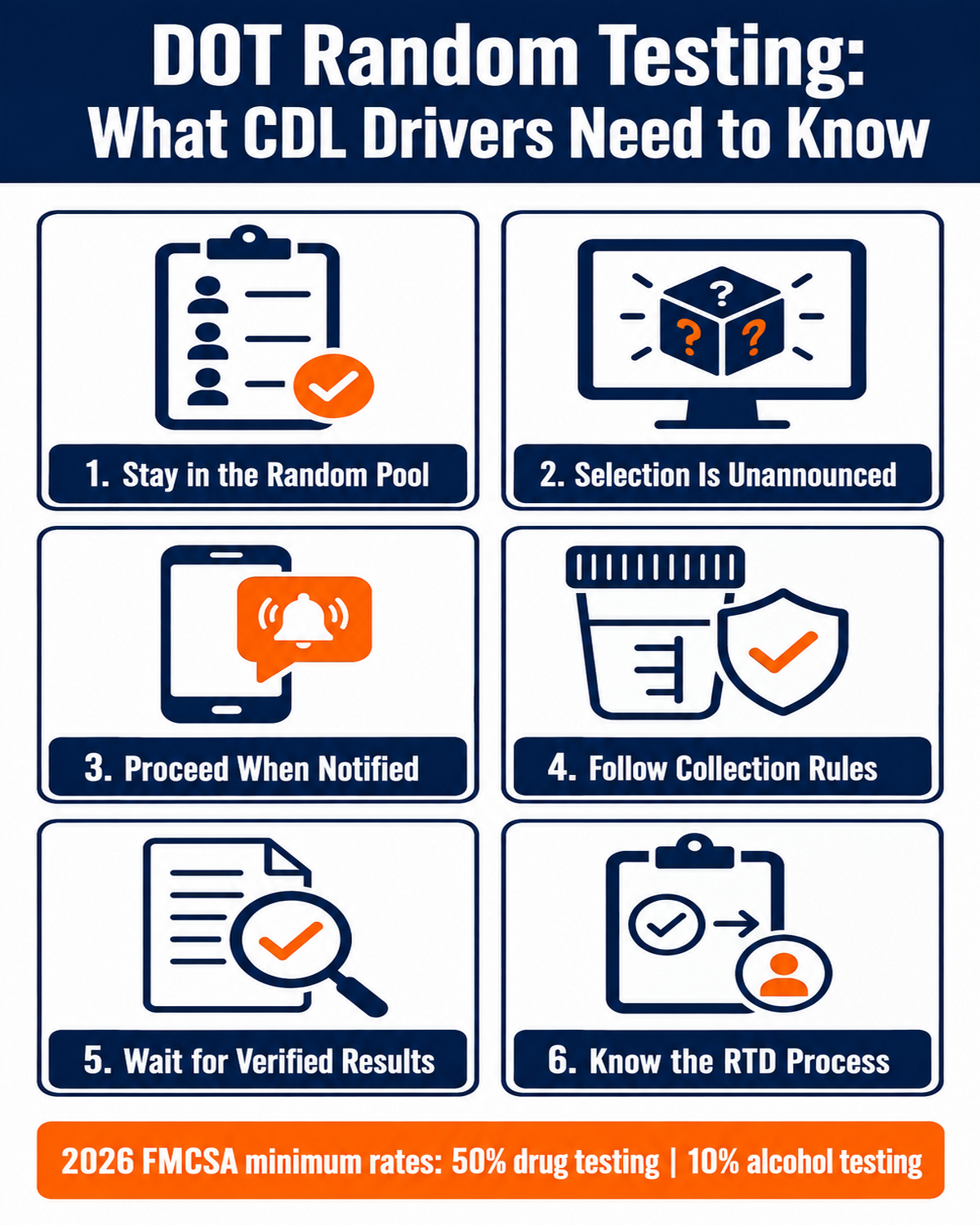
For 2026, the FMCSA minimum annual rates remain 50% for random controlled-substances testing and 10% for random alcohol testing. Those percentages apply to the employer's average number of covered driver positions—not to each driver's personal odds of being tested exactly once.

Quick Answer: What Are the FMCSA Random-Testing Rates for 2026?
The U.S. Department of Transportation's official lists the FMCSA minimums as 50% for controlled substances and 10% for alcohol. DOT states that the FMCSA rates did not change for 2026. The chart was updated January 15, 2026.
| FMCSA random test | 2026 minimum annual rate | Rate is calculated from | Important driver point |
|---|---|---|---|
| Controlled substances | 50% | Average number of covered driver positions | A driver may be selected more than once or not selected during the year |
| Alcohol | 10% | Average number of covered driver positions | Testing is limited to the safety-sensitive time window |
The percentages are employer or consortium program minimums. A carrier with an average of 100 covered driver positions needs enough completed random controlled-substances tests during the year to meet at least the 50% rate, and enough completed random alcohol tests to meet at least the 10% rate. It does not follow that 50 named drivers must each be tested once. Each selection event starts with every eligible driver having an equal chance, so repeat selection is possible.
Who Must Be Included in the FMCSA Random-Testing Pool?
says every employer must comply with the random-testing requirements and every covered driver must submit when selected. The pool is generally for drivers who operate commercial motor vehicles requiring a CDL in commerce and who are subject to Part 382.
Coverage turns on the vehicle and regulated function, not the wording of a job title. A person described as a technician, mechanic, laborer, supervisor, seasonal worker, school-bus substitute, or delivery specialist can still be a covered driver if the person operates a CDL-required CMV for the employer. Conversely, an employee who drives only a vehicle that does not meet the Part 382 coverage definition cannot be placed in the DOT pool merely because the employer wants broader workplace testing.
| Worker or situation | DOT random pool treatment | Reason |
|---|---|---|
| Full-time driver of a CDL-required CMV | Include while employed in the covered position | Performs FMCSA-regulated safety-sensitive functions |
| Part-time or intermittent CDL driver | Include | Part-time status does not remove Part 382 coverage |
| Supervisor who occasionally drives a covered CMV | Include while assigned to that covered function | Actual safety-sensitive duties control |
| Non-CDL driver of an 18,000-pound GVWR vehicle | Do not include in the DOT pool solely for that driving | FMCSA guidance says non-CDL drivers must remain outside the DOT random pool |
| Single-driver owner-operator not leased to another motor carrier | Participate through a consortium | A one-person pool cannot produce a meaningful random selection |
| Driver working for two motor carriers | Normally appears in each employer's applicable program | Each employer has its own compliance duty |
DOT and non-DOT pools must stay separate
An employer may have a broader drug-free-workplace policy or test employees who are not covered by DOT rules. Those tests cannot be represented as DOT tests, and non-covered employees cannot be mixed into the FMCSA random pool. Mixing populations changes the covered drivers' selection odds and undermines the required rate calculation.
The pool should reflect current driver positions
Employers calculate the annual rate using the average number of covered driver positions during their selection periods. Drivers who enter or leave covered positions affect that average. A carrier or consortium must keep its roster current so a former driver is not selected while an active covered driver is omitted.
How DOT Random Selection Actually Works
Section 382.305 requires a scientifically valid method, such as a computer-based random-number generator matched to payroll IDs, Social Security numbers, or comparable identifiers. Each eligible driver must have an equal chance every time the selection is made. The carrier may use a consortium/third-party administrator, but the employer remains responsible for ensuring that the pool and rates comply.
Random does not mean evenly rotating through the roster
A rotation that deliberately avoids selecting anyone twice is predictable and is not the same as independent random selection. A driver selected in one quarter goes back into the eligible pool for the next selection if still covered. That person might be selected again. Another eligible driver might go through the year without selection.
Selections and tests must be spread through the year
Tests must be unannounced, and the dates must be spread reasonably throughout the calendar year. A carrier should not wait until December and attempt to complete its entire annual requirement at once. FMCSA guidance recommends regular selection periods, and each selected driver must be tested within the period for which the selection was made.
A manager cannot substitute a favorite “alternate”
The person identified through the random process is the person to be tested. FMCSA permits an alternate only in limited circumstances, such as when the originally selected driver will be unavailable throughout the entire selection period because of a long-term absence. Replacing a selected driver merely because a collection is inconvenient defeats the selection process.
| Random-program principle | Compliant practice | Problem practice |
|---|---|---|
| Equal chance | All active covered drivers are eligible at every selection | Managers remove preferred drivers or add non-covered workers |
| Unannounced | Driver learns of selection only when instructed to test | Roster or likely testing date is disclosed in advance |
| Reasonable distribution | Selections and collections occur throughout the year | Annual quota is postponed to a last-minute testing rush |
| Selection-period completion | Selected driver tests during the assigned period | Carrier carries the name into a later quarter without a permitted reason |
| Impartiality | Scientifically valid process determines names | Supervisor chooses a driver based on attitude, rumors, or performance |
What Should a CDL Driver Do When Selected?
Once notified, the driver must proceed to the test site immediately as directed. Section 382.305(l) says that if the driver is performing a safety-sensitive function other than driving a CMV at notification, the employer must have the driver stop that function and go to the testing site as soon as possible.
Safe communication still matters. A driver should never read a message, handle paperwork, or make a call while the truck is moving. The carrier should manage notification so the driver can receive instructions safely. Once the driver is safely notified, unnecessary stops, detours, delay, or leaving the process can create serious refusal questions.
Practical notification sequence
- Confirm the instruction. Identify the employer representative, test type, authorized collection site, and any deadline.
- Secure the operation. Park or transfer responsibility for the vehicle and cargo as the employer directs.
- Proceed without avoidable delay. Go directly to the authorized site; do not add errands or personal stops.
- Bring identification. Use a current government-issued photo ID and any employer authorization.
- Follow Part 40 collection rules. Cooperate with identity, form, specimen, sealing, and documentation steps.
- Remain reachable. Monitor calls in case the Medical Review Officer needs to contact you.
A random selection is not an accusation. The appropriate response is to complete the process—not to debate the reason with the collector. If a driver believes the employer's process was improper, the driver can document the facts and use an appropriate compliance or legal channel after complying. DOT's employee guidance specifically cautions drivers not to refuse merely because they believe a selection was unfair.
Random Drug Testing vs. Random Alcohol Testing
The two programs share the random-selection framework but differ in timing and procedures. Controlled-substances testing follows the DOT specimen, laboratory, and Medical Review Officer process. Alcohol testing uses an approved screening and, when required, confirmation process.
| Comparison | Random controlled-substances test | Random alcohol test |
|---|---|---|
| 2026 FMCSA minimum rate | 50% of average covered driver positions | 10% of average covered driver positions |
| When testing may occur | After valid random selection and notification under the employer's program | Only while performing a safety-sensitive function, just before it, or just after ceasing it |
| Primary verification | Laboratory testing and MRO verification under Part 40 | Alcohol screening and confirmation procedures under Part 40 |
| Key violation result | Verified positive, adulterated, substituted, or refusal | Alcohol concentration of 0.04 or greater, or refusal |
| Work consequence | Removal from safety-sensitive functions after a verified violation | Removal from safety-sensitive functions after a violation |
The alcohol testing window is narrow
Section 382.305(m) limits random alcohol testing to the time a driver is performing safety-sensitive functions, immediately before those functions, or immediately after stopping them. A random alcohol test given to an off-duty driver outside that window is not administered according to the FMCSA timing rule. Drivers should still follow employer instructions and document concerns rather than walking away.
Random testing is separate from pre-employment testing
A new employer generally completes the pre-hire requirements before the first safety-sensitive assignment. Random testing begins as part of the ongoing program once the driver is in the covered pool. Our guide to the DOT pre-employment drug test for CDL drivers explains the verified-negative rule and the narrow previous-program exception.
Part-Time Drivers, Multiple Employers, and Owner-Operators
Part-time and intermittent drivers
FMCSA's official random-testing FAQ states that part-time CDL drivers of covered CMVs belong in the random pool. A driver who operates only a few days per month can still perform the same safety-sensitive function as a full-time driver. Low hours do not create an exemption.
Drivers working for two carriers
A driver performing covered duties for two different employers is normally subject to each employer's testing program. Selection by one carrier does not remove the driver from the other carrier's pool. Each employer must satisfy its own Part 382 responsibilities.
Owner-operators with one driver
A one-driver motor carrier cannot create a genuinely random one-person draw because the only driver's selection is predictable. FMCSA guidance requires a single-driver owner-operator who is not leased to another motor carrier to participate in a consortium for random testing. The consortium places covered drivers from multiple regulated employers into a compliant selection pool.
Drivers covered by more than one DOT agency
When the same employee performs functions covered by more than one DOT agency for the same employer, 382.305 uses the rate from the agency regulating more than 50% of that employee's safety-sensitive work. Employers subject to multiple agencies can use separate pools or, under the rule, a combined pool tested at the highest applicable minimum rate. This is an employer program-design issue; the driver should confirm which program issued the selection.
What Happens After the Test?
A collection receipt is not the same as a verified result. For drug testing, the laboratory and MRO complete the required review before the employer receives the official result. A driver should keep contact information current and respond promptly if the MRO requests a confidential discussion or supporting medical information.
Negative result
A verified negative random test usually requires no driver action beyond following the employer's instructions. The driver remains in the pool and can be selected again. A negative result does not “use up” the driver's chance for the year.
Verified violation or refusal
A verified positive controlled-substances result, alcohol result of 0.04 or greater, or refusal requires removal from DOT safety-sensitive functions. The employer also has Clearinghouse reporting obligations for FMCSA-covered drivers. The driver cannot return to covered duties until completing the applicable Substance Abuse Professional process, education or treatment, and a negative return-to-duty test; a prescribed follow-up plan then continues.
Drivers can review the separate FMCSA Clearinghouse guide for prohibited status, employer queries, and the return-to-duty record sequence. Clearinghouse status does not replace the employer's random-testing program.
Refusal can involve conduct, not only words
Part 40 refusal rules cover more than saying “I refuse.” Depending on the facts, failure to appear, unexplained delay, leaving before completion, failure to provide a required specimen without an adequate medical explanation, failure to cooperate, or tampering can result in a refusal determination. If a collection-site problem or emergency occurs, contact the employer's designated representative immediately and follow documented instructions.
Driver Responsibilities and Practical Protections
Keep selection details private
Do not warn coworkers that random testing is underway or post collection-site details on social media. Advance notice undermines an unannounced program and may violate employer policy. Complete your own selection and let the safety department manage other drivers.
Review forms before signing
Verify your identifying information, employer, DOT agency, and test reason on the custody-and-control paperwork. The test reason should identify “random,” not pre-employment, post-accident, or reasonable suspicion. Ask the collector to correct an obvious clerical problem before completion, and keep the employee copy provided to you.
Protect medical privacy through the MRO
Do not stop or change a prescribed medication simply because a random test may occur. Discuss medication safety with the prescribing clinician. If the MRO contacts you about a laboratory result, provide truthful prescription and medical documentation through the MRO's process rather than sharing unnecessary details with dispatchers or coworkers.
Separate compliance from job skill
Random testing is one part of a professional driving career. Employers also expect safe inspections, controlled backing, space management, documentation, and judgment. New drivers who want a stronger practical foundation can review Class A CDL training in Levittown.
DOT Random-Testing Checklist for CDL Drivers
- □ I know whether my current duties place me in an FMCSA-covered random pool
- □ My employer has my current phone number and contact information
- □ I understand that selection is unannounced and may happen more than once
- □ I will receive and respond to notification only when safely parked or off the roadway
- □ I will confirm the authorized collection site, test type, and employer contact
- □ I will proceed directly when notified and avoid unnecessary delay
- □ I will bring current government-issued photo identification
- □ I will verify that the form lists the correct employer, DOT agency, and random test reason
- □ I will remain at the site until the required process is complete
- □ I will keep my employee copy or collection receipt
- □ I will answer an MRO contact promptly and provide legitimate documentation securely
- □ I will not warn other drivers about testing activity
- □ I understand that a negative test does not remove me from later random selections
- □ I know that a violation or refusal prohibits safety-sensitive work until the return-to-duty requirements are completed
Frequently Asked Questions
Can a CDL driver be randomly tested twice in the same year?
Yes. Every eligible driver must have an equal chance during each selection. A driver selected earlier returns to the pool for later selections and may be selected again, while another driver may not be selected that year.
Can an employer tell a driver about a random test in advance?
No advance schedule should be provided. Random tests must be unannounced. Once notified, the driver must proceed as directed without unnecessary delay and complete the test during the applicable selection period.
Are part-time CDL drivers included in random testing?
Yes, when they operate CDL-required CMVs covered by Part 382. FMCSA guidance says covered part-time drivers must remain in the employer's DOT random pool.
Does a negative random test remove a driver from the pool?
No. A negative result completes that selected test but does not remove the driver from future selections. The driver remains eligible every time the employer or consortium conducts another random draw.
Educational information only, not legal, medical, or employment advice. Coverage, testing rates, procedures, and employer policies can change. Official U.S. DOT, FMCSA, and eCFR sources reviewed August 16, 2026; eCFR Title 49 was displayed as current through August 13, 2026.