


DOT reasonable suspicion testing is not a random selection, a disciplinary shortcut, or a supervisor's personal guess. For an FMCSA-covered CDL driver, the decision must rest on specific, current observations that a trained supervisor or company official can clearly describe. The observations may support an alcohol test, a controlled-substances test, or both—but the timing and documentation rules are not identical.
This guide explains the driver-facing process under 49 CFR 382.307: what qualifies as an observation, who may make the decision, when alcohol testing is authorized, how the 2-, 8-, and 24-hour rules work, and what happens after the collection.

When Can a CDL Driver Be Sent for Reasonable Suspicion Testing?
An employer must require testing when a trained supervisor or company official has reasonable suspicion that an FMCSA-covered driver violated Part 382's alcohol or controlled-substances prohibitions. The determination must be based on specific, contemporaneous, articulable observations concerning the driver's appearance, behavior, speech, or body odors. For controlled substances, the observations may also include indications of chronic use or withdrawal.
The controlling text is . A supervisor does not have to prove which substance is involved or make a medical diagnosis. The supervisor does need enough objective detail to explain what was personally observed, when it occurred, and why those facts supported the particular test.
| Question | Alcohol test | Controlled-substances test |
|---|---|---|
| What supports the decision? | Specific, current, describable observations of appearance, behavior, speech, or body odors | The same categories; observations may also include indications of chronic use or withdrawal |
| Who observes? | A supervisor or company official trained under 382.603 | A supervisor or company official trained under 382.603 |
| When can the driver be directed to test? | During, immediately before, or immediately after safety-sensitive functions | Promptly after the determination; 382.307 does not impose the same alcohol-only duty-window wording |
| Special deadline? | Document delay at 2 hours; stop attempts at 8 hours | No 2- or 8-hour cutoff in 382.307; collection should occur as soon as practicable |
| Written observation record? | Within 24 hours of the behavior or before results are released, whichever is earlier | The same written-record deadline |
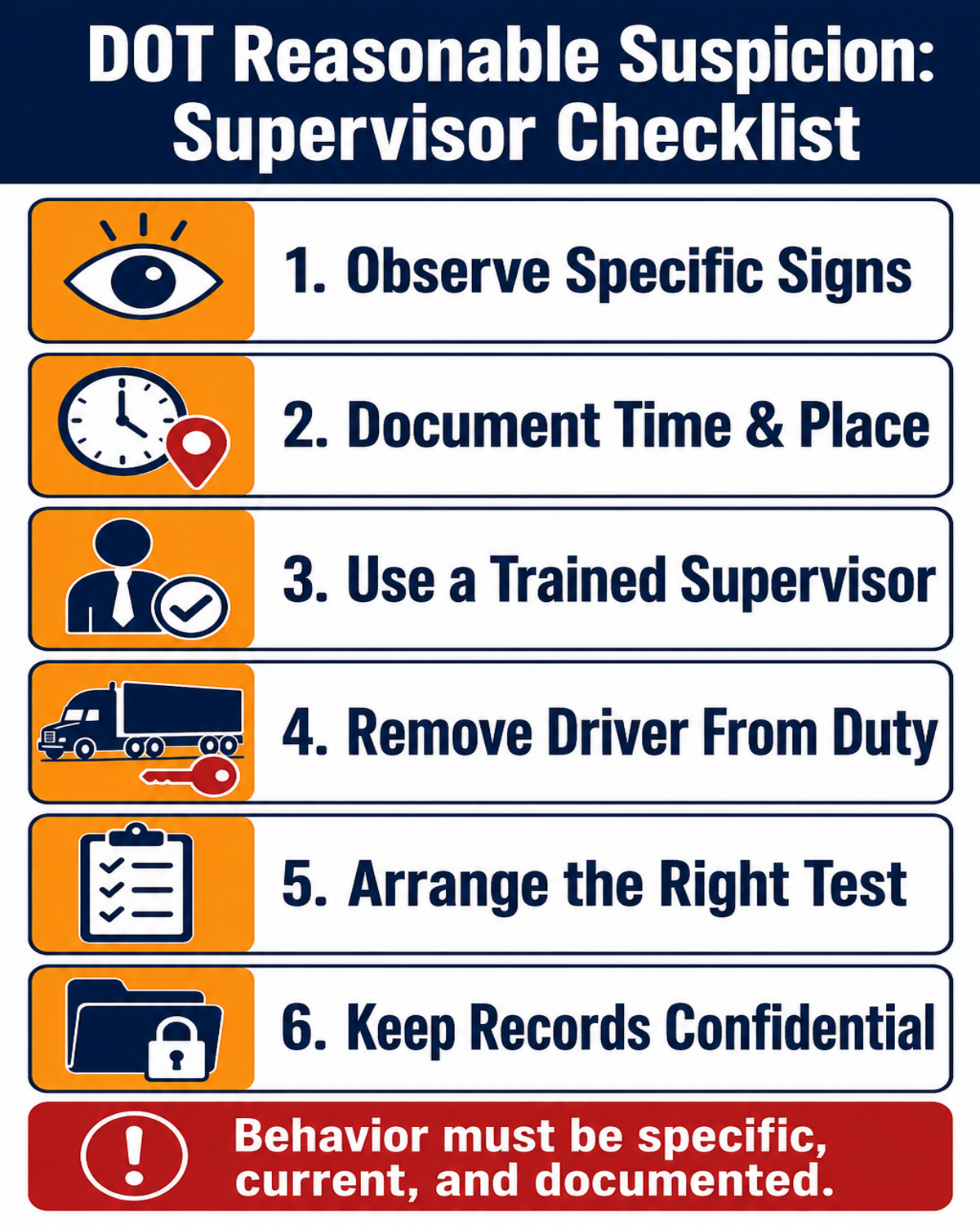
What Counts as a Specific, Contemporaneous, Articulable Observation?
These three words set the standard. Specific means the supervisor records concrete facts rather than a label such as “looked impaired.” Contemporaneous means the facts are being observed now or in direct connection with the current event—not reconstructed from old rumors. Articulable means the observer can put the facts into clear language another person can understand.
Observable facts are different from a diagnosis
A trained supervisor might record that a driver repeatedly lost balance while standing still, spoke unusually slowly, had difficulty following a simple dispatch instruction, and emitted an odor consistent with an alcoholic beverage at a stated time and location. That is more useful than writing “driver was drunk.” The first description identifies observable facts; the second states a conclusion without showing the basis.
Some signs may have innocent explanations. Fatigue, diabetes, a stroke, prescription side effects, anxiety, heat illness, or another medical emergency can affect speech, movement, or behavior. A supervisor should not try to diagnose the cause. If urgent medical symptoms are possible, emergency care comes first. The testing decision still rests on the complete set of current facts and the employer's compliant procedure.
| Observation area | Examples of objective detail | What to avoid |
|---|---|---|
| Appearance | Unusual sweating, markedly flushed or pale appearance, visible tremors, or difficulty maintaining balance | Judging clothing, culture, disability, or a person's normal appearance |
| Behavior | Uncharacteristic agitation, confusion, repeated inability to follow a simple instruction, or unsafe actions observed directly | Personality conflicts, vague impressions, or a single unsupported rumor |
| Speech | Slurring, unusually slow responses, incoherent statements, or abrupt speech changes compared with the current interaction | Assuming an accent, limited English, or a speech condition shows impairment |
| Body odors | A clearly described odor and where it appeared to originate | Treating odor alone as proof of consumption or identifying a specific substance without evidence |
| Performance | Current difficulty with ordinary safety steps, coordination, or equipment procedures witnessed by the supervisor | Relying only on an old performance problem unrelated to current signs |
Rumor alone is not the regulatory standard
A coworker's report can alert management to a safety concern, but the reasonable-suspicion determination under 382.307 must be based on the required observations made by the trained supervisor or company official. The decision should not be based solely on gossip, an anonymous accusation, a previous test, or the fact that a driver takes lawful medication.
Reasonable suspicion is different from random and post-accident testing
Random selection must come from a valid impartial process and does not require observed signs. The DOT random-testing guide explains that separate program. Post-accident testing depends on crash outcomes, citations, and regulatory time windows—not a supervisor's observations. See the separate DOT post-accident testing checklist for those triggers.
Who Can Make the Reasonable-Suspicion Decision?
The observer must receive the required supervisor training
Under , each person designated to supervise covered drivers must receive at least 60 minutes of training on alcohol misuse and an additional 60 minutes on controlled-substances use. The curriculum must address physical, behavioral, speech, and performance indicators. The regulation does not require recurrent training, although an employer may choose refreshers as a best practice.
FMCSA's describes this as a one-time, two-hour minimum for designated supervisors, except for an owner-operator employing only himself or herself as the sole driver. A training certificate is not a license to test on instinct; the observer must still document the current facts supporting each decision.
One trained observer can make the decision
Part 382 does not require two supervisors to agree. An employer may use a two-observer policy, but the federal rule allows the required observations to be made by a trained supervisor or company official. If a second trained person independently observes the driver, separate notes can strengthen the factual record, but one person should not copy another person's observations as though they were personally witnessed.
The observer cannot conduct the alcohol test
The person who makes the reasonable-suspicion determination for alcohol may not conduct that driver's alcohol test. The employer must arrange the appropriate qualified testing professional and equipment under DOT procedures. The supervisor's role is to observe, decide, document, protect safety, and coordinate—not to diagnose or perform the alcohol test.
| Supervisor responsibility | Federal minimum | Practical record |
|---|---|---|
| Training | 60 minutes alcohol plus 60 minutes controlled substances | Training date, provider or materials, topics, and completion record |
| Observation | Specific, contemporaneous, articulable facts | Time, location, duty status, exact actions, speech, appearance, and odors |
| Decision | Identify whether facts support alcohol, controlled substances, or both tests | Test type, decision time, DER notification, and collection instructions |
| Documentation | Signed within 24 hours or before results are released, whichever comes first | Contemporaneous notes converted into a signed formal record |
| Confidentiality | Limit disclosure according to Part 40 and applicable law | Secure storage and need-to-know access |
Alcohol and Controlled-Substances Timing Rules
Alcohol observations must connect to safety-sensitive work
For alcohol, the observations must occur during, immediately before, or immediately after the portion of the workday when the driver must comply with Part 382. The employer may direct the alcohol test only while the driver is performing a safety-sensitive function, just before performing it, or just after stopping it. A supervisor cannot save an old observation and later label an unrelated test as DOT reasonable suspicion.
The 2-hour mark is a documentation checkpoint
If the required alcohol test is not administered within two hours after the determination, the employer must prepare and keep a record explaining why it was not promptly administered. Attempts should continue. Two hours is not permission to abandon the test.
The 8-hour mark ends alcohol-test attempts
If the alcohol test is not administered within eight hours, the employer must stop trying and document why it was not completed. Separately, when the employer has made the alcohol reasonable-suspicion determination, the driver may not perform safety-sensitive functions until an alcohol test measures below 0.02 or 24 hours have elapsed, as specified in 382.307(e)(2).
The drug-test rule does not copy the alcohol cutoff
Section 382.307 does not set a two- or eight-hour deadline for the controlled-substances collection. FMCSA guidance says the driver should report within a reasonable time and encourages collection as soon as possible because detection can become less reliable as time passes. Employers should not invent a 32-hour reasonable-suspicion deadline by borrowing the post-accident rule.
| Point in process | Alcohol | Controlled substances |
|---|---|---|
| Observation | During, just before, or just after safety-sensitive work | Current observations supporting the determination |
| Collection | As soon as practicable | As soon as practicable and within a reasonable time |
| 2 hours | Employer explains delay if test has not occurred | No matching 2-hour rule in 382.307 |
| 8 hours | Employer stops attempts and documents the reason | No matching 8-hour rule in 382.307 |
| 24 hours | Supervisor's written observation record must be signed within 24 hours or before test results are released, whichever occurs first | |
What Should a CDL Driver Expect?
A private, direct notification
The supervisor should remove the conversation from public view when practical, explain that a DOT reasonable-suspicion test is being required, identify whether it is alcohol, controlled substances, or both, and give clear instructions. The supervisor does not need to debate every observation before arranging the test, but the driver can listen carefully, stay calm, and ask where to report and who the designated employer representative is.
Safe transportation to the collection site
A driver who has just been removed from a safety-sensitive assignment should not drive the commercial vehicle to the collection site. The employer should follow its safety procedure for transportation and vehicle security. A driver should not leave, delay, or arrange a private test without the employer's direction.
Correct DOT paperwork and test reason
At the site, verify identifying information, the employer, the DOT agency, and the test reason. The form should identify “Reasonable Suspicion/Reasonable Cause,” not random, pre-employment, or post-accident. DOT and non-DOT tests must remain separate under . Keep the employee copy or collection receipt.
Cooperation without unnecessary medical disclosure
Follow lawful collection instructions and remain at the site until the process is complete. Do not argue with the collector about the supervisor's decision; the collector administers the authorized procedure. For a drug test, legitimate prescription information should be provided confidentially through the Medical Review Officer process if the MRO contacts you—not discussed broadly with dispatch or coworkers.
Results, Refusals, and Confidentiality
A negative result does not erase the safety event
A negative DOT result means the test did not establish a drug or alcohol violation. It does not prevent an employer from addressing a separate medical concern, fatigue, unsafe conduct, or a policy issue under independent lawful authority. The employer should not misrepresent the negative test or disclose it beyond authorized channels.
A verified violation removes the driver from covered work
A verified positive controlled-substances result, an alcohol concentration of 0.04 or greater, or a refusal prohibits DOT safety-sensitive functions and triggers the applicable return-to-duty process. For FMCSA-covered drivers, reportable violations affect Clearinghouse status. The FMCSA Clearinghouse guide explains prohibited status, the Substance Abuse Professional process, and return-to-duty steps.
Refusal can involve conduct, not only the word “no”
prohibits refusing a required reasonable-suspicion alcohol or controlled-substances test. Depending on the Part 40 facts, failure to appear, unexplained delay, leaving before completion, failing to cooperate, or specimen tampering can result in a refusal determination. If a medical emergency or collection problem occurs, contact the DER immediately and document what happened.
Records belong in a restricted compliance system
Observation reports and test information are sensitive employment and medical-adjacent records. Supervisors should not discuss them in a driver lounge, group text, or public dispatch channel. Drivers should also avoid posting the event or paperwork online. Questions about access or correction should go through the employer's designated process.
Common Reasonable-Suspicion Compliance Mistakes
- Using a label instead of facts: “Acted high” does not show what was observed.
- Relying on rumor: A report may prompt an assessment, but it does not replace the trained official's current observations.
- Confusing fatigue with proof: Fatigue can be a serious safety issue, but the supervisor must document the full factual basis for the DOT test.
- Choosing the wrong test reason: Random, post-accident, and reasonable suspicion are different regulatory pathways.
- Missing the alcohol duty window: The alcohol observation and direction to test must connect to safety-sensitive functions.
- Copying post-accident deadlines: The 32-hour controlled-substances rule belongs to post-accident testing, not 382.307.
- Letting the observer administer the alcohol test: The person making the alcohol determination cannot conduct that driver's alcohol test.
- Late documentation: The signed record is due within 24 hours of the behavior or before results are released, whichever is earlier.
- Public confrontation: A loud accusation creates avoidable privacy and fairness problems.
Reasonable-Suspicion Checklist for CDL Drivers
- □ I will stop performing the safety-sensitive task when directed
- □ I will listen for whether the employer ordered alcohol, controlled substances, or both tests
- □ I will confirm the authorized collection site and employer contact
- □ I will use the transportation arranged under the employer's safety procedure
- □ I will not drive the CMV after being removed from the assignment
- □ I will bring current identification when available
- □ I will verify the employer, DOT agency, and reasonable-suspicion test reason on the form
- □ I will cooperate with the collection and remain until released
- □ I will keep my employee copy or collection receipt
- □ I will contact the DER immediately if a medical emergency or site problem occurs
- □ I will respond promptly and privately if the MRO contacts me
- □ I will not share testing paperwork or accusations on social media
- □ I understand that refusing a required test can itself be a DOT violation
- □ I will follow written employer instructions about my duty status and return
Frequently Asked Questions
Does a supervisor need two witnesses to order a reasonable-suspicion test?
No. Part 382 allows the determination to be made by a trained supervisor or company official. An employer may adopt a two-observer policy, but it is not the federal minimum in 382.307.
Can a supervisor order a test based only on a coworker's report?
A report can alert management, but the federal reasonable-suspicion determination must be based on the required current, specific observations made by the trained supervisor or company official.
How long does the employer have to conduct the alcohol test?
The test should occur as soon as practicable. If it is not administered within two hours, the employer documents the delay. At eight hours, the employer stops attempts and documents why the test was not completed.
Can a CDL driver refuse a reasonable-suspicion test?
A driver may physically decline, but refusal to submit to a required test is itself prohibited and prevents safety-sensitive work. The employer must apply the DOT refusal and return-to-duty rules to the facts.
Educational information only, not legal, medical, or employment advice. Employer policies and applicable state law may impose additional lawful requirements. Official eCFR and FMCSA sources reviewed August 18, 2026; eCFR Title 49 was displayed as current through August 14, 2026.