

A crash involving a commercial motor vehicle does not automatically trigger a federal DOT drug and alcohol test. Under FMCSA rules, the answer depends on the outcome of the crash, whether the CDL driver receives a moving-traffic citation, and when that citation is issued. Fatal crashes follow one rule; nonfatal crashes involving off-site medical treatment or a tow-away follow another.
This guide turns 49 CFR 382.303 into a driver-focused decision process. It explains the federal triggers, the 2-, 8-, and 32-hour deadlines, the duty to remain available without delaying emergency care, and the documents a driver should preserve.
When Is DOT Post-Accident Testing Required?
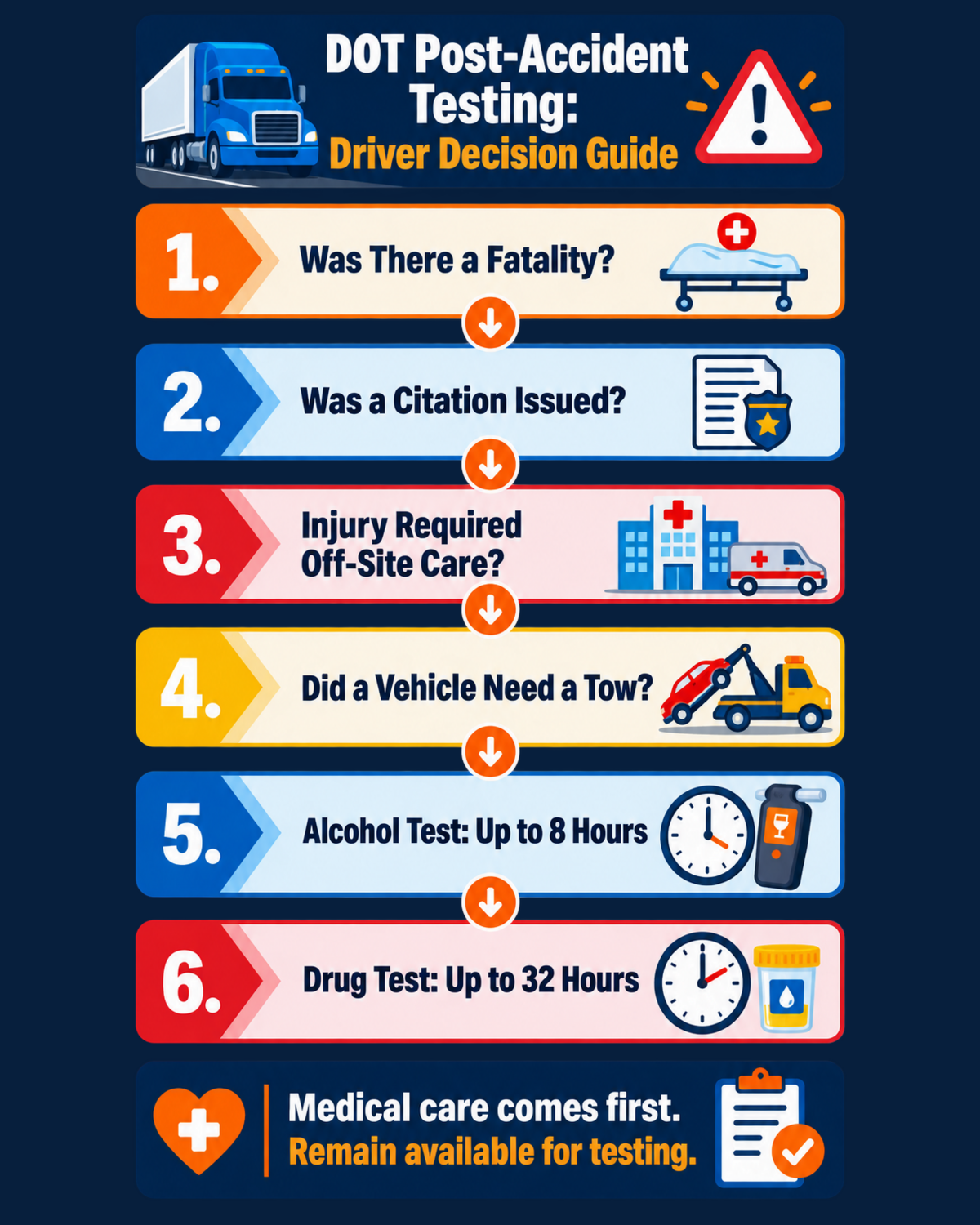
The federal decision starts with a commercial motor vehicle operating in commerce on a public road. If the crash causes a human fatality, the employer must arrange alcohol and controlled-substances testing for each surviving covered driver who was performing a safety-sensitive function, whether or not the driver receives a citation.
For a nonfatal crash, both of these conditions must be present: the crash causes either immediate medical treatment away from the scene or disabling damage requiring a vehicle to be towed, and the CMV driver receives a citation for a moving traffic violation arising from that crash within the applicable testing window. The official sets out those triggers.
| Crash outcome | Moving-traffic citation to CMV driver? | Federal post-accident test? |
|---|---|---|
| Human fatality | Yes or no | Yes. Alcohol and controlled-substances testing are required for the surviving covered driver. |
| Injury with immediate medical treatment away from the scene | Yes, within the applicable window | Yes. The citation and timing rules determine which test is required. |
| Injury with immediate medical treatment away from the scene | No | No under the federal post-accident rule. |
| Disabling damage requiring any motor vehicle to be towed | Yes, within the applicable window | Yes. The citation and timing rules determine which test is required. |
| Disabling damage requiring a tow | No | No under the federal post-accident rule. |
| Property damage without a qualifying tow, injury, or fatality | Either | No under 382.303, although another lawful policy may apply. |
The FMCSA also publishes a plain-language . It is a useful field reference, but the regulation and the carrier's written instructions control the compliance process.
What Counts as a Covered Post-Accident Event?
The CMV must be operating on a public road in commerce
Section 382.303 applies after an occurrence involving a commercial motor vehicle operating on a public road in commerce. A parking-lot incident on private property may be covered by company policy, insurance requirements, a collective-bargaining agreement, or another law, but it does not automatically fit this specific federal post-accident trigger. Drivers should still report every incident under employer policy instead of deciding alone that no test is needed.
A fatality creates the clearest trigger
If any person dies in the crash, a moving-traffic citation is not required for the federal post-accident testing obligation. The rule applies to each surviving covered driver who was performing a safety-sensitive function with respect to the CMV. The employer should start arranging both tests as soon as practicable while emergency response and necessary medical care take priority.
Off-site medical treatment must be immediate
The nonfatal injury branch applies when any person—driver, passenger, pedestrian, or another road user—suffers bodily injury and, because of that injury, immediately receives medical treatment away from the scene. First aid given at the scene is not the same fact pattern. A later routine appointment is also different from immediate transport or treatment away from the scene. The employer should document the facts rather than ask the driver to make a medical or legal conclusion.
A qualifying tow can involve any motor vehicle
The rule is not limited to the commercial truck being towed. Disabling damage to one or more motor vehicles can satisfy the crash-outcome branch when the damaged vehicle must be transported away by a tow truck or another motor vehicle.
Under , disabling damage generally means damage that prevents a vehicle from leaving the scene in its usual manner in daylight after simple repairs. It includes a vehicle that could move but would be damaged further by doing so. The definition excludes damage that can be temporarily repaired at the scene without special tools or parts, tire disablement alone, and damage limited to headlights, taillights, turn signals, the horn, or windshield wipers.
| Scene fact | What it usually means for 382.303 | What to document |
|---|---|---|
| Ambulance transports an injured person for immediate care | Injury outcome branch is present | Person transported, approximate time, and responding agency |
| Another vehicle cannot leave without a tow | Tow-away outcome branch may be present | Vehicle, damage, tow company, and time |
| Only a flat tire, with no other damage | Excluded from the federal definition of disabling damage | Photos and repair or tow reason |
| Minor scrape; every vehicle drives away | No qualifying crash outcome based on those facts alone | Photos, police report number, and employer notification |
| Crash occurs entirely on private property | Not the public-road occurrence described in 382.303 | Location and any separate employer instructions |
How the Moving-Traffic Citation Rule Works
A citation matters only in the two nonfatal branches: immediate medical treatment away from the scene and disabling damage requiring a tow. The citation must be issued to the CMV driver under state or local law for a moving traffic violation arising from the crash. A parking ticket, equipment citation unrelated to vehicle movement, or citation issued to another motorist does not satisfy that wording.
Alcohol and drug testing have different citation windows
For alcohol testing, the driver must receive the qualifying citation within eight hours of the occurrence. For controlled-substances testing, the driver must receive it within 32 hours. That creates an important middle case: if a qualifying injury or tow-away occurred and the driver receives the moving citation after hour eight but by hour 32, the controlled-substances test can be required even though the federal alcohol-test trigger has expired.
A delayed citation does not let the employer extend testing indefinitely
The testing clocks begin at the time of the crash, not when dispatch learns about it, a citation is written, or the driver arrives at a collection site. Employers need prompt notice of injury transport, tow-away status, citation details, location, and elapsed time so they can apply the correct branch before the window closes.
Do not self-dispatch to an ordinary clinic
A DOT test must follow the employer's program and Part 40 procedures. An ordinary urgent-care screen, a home test, or a non-DOT employer panel does not become a compliant 382.303 test simply because it was completed after a crash. Contact the designated employer representative and follow the authorized collection instructions unless emergency responders direct otherwise.
The 2-, 8-, and 32-Hour Deadlines
“As soon as practicable” is the operating standard. The eight- and 32-hour marks are final limits, not suggested appointment times. The two-hour alcohol mark is a documentation checkpoint for the employer.
| Time from crash | Requirement | Practical meaning |
|---|---|---|
| Immediately | Arrange required alcohol and controlled-substances tests as soon as practicable | Emergency response and necessary medical care come first; notify the carrier promptly. |
| 2 hours | If a required alcohol test has not occurred, employer records why it was not promptly administered | Testing attempts continue; this is not the cutoff. |
| 8 hours | Stop attempts to administer the required alcohol test and document the reasons | The employer may not treat hour eight as permission to conduct a late DOT post-accident alcohol test. |
| 32 hours | Stop attempts to administer the required controlled-substances test and document the reasons | The drug-test window does not remain open after hour 32. |
The driver has a separate alcohol-use restriction. prohibits a driver who is required to take a post-accident alcohol test from using alcohol for eight hours after the crash or until the post-accident alcohol test occurs, whichever comes first. That means no beer, wine, liquor, or alcohol-containing preparation during the restricted period.
Driver rule of thumb: never wait to see whether a citation appears before notifying the employer. Report the crash facts promptly, avoid alcohol, and stay reachable while the carrier determines the federal testing obligation.
What a CDL Driver Should Do After a Crash
1. Protect life and prevent a second crash
Stop safely, call emergency services when needed, follow lawful instructions, and use warning devices when it is safe and required. Do not move an injured person unless necessary to prevent greater harm. Post-accident testing never takes priority over necessary emergency medical attention.
2. Notify the carrier's designated contact
As soon as conditions allow, call the number in the employer's accident packet or written policy. Provide your exact location, time of occurrence, whether anyone died or left for medical treatment, whether any vehicle needs a tow, whether a citation was issued, and how the safety representative can reach you.
3. Preserve objective facts
Record the responding agency, report or incident number, officer name or badge number if available, tow company, medical transport, citation number, and times. Take lawful photos of vehicle positions, damage, road conditions, and documents without interfering with responders. Avoid speculation or admissions about fault.
4. Remain readily available
Section 382.303 says a driver subject to testing must remain readily available or may be deemed by the employer to have refused. The same section expressly says this does not require delaying necessary medical care or prevent leaving long enough to obtain emergency assistance. If you must go to a hospital or leave for emergency help, tell the employer where you are going and keep a reliable contact channel open.
5. Follow the authorized test instructions
Confirm the collection site, test reason, employer, DOT agency, and contact person. Bring identification when available, arrive without unnecessary delay, cooperate with the collection process, and keep the employee copy or receipt. The form should identify the reason as post-accident—not random or pre-employment. Drivers who want to compare the different trigger types can review the separate guides to DOT pre-employment drug testing and DOT random testing.
| Driver action | Do | Avoid |
|---|---|---|
| Communication | Report objective facts and elapsed time | Waiting until the end of a shift or assuming police will notify the carrier |
| Medical care | Accept necessary emergency evaluation and share location | Delaying care to protect a testing window |
| Availability | Keep the phone on and advise the employer before moving locations | Going home, sleeping, or becoming unreachable without instructions |
| Alcohol | Avoid use for the required period | Drinking because police did not test at the scene |
| Collection | Use the employer-authorized DOT process | Substituting a home test or self-ordered non-DOT screen |
Can a Police or Public-Safety Test Satisfy the DOT Rule?
Sometimes. Section 382.303(g) permits qualifying breath or blood alcohol results and urine controlled-substances results obtained by federal, state, or local law-enforcement or public-safety officials with independent authority to satisfy the federal post-accident requirement. The test must conform to the applicable federal, state, or local requirements, and the employer must obtain the result.
FMCSA explains why this is a limited post-accident substitution in its . A police request does not automatically replace the carrier's responsibility. The driver should immediately tell the employer what specimen or breath test was conducted, by which agency, and how the employer can request the result. The carrier decides whether the regulatory conditions are satisfied and whether an additional employer-arranged test is still needed within the window.
Results, Refusals, and the FMCSA Clearinghouse
A test result is not a fault finding
A negative result does not determine who caused the crash, and the fact that a federal test was required does not mean the driver was suspected of impairment. Post-accident testing is triggered by regulatory criteria. Crash responsibility is evaluated separately by law enforcement, insurers, courts, and carrier safety processes.
Positive results and refusals have separate consequences
A verified positive controlled-substances result, an alcohol result of 0.04 or greater, or a refusal is a DOT drug-and-alcohol program violation that prohibits safety-sensitive functions. For FMCSA-covered drivers, employers and service agents have Clearinghouse reporting duties. The driver must complete the applicable Substance Abuse Professional evaluation, education or treatment, return-to-duty test, and follow-up plan before resuming covered work.
The FMCSA Clearinghouse guide for CDL drivers explains prohibited status and the return-to-duty sequence. A driver should not assume that leaving the scene, missing calls, or declining an employer-directed test is harmless merely because no substance was used; refusal rules can apply to conduct as well as an express statement.
Keep records without oversharing medical information
Keep the crash report number, citation, collection receipt, employer instructions, and a timeline of communications. If a Medical Review Officer contacts you about a laboratory result, respond promptly and provide legitimate prescription information through the confidential MRO process. Do not post crash details, medical facts, or testing paperwork on social media.
DOT Post-Accident Checklist for CDL Drivers
- □ Stop safely, call for help, and protect the scene
- □ Obtain necessary emergency medical care without delay
- □ Notify the carrier's accident or safety contact as soon as practicable
- □ Record the exact crash time and public-road location
- □ Report any fatality or immediate medical treatment away from the scene
- □ Report whether any motor vehicle requires a tow
- □ Record any moving-traffic citation issued to the CMV driver and the issue time
- □ Stay reachable and tell the employer before changing locations
- □ Do not use alcohol for eight hours or until the required alcohol test, whichever comes first
- □ Follow only the employer-authorized DOT collection instructions
- □ Verify that collection paperwork identifies the correct employer and post-accident reason
- □ Keep the employee copy or collection receipt
- □ Tell the employer immediately about any law-enforcement breath, blood, or urine test
- □ Preserve the police report number, tow information, photos, citations, and communication timeline
- □ Respond promptly to the employer, collector, and MRO
Frequently Asked Questions
Does every CDL crash require a DOT drug and alcohol test?
No. A fatality requires testing without a citation. For a nonfatal crash, immediate medical treatment away from the scene or disabling damage requiring a tow must be paired with a moving-traffic citation to the CMV driver within the applicable window.
What if the citation is issued more than eight hours after the crash?
If a qualifying injury or tow-away occurred and the moving citation is issued after hour eight but within 32 hours, the federal controlled-substances test may still be required. The federal post-accident alcohol-test citation window has closed.
Can a CDL driver leave the crash scene for medical treatment?
Yes. The rule does not require delaying necessary medical attention or prohibit leaving to obtain emergency assistance. The driver should notify the employer, share the destination, and remain reachable for testing instructions.
Does a police test automatically replace the employer's DOT test?
No. A qualifying law-enforcement breath, blood, or urine result can satisfy the post-accident rule only when the applicable conditions are met and the employer obtains the result. The employer must decide whether those requirements are satisfied.
Educational information only, not legal, medical, or employment advice. Employer policies and state requirements may impose additional duties. Official eCFR and FMCSA sources reviewed August 17, 2026; eCFR Title 49 was displayed as current through August 13, 2026.