Earning your Commercial Driver's License is a process, but it's a straightforward one. It really comes down to a few key milestones: meeting the basic requirements, hitting the books to pass your written tests, getting professional hands-on training, and then acing the final skills test.
Each step is designed to make sure you're not just a driver, but a safe and knowledgeable professional behind the wheel of a big rig.
Your Complete Roadmap to a Professional Driving Career
Getting your CDL is so much more than just getting a license. It's your ticket to a career with real job security, solid pay, and the kind of freedom you just can't find in an office. Truckers are the lifeblood of the American economy, which means skilled drivers are always needed.
Right now, the average salary for a CDL driver is around $75,000 annually. And for seasoned owner-operators? They can easily clear six figures.
But you have to start somewhere. Think of this guide as your personal roadmap, showing you the exact route from day one to the day you're a licensed, hirable professional. We'll walk through every single phase so there are no surprises.
What This Guide Covers
This is more than just a simple to-do list. We're going to dig into the details to give you the insider knowledge you need to succeed. Here’s what you'll learn:
- Core Eligibility: We'll cover the must-haves—age, medical qualifications, and what your driving record needs to look like.
- CDL Classes and Endorsements: It's crucial to know the difference between a Class A, B, and C license. We’ll also show you how adding endorsements can open up better-paying jobs.
- Permit and Written Exams: I'll share some practical tips for studying and passing the knowledge tests to get your Commercial Learner's Permit (CLP).
- Certified Training Programs: Choosing the right school is critical, especially with the federal Entry-Level Driver Training (ELDT) rules. Our guide on CDL training programs breaks down what a good program looks like.
- The Final Skills Test: We’ll pull back the curtain on the three parts of the final exam: the pre-trip inspection, basic control skills, and the on-road test itself.
I always tell new students to think of getting a CDL like building a house. You need a solid foundation of knowledge (your permit), the right framework and tools (your training), and a final inspection (the skills test) before you can move in. If you rush any part, you'll run into trouble later.
This path takes dedication, but the payoff is absolutely worth it. Stick with this guide, and you'll have everything you need to navigate the process with confidence.
First Things First: Are You Eligible for a CDL?
Before you even crack open a study guide or start pricing out truck driving schools, you need to pump the brakes and ask a simple question: "Do I even qualify?" Getting your CDL isn't just about passing a test; it's about meeting a strict set of federal and state standards from day one.
These aren't just suggestions—they're hard-and-fast rules. Think of them as the first checkpoint on your road to a new career. With roughly 3.5 million professional truck drivers on the road in the U.S. as of 2023, these standards are what keep our highways safe.
Age and Where You Can Drive
One of the biggest questions I get from newcomers is about age. It’s not a one-size-fits-all answer, because it all comes down to where you plan on driving. This is a critical distinction that shapes your career path right out of the gate.
- Driving In-State (Intrastate): Want to drive a commercial vehicle but stay within your home state's borders? The federal minimum age for this is 18 years old. It's a great way to get your foot in the door with local delivery or construction jobs.
- Driving Across State Lines (Interstate): If you're dreaming of the open road and a long-haul career, you’ll need to be at least 21 years old. This is a firm federal mandate, no wiggle room.
Honestly, most people aim for an interstate license. It just opens up a world of better-paying jobs and more opportunities.
"Your age determines your operational range. An 18-year-old can get a CDL and start a great local career, but the 21-year-old mark is the true key to unlocking a nationwide career and the highest-paying jobs."
Meeting the Physical and Medical Standards
Let's be real: this job can be tough on the body. That's why every single person going for a CDL has to pass a Department of Transportation (DOT) physical. This isn't your average annual check-up; it's a specific, thorough exam to ensure you're fit for the demands of driving professionally.
You can't just go to any doctor, either. The exam has to be done by a certified medical examiner who is listed on the FMCSA's National Registry.
Here’s a glimpse of what they’ll check:
- Vision: You'll need at least 20/40 vision in both eyes (glasses or contacts are fine) and a 70-degree field of vision.
- Hearing: The test is simple but effective—you have to hear a "forced whisper" from five feet away.
- Blood Pressure: Ideally, you'll be under 140/90. If it's higher, you might be looking at more frequent check-ups or needing to manage it before you can get certified.
- General Health: The examiner will also screen for other conditions that could be a problem behind the wheel, like uncontrolled diabetes, heart problems, or sleep apnea.
Once you pass, you'll be issued a medical examiner's certificate (your "med card"). This little piece of paper is a crucial part of your license, and you have to keep it up to date for your entire career.
Your Driving Record and Legal Standing
Finally, the government needs to know you're a responsible driver and have the right to work here. It starts with the basics: you must already have a valid, standard driver's license from the state where you live.
Beyond that, your driving record will be put under a microscope. A clean record is your best friend.
Major red flags that can get you disqualified include things like:
- A DUI conviction
- Hit-and-run incidents
- Using a vehicle to commit a felony
- A pattern of reckless driving or serious speeding tickets
You'll also need to prove you are a U.S. citizen or have lawful permanent residency. This means getting your documents in order, whether it's a birth certificate, a passport, or a Green Card.
Getting a handle on all these foundational requirements is the real first step. Nail these down, and you're ready to start your engine and move on to the next phase.
Passing the Written Exams for Your CDL Permit
Before you can even think about getting behind the wheel of a big rig, you’ve got to get your Commercial Learner's Permit (CLP). This is your official ticket to start practicing on public roads, but only with a certified instructor sitting next to you. To earn that permit, you first have to prove you know your stuff by passing a series of written knowledge exams at the DMV.
Don't underestimate this step. These tests are designed to build the foundation for everything you'll do on the road. They cover vehicle mechanics, critical safety rules, and the nitty-gritty of systems like air brakes. What you learn here isn't just for passing a test; it's what will keep you and everyone else safe when you're driving an 80,000-pound machine.
Decoding the Core Knowledge Exams
Every state has its own little quirks, but the core written tests are pretty standard across the board. If you're going for a Class A CDL, you can count on facing three main exams. You have to master the material in each one—no exceptions.
Here's a look at the most common written tests you'll encounter on your way to getting that Class A permit.
| Exam Name | Core Topics Covered | Importance for Drivers |
|---|---|---|
| General Knowledge | Vehicle inspection, basic control, hazard perception, federal regulations, and skid control. | This is the bedrock of all commercial driving. It covers the universal rules and safety practices for any large vehicle. |
| Air Brakes | Components of the air brake system, proper inspection techniques, and how to use them effectively. | Most heavy-duty trucks rely on air brakes, which are completely different from your car's. Understanding them is a non-negotiable safety requirement. |
| Combination Vehicles | Coupling/uncoupling, pivot points, trailer dynamics, and avoiding the "crack-the-whip" effect. | Specific to Class A, this tests your understanding of how a tractor and trailer work together—a skill crucial for preventing rollovers and jackknifes. |
These exams cover a lot of ground, and the stakes are high.
You'll need to score at least 80% to pass each one. The good news? Every single question is pulled directly from your state's official CDL manual. That book needs to become your best friend.
Real Strategies for Exam Success
Just reading the CDL manual cover-to-cover probably won't cut it. It’s dense, and a lot of the information is technical. A smarter approach is to break it down.
Try tackling one major topic at a time. Spend a day on pre-trip inspections, another on air brakes. As you study, take notes on the details that trip people up—things like specific stopping distances, legal limits, and procedural steps. These are exactly the kinds of things you'll see on the test. For more tips, check out our in-depth guide to getting your CDL permit.
The written tests aren't just about memorizing rules; they're about understanding the why behind them. Knowing why you check brake slack or why you need a certain following distance makes you a safer driver, not just a better test-taker.
Finding and Using Practice Tests
I can’t stress this enough: practice tests are your secret weapon. A good practice exam will feel just like the real thing at the DMV, showing you exactly what to expect. More importantly, they shine a bright light on any topics you're still shaky on before it’s too late.
Look for practice tests that don't just tell you you're wrong but explain why you're wrong. Getting a question right is great, but understanding your mistakes is how you truly learn. My rule of thumb? Don't even think about scheduling your official exam until you're consistently hitting 90% or higher on your practice runs. That gives you a nice cushion for any test-day jitters.
Finding the Right ELDT Certified Training Program
Got your Commercial Learner's Permit (CLP) in hand? Fantastic. You've just unlocked the most critical phase of this journey: getting behind the wheel.
It wasn't that long ago that you could learn the ropes from a friend or a family member with a CDL. Those days are over. Now, finding a federally certified training provider isn’t just a good idea—it's the law. The Federal Motor Carrier Safety Administration (FMCSA) brought in the Entry-Level Driver Training (ELDT) rule, and it completely changed the game for new drivers.
This rule means every new applicant has to complete a standardized program of classroom and hands-on instruction from an approved school. Only then can you even schedule your final CDL skills test. It’s a big shift, but one aimed at making our roads safer by building a solid foundation for every driver.
This makes your choice of a driving school one of the most important decisions you'll make in your entire trucking career.
What ELDT Requires From You
The ELDT mandate is broken down into two essential parts. You have to pass both of them at an FMCSA-approved school before you’re legally allowed to take your final CDL exam.
- Theory (Classroom) Training: This is the book-smarts part of the equation. You'll cover at least 30 specific topics, running the gamut from hours-of-service rules and whistleblower protections to practical on-road skills like managing your speed and spotting hazards. To pass, you must score at least 80% on the final assessment.
- Behind-the-Wheel (BTW) Training: Here’s where the rubber meets the road—literally. You’ll be in a real truck, applying everything you learned in the classroom. This training has to be in the same class of vehicle you’re getting your license for. While the feds don't set a minimum number of hours, your instructor has to personally certify that you're proficient in all required skills, both on a closed range and out on public roads.
The ELDT mandate isn't just another bureaucratic hoop. It’s about building professionals from the ground up. The school you choose is on the hook to certify to the federal government that you are a safe, competent driver. They take that responsibility very seriously, and so should you.
Want to get into the nitty-gritty of the regulations? We break down the ELDT mandate in full detail here.
Comparing Your Training Options
Let's be clear: not all CDL schools are the same. They vary wildly in price, program length, and teaching style. Figuring out which type fits your budget, schedule, and how you learn best is your next move.
Private CDL Schools
These are specialized schools that do one thing and one thing only: train truck drivers. They're often geared toward getting you licensed and on the road as quickly as possible.
- Pros: Programs are fast, often just a few weeks long. They usually have frequent start dates and an intense focus on passing the CDL exam.
- Cons: This is usually the priciest route. Tuition can easily run from $5,000 to $10,000.
Community College Programs
Many local community colleges offer CDL training as part of their vocational programs. These tend to be more paced out and might take a full semester to complete.
- Pros: Often much more affordable than private schools. Plus, you might be able to use traditional financial aid.
- Cons: The pace is slower, the schedules are less flexible, and you're tied to the college's academic calendar for enrollment.
Company-Sponsored Training
Some of the big carriers will front the cost of your CDL training. The catch? You have to sign a contract to drive for them for a set amount of time, usually one or two years.
- Pros: You pay little to nothing upfront and have a guaranteed job waiting for you right after you pass your test.
- Cons: You are locked into that contract. If you quit or get fired before it's up, you'll likely be on the hook for the full tuition cost, which can be a nasty surprise.
How to Vet a CDL School
Choosing the wrong school can be a costly mistake, both in time and money. Before you sign a single piece of paper, you need to do some digging and ask the hard questions.
Your absolute first step: verify the school is on the FMCSA's Training Provider Registry (TPR). If a school isn't on that official list, any training you do with them is worthless in the eyes of the government. You won't be allowed to take your test. Period.
Once you've confirmed they're on the TPR, here are a few things you should grill them on:
- What's your instructor-to-student ratio when we're actually in the truck?
- How much real driving time do I get versus just sitting in the back observing?
- What does the total tuition cost actually cover? Ask about fees for tests, permits, and books.
- What's your school's first-time pass rate for the CDL skills test?
- Do you help with job placement? Which specific companies do you work with?
Be skeptical of any school that gets cagey with their answers or makes wild promises about guaranteed jobs and huge starting salaries. A good, honest program will be upfront about their costs, what you can expect from their training, and the realities of the job market.
Mastering the Three-Part CDL Skills Test
You’ve hit the books, passed the written exams, and put in the time with a certified ELDT trainer. Now, only one thing stands between you and your professional driving career: the hands-on CDL skills test.
This isn't just a quick spin around the block. It's a comprehensive, three-part exam that can easily take over two hours to complete. Examiners are thorough because they have to be—they need to be absolutely sure you can safely handle an 80,000-pound machine on public roads.
Let's walk through each part of the test so you know exactly what’s coming.
The Make-or-Break Pre-Trip Inspection
I can't stress this enough: for many new drivers, the pre-trip inspection is the most nerve-wracking part of the whole process. There's a reason for that. An estimated 8 out of 10 applicants who fail the skills test get knocked out right here, in this very first stage.
Why? It’s not just about knowing what the parts of the truck do. It’s a performance. You have to follow a very specific script, pointing to or touching each component, naming it correctly, and explaining exactly what you're checking for. From the engine compartment and brake lines to the tires and coupling system, everything has a procedure.
For a deep dive into the specifics, check out our complete guide to the pre-trip inspection. It lays out the checklist you’ll need to master.
"The pre-trip inspection is a test of memory, procedure, and communication all at once. Examiners aren't trying to trick you; they're confirming you've mastered a critical safety routine that you'll perform every single day of your career."
Your school will drill you on the exact script required by the FMCSA. The only way to nail it is practice, practice, practice until it’s second nature.
Navigating the Basic Control Skills Test
Once you ace the pre-trip, you'll move on to the basic control skills, which everyone just calls the yard skills or maneuvering test. This happens in a controlled lot, away from traffic, usually marked up with a maze of cones and painted lines.
This is all about showing you can handle the rig in tight quarters. The examiner needs to see that you have complete mastery over the truck and trailer at low speeds.
You'll be asked to perform a few specific maneuvers, though the exact set can vary by state. The big ones are almost always the same:
- Straight Line Backing: Sounds simple, but you have to back the rig straight for about 100 feet without wandering out of a narrow lane.
- Offset Backing (Left or Right): This one simulates backing into a parking spot or dock next to you, requiring you to move the entire rig from one lane into an adjacent one.
- Alley Dock (90-Degree Backing): This is the one that trips up most people. It's a tight, 90-degree back-in, just like you’d do at a real loading dock.
The examiner is watching for smooth control and your ability to judge distances. They also want to see you Get Out and Look (G.O.A.L.) if you can't see what's happening. Hitting a cone or crossing a boundary line will cost you points, and enough mistakes will mean an automatic fail.
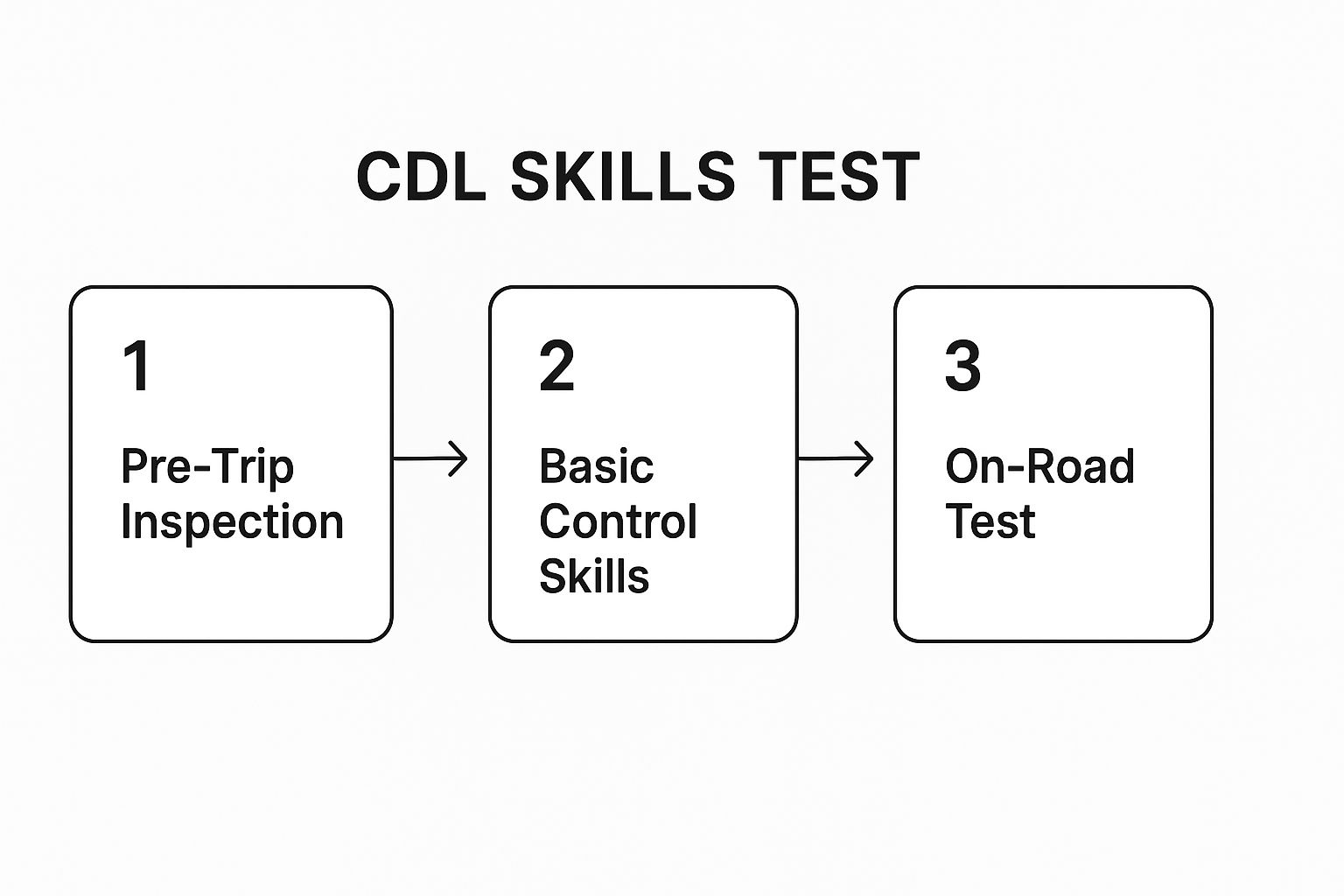
As you can see, each part of the test acts as a gatekeeper. You can't move on to the road test until you've proven you can handle the truck in the yard.
The Final Challenge: The On-Road Driving Test
After you've conquered the yard skills, it's time for the main event: taking the truck out on public roads with the examiner. This is the last piece of the puzzle, and it’s the part that feels most like a normal driving test, only with much higher stakes.
The examiner will give you directions, guiding you through a series of real-world driving scenarios to see how you react.
Here’s what they’re looking for:
- Traffic Smarts: Are you using your turn signals properly? Checking your mirrors constantly? Keeping a safe following distance?
- Gear Shifting: If you’re in a manual, you need to shift up and down smoothly without grinding gears or killing the engine.
- Making Turns: They'll be watching your turns at intersections closely, especially right turns. You have to swing wide enough to clear the curb without wandering into another lane.
- Situational Awareness: This is all about spotting potential hazards, paying attention to road signs, and adjusting your speed for the conditions.
The best advice I can give you here is to stay calm and focus. The examiner isn't trying to trick you. They just want to see a safe, confident, and defensive driver in action. Listen to their instructions, drive the way you were taught, and show them you’re ready to be a professional.
Pass this final section, and you've officially earned your CDL.
Still Have Questions About Getting Your CDL?
Even with a step-by-step plan, a few questions are probably still bouncing around in your head. That's completely normal. Anyone thinking seriously about how to get a CDL is going to wonder about the real-world costs, the time commitment, and what might stand in their way.
Let's tackle some of the most common questions we hear from people just starting out. Getting these answers sorted will help you move forward with a lot more confidence.
How Much Does It Really Cost to Get a CDL?
This is the big one, right? The total investment for your CDL can land anywhere between $3,000 and $10,000. The huge range really boils down to the path you take to get trained.
- Private CDL Schools: These programs are usually on the higher end of that scale. You're paying for an accelerated, focused experience designed to get you licensed and on the road fast.
- Community College Programs: This is often a more affordable route. The trade-off is that the training is typically spread out over a semester, so it takes a bit longer.
- Company-Sponsored Training: Some of the big carriers will train you for little to no upfront cost. But let's be clear—it's not free. You're paying for it by signing a contract to drive for them, usually for a year or two.
And remember, that price tag isn't just for classes. It needs to cover your permit application, the final skills test fee, and the cost of the physical license itself. Before you sign up anywhere, always ask for a complete breakdown of every single cost.
The price of your CDL training is an investment in your career. It's tempting to just hunt for the cheapest option, but the real value comes from the quality of instruction, the amount of time you actually spend behind the wheel, and the job placement support you get.
How Long Does the CDL Process Take?
If you can commit to a full-time training program, you can realistically go from your first day of class to having your CDL in hand in about three to seven weeks. It's an intense, fast-paced timeline that packs in all the required ELDT classroom theory and behind-the-wheel hours.
Of course, not everyone can just drop everything. If you're working around another job, a part-time program can stretch the process out over a few months. You get more flexibility, but the journey to the finish line is naturally longer.
One of the biggest wildcards is just getting an appointment for your final skills test. In some states, the DMV or third-party testing sites can get really backed up, creating a bottleneck. A good school knows how to navigate this and will help you get a test date as soon as you're ready.
Can I Get a CDL with a Criminal Record?
This is a serious and very common question. The honest answer is: it depends. A criminal record can definitely make things more challenging, but it’s not always an automatic "no." What really matters are the specifics of the offense and how long ago it happened.
Some violations have clear-cut consequences. The FMCSA has rules that will disqualify you for a set period for serious driving offenses, like a DUI or leaving the scene of an accident. For instance, a first-time DUI in your personal car typically means you're disqualified from getting a CDL for one year.
For other convictions, it gets a bit more complex.
- Felonies: Certain felonies can result in a lifetime ban, especially if they involved using a commercial truck to commit the crime or were related to serious drug trafficking.
- Other Offenses: For many other offenses, it’s a case-by-case review. The state licensing agency and potential employers will look at the nature of the crime and how much time has passed.
Your best bet is to be 100% honest from the very beginning. Look up your state’s specific rules and have an open conversation with the schools and companies you're considering. They've dealt with this before and can give you real advice based on their experience. Transparency is the only way to work through this.
Ready to stop asking questions and start driving toward your new career? At Patriot CDL, we provide the expert training and support you need to get your CDL and hit the road with confidence. Learn more about our programs and get started today.