Getting your Commercial Driver's License is a process, but it's a straightforward one. Think of it as hitting a few key milestones: first, you'll tackle the basic requirements, then get your learner's permit, complete your training, and finally, pass the hands-on skills test.
It all starts with making sure you've got your ducks in a row before you even set foot in a truck.
Meeting the Initial CDL Requirements
Before you start dreaming about open roads and hitting the books for the permit test, you need to clear a few fundamental hurdles. This is the foundation of your entire career. It's about proving you meet the legal, medical, and personal qualifications to safely get behind the wheel of an 80,000-pound machine.
Age and Driving Jurisdiction
Believe it or not, how old you are determines where you can drive. It’s a critical distinction that will absolutely shape your first few years in the industry.
At a minimum, you must be 18 years old to get a CDL for driving within your own state (this is called intrastate driving). But if you want to cross state lines, which is essential for most long-haul jobs, you have to be at least 21 years old for that interstate commerce. For a deeper dive into industry numbers, check out these trucking statistics from WarriorLogistics.com.
So, what does this look like in the real world? An 18-year-old in California could land a great job driving a cement mixer for a local construction company, but they couldn't legally haul a load of avocados to Arizona. You need to be 21 for those Over-the-Road (OTR) gigs.
Key Takeaway: Age is the first gate you have to pass through. If you're under 21, plan on building your experience with in-state work. The rest of the country opens up once you hit that 21st birthday.
The DOT Medical Exam
Every single person who wants to drive a commercial truck has to pass a Department of Transportation (DOT) physical exam. This isn't your average annual check-up. It's a comprehensive medical evaluation designed specifically to ensure you're fit for the job's unique demands.
You can't just go to any doctor. The exam must be performed by a certified medical examiner who is listed on the Federal Motor Carrier Safety Administration's (FMCSA) National Registry. The doctor will screen for anything that could make you a risk on the road, including:
- Vision and Hearing: Your eyesight has to meet a minimum standard (with or without corrective lenses), and you'll need to demonstrate you can hear well enough to notice potential hazards.
- Blood Pressure and Heart Health: Uncontrolled high blood pressure is a common disqualifier, so if you have it, you'll need to show it's well-managed.
- Diabetes: You can absolutely drive with diabetes, but it needs to be properly managed and may require special documentation or an exemption from your doctor.
- Sleep Apnea: This is a huge red flag for safety. If the examiner suspects you might have it, you'll likely be sent for a sleep study before you can be cleared.
Once you pass, you’ll be issued a DOT medical card. Guard this little piece of paper with your life—you're legally required to have it on you anytime you're working.
Essential Legal Documentation
Alright, the last step before you can apply for your permit is getting your paperwork in order. Walking into the DMV unprepared is a recipe for frustration and wasted time. Do yourself a favor and get everything organized in a folder first.
You're going to need to prove who you are, where you live, and that you're legally allowed to work. Here’s a typical checklist:
- Your current, valid state driver's license (your regular car license).
- Your original Social Security card (not a copy) or another official proof of your number.
- Proof of U.S. citizenship or lawful permanent residency. A birth certificate, passport, or green card works.
- One or two documents proving you live in the state. Think utility bills, a lease agreement, or a bank statement with your name and current address.
Having all this ready shows you're serious and makes the whole process smoother. Once you’ve checked off these boxes, you’re officially ready to start studying for your permit and get on the path to becoming a professional driver.
Securing Your Commercial Learner's Permit (CLP)

Once you’ve ticked all the initial boxes, your next big step is getting your Commercial Learner's Permit, or CLP. Think of this as your official "license to learn." It's the piece of paper that proves you've got the theory down and finally lets you get behind the wheel—with a licensed instructor beside you, of course.
This permit isn't just handed out. You earn it by passing a series of written knowledge tests at your local DMV. These exams are the gatekeepers to your hands-on training, making sure you understand the rules of the road before you ever turn the key.
Mastering the Core Knowledge Tests
To get your CLP, everyone has to pass a few foundational written exams, no matter which CDL class you’re aiming for. These aren't just about memorizing facts; they test your real understanding of the principles that keep you and everyone else on the road safe.
You absolutely have to nail these three core tests:
- General Knowledge: This is the big one. It covers a massive range of topics, from basic vehicle control and safe driving techniques to handling emergencies and conducting pre-trip inspections. It truly is the bedrock of your CDL knowledge.
- Air Brakes: If you plan on driving most Class A or Class B trucks, this test is non-negotiable. It gets into the nitty-gritty of the air brake system—how it works, how to inspect it, and how to use it properly in different conditions.
- Combination Vehicles: This one is specifically for aspiring tractor-trailer drivers going for a Class A license. It covers the unique challenges of driving a combo rig, like proper coupling and uncoupling, and how to prevent that dangerous "crack-the-whip" effect when turning.
Passing these exams takes serious study. The standards for getting a CDL have come a long way since the Commercial Motor Vehicle Safety Act of 1986 established federal requirements. Before then, licensing was a bit of a free-for-all, with rules varying wildly by state. You can learn more about how driver licensing has evolved at HedgesCompany.com.
Proven Study Strategies for Success
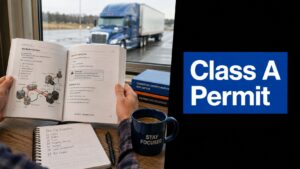
Your number one tool for studying? Your state's official CDL manual. I can't stress this enough. The test questions are pulled directly from this book. Download it, grab a physical copy if you can, and make it your bible.
Beyond just reading, how you study makes a huge difference. Don't try to cram everything at once. Break the material into smaller, manageable chunks. Instead of trying to learn the entire General Knowledge section in one night, just focus on a single chapter, like "Controlling Your Vehicle" or "Transporting Cargo Safely."
A game-changer for many new drivers is using online practice tests. There are tons of sites out there with quizzes that mimic the real exam. This is the best way to get comfortable with the multiple-choice format and, more importantly, figure out what you don't know before you're sitting in the DMV testing room.
Deciding on Your Endorsements
While you're grinding away on the core tests, start thinking strategically about endorsements. These are special add-ons to your CDL that qualify you to drive specific types of vehicles or haul certain cargo. Each one requires passing its own written test.
Getting the right endorsements now can swing open the doors to better job opportunities down the road.
Common CDL Endorsements
| Endorsement | What It Allows You to Haul | Who Needs It? |
|---|---|---|
| T (Tanker) | Liquids or gasses in a tank | Drivers hauling anything from milk and water to fuel. |
| N (Tank Vehicle) | Liquids or gasses in a tank | This is often combined with HazMat for fuel-hauling jobs. |
| H (Hazardous Materials) | Regulated hazardous materials | A must for drivers at chemical companies or fuel transporters. |
| X (Tanker/HazMat Combo) | Hazardous materials in a tank | This is often considered the gold standard for tanker jobs. |
| S (School Bus) | Students in a school bus | A requirement for all school bus drivers. |
| P (Passenger) | 16 or more passengers | Needed for driving a coach, city, or tour bus. |
If you're not sure where to start, the Tanker (T) endorsement is a fantastic choice, as it's needed for a wide variety of gigs. The HazMat (H) endorsement is a bit more involved—it requires a separate background check—but it often leads to higher-paying work. Figure out which path fits your career goals and tackle those tests at the same time as the core exams. It's a smart move that sets you up for success from day one.
Choosing the Right CDL Training Path
Once you’ve got that Commercial Learner’s Permit in hand, you’re staring down one of the biggest forks in the road: how you're going to get your behind-the-wheel training. This isn't just about passing a test. This decision hits your wallet, shapes your skills, and can even dictate where you land your first job.
There are three main routes you can take to get your CDL. Each one has its own set of pros and cons, and it's crucial to look past the shiny brochures to understand what you're really signing up for.
Private Truck Driving Schools
If speed is your top priority, a private CDL school is often the way to go. These are dedicated training facilities, like our own school at Patriot CDL, that have one mission: getting you licensed and ready for the road, fast.
Most full-time programs are intense, cramming everything into just three to seven weeks. For anyone eager to start earning a real paycheck, that accelerated timeline is a huge advantage. The trade-off? The upfront cost. You can expect tuition to run anywhere from $3,000 to $8,000. It’s a serious investment, but you walk away with your license and the freedom to work for any carrier you choose.
Another big plus is the focused environment. The instructors are typically old-school truckers with years of experience, and the entire curriculum is built around the real-world skills you need to pass your exam and handle a rig safely.
Community College Programs
Another solid option is your local community college. These CDL programs tend to be more spread out, often running for a full semester. This can be perfect if you need to keep your current job while you're learning.
The cost is usually in the same ballpark as private schools, sometimes a bit less. A key benefit here is that you might qualify for financial aid, like federal grants or scholarships, which most private schools can't offer. The quality of training is just as rigorous, as every school in the country has to meet the same federal Entry-Level Driver Training (ELDT) standards.
The main difference really is the pace. A private school might get you through in a month, while a community college program could take three or four. That’s not a bad thing at all—some people actually prefer the slower pace to really let the material sink in.
Pro Tip: No matter which school you're looking at, always ask about their instructor-to-student ratio. A lower ratio—say, one instructor for every three or four students in the truck—means more personal coaching and, most importantly, more time for you behind the wheel.
Company-Sponsored CDL Training
The promise of "free" CDL training is a powerful magnet, especially if you don't have thousands of dollars sitting around. With this model, a large carrier covers your training costs and even your lodging. The catch? You have to sign a contract promising to drive for them for a set period, usually one to two years.
This can be a golden opportunity, but you have to go in with your eyes wide open. If you quit or get fired before your contract is up, you'll almost certainly have to pay back the full cost of the training, which can sometimes be inflated.
Comparing Your Training Options
| Training Path | Typical Cost | Average Duration | Key Advantage | Major Consideration |
|---|---|---|---|---|
| Private School | $3,000 – $8,000 | 3-7 Weeks | Speed and freedom of choice | Requires upfront cash |
| Community College | $3,000 – $7,000 | 3-4 Months | Slower pace, financial aid options | Longer time to get licensed |
| Company-Sponsored | $0 Upfront | 3-6 Weeks | No initial out-of-pocket cost | Locked into an employment contract |
The training itself can feel a bit rushed because the company’s number one goal is to fill seats in their trucks. On the flip side, it completely removes the stress of a job hunt because you have one waiting for you the second you pass your test.
Before you put your signature on anything, read that contract like a hawk. Understand the repayment terms, know what your pay will be as a rookie, and get a clear picture of the routes they'll have you running. This isn't just a school agreement—it's an employment contract that will define the first year or more of your new career.
Conquering the CDL Skills Test
Alright, this is it—the final gatekeeper between you and your new career. The CDL skills test is where all your hard work on the books and behind the wheel finally comes together. An examiner will be riding shotgun to make sure you can handle a commercial vehicle safely and confidently.
Don't let the nerves get the best of you. I've seen countless students pass this test, and the ones who succeed treat it as a chance to simply show off what they’ve learned. With the right preparation, you'll do just fine.
The test structure is pretty consistent across the country, though you might find minor differences from state to state. It always boils down to three core parts. Knowing exactly what's coming is half the battle.
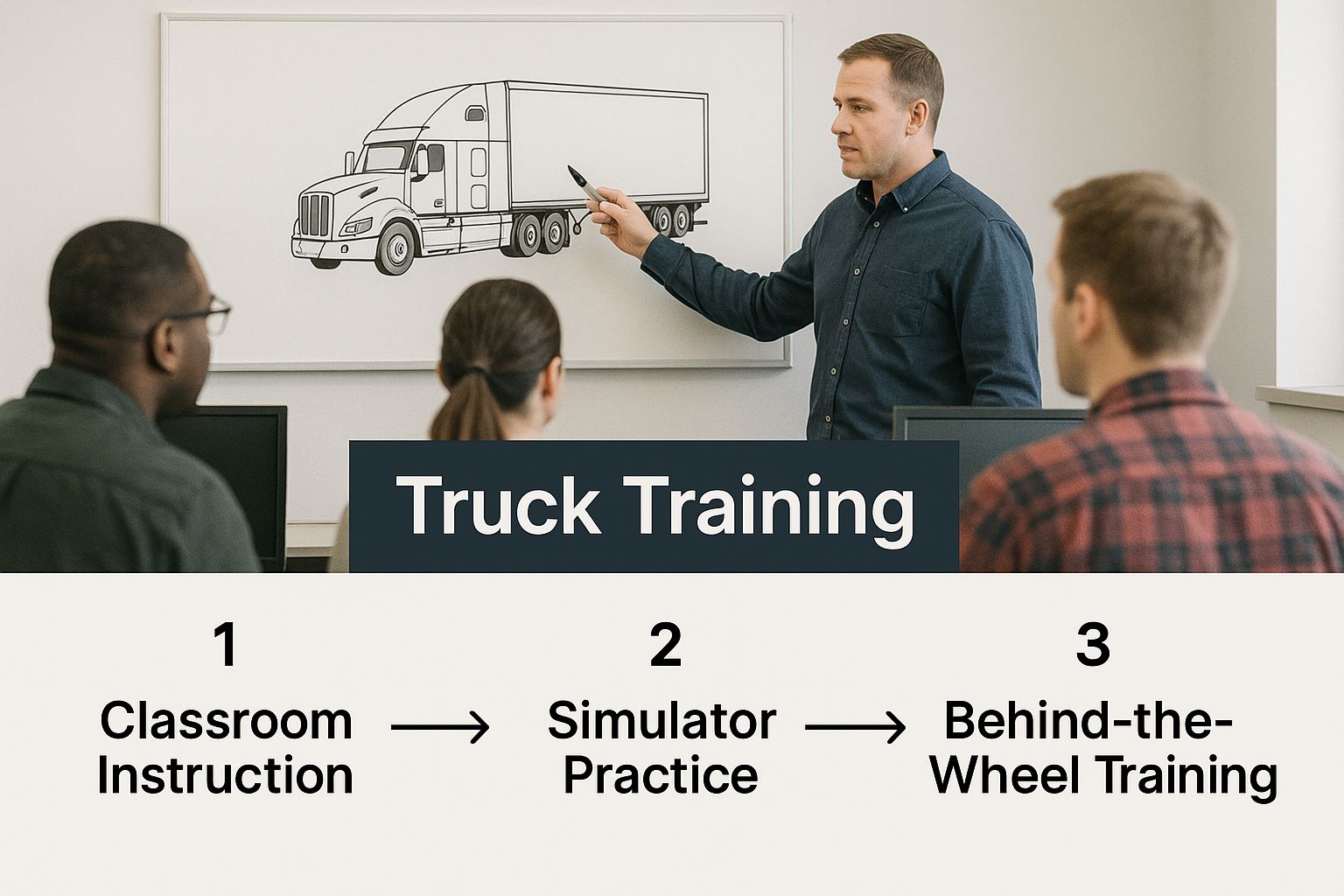
As you can see, getting your license is a journey. It starts with classroom theory, moves to hands-on practice, and culminates in this final exam.
Part One: The Vehicle Inspection
First up is the pre-trip inspection. This is so much more than just rattling off a list of truck parts you memorized. The examiner needs to see that you can walk around your vehicle, systematically spot potential safety problems, and explain what you’re looking at and why it's important.
Honestly, this is the part that intimidates students the most. There are over 100 items to check! The secret isn't memorization; it's developing a routine. Don't try to remember a random list. Create a logical path and stick to it every single time.
A method I always recommend is breaking the truck down into zones:
- The engine compartment
- The front of the vehicle
- The driver's side (tractor and trailer)
- The rear of the trailer
- The passenger side (trailer and tractor)
- The coupling system
- The in-cab inspection and brake tests
When you follow the same path every time you practice, it becomes muscle memory. You stop worrying about what’s next and just do it. Verbally call out each component, touch it or point to it, and explain what you're checking for. For example, "I'm checking this tire for proper inflation, even tread wear, and any cuts or bulges in the sidewall."
Part Two: Basic Control Skills
Once you've demonstrated you know the truck inside and out, you’ll head to the backing portion of the test. Officially, this is called the basic control skills test. It takes place on a closed course, usually marked with a sea of cones, where you’ll perform several specific, low-speed maneuvers.
You won't be asked to do anything you haven't already practiced dozens of times. Good schools, like Patriot CDL Training, drill these skills relentlessly for a reason. While the exact combination of maneuvers can vary, they're all designed to test your command of the trailer.
You can almost certainly expect to see a few of these:
- Straight Line Backing: The foundation for everything else.
- Offset Backing (Left or Right): Shifting the whole rig one lane over while in reverse.
- Alley Dock: The classic maneuver of backing the trailer into a space perpendicular to your truck, just like a real loading dock.
- Parallel Parking (Conventional or Sight-Side): Yes, just like in your driver's ed car, but on a much, much bigger scale.
The real secret to success here is simple: slow down. You are allowed to get out of the truck and look (G.O.A.L. – Get Out And Look) a set number of times. Use this! A quick peek is always better than hearing the dreaded sound of a cone being hit, which will cost you points.
Part Three: The On-Road Driving Test
Finally, it’s time to take the examiner for a spin on public roads. This is your chance to prove you can manage the truck in real-world traffic. The examiner isn't there to trick you or throw you curveballs; they just want to see a safe, professional, and law-abiding drive.
They'll be scoring you on everything from how you manage your speed and space to how you signal your intentions to other drivers.
To give you a clearer picture, the final test is really a three-part performance. Each section tests a different, vital skill set you'll use every day on the job.
CDL Skills Test Breakdown
| Test Component | What It Covers | Pro Tip for Success |
|---|---|---|
| Vehicle Inspection | A comprehensive, hands-on check of the truck's major components and safety systems. | Develop a consistent, repeatable routine. Talk the examiner through your process so they know what you're thinking. |
| Basic Control Skills | Low-speed backing maneuvers on a closed course, like alley docking and parallel parking. | Take it slow. Get Out And Look (G.O.A.L.) whenever you're unsure. Small corrections are better than big mistakes. |
| On-Road Driving | Navigating public roads, intersections, and traffic while demonstrating safe vehicle control. | Make your mirror checks and head movements obvious. Exaggerate them slightly so the examiner knows you're scanning. |
Mastering each of these components one by one is the key. When you can perform each part confidently on its own, putting them all together on test day becomes much less daunting. With enough practice and a calm approach, you'll walk out of that testing center with your CDL in hand.
Navigating Your First CDL Job Search

So, you’ve done it. You passed the tests, aced the skills portion, and now you’re holding a brand new Commercial Driver’s License. Congratulations! That’s a massive accomplishment, but the real journey is just getting started. Now it’s time to turn that hard-earned license into a steady paycheck.
Making the leap from a student driver to a paid professional can feel intimidating, but landing a great first gig is totally achievable if you know how to approach it.
Crafting a Powerful Entry-Level Resume
Right now, your most important qualification is that new CDL, and your job search begins by showing it off. Don't sweat it if you don't have years of professional driving on your resume yet—you've got other valuable assets to highlight.
Your resume should be all about your training and qualifications. Think of your time at CDL school as your most recent and relevant "job experience."
Put your training front and center. Name the school you attended, like Patriot CDL Training, list your graduation date, and specify the class of license you earned. But don't stop there—get into the details of what you actually did.
- Skills Mastered: Did you nail your alley docking? Mention it. Got the hang of offset backing or coupling and uncoupling? Put it down.
- Time Behind the Wheel: Be sure to note the number of behind-the-wheel hours you logged during your training. This is a key metric for recruiters.
- Valuable Endorsements: Clearly list every endorsement you've earned, whether it’s for a Tanker (N) or HazMat (H).
- Safety First: Emphasize your clean driving record and your successful completion of all safety protocols.
This level of detail shows recruiters that you have the solid, foundational skills they need. Many companies would rather hire a well-trained rookie with a great attitude than a seasoned driver who’s picked up bad habits over the years.
Finding the Right Entry-Level Trucking Job
With a solid resume in hand, you need to know where to start looking. Sure, you could get lost in the massive online job boards, but it's smarter to focus your energy on platforms and events built specifically for the trucking world.
Specialized job boards are your best bet. Websites dedicated to trucking let you filter openings by experience level, the type of route you want, and even the endorsements required. This is the fastest way to sift through the noise and find companies that are eager to hire new graduates.
And don't sleep on company hiring events or local career fairs. These are golden opportunities to talk face-to-face with recruiters, get your questions answered, and make a real personal impression that a simple online application just can't match.
Don’t forget about your CDL school. They often have strong, established relationships with carriers who trust their graduates. Tap into their job placement assistance—it’s one of the most valuable services they provide and can be a direct pipeline to your first interview.
OTR vs. Regional vs. Local Driving
One of the biggest decisions you'll make right out of the gate is what kind of driving actually fits your life. There’s no single "best" job; it all comes down to what you need in terms of pay, home time, and overall lifestyle.
Over-the-Road (OTR): This is the classic long-haul experience. OTR drivers are often out for 2-4 weeks at a time, crisscrossing the country and racking up serious miles. It generally offers the highest starting pay but requires a significant commitment to being away from home.
Regional: Think of this as the happy medium. Regional drivers stick to a specific part of the country, like the Southeast or the Pacific Northwest. You’ll still be on the road for several days straight, but you’ll get home far more often, usually for the weekend.
Local: If you want to sleep in your own bed every night, a local driving job is what you’re looking for. These roles usually involve deliveries for beverage distributors, construction companies, or waste management services, all within a specific city or metro area. The pay is also different, often hourly instead of by the mile.
Getting clear on these differences will help you focus your job search. It makes no sense to apply for OTR positions if you know you need to be home for family commitments every weekend. Your first year is all about getting that crucial experience under your belt, and finding a role you can stick with is the key to building a long and successful career on the road.
Common Questions About Getting a CDL
Taking the leap to get your commercial license is a big decision, and it’s completely normal to have questions swirling around. Figuring out the costs, the time commitment, and what to expect can feel overwhelming. Let’s clear up some of the most common questions I hear from aspiring drivers.
How Much Does It Cost to Get a CDL?
There’s no single, fixed price for a CDL. The biggest factor is the training path you take, but you can generally expect to invest somewhere between $3,000 and $8,000. This range usually covers the full tuition for a program at a private truck driving school or a local community college.
Keep in mind, that's just the tuition. You’ll also have smaller, but necessary, fees along the way. Be sure to budget for your DOT physical exam, permit application fees at the DMV, and the final state licensing fees. These can add a few hundred dollars to your total out-of-pocket cost.
Another route is company-sponsored training. Some of the big carriers offer programs with little to no upfront cost, which can be a huge help. The catch? You’ll have to sign a contract agreeing to drive for them for a specific period—usually about a year—to "pay back" the cost of your training.
How Long Does the CDL Process Take?
Your timeline for getting licensed really depends on the intensity of your program. If you can commit to a full-time, accelerated course, you could be licensed and ready to hit the road in as little as three to seven weeks. These programs are immersive and fast-paced, designed to get you working quickly.
If you need more flexibility, a part-time program at a community college might be a better fit. These often stretch out over several months, allowing you to keep your current job while you learn.
A couple of key rules affect everyone's timeline. First, all training must meet the federal Entry-Level Driver Training (ELDT) standards. Second, once you earn your Commercial Learner's Permit (CLP), you are required by law to wait a minimum of 14 days before you can take your final skills test. For most people, the entire journey—from opening the manual to holding your CDL—takes between one and six months.
Can I Get a CDL With a Bad Driving Record?
This is a big concern for many, and the honest answer is: it depends. A couple of minor speeding tickets from years ago probably won't stop you. Most schools and trucking companies understand that nobody's perfect.
However, serious violations are a different ballgame. Things like a recent DUI/DWI conviction, reckless driving, or leaving the scene of an accident can be immediate deal-breakers. Each state has its own disqualification rules, and every company will run a thorough check of your Motor Vehicle Record (MVR), typically looking back three to ten years.
The best policy is always honesty. Be upfront about your driving history with any school or potential employer. Hiding something serious will only cause bigger problems down the road and could get you kicked out of a program or fired from a job.
What Is the Difference Between Class A and Class B?
Choosing the right license class boils down to what kind of truck you want to drive and what career you’re aiming for. It’s all about the weight and configuration of the vehicle.
Class A CDL: This is the big one. It lets you operate combination vehicles (like a tractor-trailer) with a Gross Combination Weight Rating (GCWR) of 26,001 pounds or more, where the trailer being pulled weighs over 10,000 pounds. A Class A license is the most versatile and opens up the most job opportunities, especially for long-haul, over-the-road (OTR) work.
Class B CDL: This license is for single vehicles with a Gross Vehicle Weight Rating (GVWR) of 26,001 pounds or more. You can still tow a trailer, but it must weigh less than 10,000 pounds. Think dump trucks, straight trucks, cement mixers, and city buses.
So, if you dream of driving a big rig across the country, you need a Class A. If you'd rather stick to local routes in a large vehicle like a dump truck or a delivery truck, a Class B is the perfect choice.
At Patriot CDL, we provide the expert, hands-on training you need to confidently earn your CDL and start a successful career. Learn more about our accelerated programs and how we can help you get on the road.
Article created using Outrank