


An O restriction can surprise a Class A CDL holder who expects the license to cover conventional tractor-trailer work. The restriction concerns the type of combination used for the qualifying skills test, specifically the absence of the usual fifth-wheel tractor-semitrailer connection. Removing it requires more than becoming familiar with a new coupling word. The driver needs the appropriate Pennsylvania licensing process, suitable equipment, and a realistic assessment of tractor-trailer inspection and handling skills. This guide explains how to organize the process while keeping official requirements separate from the training that helps a driver prepare safely.
Understand the equipment limit on the current license
Read the restriction codes on your license and confirm their meaning through PennDOT. The O restriction prohibits the relevant Class A fifth-wheel tractor-trailer operation; it is distinct from a transmission or air-brake restriction. A driver may hold Class A authority while still lacking authority for a particular configuration. Do not accept an assignment based only on the large Class A label. Compare the actual vehicle and connection with the license record. If the meaning is uncertain, resolve it before operating rather than assuming an employer’s description overrides the restriction.
A situation to discuss
A driver has experience with a non-fifth-wheel combination and is offered work in a conventional tractor-semitrailer. The class alone looks suitable, but the O restriction changes the answer. The equipment and the complete license record must be matched before an assignment is accepted.
Practice with a clear purpose
List every restriction and endorsement on the current license. For each, write the equipment or operation it affects. Ask PennDOT about unclear entries and keep the confirmed explanation with the plan for removal.
Ask yourself: Does my complete license record authorize this specific vehicle configuration?
Start with PennDOT’s restriction-removal process
Contact PennDOT about the permit and documentation required for your record. Its current skills-test guidance lists vehicle inspection, basic controls, and on-road testing for No Tractor-Trailer restriction removal, without an additional knowledge-test entry in that row. PennDOT also states that adding a restriction removal requiring a skills test resets its applicable 15-day permit period. Confirm the date on which you become eligible to test rather than applying a generic federal waiting-period summary. Keep the permit, medical qualification where applicable, and scheduling information organized before arranging equipment.
A situation to discuss
A driver books training and expects to test immediately because they already hold a CDL. The new restriction-removal permit introduces a timing requirement. Checking the current PennDOT process first prevents a schedule built around a date that is not eligible.
Practice with a clear purpose
Ask the licensing office to confirm the exact permit transaction, earliest eligible test date, documents, and current fees. Record the answers and the source date. Verify them again if your record or intended test changes.
Ask yourself: What must be completed before this particular restriction-removal test can be scheduled?
Distinguish restriction removal from a first-time Class A application
Federal ELDT rules cover specified first-time licenses, upgrades, and endorsements. Removing only an O restriction from an existing Class A CDL is not ordinarily the same as obtaining Class A for the first time. Do not infer that exemption from a full beginner course means no preparation is needed, and do not assume your case is restriction-only if another upgrade or endorsement is also involved. Confirm the actual transaction with PennDOT and the training provider. The right training plan follows the driver’s needs and the legal goal rather than the broadest or shortest package name.
A situation to discuss
A driver asks for O-removal training but also intends to change other license privileges. Combining transactions can change the questions that must be answered. The instructor and licensing authority need the complete goal, not only the restriction the driver mentioned first.
Practice with a clear purpose
Write a clear description of the license you hold and the exact change you want. Separate O removal from any additional class, endorsement, or restriction issue. Ask which requirements apply to each change.
Ask yourself: Am I removing only this restriction, or making other licensing changes at the same time?
Learn fifth-wheel inspection as a connected system
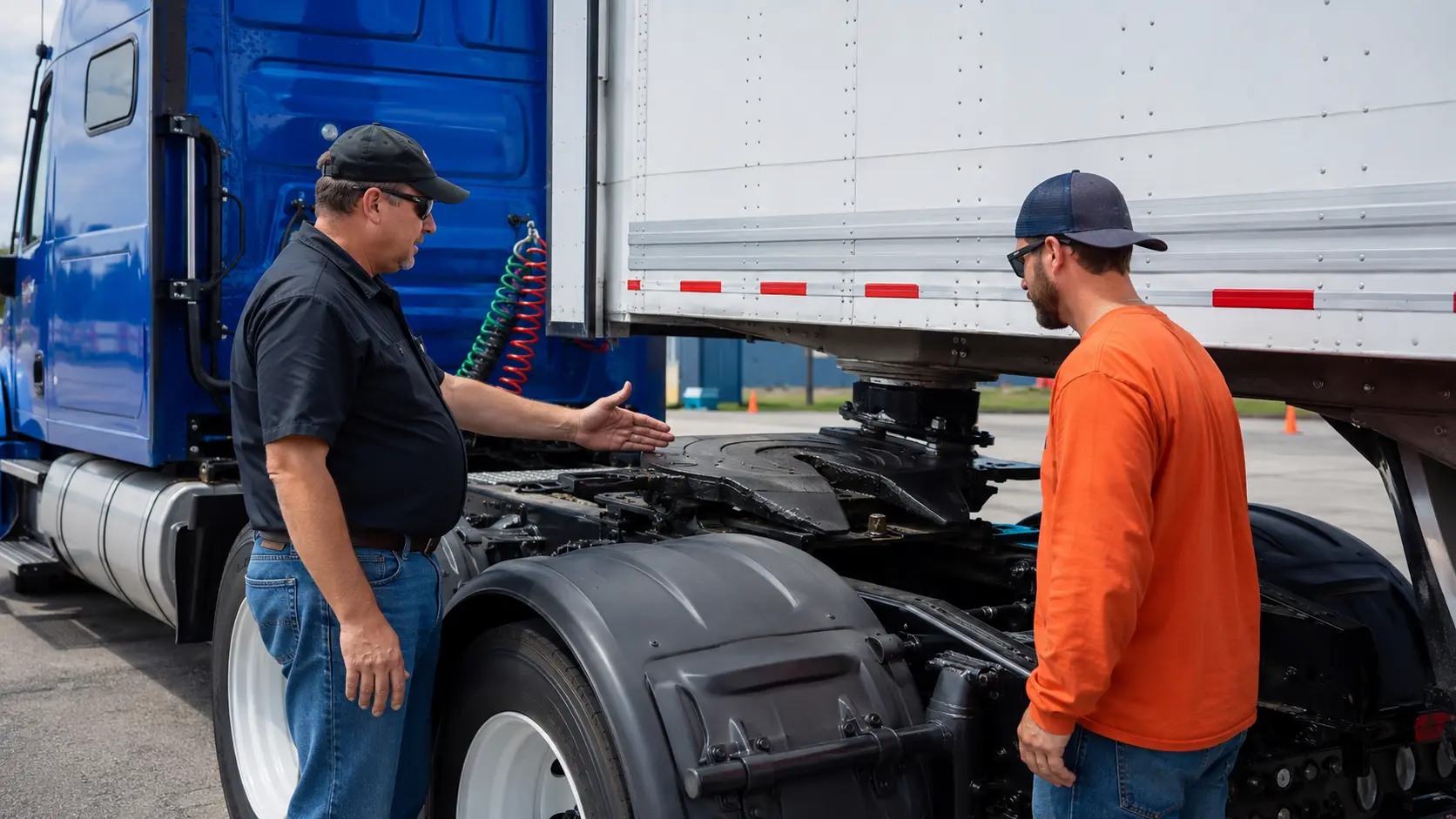
The fifth wheel is a coupling system with interacting parts, not just the visible plate behind the cab. Under instructor supervision, connect the kingpin, locking mechanism, release mechanism, mounting, trailer apron, connections, and clearances with their functions. Learn the current inspection requirements and the actual equipment’s configuration. Never enter a pinch area, disconnect equipment, or move between units without authorization and a safe setup. A correct verbal description should correspond to what you can properly observe and what the required check establishes. Familiarity with another connection does not establish fifth-wheel competence.
A situation to discuss
A driver accustomed to a different coupling focuses on the main attachment and overlooks the relationship between locking engagement and supporting components. A supervised system walkthrough helps reveal the unfamiliar inspection points before the driver attempts an operational sequence.
Practice with a clear purpose
Build a component map with the instructor. For each item, explain its purpose, the permitted observation method, and the unsafe condition the check is intended to detect. Keep operational coupling steps in the verified vehicle-specific procedure.
Ask yourself: Can I explain how the connection is secured rather than merely identify the largest visible part?
Reassess backing and turning in the new combination
Previous experience can help, but a conventional tractor-semitrailer may respond differently from the vehicle used for the original test. Trailer length, wheelbase, articulation, mirror view, off-tracking, and overhang affect the path. Begin with an instructor’s assessment in an appropriate controlled area. Learn to recognize a developing alignment problem early, use allowed corrections, and stop when the view or intended path is uncertain. Avoid chasing the trailer with large repeated steering inputs. The goal is controlled movement and a coherent understanding of the combination, not a fast demonstration based on experience with different equipment.
A situation to discuss
An experienced driver turns as if operating the previous combination and finds the trailer tracking closer to an obstruction. The instructor uses the moment to compare paths and explain why prior experience must be adapted rather than copied automatically.
Practice with a clear purpose
Sketch the tractor and trailer paths before a supervised exercise. Identify the tightest clearance and where it should be checked. After the exercise, compare the sketch with the actual movement and select one correction to practice.
Ask yourself: Which behavior from my previous equipment needs adjustment for this combination?
Prepare for all required skills-test components
Because the applicable PennDOT chart includes inspection, basic controls, and road testing, preparation should not focus exclusively on coupling terminology. Review the current testing format with the authorized provider and ask what the vehicle must satisfy. Train on observation, control, communication, turning, lane use, and safe decision-making as appropriate to the driver’s needs. A readiness evaluation should identify weaknesses before the appointment. Avoid a calendar-only standard that assumes a fixed number of sessions makes every driver ready. The instructor’s evidence and the official test requirements should guide the final preparation.
A situation to discuss
A driver spends most practice time backing and assumes the road section will be automatic because they already work professionally. The assessment reveals late mirror checks during turns in the new combination. Addressing that specific gap is more useful than repeating only the strongest maneuver.
Practice with a clear purpose
Create a preparation matrix with the required test components and the instructor’s observed strengths and gaps. Give each unresolved item a focused practice objective. Confirm test-vehicle suitability and documents separately from driving readiness.
Ask yourself: Have I prepared for the whole required test, not merely the most unfamiliar component?
Confirm the updated privilege before accepting work
Passing a test is an important step, but verify that the license record and issued credential reflect the restriction removal before operating equipment that was previously prohibited. Keep other restrictions in view; removing O does not automatically remove transmission or air-brake restrictions. Discuss the intended work with the employer, including the exact configuration and any further qualification requirements. Restriction removal expands the set of vehicles you may be eligible to operate but does not guarantee a position or replace employer orientation. Treat the first work assignment as a new operational setting requiring its own preparation.
A situation to discuss
A driver passes an O-removal test but assumes every other equipment limitation disappeared as well. A review of the updated license reveals a separate restriction still affecting the offered vehicle. Checking the whole record prevents a new mismatch.
Practice with a clear purpose
After completion, compare the updated record with the original list of restrictions. Resolve discrepancies through PennDOT. Review the employer’s equipment, orientation, and qualification expectations before agreeing to operate.
Ask yourself: Does the updated credential match the actual equipment and work I am about to accept?
Decision worksheet
| Focus | Why it matters | Practical action |
|---|---|---|
| License record | Class plus all restrictions | Confirm exact equipment authority |
| PennDOT process | Permit, timing, and required test | Verify before booking |
| Preparation | Inspection, controls, and road skills | Use an individual readiness assessment |
| After passing | Updated credential and remaining restrictions | Check before operating |
Preparation checklist
- Confirm O and every other code on the license.
- Ask PennDOT about the correct permit and timing.
- Separate restriction-only removal from other upgrades.
- Train in suitable fifth-wheel equipment under supervision.
- Prepare all required test components.
- Verify the updated credential before operating.
Workshop: build an O-removal readiness file
Create a folder with separate sections for licensing, equipment, learning, and the final credential. In the licensing section, keep the confirmed restriction-removal transaction, permit details, eligibility date, and required documents. In the equipment section, record the suitable vehicle configuration and the test provider’s requirements. This separation prevents a completed training session from being mistaken for proof that the administrative side is ready.
In the learning section, use the instructor’s assessment to list specific gaps. An experienced driver may need more work on one inspection area and less on routine traffic observation, while another may need broader adaptation to the combination. Do not fill the file with a generic claim that prior experience makes the driver ready. Keep evidence from supervised performance and the remaining practice objectives.
Before the appointment, review the whole path from eligibility to test completion. Confirm who provides the vehicle, what must be brought, and how a scheduling change will be handled. Ask the authorized provider about the current format rather than relying on another driver’s memory from an older test. If another restriction is also being removed, keep its requirements visible instead of assuming the O-removal plan covers it automatically.
After passing, add the updated credential or official record confirmation. Compare it with the original list of codes and the intended work vehicle. The process ends when the privilege and equipment match, not merely when someone says the test went well. This file also gives the driver a useful way to discuss the change with an employer: the restriction removed, the preparation completed, and any limits that remain. It does not promise employment or establish competence for every new cargo or workplace procedure, which still needs appropriate orientation.
Keep career planning tied to the actual equipment
When researching work after O removal, ask what combination the employer uses and what additional qualifications the position requires. A job advertisement that says Class A may still involve particular transmission, brake, cargo, endorsement, or experience expectations. The updated license removes a specific legal limitation; it does not answer every question about a position. Read the requirements and describe your preparation accurately.
Use the same accuracy when discussing prior experience. Experience with a non-fifth-wheel combination is relevant, but it should not be represented as years of operating a conventional tractor-semitrailer if that is not what occurred. An employer can make a better orientation plan when the driver explains the equipment actually used and the skills recently practiced. This also keeps the training goal realistic: expand appropriate vehicle authority, demonstrate required skills, and continue learning in the employer’s setting. No single restriction-removal test replaces that later orientation or guarantees access to every Class A assignment.
Frequently asked questions
What does an O restriction mean?
It limits the relevant Class A tractor-trailer operation with a fifth-wheel connection. Confirm the exact restriction on your Pennsylvania record before accepting equipment assignments.
Does Pennsylvania require only a coupling demonstration?
No. PennDOT’s current No Tractor-Trailer restriction-removal chart lists vehicle inspection, basic controls, and on-road testing. Confirm your individual requirements with PennDOT and the authorized test provider.
Is O removal always a new first-time Class A ELDT course?
Removing only O from an existing Class A CDL is ordinarily distinct from a first-time Class A application. Other simultaneous changes can affect the analysis, so confirm your transaction with PennDOT.
Where can I discuss preparation for O removal?
Contact Patriot CDL at 267-910-2000 with your current license details, intended equipment, and experience. Ask about an assessment and current preparation options without assuming a fixed duration or guaranteed test outcome.
Official references and further reading
- : consult the current sections relevant to your vehicle and test.
- : an official starting point for road-safety topics.
- : check the categories covered by federal entry-level training requirements.
Reviewed October 19, 2026. Educational preparation supports, and does not replace, current official requirements and supervised vehicle-specific instruction.