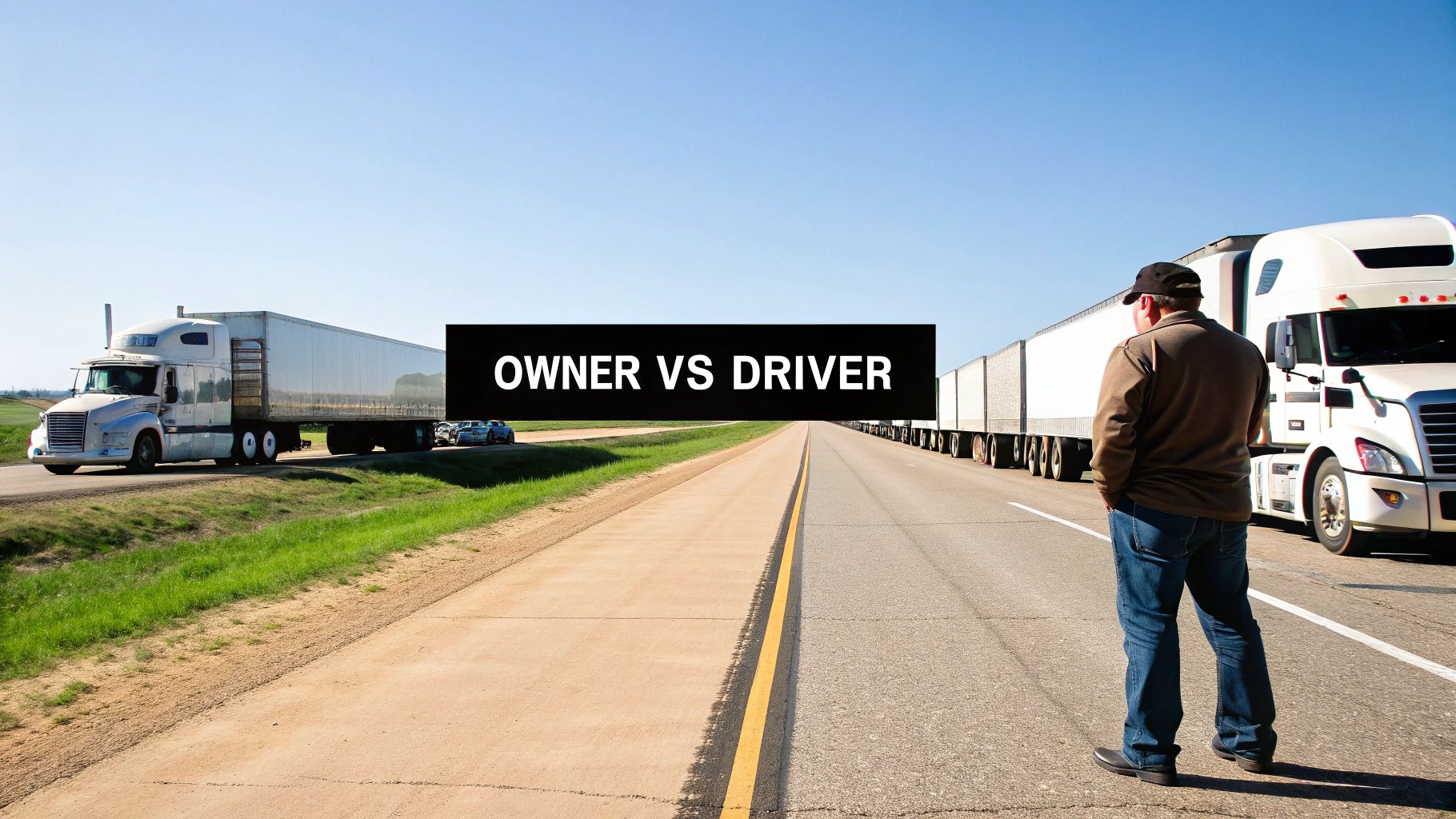
At its heart, the difference between an owner-operator and a company driver is a classic tale of two careers: one is a business owner, the other is an employee. One path offers the risks and rewards of entrepreneurship in exchange for serious income potential and freedom. The other provides a steady paycheck and benefits for the stability and structure that come with being part of a larger team.
Choosing Your Path in the Trucking Industry
Deciding whether to buy your own rig or stick with a company is one of the biggest crossroads in a trucker's career. Both jobs demand the same core skills and qualifications, but they couldn't be more different in how you live and work. Getting a handle on these differences is the first step to building a career on the road that truly works for you.
This infographic lays out the key distinctions at a glance.
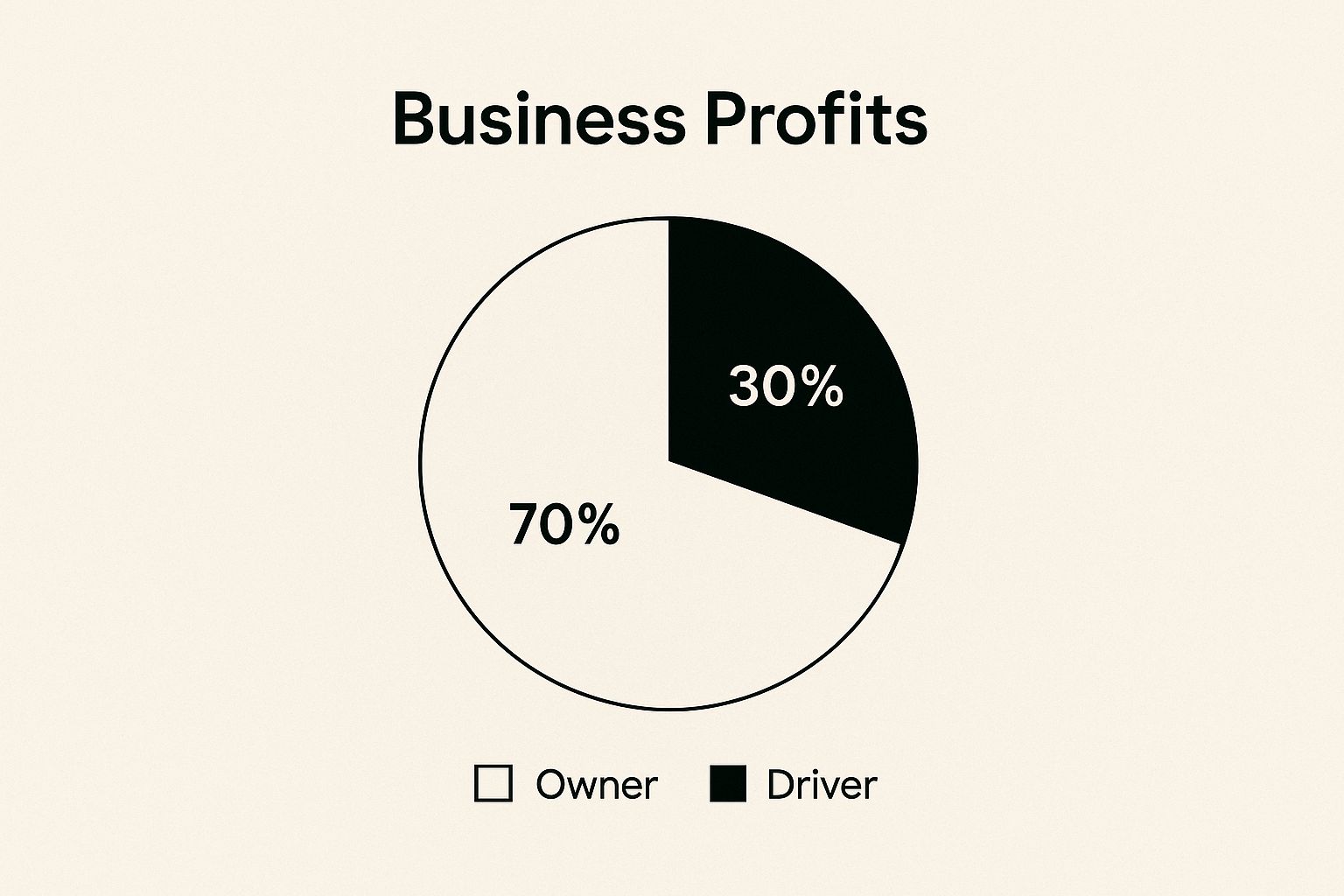
As you can see, the owner-operator’s journey is all about business ownership, while the company driver finds their stability in employment.
The Fundamental Divide
The real split comes down to responsibility and control. If you're a company driver, your carrier hands you the keys to the truck, finds the loads, handles the maintenance, and pays for the big-ticket items like fuel and insurance. On the flip side, an owner-operator is a self-contained business, responsible for juggling all of that and more.
- Company drivers have one primary job: drive the truck and get the freight delivered safely and on schedule.
- Owner-operators wear multiple hats, adding bookkeeper, compliance manager, and customer service rep to their driving duties.
According to the Federal Motor Carrier Safety Administration (FMCSA), there are over 922,000 independent owner-operators on the road, which sounds like a lot until you realize that's only 11.1% of all U.S. truck drivers. It’s clear that while the idea of being your own boss is tempting, most drivers opt for the structured life of a company employee.
The choice isn't just about money; it's about lifestyle. You're deciding between the structured security of an employee and the demanding freedom of an entrepreneur.
For anyone just breaking into the industry, the first and most important step is to master the fundamentals behind the wheel. Before you get too far down the road on this decision, you can learn more about the CDL requirements that are mandatory for either path.
Quick Comparison Owner Operator vs Company Driver
To get a clearer picture right away, it helps to put the two roles side-by-side. This table breaks down the core differences at a high level.
| Factor | Owner Operator | Company Driver |
|---|---|---|
| Income Structure | Percentage of load revenue, high gross potential | Pay-per-mile or salary, predictable income |
| Operational Costs | Responsible for all costs (truck, fuel, insurance) | Company covers all major operational costs |
| Freedom & Flexibility | High autonomy, choose your own loads and schedule | Low autonomy, follows company dispatch and schedule |
| Financial Risk | High personal and business financial risk | Low to no personal financial risk |
As you can see, the trade-offs are significant. The high-risk, high-reward nature of being an owner-operator is a direct contrast to the stability and lower personal risk of being a company driver.
The Financial Reality of Each Trucking Path
When you're weighing a career as an owner-operator against being a company driver, the conversation almost always lands on money. On paper, it looks like a no-brainer. An owner-operator can pull in a massive gross revenue that makes a company driver's salary look small. But the real story isn't about what you make—it's about what you keep.
A company driver's income is all about predictability. You get a steady paycheck, usually based on a cents-per-mile rate, and the carrier handles nearly all the big-ticket costs. Fuel, insurance, maintenance, and tolls? That's the company's problem, not yours. This setup gives you a reliable financial baseline with very little personal risk.
Gross Revenue vs. Net Take-Home Pay
The big draw for owner-operators is the earning potential. It’s not rare to see them grossing well into the six figures, sometimes pulling in $200,000 or more a year. But that eye-popping number is just revenue, not profit.
The gap between what owner-operators and company drivers earn looks huge at first glance. An owner-operator in the U.S. might gross three times what a company driver makes—sometimes even ten times more than a private fleet driver. But those gross figures are only half the equation. Owner-operators are on the hook for every business expense, from truck payments and fuel to maintenance and insurance. These costs can take a massive bite out of their net pay, sometimes dropping it close to—or even below—what a company driver earns, especially when freight is slow.
The Owner-Operator Expense Sheet
Running your own truck means you're running a business, and every business has costs. Those expenses start chipping away at your gross revenue from the moment you turn the key. A quick look at the major costs includes:
- Truck Payment: Whether you lease or buy, this is a hefty monthly bill, often running thousands of dollars.
- Fuel Costs: This is your biggest moving target. It can swing wildly with market prices and eat up a huge chunk of your income.
- Insurance Premiums: You can't hit the road without commercial truck insurance, and it's a major expense. Expect to pay over $10,000 a year, sometimes much more.
- Maintenance and Repairs: You need a serious maintenance fund. It's not just about oil changes; a single blown tire on the road can set you back hundreds of dollars instantly, and a major engine issue can be financially devastating.
- Taxes: As a self-employed business owner, you're responsible for your own income tax, self-employment tax, and filing quarterly estimates.
The real question isn't "How much can I make?" It's "How much can I keep?" A company driver’s paycheck is almost entirely take-home pay. An owner-operator's revenue is just the starting line.
This financial dynamic is at the very heart of the debate. An owner-operator who grosses $250,000 might easily spend $170,000 on expenses, leaving them with an $80,000 net income before they even pay taxes. A top-performing company driver could earn a similar amount without any of the risk or administrative headaches. The choice really boils down to how much financial risk and business management you're willing to take on.
Choosing Your Lifestyle: Freedom vs. Structure
Forget the spreadsheets and income projections for a moment. The real difference between being an owner-operator and a company driver comes down to lifestyle. It's a choice between the wide-open road of entrepreneurship and the well-paved highway of a steady job. Neither path is right or wrong, but one of them is almost certainly a better fit for you.
The biggest draw for owner-operators? Autonomy. You're the captain of your own ship—or in this case, the CEO of your own one-truck business. You call the shots, and that freedom shows up in big ways every single day.
- You Pick Your Freight: You have the final say on what loads you haul, where you're going, and which brokers or shippers you work with.
- You Control Your Calendar: Want to head home for a week to catch your kid's baseball games? As long as you can afford the downtime, you can.
- Your Cab is Your Castle: It's your truck. You can set it up and customize it exactly how you want for comfort and a better work environment.
Of course, that independence is a double-edged sword. With great freedom comes great responsibility. The pressure is always on. Time you're not driving is time you're not earning, so you're constantly hustling—booking your next load, handling paperwork, or scheduling maintenance.
The Structure of a Company Driver
On the flip side, life as a company driver is all about structure and support. The company’s dispatchers and logistics team handle the headaches, which frees you up to do one thing: drive. Your routes are planned, your schedule is largely set, and you generally have a good idea of when you'll get home. It’s a much more predictable, and often less stressful, existence.
The trade-off, of course, is control. You go where you’re told, haul what you’re assigned, and run on the company’s schedule. While most carriers do a good job of getting you home on time, you lose that ability to make a spontaneous decision to take an extra day off.
An owner-operator splits their time between driving and running a business. A company driver’s job is almost entirely about driving. The real question is, where do you want your responsibilities to begin and end?
Think about it this way. An owner-operator might turn down a high-paying load into a city they hate driving in, choosing a slightly cheaper but less stressful run instead. A company driver takes the load they're given.
Here's another real-world example: finding a safe place to park overnight is a massive headache that gets worse every year. An owner-operator is on their own to solve that puzzle every night. If you're new to that struggle, you can learn more about finding reliable spots for secure truck parking. A company driver, however, often has their stops and fuel-ups planned by dispatch, taking that problem completely off their plate.
Ultimately, your decision hinges on a simple question: Do you want to be the one making all the calls, or do you prefer the stability that comes from letting someone else handle them?
Where the Buck Stops: Costs and Responsibilities
When you're weighing a career as an owner-operator versus a company driver, the biggest question is simple: who foots the bill? The answer completely changes the nature of the job. For a company driver, the job is driving. For an owner-operator, driving is just one part of running a full-blown business.
If you're a company driver, your wallet is largely protected. The trucking company you work for covers just about every major expense needed to keep that rig on the road—fuel, insurance, tolls, and any maintenance or repairs. Your paycheck is just that: your paycheck.
But for an owner-operator, it's a totally different story. You're on the hook for every single expense. That huge potential for high gross revenue comes with a long, long list of costs that can chew through your profits if you're not on top of your game.
The Business of Being an Owner Operator
Stepping into the owner-operator world means you’re instantly the CEO, the accountant, and often the mechanic. The financial and administrative workload is massive and never really stops. Your ability to juggle these tasks is what separates a successful business from a failed one.
Here’s a look at the major costs and duties you'll have to manage:
- The Truck Itself: This is your number one investment, whether you're financing a new or used truck or leasing one.
- Insurance: You're required to carry your own commercial liability and cargo insurance. Be prepared for this to run $10,000 to $15,000 a year, sometimes more.
- Fuel & IFTA: You pay for all your fuel out-of-pocket and have to handle the quarterly International Fuel Tax Agreement (IFTA) filings.
- Maintenance & Repairs: A blown tire, a brake job, or a serious engine problem—it all comes out of your revenue. This is why a meticulous pre-trip inspection isn't just a good habit; it's a critical business practice.
- Taxes & Compliance: Get ready for the Heavy Vehicle Use Tax (HVUT), self-employment taxes, and making sure all your permits and operating authority are current and in good standing.
The real "hidden job" for an owner-operator has nothing to do with driving. It's the constant, behind-the-scenes work of bookkeeping, finding profitable loads, and navigating the maze of regulations that truly determines if you’ll sink or swim.
Cost and Responsibility Breakdown
To really see the contrast, let's put the two roles side-by-side. The table below clearly shows who is responsible for what.
| Responsibility | Owner Operator Pays/Manages | Company Driver Pays/Manages |
|---|---|---|
| Truck Payment | Yes, handles the lease or loan payments. | No, the company provides the truck. |
| Fuel & Tolls | Yes, this is a major variable expense. | No, usually covered by a company fuel card. |
| Insurance | Yes, must find and pay for their own policy. | No, covered under the carrier's insurance. |
| Repairs & Maintenance | Yes, all costs are paid out-of-pocket. | No, the company shop handles it. |
| Load Sourcing | Yes, must find and book their own freight. | No, loads are assigned by dispatch. |
| Bookkeeping & Taxes | Yes, manages all financial records and taxes. | No, receives a simple W-2 from the employer. |
This breakdown really gets to the heart of the decision. As a company driver, you trade some freedom for stability and financial predictability. As an owner-operator, you take on all the risk and responsibility for a shot at much bigger rewards and complete control over your destiny.
Navigating Your Long-Term Career Trajectory
https://www.youtube.com/embed/1iO_cxthFK4
Deciding between being an owner-operator and a company driver isn't just about your next paycheck. It's about mapping out the next five, ten, or even twenty years of your life on the road. The long-term picture for each path is shaped by everything from industry trends and fuel costs to your own personal ambition.
For most folks, the journey starts behind the wheel of a company truck. Think of it as a paid apprenticeship. You get priceless, real-world experience without the massive financial gamble of buying your own rig. It's the perfect place to learn the ropes—from navigating the best routes to understanding freight cycles—all while earning a steady paycheck with benefits.
Many drivers use this time to build a solid reputation and save up, seeing it as a crucial stepping stone to one day owning their own truck.
The Evolving Role of the Owner-Operator
The trucking world has changed a lot over the years. Decades ago, owner-operators were a much bigger slice of the pie, with some estimates putting them as high as 50% of all drivers. Today, things look different. The Owner-Operator Independent Drivers Association (OOIDA) recently reported that only about 16% of U.S. truckers are owner-operators.
What caused the shift? Mostly, the rise of mega-carriers and the skyrocketing cost of new equipment.
But don't count the owner-operator out. They remain an absolutely vital part of the supply chain, often handling the specialized loads that big carriers won't touch—think oversized equipment or time-critical freight. This flexibility is their secret weapon.
For an owner-operator, the long-term game is about becoming a specialist and a sharp business owner. For a company driver, it's about climbing the ladder to better pay, dedicated routes, or even a management role.
Planning Your Next Move
Your career path doesn't have to be a straight line. I've known veteran owner-operators who sold their rigs to finish their careers as top-paid company drivers, trading the stress of ownership for stability. On the flip side, I've seen seasoned company drivers finally take the plunge into entrepreneurship after years of careful planning.
If your goal is to advance within a company or land a specialized gig, beefing up your skills is the way to go. Adding endorsements to your CDL opens up a ton of doors. For instance, an E-Restriction Removal Course is a great starting point for drivers wanting to operate a wider range of vehicles.
Ultimately, both paths offer rewarding, long-term careers. They just demand different things from you and reward different strengths.
Making the Right Call for Your Future
Choosing between being an owner-operator and a company driver isn't about which path is "better"—it's about which path is better for you. This decision is one of the most important you'll make in your trucking career, and it really comes down to your personality, your financial situation, and what you want your life to look like down the road.
Forget looking for a one-size-fits-all answer. The real key is an honest look in the mirror. Are you the type of person who thrives on a predictable schedule and the comfort of a steady paycheck? Or does the idea of being your own boss, with all the risks and rewards that come with it, get your engine running?
This isn't just about the money. It’s about the kind of life you want to build for yourself.
Are You Built for Stability or for the Corner Office?
Let's break it down into two distinct mindsets. See which one sounds more like you. Nailing this down is the first, and most crucial, step in making a choice you'll be happy with for the long haul.
The Stability Seeker
This driver is a natural fit for a company role. They’re looking for a solid foundation, not a high-wire act. This person typically values:
- Predictability: They want to know exactly when their next paycheck is coming and have a reliable schedule for getting home. No guesswork.
- Simplicity: Their focus is on one thing: driving. All the headaches—booking loads, scheduling maintenance, dealing with insurance—are someone else's problem.
- Low Financial Risk: They aren’t interested in putting their personal finances on the line to own and maintain a massively expensive piece of equipment.
The Entrepreneurial Spirit
This is the driver who was born to be an owner-operator. They don't just want a job; they want to build a business. This driver is all about:
- Total Autonomy: They have a burning desire to be their own boss. That means choosing their own loads, setting their own schedule, and deciding their own routes.
- Business Savvy: They get a buzz from managing the numbers, negotiating rates, and finding ways to grow their bottom line.
- A High Tolerance for Risk: They understand that to make the big bucks, you have to take big risks. They're willing to invest their own capital and ride the waves of a fluctuating income.
Your personality is your best guide. If the thought of hunting for freight and managing quarterly tax payments makes you break out in a cold sweat, the company driver life is probably for you. If it sounds like a thrilling challenge, you might have the heart of an entrepreneur.
At the end of the day, both paths can lead to a long and successful career out on the open road. The trick is to pick the lane that lets you drive straight toward your own definition of success.
Frequently Asked Questions
When you're weighing a career as an owner-operator against being a company driver, a lot of practical questions come up. Getting straight answers to these common queries can make all the difference in helping you decide which path is right for you.
What Savings Do I Need to Become an Owner-Operator?
Most seasoned truckers will tell you to have at least $10,000 to $25,000 socked away before even thinking about buying your own rig. This isn't just for a down payment; it's your safety net. That cash buffer is meant to cover your initial insurance, plates, and most importantly, a maintenance fund for those inevitable repairs that pop up when you're just starting out and cash flow is tight.
Are Lease-Purchase Programs a Smart Choice?
Lease-purchase programs can look like a shortcut to owning your own truck, but you have to walk into those with your eyes wide open. Many of these deals are loaded with high weekly payments and restrictive contracts that can make it incredibly tough to actually turn a profit. Before you sign anything, it's absolutely critical to have a lawyer who knows the industry review the agreement so you understand exactly what you're getting into.
Which Role Truly Earns More Money?
This is the million-dollar question, isn't it? An owner-operator absolutely has a higher potential for gross earnings—the numbers can look huge on paper. But the net income is what really matters.
Once you subtract all the business expenses—fuel, insurance, maintenance, taxes, and everything in between—their take-home pay can end up looking surprisingly similar to what a top-earning company driver makes. A company driver has a lower ceiling on their income, but they have a much more stable floor and predictable paychecks.
The real difference is this: owner-operators have higher gross potential but carry all the financial risk. Company drivers have predictable net income without the headaches of running a business.
Of course, before you can even get to this point, you have to master the skills of a professional driver. It all starts with the right training and understanding the latest FMCSA requirements. For anyone new to the industry, getting familiar with Entry-Level Driver Training (ELDT) is non-negotiable. You can get a full breakdown of the ELDT program from official sources.
Ready to start your journey on the open road? Patriot CDL offers accelerated training programs to get you licensed and hired fast. Learn more and enroll at https://patriotcdl.com.