

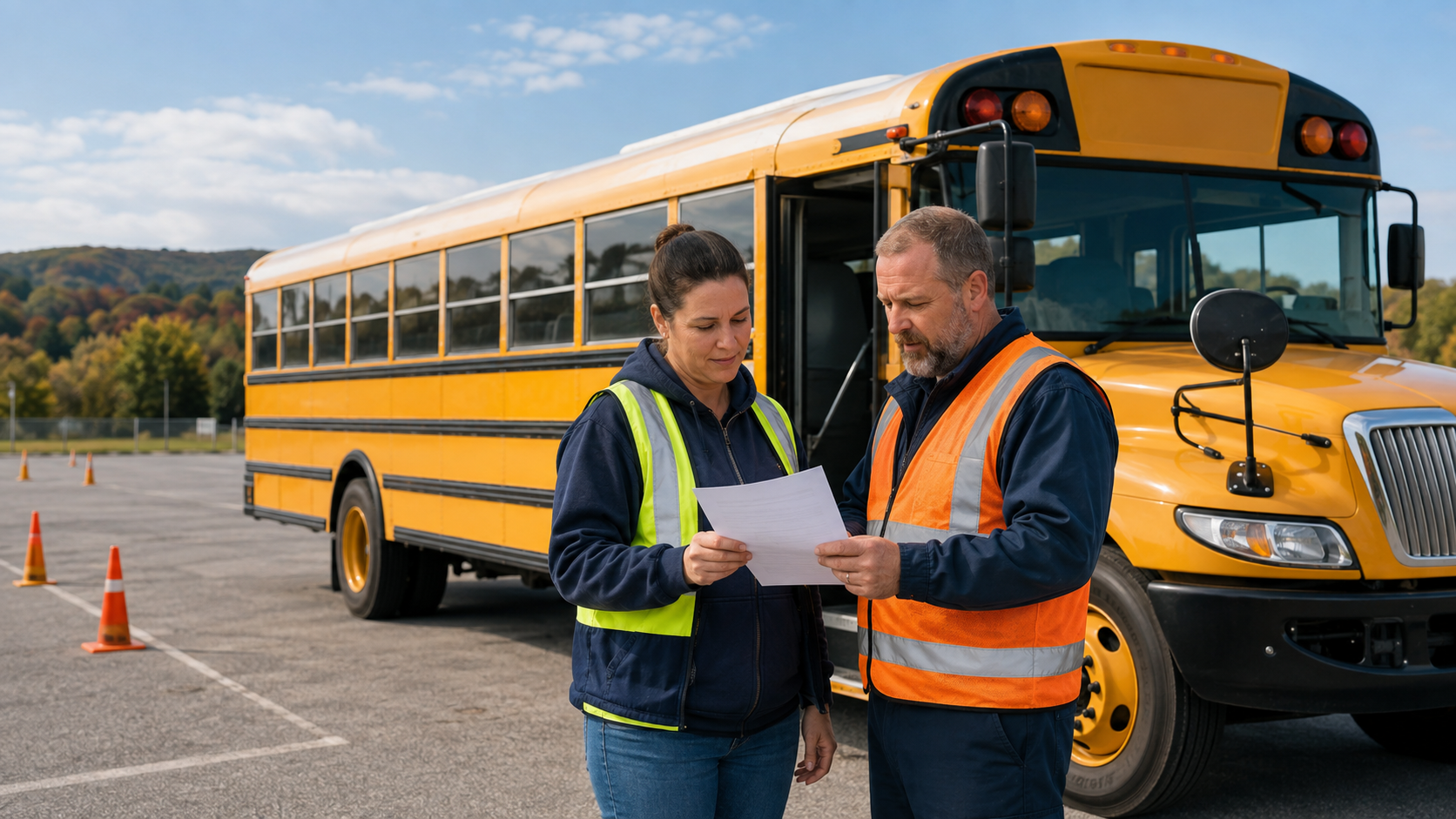
To drive a school bus carrying students in Pennsylvania, you generally need the correct commercial license class plus both the Passenger (P) and School Bus (S) endorsements. The process combines federal Entry-Level Driver Training with Pennsylvania-specific medical, training, testing, background-check, and recertification rules.
This guide puts those requirements in a practical order, explains where P and S differ, and gives you a document-and-test checklist for the first application and every renewal cycle.
Pennsylvania School Bus Endorsement Requirements at a Glance
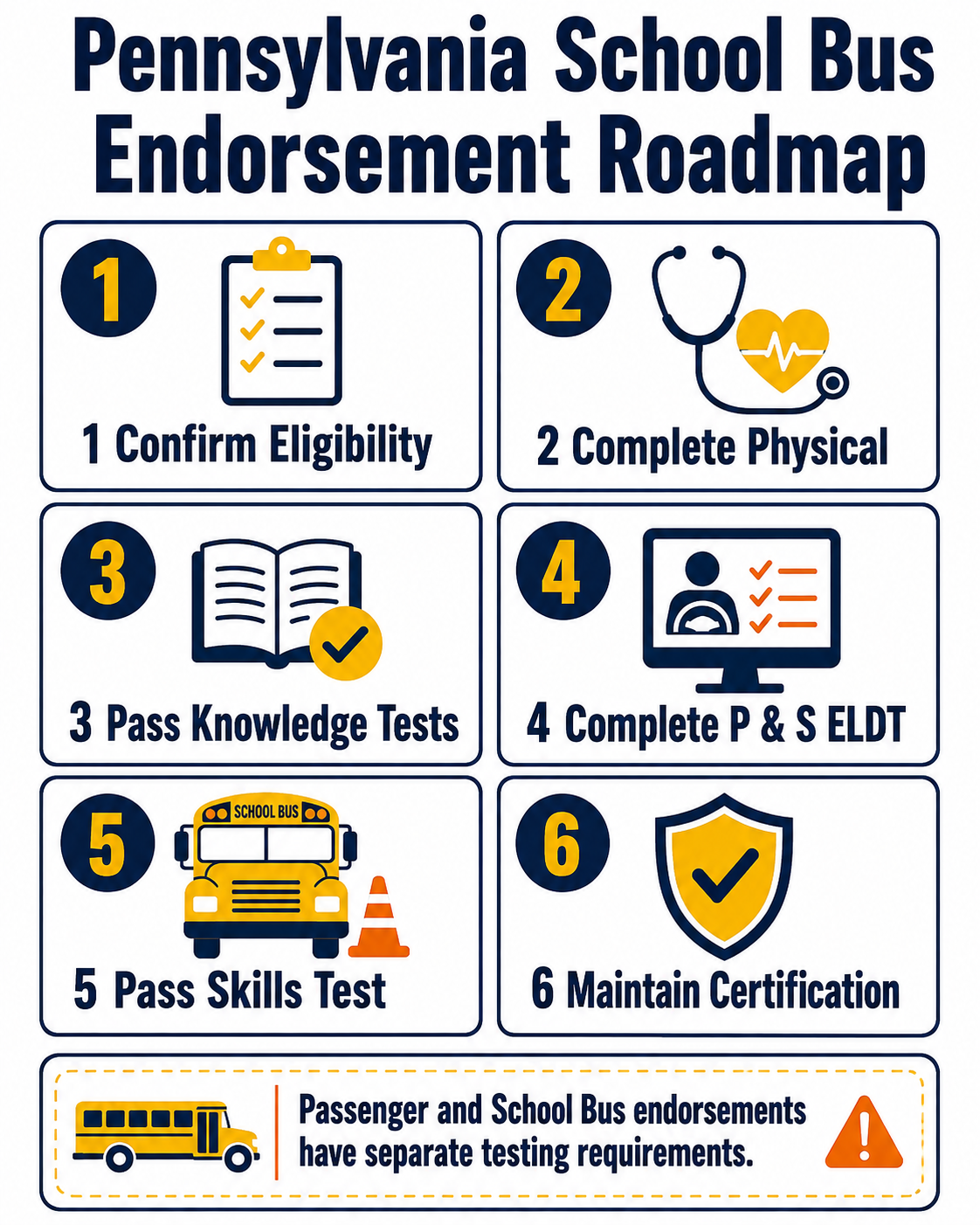
requires applicants to complete the commercial permit process, a Pennsylvania school bus physical, applicable knowledge tests, at least 20 hours of school-bus-specific instruction, and the commercial skills test with school bus exercises. Pennsylvania also requires state criminal history and child abuse history checks.
| Requirement | What it means for the applicant | Who verifies it |
|---|---|---|
| Correct CDL class | Class B is common for full-size school buses; the required class depends on the vehicle’s rating and configuration | PennDOT |
| Passenger endorsement (P) | Required when transporting passengers in a vehicle that meets the federal passenger definition | PennDOT / FMCSA framework |
| School Bus endorsement (S) | Required with P when actually transporting students in a school bus for covered school transportation | PennDOT |
| School bus physical | Complete the Pennsylvania DL-704 examination; renew it on the state schedule | Qualified medical provider / PennDOT |
| Federal ELDT | First-time P and S applicants generally complete applicable theory and behind-the-wheel curricula through registered providers | FMCSA TPR / PennDOT before skills testing |
| Pennsylvania school bus training | Minimum 20 hours: at least 14 classroom and 6 in-bus | Certified school bus instructor / PennDOT |
| Testing | Vision, applicable knowledge tests, and a vehicle-specific skills test | PennDOT or authorized third-party tester |
| Background checks | Pennsylvania State Police criminal history and Department of Human Services child abuse history clearances | State agencies / employer |
Before paying for training, confirm the underlying Pennsylvania CDL eligibility and medical requirements. An endorsement does not override a disqualification, medical downgrade, expired credential, or restriction that prevents operation of the training vehicle.
P Versus S Endorsements: Why Pennsylvania School Bus Drivers Usually Need Both
The letters serve different purposes. P authorizes operation of a qualifying passenger vehicle. S is the added school bus privilege for drivers transporting students in covered school transportation. PennDOT says a school bus driver must hold a valid CDL with both Passenger and School Bus endorsements.
| Credential | Main purpose | Typical school bus applicant requirement |
|---|---|---|
| Class B CDL | Operate a single commercial vehicle with a gross vehicle weight rating of 26,001 pounds or more, including many full-size buses | Often required; verify the exact bus rating |
| Class C CDL | Operate a smaller commercial vehicle that does not meet Class A or B thresholds but carries 16 or more occupants including the driver, or placardable HazMat | May apply to a smaller passenger vehicle that still meets CDL passenger criteria |
| P endorsement | Carry passengers in a qualifying commercial passenger vehicle | Required for covered school bus operation |
| S endorsement | Carry students in a school bus for covered school transportation | Required together with P |
| Air-brake qualification | Operate a vehicle equipped with air brakes without an L or Z restriction | Needed when the test and work vehicle uses the applicable air-brake system |
PennDOT’s school transportation FAQ makes an important distinction: a mechanic, delivery driver, or another driver operating an empty school bus may need P but not S, depending on the operation. P alone can also cover some non-school-sponsored passenger transportation. Actual transportation of preprimary, primary, or secondary students between home, school, and school-sponsored events in a school bus generally requires both P and S. Have PennDOT or the employer confirm any unusual operation before driving.
Choose the CDL class by vehicle, not by job title
“School bus driver” does not automatically mean Class B in every vehicle. Look at the manufacturer’s gross vehicle weight rating, passenger design capacity, and combination status. Testing in a smaller vehicle can limit which buses you may legally drive. If your career target is a full-size bus, prepare and test in a representative vehicle that supports the class and brake qualifications your employer needs.
Eligibility, Physical, and Background Checks
Start with a valid Pennsylvania driver record
Your non-commercial or commercial license must be valid, and your identity, address, and legal presence information must be correct. Existing suspensions, disqualifications, unresolved medical issues, or incompatible restrictions can stop the application. Confirm your current record before arranging training or a test vehicle.
Complete the Pennsylvania school bus physical
Every applicant begins with the Pennsylvania School Bus Driver’s Physical Examination, form DL-704. This is a state school bus medical standard and should not be casually treated as interchangeable with a federal Medical Examiner’s Certificate. PennDOT says school bus drivers must repeat the DL-704 physical every 13 months.
Whether you also need a federal Medical Examiner’s Certificate depends on self-certification and the kind of commerce you perform. PennDOT explains that a school bus applicant engaging in non-excepted transportation must submit a valid federal medical certificate before the learner’s permit is issued. Discuss the intended routes—including interstate trips—with the employer and select the correct self-certification category.
Complete the required Pennsylvania clearances
Pennsylvania law requires a criminal history check through the Pennsylvania State Police and a child abuse history check through the Department of Human Services. Employers, school entities, contractors, and other laws may impose additional hiring or fingerprint requirements. A CDL school can explain the training sequence, but it cannot promise that a state agency or employer will approve an individual background record.
How to Get P and S Endorsements in Pennsylvania
- Identify the bus and required class. Obtain the gross vehicle weight rating, seating capacity, brake type, and expected route information from the employer or training provider.
- Review your license and medical status. Resolve an expiration, suspension, address mismatch, self-certification problem, or medical downgrade before submitting the permit package.
- Complete the DL-704 school bus physical. Use the current PennDOT form and a provider qualified to perform the examination. Keep copies of all pages and follow the submission instructions.
- Prepare the permit application. School bus applicants use the Commercial Learner’s Permit Application DL-31CD, Self-Certification Form DL-11CD, and the documents or federal medical certificate required for their category.
- Receive the KTA and school bus learner’s permit. The Knowledge Test Authorization identifies the required tests. The initial school bus learner’s permit allows mandatory in-bus training; PennDOT cautions that this driving document alone does not authorize skills testing.
- Pass all applicable knowledge tests. These can include commercial general knowledge, Passenger, School Bus, and Air Brakes, depending on the license and vehicle.
- Complete applicable federal ELDT. A first-time Class B, P, or S applicant generally needs the matching curricula from providers listed in FMCSA’s Training Provider Registry.
- Complete Pennsylvania’s 20-hour school bus curriculum. Finish at least 14 hours of classroom instruction and 6 hours in a school bus with the required state documentation.
- Observe the waiting period when applicable. PennDOT states that an applicant adding or upgrading the commercial class must wait at least 15 days before the school bus skills test. Do not assume every endorsement-only scenario has the same clock.
- Pass the vehicle skills test. Demonstrate inspection, basic control, road driving, student discharge, and railroad-crossing procedures in the appropriate vehicle.
- Inspect the issued credentials. Verify the CDL class, P and S endorsements, air-brake status, restrictions, expiration, school bus endorsement card, and physical certificate before driving students.
If your goal is a full-size bus, Patriot CDL’s Class B training overview explains the commercial vehicle skills foundation. Ask the admissions team whether the current program and equipment align with your school bus pathway; Pennsylvania school-bus-specific certification may involve a separate approved instructor or employer process.
Federal ELDT and Pennsylvania School Bus Training Are Separate Layers
lists first-time Class A, Class B, P, and S applicants among those subject to the federal training rule. For P and S, covered drivers complete theory and behind-the-wheel instruction through a provider listed on the Training Provider Registry before the state administers the applicable skills test.
| Training layer | Minimum or completion standard | When it matters |
|---|---|---|
| Class B ELDT, when first obtaining Class B | Theory plus BTW range and public road; theory assessment standard and demonstrated BTW proficiency | Before the Class B skills test |
| Passenger (P) ELDT | Theory plus applicable BTW curriculum | Before the P skills test |
| School Bus (S) ELDT | Theory plus applicable BTW curriculum | Before the S skills test |
| Pennsylvania school bus instruction | At least 20 hours: 14 classroom and 6 in-bus | For initial Pennsylvania school bus endorsement qualification |
Federal ELDT does not set a minimum number of behind-the-wheel hours for P or S; the instructor certifies proficiency in the required curriculum. Pennsylvania separately imposes its 20-hour school-bus-specific minimum. Completing one layer does not automatically prove completion of the other.
Verify every provider and curriculum
A provider can be registered for one curriculum but not another. Before enrolling, confirm the location and each required training type—Class B if applicable, Passenger, and School Bus. Then verify the provider will submit your completion using the exact license number, state, name, and birth date PennDOT has on record. Use the step-by-step guide to checking a CDL school in FMCSA’s Training Provider Registry.
Pennsylvania Knowledge and Skills Tests
Knowledge tests
PennDOT lists Commercial General Knowledge, Passenger, School Bus, and Air Brakes among the tests that may apply. The exact combination depends on whether you already hold a CDL, are changing class, and whether the vehicle has air brakes. Study the current Pennsylvania Commercial Driver’s Manual and School Bus Driver Operator’s Manual rather than relying only on generic practice questions.
| Test area | What to understand | Frequent preparation error |
|---|---|---|
| General knowledge | Safe vehicle operation, inspections, braking, speed and space management, emergencies | Studying only school bus signs and signals |
| Passenger | Loading, unloading, prohibited practices, passenger safety, vehicle inspection | Assuming S material covers every P topic |
| School Bus | Student management, danger zones, loading procedures, railroad crossings, emergency evacuation | Memorizing sequences without understanding why each step protects students |
| Air Brakes | System components, checks, warning devices, stopping, failure response | Testing in hydraulic-brake equipment when the job requires an unrestricted air-brake qualification |
Skills test
The Pennsylvania school bus examination includes the commercial pre-trip inspection, basic vehicle-control maneuvers, and on-road driving. School bus candidates must also successfully perform a simulated student discharge and a simulated or actual railroad crossing. Practice the complete verbal and physical sequence until you can perform it consistently without coaching.
Your test vehicle matters. It must represent the class and endorsements sought and must be legally available, properly registered, insured, inspected, and safe. Testing in an automatic transmission or without a full air-brake system can produce restrictions that reduce employment options. Confirm the exact vehicle and examiner requirements before the appointment.
Application Documents and Credentials to Carry
| Item | Purpose | Practical check |
|---|---|---|
| DL-31CD | Commercial learner’s permit application | Use the current revision and request the correct class and endorsements |
| DL-11CD | CDL self-certification | Choose the category that matches the actual operation |
| DL-704 | Pennsylvania school bus physical examination | Check signatures, dates, and every required medical section |
| Medical Examiner’s Certificate, when required | Federal medical qualification for non-excepted operation | Confirm electronic status with PennDOT rather than relying only on paper |
| KTA and learner’s permit | Authorize knowledge testing and supervised training according to their terms | Know which document authorizes practice and which stage authorizes skills testing |
| DL-714 training report | Documents Pennsylvania’s mandatory school bus training | Do not sign for hours or instruction you did not receive |
| Background clearances | Support legal and employer qualification | Track issue dates and provide them only through approved channels |
Once qualified, PennDOT says a driver operating a school bus must carry a valid CDL, Pennsylvania school bus endorsement card, Physical Examination Certificate DL-742, the bus registration card, and valid insurance or other proof of financial responsibility for the bus. The employer may require additional route, student, inspection, or emergency documents.
How to Maintain a Pennsylvania School Bus Endorsement
School bus qualification is an ongoing safety credential, not a one-time test. PennDOT identifies two overlapping maintenance cycles:
- Every 13 months: pass the Pennsylvania school bus physical required by Title 67, Chapter 71.
- Every four years: complete at least 10 hours of refresher training—at least 7 classroom and 3 in-bus—pass the School Bus Knowledge Test, and pass a road test in a school bus.
Track the physical certificate, school bus endorsement card, CDL, and employer clearances separately because their expiration dates may not match. Start the four-year refresher process early enough to secure an instructor, bus, and test appointment. If your federal medical certification or self-certification category applies, monitor that status separately as well.
Common mistakes that delay or narrow qualification
- Applying for S without understanding P. A Pennsylvania school bus driver generally needs both endorsements.
- Confusing the DL-704 with a DOT medical card. They serve different regulatory purposes, and some drivers may need both.
- Completing only federal ELDT. Pennsylvania’s separate 20-hour school bus curriculum still applies.
- Using a provider not registered for every needed curriculum. Verify Class B, P, and S separately when all three apply.
- Testing in the wrong vehicle. Vehicle class, transmission, and brake equipment can limit the issued credential.
- Scheduling too soon. A 15-day wait applies when adding or upgrading the commercial class, and all prerequisite records must be visible before testing.
- Letting a recurring credential expire. A valid CDL alone does not replace the school bus physical, endorsement card, recertification, or clearances.
Pennsylvania School Bus Endorsement Checklist
- □ I identified the exact bus, CDL class, passenger capacity, transmission, and brake system
- □ My Pennsylvania license, identity, address, and driving status are accurate
- □ I completed the current DL-704 school bus physical
- □ I determined whether a federal Medical Examiner’s Certificate is also required
- □ I submitted current DL-31CD and DL-11CD forms with required documents and fees
- □ My KTA lists all applicable knowledge tests
- □ I passed General Knowledge, P, S, and Air Brakes tests as applicable
- □ I completed every applicable ELDT curriculum through registered providers
- □ The providers submitted correct completion records to FMCSA
- □ I completed at least 14 classroom and 6 in-bus Pennsylvania school bus training hours
- □ My DL-714 accurately records the instruction I received
- □ I observed the 15-day waiting period if adding or upgrading my CDL class
- □ I practiced pre-trip, controls, road driving, student discharge, and railroad crossing procedures
- □ My test bus represents the class, transmission, and brake qualification I need
- □ I completed the required criminal and child abuse history checks
- □ After issuance, I verified the CDL, P and S endorsements, restrictions, card, and physical certificate
- □ I calendared the 13-month physical and four-year recertification deadlines
Frequently Asked Questions
Do Pennsylvania school bus drivers need both P and S endorsements?
Yes, when actually transporting students in a school bus for covered school transportation. P covers qualifying passenger operation, while S is the additional school bus endorsement. PennDOT notes that some empty-bus or non-school-sponsored operations may require P but not S.
Is ELDT required for first-time P and S endorsements?
Generally yes. FMCSA requires applicable theory and behind-the-wheel ELDT from registered providers for first-time P and S applicants covered by the rule before the state skills test. The rule is not retroactive for an endorsement issued before February 7, 2022, and limited exceptions may apply.
How much Pennsylvania-specific school bus training is required?
PennDOT requires at least 20 hours for initial qualification: 14 hours of classroom instruction and 6 hours of in-bus training. This state requirement is separate from the federal ELDT curricula.
How often must a Pennsylvania school bus driver recertify?
The school bus physical is required every 13 months. Every four years, the driver must complete at least 10 hours of refresher training—7 classroom and 3 in-bus—pass the School Bus Knowledge Test, and pass a road test in a school bus.
Educational information only. Forms, fees, medical standards, background-check procedures, testing availability, and employer requirements can change. Confirm your individual transaction with PennDOT, FMCSA, the selected training providers, and the employing school entity or contractor. Official sources reviewed August 7, 2026.