


Heavy rain creates more than a visibility problem for a commercial driver. Water can reduce tire contact, hide potholes and pavement edges, collect in wheel tracks, and turn a familiar route into a place where steering or braking response changes without much warning. A tractor-trailer can look stable one moment and begin riding on a film of water the next. The safest response begins before the tires lose contact: reduce speed early, increase space, inspect the vehicle, read the road surface, and refuse to enter a genuinely flooded roadway.
Hydroplaning and flooding are related but different hazards. Hydroplaning occurs when tires lose contact with the pavement and ride on water, leaving little or no traction for steering or braking. A flooded road can add current, uncertain depth, debris, electrical hazards, and a washed-out surface. This guide gives CDL students and working drivers a structured way to prevent hydroplaning, recover smoothly if it begins, and make a clear stop-and-reroute decision when standing water becomes a flood hazard.
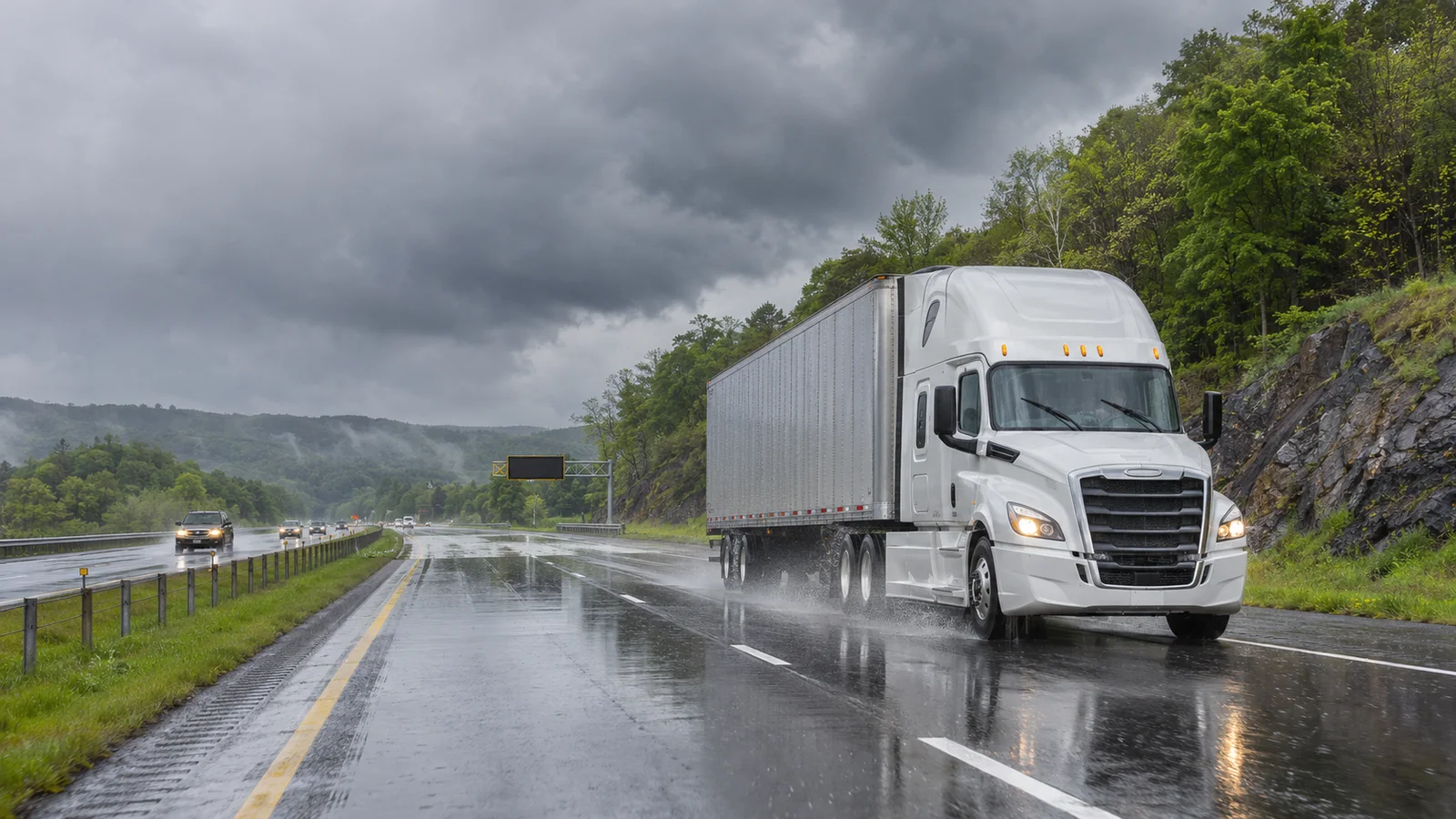
Hydroplaning, standing water, and flooding are not the same problem
Hydroplaning is a loss of tire-road contact
Tire grooves are designed to move water away from the contact area. When they cannot clear water fast enough, a layer can separate the tread from the pavement. Steering may feel light or unresponsive, engine speed may change as drive-wheel traction drops, and the vehicle may no longer follow the intended path. The Pennsylvania Commercial Driver’s Manual warns that a vehicle may not be able to steer or brake normally while hydroplaning.
Standing water may be shallow, deep, or hiding damage
A puddle across part of a lane can produce uneven traction between the left and right sides of a combination. Water in wheel tracks can also be deeper than the surrounding film. Depth is difficult to judge at road speed, especially at night. The visible surface does not reveal a pothole, debris, missing shoulder, blocked drain, or pavement washout underneath.
Floodwater creates a stop-and-reroute hazard
Floodwater is not a traction test. The National Weather Service advises drivers not to enter flooded roads or drive around barricades because the water may be deeper than it appears, may be moving, and may hide a damaged road. A commercial vehicle’s size does not guarantee that it can resist current, maintain tire contact, or clear a submerged obstacle. When the roadway is flooded, turn around or choose a safe alternate route.
Why a heavy commercial vehicle can still hydroplane
Weight does not guarantee contact
A loaded truck has substantial tire loading, but hydroplaning depends on more than vehicle weight. Speed, water depth, tread condition, tire pressure, pavement shape, and wheel-path drainage all affect whether water can escape from beneath the tire. The CDL Manual states that hydroplaning can occur at speeds as low as 30 mph when there is a lot of water. That is a warning against relying on a familiar speed or the posted limit during a downpour.
Tread and pressure affect water evacuation
Worn grooves cannot channel water as effectively. Low tire pressure can also increase hydroplaning risk. A driver should connect wet-weather decisions with a disciplined commercial-truck tire inspection: correct pressure, adequate tread, no cuts or exposed material, secure valve components, and no obvious damage. A pre-trip cannot drain the road, but it can prevent avoidable loss of tire performance.
Different axles may meet different water
The steer axle can encounter a puddle before the drive axles and trailer. One side may enter deeper water than the other. A tractor may regain contact while the trailer is still crossing the wet patch. Those timing differences can produce a pull, trailer movement, or delayed response. Smooth control inputs give each unit a better chance to remain aligned.
Read the road before traction changes
Look for reflections and changing spray
The CDL Manual identifies clear reflections, tire splashes, and visible raindrops on the road as signs of standing water. Watch the spray from vehicles ahead. A sudden fan of water can reveal a puddle before your headlights or windshield view makes its depth obvious. Dark wheel tracks beside brighter pavement, water crossing from a median, and pooling near blocked drains are additional reasons to reduce speed.
Use traffic behavior as a clue, not permission
Brake lights, lane changes, and vehicles slowing near an underpass may signal water ahead. However, a passenger car crossing a puddle does not establish that the path is safe for a tractor-trailer. Its wheel track, ground clearance, speed, and exposure to cross-current are different. Treat other traffic as information to investigate—not proof to proceed.
Pay attention when rain first begins
The CDL Manual notes that water can mix with oil left on the roadway when rain begins, making the surface especially slippery. Reduce speed before the road looks dramatic. On a long trip, conditions can change from light spray to standing water within minutes, so the wet-road plan must be updated continuously rather than set once at departure.
Prepare the truck and trip for heavy rain
Complete the visibility checks
Inspect the windshield, wipers, washers, defroster, mirrors, lights, and reflective material. Replace the idea that “I can see enough” with a functional check. The windshield and wiper inspection guide explains how small defects can become major problems when spray and darkness combine.
Review weather, drainage trouble spots, and alternate routes
FMCSA advises commercial drivers to check weather and road conditions and plan the trip in advance. Identify low underpasses, flood-prone valleys, construction zones, and roads close to streams. Know where a safe truck-compatible detour is available. A consumer navigation app may not account for commercial height, weight, or route restrictions, so verify any reroute before committing the vehicle.
Leave more time and space
A schedule is not a reason to maintain dry-road speed. Build a larger following interval, avoid driving beside another vehicle through visible water, and keep an open path ahead. FMCSA recommends adjusting following distance to weather, road, visibility, and traffic conditions. The detailed space-cushion plan can be adapted for rain by creating more time to see and respond.
Prevent hydroplaning while the truck is moving
Reduce speed before the water
Speed reduction is the primary prevention step. Ease off early so the combination is stable before reaching the wet patch. Hard braking inside standing water can add wheel lock or uneven braking to a surface that already provides reduced traction. If traffic allows, keep the vehicle straight and avoid changing lanes across pooled water.
Use smooth steering and throttle
Abrupt acceleration can spin drive wheels; abrupt steering can ask the tires for more side grip than the wet surface provides. Hold a steady lane position and make only gradual corrections. Do not chase every small splash with a steering input. If a water patch covers only part of the lane, prepare for a brief pull and keep the wheel controlled without making a sharp counter-movement.
Avoid cruise control in changing traction
In heavy rain or variable standing water, the driver needs direct, sensitive control of the accelerator. Follow the vehicle and carrier guidance on cruise control, and disengage it before conditions demand frequent speed adjustment. The goal is to feel and respond to traction changes without an automated throttle command complicating the situation.
Choose a safe place to stop when conditions exceed the plan
If visibility, water, or traffic makes continued travel unsafe, exit or stop at a location designed to hold the vehicle. Do not stop on a travel lane or narrow shoulder merely because the rain is intense. Plan the decision early enough to reach a truck parking area, rest area, terminal, or other lawful location. Use the hazard-perception framework to turn early clues into action.
Recover smoothly if hydroplaning begins
Ease off the accelerator
The Pennsylvania CDL Manual tells drivers to release the accelerator so the vehicle slows and the wheels can turn freely. Do not add power in an attempt to pull through the water. A gradual reduction in speed lets the tire grooves regain the ability to clear the water film.
Hold the intended path with small inputs
Keep both hands on the steering wheel, look toward the open path, and avoid sudden turns. When the steer tires are riding on water, a large steering input may not produce an immediate response. When traction returns, that stored steering angle can make the vehicle move sharply. Small inputs reduce that risk.
Do not brake hard
The CDL Manual advises not using the brakes to slow a hydroplaning vehicle. Hard braking can contribute to a skid and may affect different axles unevenly. Let speed decrease through accelerator release while keeping the combination aligned. If the drive wheels begin to skid in a manual-transmission vehicle, the manual directs the driver to depress the clutch so the wheels can turn freely. Vehicle-specific instructions and supervised training remain important.
Reassess after traction returns
Do not immediately accelerate back to the previous speed. The water hazard may continue, and the trailer may still be crossing the patch. Confirm steering response, check the mirrors, maintain a lower speed, and increase following space. If response feels abnormal, reach a safe location and inspect before continuing.
Make a firm decision at a flooded roadway
Stop before entering the water
Hydroplaning recovery guidance is not permission to enter floodwater. If water covers the road and its depth, current, or pavement condition is unknown, stop short in a safe location. Do not drive around a barricade or road-closed sign. Do not place the tractor where turning around becomes impossible.
Do not use the truck as a depth gauge
Water can conceal a washed-out lane, open utility cover, debris, sharp objects, or an eroded shoulder. It can rise while the vehicle is committed. A trailer can be pushed differently from the tractor, and water can reach brakes, electrical connections, wheel ends, or the engine intake. The correct professional decision is a verified commercial route around the hazard.
Communicate without letting the schedule control the decision
Notify dispatch or the customer only after the vehicle is safely positioned. State the road location, closure or flood condition, and proposed truck-safe alternate route. Do not accept pressure to follow another vehicle through. A delay is manageable; a disabled combination in water can block emergency access and endanger the driver and responders.
Worked scenario: water collecting beyond an underpass
A driver hauling a dry van encounters heavy rain on a familiar regional route. Speed has already been reduced and following distance increased. Vehicles ahead begin braking near a low underpass, and spray rises across both lanes.
Step 1: recognize the changing category of hazard
The driver first sees reflective water in the right wheel tracks, then notices that the road appears covered across its full width beyond the underpass. A passenger car crosses slowly, but a local truck turns into a side road. The driver treats these as clues, not proof that the path is safe.
Step 2: stop before commitment
The driver checks the mirrors, signals, and slows smoothly before the water. The combination remains on normal pavement with enough room to maneuver. The driver does not enter the underpass to “take a closer look,” because that could remove the ability to turn around.
Step 3: verify an alternate commercial route
Once safely stopped off the travel lane, the driver checks official road information and contacts dispatch. The first suggested detour includes a low-clearance road, so it is rejected. A longer route with verified clearance and weight limits is selected instead.
Step 4: continue with the rain plan
On the alternate route, the driver maintains the lower speed and expanded space. A shallow puddle later causes a brief steering-light sensation. The driver eases off the accelerator, keeps the wheel steady, avoids braking, and allows the tires to regain contact. The response succeeds because speed and space were adjusted before the puddle.
Rain, standing-water, and flood decision table
| Observation | Likely concern | Best immediate action | Avoid |
|---|---|---|---|
| Clear reflections or increased spray | Standing water may be forming | Reduce speed early and increase space | Waiting until steering changes |
| Steering feels light | Steer tires may be hydroplaning | Ease off the accelerator and hold a steady path | Sharp steering or hard braking |
| Engine speed rises without matching motion | Drive-wheel traction may be reduced | Reduce throttle smoothly and keep the combination aligned | Adding more power |
| Water covers one side of the lane | Uneven drag and traction | Slow before contact and keep small steering inputs | Sudden lane change |
| Water covers the full road | Unknown depth, current, or road damage | Stop before the water and reroute | Following another vehicle through |
| Barricade or road-closed device | Officially identified hazard | Obey it and select another route | Driving around the closure |
| Pulling, warning lamp, or changed brake feel afterward | Possible vehicle damage or contamination | Stop safely, report, and inspect | Continuing to test it at road speed |
After the truck contacts deep standing water
Move to a safe inspection location
Do not stop in the water or immediately beside a moving traffic lane unless the vehicle cannot continue. Once on firm ground in a safe location, secure the vehicle and follow company inspection procedures. If steering or braking is abnormal, do not continue simply to reach a more convenient destination.
Check the systems most exposed
Inspect tires and wheels for impact damage, look for material wrapped around components, and check visible air lines and electrical connections. Confirm that lamps operate and no new warning indicator is present. Evaluate brake response at very low speed in a safe area according to procedures; wet brakes may not respond normally. Look for underbody or aerodynamic-panel damage from hidden debris.
Report the event accurately
Record the location, approximate conditions, which side of the combination met the water, any impact or pull, and every warning or handling change. Good information helps maintenance staff diagnose damage. Do not attempt unauthorized repairs. If the vehicle is disabled on or near the roadway, use the required warning devices when safe, as explained in the emergency-equipment guide.
Wet-road and standing-water checklist
- Check official weather and road conditions before departure.
- Identify flood-prone sections and truck-safe alternate routes.
- Inspect tire pressure, tread, damage, and valve components.
- Check windshield, wipers, washer, defroster, lights, and mirrors.
- Confirm brakes respond normally during the pre-trip functional check.
- Reduce speed when rain begins—not only when water becomes deep.
- Increase following distance for the actual visibility and traction.
- Watch reflections, spray, wheel tracks, drains, and low areas.
- Avoid driving beside another vehicle through standing water.
- Keep the tractor and trailer straight before a wet patch.
- Use smooth throttle and steering inputs.
- Follow vehicle guidance for cruise control in adverse conditions.
- If hydroplaning begins, ease off the accelerator.
- Hold the wheel steadily and avoid sudden steering.
- Do not brake hard while the tires are hydroplaning.
- Do not accelerate immediately when traction returns.
- Never enter a flooded road to estimate depth.
- Never drive around a flood barricade or closure.
- Verify height, weight, and restrictions on every detour.
- Inspect and report any changed braking, steering, warning, or damage.
Common wet-road mistakes to avoid
Using the posted limit as the rain speed
A speed limit does not promise adequate traction in standing water. The safe speed may be far lower and may change from one section of pavement to the next.
Braking after entering the puddle
The better plan is to slow before contact. Hard braking in water can add instability when the tires already have reduced grip.
Following the vehicle ahead into floodwater
Another driver’s decision does not verify the road. Stop where the combination can still turn around and select a safe route.
Steering aggressively when the truck feels light
Large steering angles may take effect suddenly when traction returns. Hold the desired path with small corrections while speed decreases.
Continuing after an abnormal impact or response
Water can hide damage. A pull, warning lamp, vibration, brake change, or visible damage requires a safe stop and inspection, not another road-speed test.
Frequently asked questions
What should a CDL driver do first if a truck begins to hydroplane?
Ease off the accelerator, hold the steering wheel steadily, avoid sudden steering, and do not brake hard. The goal is to let the vehicle slow so the tires can regain contact with the road while keeping the combination aligned.
Can a commercial truck hydroplane at a relatively low speed?
Yes. The Pennsylvania Commercial Driver’s Manual warns that hydroplaning can occur at speeds as low as 30 mph when there is a lot of water. Worn tread and low tire pressure make hydroplaning more likely, so speed must match the actual road and tire conditions.
Should a truck driver continue through a flooded roadway if other vehicles are crossing?
No. Other vehicles do not prove that the water depth, current, pavement, or clearance is safe for a commercial vehicle. Obey closures and barricades, stop before the water, and use a safe alternate route.
What should be inspected after a truck hits deep standing water?
After reaching a safe location, check tires, wheels, brakes, air lines, electrical connections, lights, steering response, and visible underbody damage according to company procedures. Do not continue if braking, steering, warning lamps, or vehicle handling are abnormal.
Official sources
- , especially Sections 2.6 and 2.9.
- .
- .