


Hazard perception is not the same as reacting quickly after something goes wrong. For a commercial driver, it is the disciplined habit of finding small clues early, deciding what they could become, and creating time and space before a conflict becomes urgent. A brake-light wave far ahead, a parked van that blocks a crosswalk, a stale green signal, or a vehicle edging toward a driveway may not require a sudden maneuver. Each one should, however, change what an attentive driver watches and how much margin the driver keeps.
That distinction matters in a large vehicle. A truck needs room for gradual speed changes, lane-position choices, and communication with surrounding traffic. An early clue can often be handled with a lifted accelerator, a larger following gap, a mirror check, or a planned stop. The same clue noticed late can force hard braking or an abrupt lane change. This guide turns hazard perception into a repeatable CDL training routine rather than a vague instruction to “pay attention.”
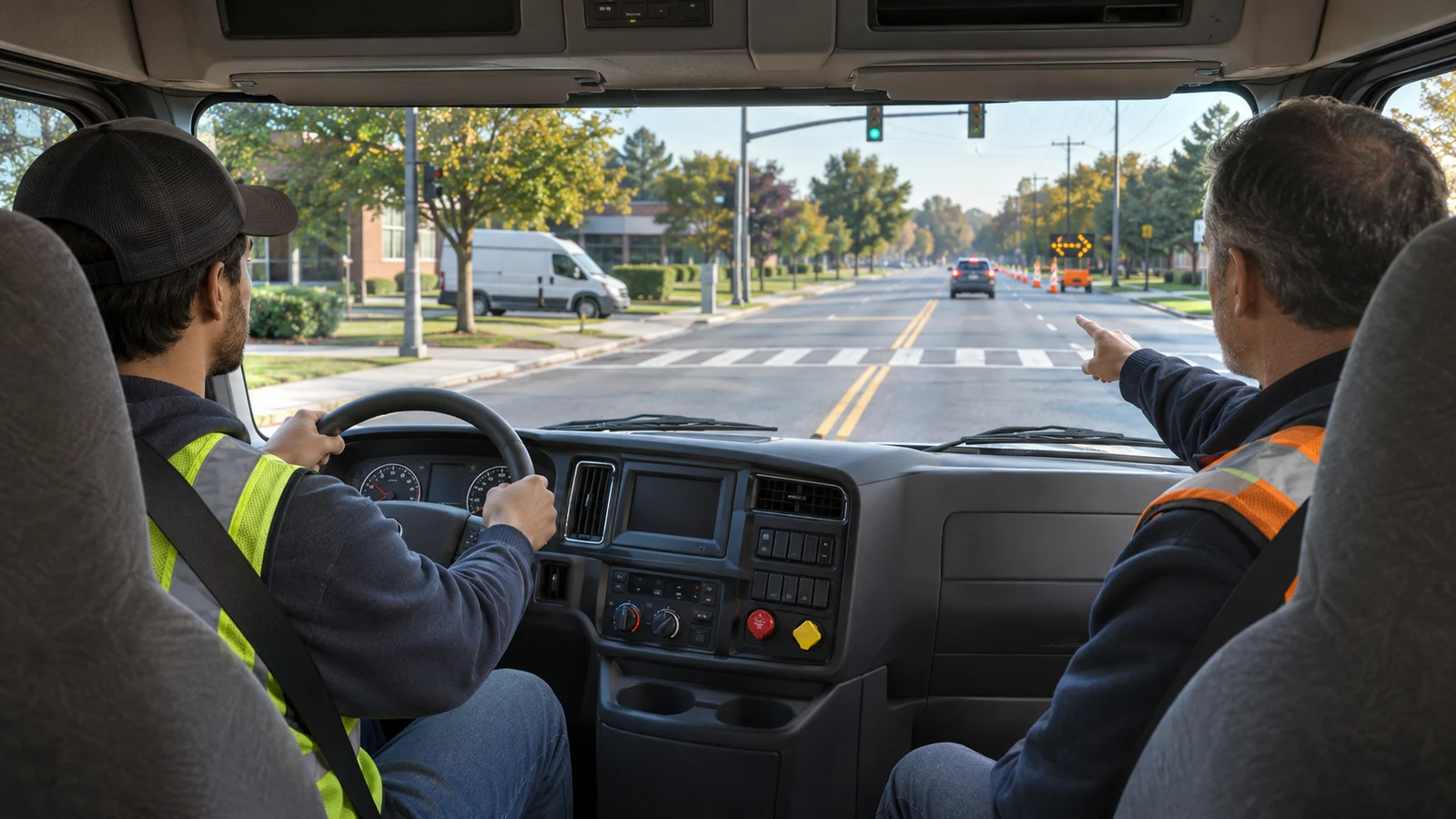
What hazard perception means in a commercial vehicle
A hazard is any road user, object, surface condition, restriction, or developing traffic pattern that could require a driver to change speed, position, or plan. Hazard perception has three linked parts: seeing the clue, predicting a reasonable next development, and preparing a safe response. The goal is not to imagine every possible disaster. It is to notice what is changing and preserve enough margin to handle the most credible development.
Observation is only the first step
A student may correctly report, “There is a delivery van on the right.” Hazard perception adds meaning: the van blocks part of the sidewalk and crosswalk, so a pedestrian or vehicle could emerge from behind it. The appropriate preparation may be to ease off the accelerator, cover the brake when conditions call for it, increase side clearance where possible, and keep the crosswalk in the visual search. The driver has not assumed that someone will appear; the driver has created a safer answer if someone does.
Why commercial vehicles need earlier decisions
Large vehicles change speed and direction differently from passenger cars. They also create sight-line and blind-spot challenges for their drivers and for nearby road users. Early observation gives a driver time to make smooth control inputs, signal intentions, and avoid trapping the vehicle without an open path. It also supports the space-management habits explained in our CDL following-distance and space-cushion guide. Hazard perception and space management are not separate skills: the search finds the problem, and the space cushion gives the driver options.
Build a complete visual search
The current Pennsylvania Commercial Driver’s Manual says most good drivers look at least 12 to 15 seconds ahead. It describes that distance as about one block at lower city speeds and about a quarter mile at highway speeds. The manual also makes an important qualification: looking far ahead does not mean ignoring what is close. A good driver shifts attention near and far and checks the entire traffic scene.
Use the 12–15-second window as a moving planning zone
Choose a point ahead that the truck will reach in roughly 12 to 15 seconds, then search the area between the truck and that point. Look for traffic lights, brake lights, merging vehicles, curves, hills, lane reductions, work vehicles, people near the road, and anything that limits the view. As the vehicle moves, the planning zone moves too. The scan should be continuous; it is not a single long stare at a distant point.
FMCSA’s current truck-and-bus driver tips similarly recommend scanning about 15 seconds ahead and checking mirrors every 8 to 10 seconds to remain aware of vehicles entering blind spots. Treat those figures as a structured search rhythm, not permission to ignore a mirror or side area when a specific maneuver requires an immediate check. Before a lane change, turn, merge, or major speed adjustment, the situation itself determines what must be checked and when.
Rotate attention: far, middle, near, sides, mirrors
A useful practice rhythm is: search far ahead for developing patterns; move to the middle distance for signals, brake lights, and lane changes; check the near path for lane position and surface problems; sweep the sides for intersections, driveways, pedestrians, and cyclists; then make quick mirror checks and return to the road ahead. The eyes should keep moving without becoming frantic. Long mirror stares can hide a change ahead, while a tunnel view straight down the lane can hide a vehicle entering from the side.
Search beyond the vehicle directly ahead
If the view is open, look through and around traffic to see what several vehicles ahead are doing. A wave of brake lights may provide warning before the vehicle immediately ahead slows. If a bus, van, curve, crest, or heavy rain blocks the view, recognize that the missing information is itself a clue. Increase the margin and avoid a commitment that depends on seeing through an obstruction.
Read early clues before they become conflicts
Strong hazard perception comes from connecting visible clues with reasonable possibilities. Students improve fastest when they learn categories of clues rather than trying to memorize isolated scenes.
Traffic-flow clues
Brake lights appearing in a sequence, a tightening cluster of vehicles, or traffic drifting toward one lane can signal a queue, lane blockage, or slow vehicle ahead. A vehicle that varies speed may be distracted, searching for an address, or preparing to turn. A wheel angle, turn signal, or slight movement toward a lane line can reveal intent before the full maneuver begins. The safe response is usually to add space and delay a commitment, not to race past the uncertainty.
Blocked-view clues
Parked trucks, landscaping, buildings, and stopped traffic can hide people or vehicles. A rolling ball near the road, an open vehicle door, or feet visible below a parked vehicle may add information. At an intersection with a blocked cross street, reduce speed enough to gain the view gradually. Do not assume that a green light makes an unseen path clear. Our city-driving guide for pedestrians and cyclists develops the vulnerable-road-user side of this search.
Road and environment clues
A shiny surface in freezing weather, standing water, wind moving trees or signs, fresh gravel, shadowed pavement, or a line of cones should change the driver’s expectations. The clue may require a lower speed, more following distance, a different lane position, or a stop if conditions are unsafe. Read warning signs early enough to act smoothly. For specialized conditions, review the separate guides to winter traction decisions, night-driving visibility, and work-zone queues and lane shifts.
Human-behavior clues
Look for head movement, hesitation, eye direction when visible, a driver’s hands on the wheel, a pedestrian’s walking direction, or a cyclist approaching a gap. These clues are useful but never guarantees. A person may not see the truck, may change direction, or may make a mistake. The professional response is to preserve space and stay prepared rather than trying to claim priority through speed or size.
Protect space and escape paths
An escape path is an area the driver could use to reduce exposure if a hazard develops. It might be open roadway ahead, usable space to one side, or enough following distance to stop smoothly. It is not an invitation to swerve onto a shoulder, sidewalk, or occupied lane. A path is only useful if it is legal and physically usable, and if the driver has checked it before needing it.
Keep more than one option when possible
A driver who follows too closely and drives beside another vehicle has very few choices. Creating a larger forward gap, avoiding long periods beside traffic, and knowing what is in the mirrors can restore options. Sometimes the best choice is simply to wait behind a developing conflict rather than entering a narrow gap. The controlled merge process in our lane-change and highway-merging guide shows how search, signaling, and space work together.
Recheck the path as the scene changes
Open space is temporary. A car may enter from behind, a shoulder may narrow, or a construction barrier may begin. Continue mirror checks and forward scanning after choosing a plan. Never steer toward a space that was checked several seconds ago without confirming that it remains open. When no safe escape path exists, the correct strategy is often to reduce speed earlier and avoid entering the conflict area.
Use a calm decision ladder
A simple decision ladder keeps the response proportional to the evidence. Use five verbs: see, interpret, create, communicate, act. See the clue. Interpret the most reasonable development. Create time and space. Communicate with signals, brake lights, or lane position as appropriate. Act smoothly while continuing to reassess. Not every clue needs every action, but every action should follow an observed reason.
| Early clue | What may develop | Space decision | Communication and control |
|---|---|---|---|
| Brake lights several vehicles ahead | A slowing queue or stopped traffic | Increase the forward gap; avoid becoming boxed in | Ease off early, check mirrors, and brake gradually if needed |
| Parked van blocks a crosswalk view | A pedestrian, cyclist, or vehicle may emerge | Add side clearance where legal and preserve stopping room | Reduce speed and keep the hidden area in the scan |
| Vehicle drifts toward the lane line | An unannounced lane change or distraction | Do not linger beside it; create separation | Hold a predictable path and avoid an abrupt pass |
| Green signal has been visible for a long time | The light may change before arrival | Protect a smooth stopping zone | Come off the accelerator and be ready to stop without racing the light |
| Cones and arrow board appear ahead | Lane shift, workers, equipment, or a queue | Choose the open lane early and build following distance | Signal early, reduce speed, and obey signs and flaggers |
| View disappears over a crest or around a curve | Stopped traffic or a slow hazard may be hidden | Enter only at a speed that preserves stopping room | Reduce speed before the view is lost and avoid passing |
The table is a training model, not a fixed script. Road geometry, weather, traffic, vehicle condition, and applicable law always control the real decision. The common principle is early, smooth risk reduction. If the driver waits for certainty, the available margin may already be gone.
Worked scenario: a changing urban intersection
Imagine a CDL student driving a tractor-trailer on a four-lane urban road at a lawful, controlled speed. The signal one block ahead is green. A delivery van is parked near the right corner, partly blocking the student’s view of the sidewalk. Two vehicles ahead are moving normally. Farther beyond the intersection, an arrow board and cones indicate that the right lane will close.
Step 1: name the clues without overreacting
The student identifies four facts: the light has been green for a while, the van blocks part of the crosswalk view, traffic ahead may have to merge left after the intersection, and the work zone may create a queue. None proves that an immediate stop is required. Together, they show that speed and space should be managed before the truck reaches the intersection.
Step 2: create time and keep choices open
The student eases off the accelerator, checks the mirrors, and increases the forward gap rather than closing on the two cars. The student keeps the truck centered and does not begin a lane change inside the intersection. Because the right lane closes later, there is time to evaluate the left lane and merge in a controlled location after clearing the intersection. The blocked crosswalk stays in the scan.
Step 3: update the plan when new information appears
The first car’s brake lights illuminate as the signal changes to yellow. Because the truck already has a larger gap and lower approach speed, the student can brake progressively and stop before the line without a sudden input. A pedestrian then steps from behind the van into the crosswalk. The early stop protects the pedestrian without forcing an emergency maneuver. In the mirrors, traffic behind is slowing normally because the truck’s brake lights came on early.
Step 4: restart the search after the stop
When the signal changes, the student does not treat the old plan as complete. The student confirms the crosswalk is clear, checks the intersection left-right-left, proceeds smoothly, and then rechecks mirrors and the work-zone taper. With a safe gap available, the student signals early and completes the lane change gradually. This is successful hazard perception: no dramatic reaction, just a chain of early observations and controlled decisions.
Practice hazard perception safely
Hazard perception can be trained without manufacturing danger. The best exercises use normal road scenes, instructor supervision, and deliberate review. A student should never search for notes, record a phone video, or conduct a verbal drill if doing so distracts from vehicle control. Our distracted-driving and cab-setup guide explains why secondary tasks must be managed before moving.
Commentary driving with an instructor
On a suitable supervised route, the student briefly names important clues and the planned margin: “Brake lights ahead—adding space,” or “Blocked driveway view—reducing speed.” The comments should be short enough that they do not interfere with driving. An instructor can ask what evidence supported the decision, whether an escape path was actually open, and whether the response was early enough to stay smooth.
Static scene review
Use training images or paused, legally obtained safety videos while parked. Ask four questions: What can I see? What is hidden? What is most likely to change? What space would I want before entering? Then identify the point at which a smooth speed or position adjustment would have been appropriate. Static review is particularly useful for intersections and work zones because students can study several clues at once.
Hazard-perception checklist
Use this checklist as a lesson debrief or a mental pre-drive reminder. It is not a substitute for required inspections, traffic law, or an instructor’s directions.
- Adjust the seat and mirrors before moving so the normal scan does not require awkward body movement.
- Keep the windshield, windows, lights, and mirrors clean enough for the conditions.
- Identify a moving point roughly 12 to 15 seconds ahead and update it continuously.
- Shift attention between far, middle, and near roadway areas instead of staring at one point.
- Check intersections, driveways, shoulders, sidewalks, and highway entrances for side conflicts.
- Use quick mirror checks on a regular rhythm and whenever the driving situation requires one.
- Look beyond the nearest vehicle when the view allows.
- Treat a blocked view as missing information that calls for added margin.
- Notice brake-light waves, wheel angle, lane drift, and changes in traffic spacing.
- Read signs, signals, lane markings, cones, and flagger directions early.
- Ask what a clue could reasonably become within the next several seconds.
- Create space before choosing a lane change or committing to an intersection.
- Know whether a possible escape path is legal, open, and physically suitable.
- Recheck mirrors before changing speed or position and confirm the path remains open.
- Communicate early with signals and progressive braking.
- Prefer a smooth reduction in exposure over a late, abrupt maneuver.
- After every turn, stop, or lane change, restart the full search.
- During debrief, connect each action to the clue that justified it.
Common mistakes to correct
Staring at the hazard
Once a student notices a pedestrian, merging vehicle, or work-zone machine, attention may lock onto it. That can hide a second hazard or cause lane drift. Keep the known hazard in the scan while continuing to check the intended path, mirrors, and surrounding traffic.
Waiting for the threat to become certain
A cautious driver does not need proof that a parked car will pull out before creating space. The response can begin with a low-cost adjustment such as releasing the accelerator or increasing the gap. If the vehicle stays parked, little is lost. If it moves, the truck is already better positioned.
Using the horn or lane change as the first answer
Communication can help, but it does not transfer control of the situation to another road user. A horn does not guarantee that someone will stop. A lane change may introduce a blind-spot conflict. First manage speed and space, then use communication and position changes only when they are appropriate and the path has been checked.
Confusing an escape path with a planned swerve
The purpose of an escape path is to preserve options, not to make an abrupt steering response automatic. Hard swerving can create rollover, jackknife, roadside, or adjacent-lane hazards. Our skid and jackknife prevention guide reinforces the value of early speed management and smooth control.
Frequently asked questions
What is hazard perception in CDL driving?
Hazard perception is the process of finding an early clue, deciding what it could reasonably become, and preserving time and space for a controlled response. It is broader than reaction time because it begins before a conflict is immediate. For a CDL student, the skill includes forward scanning, side and mirror checks, prediction, space management, communication, and reassessment.
How far ahead should a commercial driver scan?
The current Pennsylvania Commercial Driver’s Manual says most good drivers look at least 12 to 15 seconds ahead, while still shifting attention near and far. FMCSA’s current truck-and-bus tips recommend scanning about 15 seconds ahead and checking mirrors every 8 to 10 seconds. These are search benchmarks; a driver must also make the additional checks required by turns, lane changes, intersections, traffic, and changing conditions.
What is an escape path for a truck driver?
An escape path is legal, open, usable space that may help a driver reduce exposure if a hazard develops. It can be sufficient stopping room ahead or verified space to one side. It is not automatically a shoulder or an adjacent lane, and it must be rechecked because surrounding traffic and road geometry change.
How can a CDL student practice hazard perception safely?
Practice with a qualified instructor through brief commentary driving, passenger-seat observation, static scene review, and lesson debriefs. Name the clue, the possible development, and the space decision. Keep the exercise secondary to vehicle control, and never use a phone, notes, or recording task while driving.
Official sources and scope
This article uses the current , especially Section 2.4 on seeing, and . FMCSA’s official provides additional training context. Always follow current traffic law, vehicle-specific procedures, employer rules, and qualified instruction. The techniques here are practice guidance and do not replace legal requirements or professional judgment.
Build the habit during CDL training
Hazard perception improves when every observation leads to a specific question: “What space do I want if this changes?” Patriot CDL can help students organize that thinking during supervised commercial-driver practice. To discuss training, call or visit Patriot CDL at 7800 Bristol Pike, Levittown, PA 19057.