


A skid begins when one or more tires lose the grip needed for steering, braking, or acceleration. In a tractor-trailer, the problem can grow quickly: locked drive wheels may let the trailer push the tractor sideways, while locked trailer wheels can allow the trailer to swing out of line. The best recovery is the one a driver never needs, which is why speed selection, space, smooth control, inspection, and early recognition belong in the same plan.
This guide uses the current , especially Sections 2.18, 2.19, and 6.1, together with . It separates legal duties from practical training guidance and does not replace the vehicle manufacturer’s instructions, a carrier’s policies, or supervised range training.
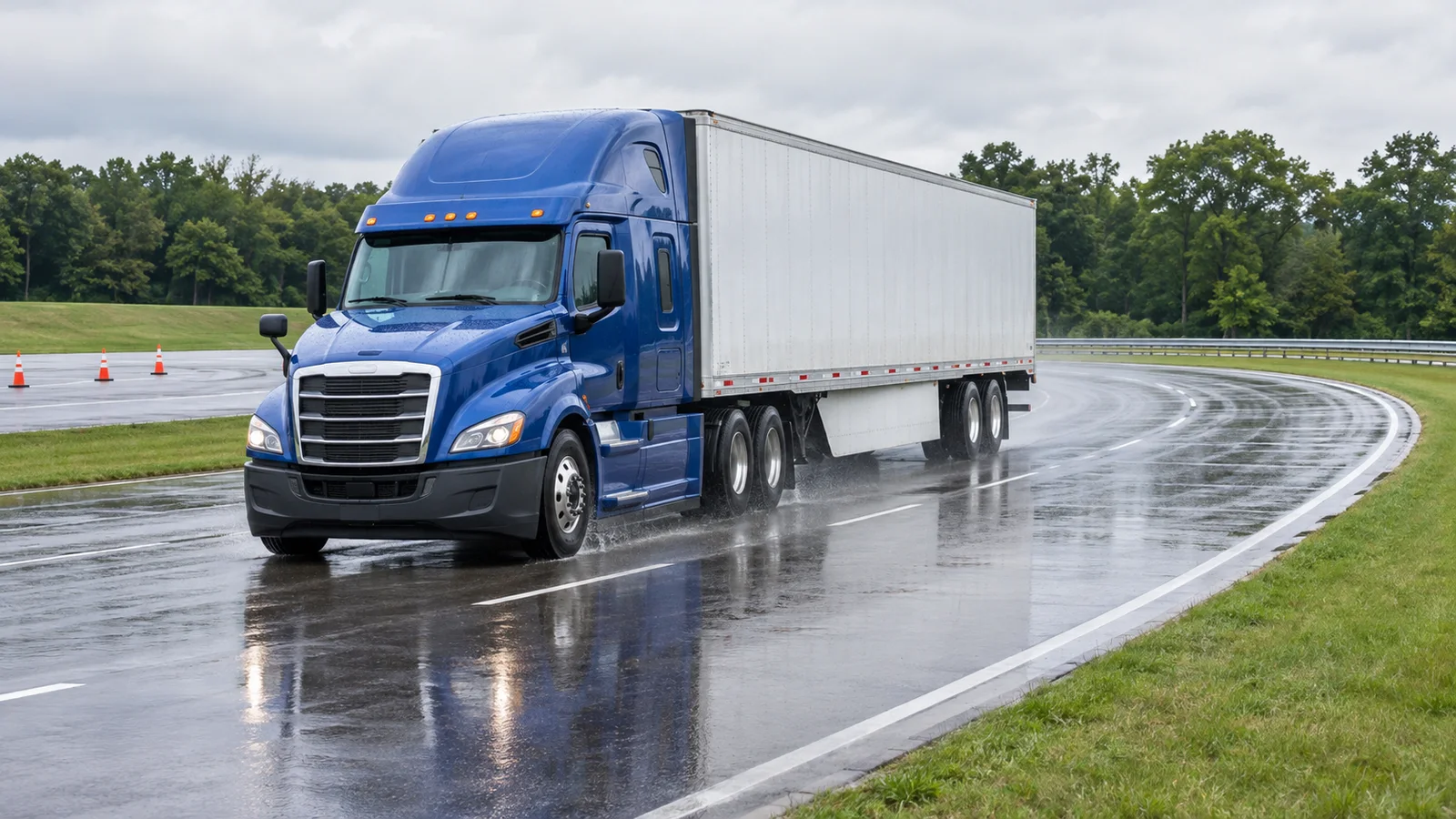
What a skid means in a commercial vehicle
Tires generate only a limited amount of grip. A driver uses that grip to accelerate, brake, and steer. When a vehicle is moving slowly on a clean, dry surface, the available margin may be generous. Water, snow, ice, loose gravel, worn tread, incorrect inflation, excessive speed, an abrupt control input, or an unbalanced load can shrink that margin. Asking the tires to brake hard and turn sharply at the same time can exceed what the surface can support.
Rolling wheels guide; sliding wheels do not
PennDOT’s manual explains that locked wheels have less traction than rolling wheels. A rolling tire can continue to provide directional control. Once a tire is sliding, steering commands may no longer produce the intended path. That is why several recovery procedures begin by reducing the input that caused the loss of traction so the wheels can roll again.
A jackknife is a loss of alignment, not a separate mystery
In a tractor jackknife, the tractor’s rear drive wheels lose traction and the trailer can push the tractor sideways. In a trailer jackknife, locked trailer wheels allow the trailer to swing toward the tractor. These movements have different beginnings, but both demonstrate why a combination vehicle must remain aligned. The earlier the driver sees a change in a mirror, the more opportunity there is to remove the cause before the angle grows.
This article focuses on prevention and recognition, not on encouraging students to create instability. Skid recovery is a perishable physical skill. The PennDOT manual itself says the proper place to practice is a large driving range or skid pad. Classroom study should prepare the sequence; hands-on practice belongs only in a controlled program with a qualified instructor.
Weather, traction, and the federal duty to use extreme caution
Federal regulation 49 CFR 392.14 requires extreme caution when conditions such as snow, ice, sleet, fog, mist, rain, dust, or smoke adversely affect visibility or traction. Speed must be reduced. If conditions become sufficiently dangerous, operation must be discontinued and not resumed until the commercial motor vehicle can be safely operated. That is a legal requirement, not merely a recommendation to “be careful.”
Reduce speed before the low-traction area
A driver who reaches a wet curve, shaded bridge, packed-snow ramp, or contaminated work-zone surface too fast has already spent much of the available margin. Slow while the combination is straight. Select the appropriate gear before the curve or downgrade. Enter at a speed that allows the truck to follow the path without heavy braking or a quick steering correction.
The posted limit is not a guarantee of safe speed for a loaded commercial vehicle. Vehicle configuration, weight distribution, tire condition, road shape, visibility, traffic, wind, and surface contamination all affect the decision. FMCSA’s current safe-speed guidance emphasizes adapting speed for curves, ramps, weather, traffic, and the commercial vehicle’s control needs.
Discontinue travel before control becomes doubtful
A professional stop-or-go decision happens before the truck begins sliding. If freezing rain, untreated pavement, flooding, smoke, or another condition removes the ability to maintain reliable control, find a lawful safe location and stop according to company procedure. The winter driving stop-or-go plan provides a fuller framework for monitoring conditions and selecting a safe stopping point.
Prevent the loss of grip with speed, space, and smooth inputs
Most skid prevention is ordinary driving performed with extra discipline. Look far enough ahead to detect brake lights, curves, standing water, shaded pavement, lane shifts, and surface changes. Maintain enough following distance to slow without a panic application. Keep the combination straight during firm braking whenever possible.
Build speed margin before steering
Brake early while traveling straight, release or ease the brakes before entering the curve, and steer one smooth path. Do not wait until the trailer is already producing strong lateral force to remove speed. This idea supports the same smooth-control principles discussed in the truck rollover prevention guide.
Keep control changes separate when traction is limited
On a low-grip surface, combine fewer demands at once. Avoid accelerating hard while turning. Avoid abrupt downshifts or sudden engine-brake changes. Do not make a sharp lane change while braking heavily. If a hazard requires a major speed or direction change, use the space you created to make the inputs progressively.
Inspect the systems that preserve traction
Tires, brakes, steering, suspension, and cargo distribution all affect stability. Inspect inflation, tread, visible damage, dual spacing, and wheel condition using a consistent commercial-truck tire inspection. Check brake components and defects with the foundation brake inspection plan. Confirm cargo is centered and secured rather than allowing a high or offset load to make the combination more sensitive.
Leave room for other drivers’ mistakes
A large space cushion converts surprise into time. The following-distance guide explains a repeatable timing method and the need to add room for weather, speed, traffic, and vehicle length. That room can let a driver slow progressively instead of choosing between a panic stop and an abrupt lane change.
Recognize four different skid patterns
“The truck is skidding” is not a complete diagnosis. The driver needs to know which wheels have lost grip and which input may be sustaining the slide. The following table organizes the patterns described in the PennDOT manual.
| Pattern | Common trigger | What the driver may notice | First priority |
|---|---|---|---|
| Drive-wheel acceleration skid | Too much power on ice, snow, or another low-grip surface | Drive wheels spin; rear of tractor may move sideways | Reduce power smoothly so tires can roll and grip |
| Drive-wheel braking skid | Rear drive wheels lock during excessive braking | Tractor rear slides; trailer may push tractor toward a jackknife | Release braking, steer toward the intended path, and prepare to countersteer |
| Front-wheel skid | Excess speed, excessive braking or turning, poor tread, or insufficient front-axle loading | Front continues straight even though the wheel is turned | Reduce the steering or braking demand and let the vehicle slow |
| Trailer-wheel skid | Trailer wheels lock, often during braking; risk can be greater when lightly loaded | Trailer begins moving sideways in mirrors | Release the service brake; do not use the trailer hand valve to straighten the rig |
Use sound and feel, but confirm with mirrors
A sudden sideways pull, a steering wheel that no longer changes the path as expected, wheel-spin sound, or the sense that the rear is rotating are warnings. Combination-vehicle drivers also need brief, disciplined mirror checks during hard braking. PennDOT identifies the mirror as the earliest and best way to recognize a trailer beginning to skid. Once the trailer swings far out of its lane, recovery becomes much more difficult.
Match the recovery to the skid instead of adding force
The exact response depends on which wheels lost traction and what caused the loss. The following sequences summarize the Pennsylvania commercial manual. They are study material, not a substitute for supervised practice or the vehicle’s operating instructions.
Drive-wheel acceleration skid: reduce the power demand
If excessive acceleration causes the drive wheels to spin, ease off the accelerator. The purpose is to let the tires slow enough to regain grip. Do not snap the throttle closed and then reapply it aggressively. On very slippery surfaces and in a manual-transmission vehicle, the PennDOT manual discusses disengaging the clutch so the wheels can roll freely; students should practice the correct vehicle-specific method only with an instructor.
Drive-wheel braking skid: release, steer, countersteer
When rear drive wheels lock under braking, stop braking so the wheels can roll again. Look and steer in the direction you want the vehicle to travel. As the tractor returns toward the intended path, countersteer promptly so it does not rotate into a skid the other way. Avoid staring at the trailer or the road edge; vision should guide the intended path while mirror checks monitor the combination.
Front-wheel skid: stop asking the front tires to do too much
In a front-wheel skid, the vehicle tends to continue straight even when the steering wheel is turned. Stop turning or braking so hard and allow the vehicle to slow without creating another skid. Adding more steering angle does not create grip. It can make the eventual response abrupt when the front tires finally regain traction.
Trailer skid: release the service brake
If the trailer wheels lock and the trailer begins to swing, release the service brake to restore rolling traction. PennDOT specifically warns not to use the trailer hand brake to straighten the rig because the trailer-brake application caused or sustains the skid. Once the wheels roll and grip, the trailer can begin following the tractor again.
After recovery: stabilize before making another decision
When the truck straightens, do not immediately accelerate, brake hard, or change lanes. Confirm the tractor and trailer are aligned, reduce speed progressively, activate hazard flashers if appropriate, and choose a safe place to stop. Inspect for tire, brake, cargo, suspension, or other problems that may have contributed. If the vehicle contacted an object, left the road, shifted cargo, or may be damaged, follow emergency and reporting procedures rather than continuing as though nothing happened.
Understand what ABS can and cannot do
Antilock braking systems are designed to help prevent wheels from locking during braking. They can help a driver retain steering control, but ABS does not guarantee a shorter stop, create traction on ice, correct excessive entry speed, or prevent every drive-wheel, front-wheel, or trailer skid. A driver must still brake appropriately for the surface and maintain enough space.
Know which units in the combination have ABS
A tractor, trailer, or both may be equipped with ABS, depending on equipment and model year. Dashboard and trailer indicator lamps help identify system status. Review the vehicle documentation and pre-trip procedure rather than assuming the whole combination has the same equipment. If a malfunction lamp remains on, report it under the carrier’s maintenance process.
Do not use the trailer hand valve as a recovery tool
The trailer hand valve is used to test trailer brakes as described in the commercial manual; it is not a normal driving brake and not a method for pulling a skidding trailer straight. Using it can lock trailer wheels and increase the jackknife risk. Students should learn the function during supervised air-brake training and avoid casual experimentation.
Worked scenario: a lightly loaded trailer on a wet exit ramp
Maria is driving a tractor-semitrailer with a light load after steady rain. Before the exit, she sees the ramp curve, reflective pavement, and traffic slowing at the bottom. She increases following distance, cancels cruise control if in use, and reduces speed on the straight approach. She selects an appropriate gear before the curve rather than shifting in the turn.
Partway through the ramp, a car ahead brakes more sharply than expected. Because Maria preserved space, she does not need a panic stop. She applies the brakes progressively while keeping steering smooth. In a quick mirror check, she notices the trailer beginning to move slightly toward the outside of the curve, an early sign that the trailer tires are losing grip.
Maria releases the service brake rather than applying the trailer hand valve. She looks through the curve, keeps the tractor’s path smooth, and avoids increasing steering angle. As the trailer wheels roll again, the trailer returns behind the tractor. Once the combination is aligned, she continues slowing gently and exits the ramp without a second abrupt input.
At the first safe location, Maria stops and performs a careful inspection. Tires appear intact, but she reports the event and checks the load, brakes, suspension, and surface-related factors under company policy. The important part of the scenario is that prevention came first: lower entry speed and added space made it possible to remove the brake input before the trailer angle became severe.
Skid-prevention and recovery study checklist
Use this checklist during classroom study, a parked-vehicle walkthrough, or instructor-led simulator work. Never create a skid on a public road or ordinary training yard to test the steps.
Before moving
- Inspect tire inflation, tread, cuts, bulges, separation, dual spacing, and wheel condition.
- Inspect visible brake, steering, and suspension components.
- Confirm cargo is centered, secured, and within legal limits.
- Know whether the tractor and trailer have ABS and understand the indicator lamps.
- Check the weather, route, curves, grades, work zones, and likely low-traction areas.
- Review the carrier’s stop-work and severe-weather procedures.
While driving
- Reduce speed when visibility or traction is affected.
- Stop operating when conditions become too dangerous for safe control.
- Look far enough ahead to avoid surprise braking or steering.
- Add following distance for rain, snow, ice, traffic, and vehicle configuration.
- Brake before a curve while the combination is straight.
- Select the correct gear before entering a curve or downgrade.
- Use smooth steering, braking, acceleration, and engine-brake changes.
- Avoid combining hard braking with a sharp turn.
- Make brief mirror checks during firm braking to monitor trailer alignment.
- Never use the trailer hand valve as a normal driving brake.
If traction is lost
- Look where you want the vehicle to travel.
- Identify whether power, braking, or excessive steering is sustaining the skid.
- Ease off excessive acceleration in a drive-wheel power skid.
- Release braking in a drive-wheel braking skid so the wheels can roll.
- Steer toward the intended path and prepare to countersteer.
- Reduce steering or braking demand in a front-wheel skid.
- Release the service brake if trailer wheels lock and the trailer swings.
- Do not apply the trailer hand valve to straighten a skid.
- Stabilize the entire combination before braking, accelerating, or changing lanes again.
- Stop safely, inspect, report the event, and address any defect before continuing.
Frequently asked questions
PennDOT’s commercial manual identifies excessive braking or acceleration as common causes of rear drive-wheel traction loss. Conditions such as rain, snow, ice, loose material, poor tires, and abrupt steering can reduce the margin further. Prevention starts with a lower speed, more space, and smooth control inputs.
What should a CDL driver do if a trailer starts to skid?Recognize the movement early in the mirrors and release the service brake so the trailer wheels can roll and regain traction. Do not use the trailer hand valve to straighten the rig. Keep looking where the combination should travel and avoid adding abrupt steering or braking.
Does ABS prevent every truck skid or jackknife?No. ABS helps prevent wheel lock during braking and may preserve steering control, but it does not create traction, overcome excessive speed, or prevent every type of skid. Drivers still need safe speed, adequate space, proper braking, good tires, and smooth steering.
Where should a CDL student practice skid recovery?Only in a controlled program with a qualified instructor and equipment intended for that training, such as an approved skid pad or simulator. A student should never attempt to create a skid on a public road, in a normal training yard, or with an occupied commercial vehicle not designed for the exercise.
Turn the manual into a calm sequence
Skid prevention is a chain of ordinary professional decisions: inspect the vehicle, read the surface, lower speed early, leave space, and keep control inputs smooth. If traction is lost, remove the input sustaining the slide and guide the vehicle back toward its intended path without adding a second abrupt demand. Pair this plan with the controlled lane-change and merging guide so every direction change begins with space and early observation.
If you are preparing for a Pennsylvania CDL and want structured instruction that connects the manual to supervised vehicle practice, contact Patriot CDL at or visit 7800 Bristol Pike, Levittown, PA 19057. You can also start with our guide to finding CDL training near you.
Official sources
- , Sections 2.18, 2.19, and 6.1.
- .
- .