


A commercial truck does not need to be speeding in the everyday sense to enter a curve too fast for its configuration and load. A tall trailer, high center of gravity, shifting cargo, partial liquid load, tightening ramp, soft shoulder, or sudden steering input can reduce the margin between a controlled turn and a rollover. The most reliable prevention strategy begins before the curve: recognize the risk, set a conservative entry speed, create space, and keep every control input smooth.
This guide gives CDL students and new drivers a practical rollover-prevention routine. It explains the forces in plain language, connects cargo placement and securement to vehicle stability, and shows how to make a safer decision on an exit ramp. It is training guidance, not a substitute for the current regulations, the vehicle manufacturer’s instructions, commodity-specific procedures, or a carrier’s approved operating practices.
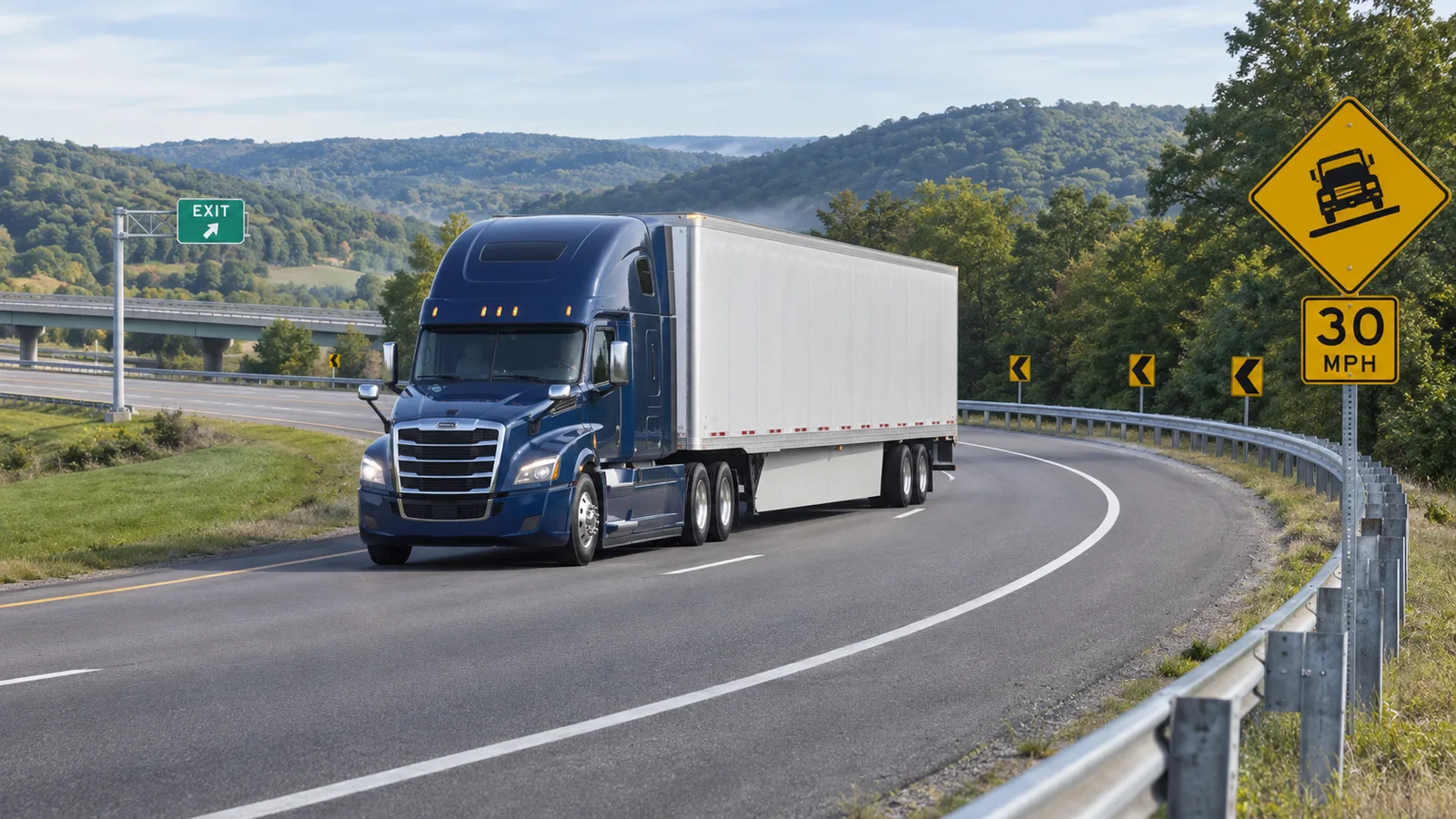
Understand what raises rollover risk
A rollover can develop when the sideways force created by a turn shifts enough of the vehicle’s weight toward the outside wheels. The sharper the curve, the higher the speed, and the higher the center of gravity, the smaller the available margin becomes. Drivers do not need to calculate a physics formula while driving. They do need to recognize that a small increase in entry speed can create a much larger change in turning demand.
Center of gravity changes the truck’s behavior
The center of gravity is the point at which the vehicle and load can be considered balanced. When heavy cargo is placed high, that point rises and the combination becomes more vulnerable to lateral load transfer. The current tells drivers not to be top-heavy and explains that a high center of gravity increases the chance of tipping, especially in curves or during a swerve.
Two trailers with the same gross weight can behave differently if one carries dense material close to the floor and the other carries heavy freight near the roof. A lightly loaded vehicle is not automatically protected either. Its suspension response, wind exposure, load distribution, and available traction still matter. “Under the legal weight limit” answers one question; it does not prove that the vehicle can take every ramp at the same speed.
Speed and curve shape work together
A long, gentle bend is different from a short ramp that tightens after the entrance. A driver who looks only at the first part may enter too quickly for the second. Roadway superelevation, surface condition, lane width, downhill grade, and an unexpected queue can also change the demand. The safe technique is to scan through as much of the curve as possible, identify whether it tightens, and choose an entry speed that leaves room for a smooth correction.
Abrupt actions spend the remaining stability margin
Hard braking, rapid steering, and a sudden lane correction can transfer weight quickly. Combining those actions in a curve is particularly demanding. Prevention therefore starts with space: adequate following distance and an escape plan reduce the chance that a driver must brake and steer sharply at the same time. Our following-distance and space-cushion plan explains how to build that margin before a hazard develops.
Read the load and vehicle before moving
Keep heavy cargo low and distribute weight deliberately
Drivers may not control every loading decision, but they must not treat a sealed door or printed weight total as a stability analysis. Where access and responsibility permit, confirm that the load matches the loading plan, heavy items are placed low, weight is not concentrated to one side, axle and vehicle limits are respected, and blocking, bracing, dunnage, tiedowns, and other securement are appropriate for the commodity.
Too much weight toward the rear can reduce steering-axle loading. Too much forward may overload components or change steering effort. Side-to-side imbalance can make the combination respond differently in left and right curves. A load can be within the gross limit yet be poorly distributed. If the distribution appears unsafe, the solution is to correct the load before departure—not to promise to “drive carefully” around a loading problem.
Securement and center of gravity are separate questions
Properly secured cargo can still be high. Low cargo can still be improperly secured. A complete review asks both questions: will the cargo stay where it belongs, and does its placement give the vehicle a stable center of gravity? Under , cargo must be contained, immobilized, or secured so shifting does not adversely affect vehicle stability or maneuverability.
Securement needs can change after the vehicle begins moving. Vibration, settling, compression, and changes in temperature can reduce tension or create space. Use the required inspections for the operation and follow commodity-specific rules. For a detailed inspection sequence, see our cargo inspection and securement recheck plan.
Some vehicle types need additional caution
Cargo tanks can be affected by liquid surge, especially when partially filled and when the tank design permits movement. Dump bodies may carry dense loads high above the frame, and a raised body creates hazards far beyond normal road travel. Livestock, hanging meat, mixers, buses, and other configurations have distinct handling characteristics. A driver must understand the particular equipment and load rather than applying one generic curve speed to every commercial vehicle.
The FMCSA is specific to cargo tanks, but its broad themes—vehicle design, load effects, highway factors, and driver factors—are useful reminders. It should supplement, not replace, required training and the procedures for the actual vehicle.
Read the road before the curve
Use signs as an early decision point
Curve arrows, chevrons, truck-rollover symbols, advisory-speed plaques, ramp geometry, and brake-light patterns all provide information. A rollover warning is not decoration. It identifies a location where excessive speed can be especially dangerous for trucks. An advisory speed deserves attention, but it is not a guarantee for a tall, heavily loaded, unusually configured, or traction-limited vehicle.
Begin reducing speed while the combination is straight. Check mirrors before slowing, signal early when leaving the main road, and avoid last-second lane changes. A disciplined merge and lane-change routine prevents the hurried steering covered in our controlled lane-change and highway-merge plan.
Look beyond the curve entrance
Scan for a tightening radius, downhill grade, standing water, debris, construction barriers, narrowed lanes, shoulder drop-off, stopped traffic, and vehicles entering from another ramp. A curve can hide the end of a queue. Entering at a speed that uses all of the truck’s stability margin leaves nothing for a stopped vehicle, a damaged surface, or a driver drifting across a lane line.
Weather reduces the usable margin
Rain, ice, snow, sleet, fog, mist, dust, and smoke can reduce visibility or traction. requires extreme caution and reduced speed when listed hazardous conditions affect visibility or traction; if conditions become sufficiently dangerous, commercial-vehicle operation must stop until it can be safely resumed.
Slowing for a curve on a slippery surface must begin earlier and be gentler. Do not rely on aggressive braking after entry. The practical stop-or-go framework in our winter-driving guide applies whenever traction is uncertain.
Use smooth speed, steering, and braking control
Set the speed before entry
The best time to remove excess speed is while the truck is straight and stable. Release the accelerator early, use the appropriate braking technique for the vehicle and conditions, select the correct gear before the curve when needed, and enter at a conservative speed. The goal is to avoid a major speed correction after lateral force is already acting on the combination.
Posted maximum speeds and passenger-car behavior are poor substitutes for vehicle-specific judgment. A car ahead may take the ramp comfortably at a speed that is unsuitable for a high-center-of-gravity commercial vehicle. Do not let following traffic pressure the truck into a faster entry. A safe commercial-driving decision is based on the truck, load, road, visibility, and traction.
Steer one clean path
Look through the curve and guide the truck along a stable lane path. Avoid cutting across lane lines, climbing a curb, dropping trailer wheels onto a soft shoulder, or making a sudden correction after drifting wide. Offtracking still matters, especially on tight ramps, but extra trailer clearance must be created through proper setup and speed—not by swinging into an occupied lane.
Keep both hands ready for controlled steering and minimize distractions before the ramp. If navigation instructions arrive late, continue safely and accept the missed exit. A detour costs time; an abrupt dive across a gore area can create a loss-of-control event.
Respond to a developing problem without making it worse
If the truck feels unstable, do not add a violent steering or braking input. Hold a controlled path, reduce speed as smoothly as conditions allow, and move to the first safe and legal stopping place. A sensation of load movement, unusual trailer lean, repeated steering correction, or new handling behavior deserves investigation. Notify the carrier and inspect when qualified and permitted. Do not continue simply because the vehicle remains movable.
Connect rollover prevention to the current rules
Safe-driving advice and legal requirements overlap but are not identical. Drivers should know which statements come from a regulation and which are practical techniques for staying well inside the boundary.
Applicable operating rules still control
requires commercial motor vehicles to follow the laws, ordinances, and regulations of the jurisdiction where they operate, while a higher FMCSA standard of care governs when applicable. Speed limits, lane controls, signs, restricted routes, and local operating rules remain part of the decision.
Cargo must not undermine stability or maneuverability
The general cargo rule in 49 CFR 393.100 addresses loss and shifting of cargo, while addresses distribution, securement, and specified driver inspections. The exact inspection provisions include exceptions, such as certain sealed loads or loads impracticable to inspect. A driver should apply the requirements for the actual load rather than repeating a simplified rule without checking whether an exception or commodity-specific section applies.
Hazardous conditions can require stopping
Reducing speed is not always enough. If visibility or traction conditions become sufficiently dangerous, the federal rule says operation must be discontinued until the vehicle can be safely operated. A schedule, appointment, or available hours-of-service time does not create traction or stability. The driver should communicate conditions early and choose a safe stop before the situation removes the remaining options.
Worked scenario: a ramp that tightens after the warning sign
A new driver is operating a tractor with a 53-foot dry van. The bills show a legal gross weight, but much of the palletized freight is tall. The driver completed the required cargo and vehicle checks before departure and noticed that the load was distributed according to the shipper’s plan and secured. This is a training scenario; it does not establish that a real load is safe.
The approach
The route leaves an interstate on a downhill right-hand ramp. A truck-rollover warning and advisory-speed plaque appear before the exit. Traffic on the main road is moving quickly, and a car follows close behind the truck. Navigation shows the exit only shortly before the gore.
The driver avoids the first bad choice: crossing late from the through lane. Because the correct lane was selected early, the driver checks mirrors, signals, and begins a gradual reduction while the combination is straight. The following car does not determine the truck’s entry speed. The driver uses the warning, the high freight, the downhill approach, and the visible curve to choose a speed below what might feel comfortable in a passenger car.
The hidden queue
After entering, the curve tightens and brake lights appear around the bend. Because the driver preserved following distance and did not enter at the edge of the truck’s handling margin, there is room to reduce speed smoothly. The driver keeps a steady lane path rather than steering toward the shoulder, where trailer wheels could encounter a drop-off or soft surface.
Had the driver entered too fast, the same queue could have forced heavy braking and a sudden steering correction together. The safe result did not depend on a heroic recovery. It came from early lane selection, conservative entry speed, stable cargo, a longer view, and unused margin.
Post-curve decision
Once clear of the ramp, the driver notices a new sensation from the trailer after passing a rough joint. Rather than dismiss it, the driver reduces speed smoothly and stops at the first suitable commercial-vehicle location. The load and securement are checked according to the applicable rules and carrier procedure. Dispatch receives a precise report. The trip resumes only after the driver and carrier confirm that the combination can be operated safely.
Rollover-risk action table
| Observation | Why it matters | Driver action |
|---|---|---|
| Truck-rollover or curve warning | Identifies a location where curve geometry and excessive speed can be hazardous | Read the full ramp, reduce early, and select a conservative entry speed. |
| High or uneven load | Can raise or shift the center of gravity and change handling | Verify loading, distribution, axle limits, and securement before departure. |
| Partially filled cargo tank | Liquid movement can change forces during braking and turning | Use vehicle- and commodity-specific training; allow extra margin and smooth inputs. |
| Downhill or tightening ramp | Speed can build while the curve becomes more demanding | Slow on the straight approach and scan beyond the entrance. |
| Rain, snow, ice, fog, dust, or smoke | May reduce traction or visibility and the ability to correct | Use extreme caution, reduce speed, and stop if safe operation is no longer possible. |
| Traffic queue hidden by curve | May require braking while lateral force is already present | Create following space before entry and avoid using all available handling margin. |
| Trailer wheel approaches shoulder | A drop-off or soft edge can increase instability | Hold a controlled lane path; do not make an abrupt correction. |
| Possible cargo shift or unusual lean | Stability and maneuverability may be compromised | Reduce smoothly, stop safely, inspect, report, and correct before continuing. |
Rollover-prevention checklist
- Know the vehicle configuration, height, load type, and special handling characteristics.
- Confirm that gross, axle, tire, suspension, and coupling limits are respected.
- Check that heavy cargo is positioned as low as the loading plan and rules permit.
- Look for side-to-side or front-to-rear imbalance.
- Verify blocking, bracing, tiedowns, doors, and other securement as applicable.
- Complete required cargo and securement rechecks during the trip.
- Select the correct lane well before an exit or curve.
- Read curve, rollover, advisory-speed, grade, and work-zone signs early.
- Scan beyond the curve entrance for a tighter radius or stopped traffic.
- Reduce speed while the combination is straight and stable.
- Enter below the speed needed to preserve a meaningful safety margin.
- Keep enough following distance to avoid simultaneous hard braking and steering.
- Use smooth steering, braking, acceleration, and gear selection.
- Protect trailer wheels from curbs, shoulder drop-offs, and soft edges.
- Lower speed further when traction, visibility, grade, or load movement is uncertain.
- Miss an exit rather than make a sudden cross-lane movement.
- Stop safely and investigate any sign of load shift or changed handling.
- Communicate the condition clearly and do not resume until operation is safe.
Frequently asked questions
Does an advisory speed guarantee that a commercial truck will not roll over?
No. An advisory speed is an important warning, but it is not a guarantee tailored to every truck. Vehicle configuration, load height and distribution, cargo movement, road surface, weather, ramp geometry, and the need for steering or braking can require a substantially lower speed.
Why should a CDL driver reduce speed before entering a curve?
Reducing speed before the curve lets the truck enter in a stable condition and allows the driver to use smooth steering with little or no hard braking. Entering too fast and then braking or steering sharply inside the curve can increase lateral load transfer and reduce the available margin for control.
Can properly secured cargo still make a truck top-heavy?
Yes. Securement prevents unacceptable movement, but a load placed high can still raise the vehicle’s center of gravity. Heavy cargo should be positioned as low and distributed as evenly as the vehicle, cargo, securement rules, axle limits, and loading plan allow.
What should a driver do if the load may have shifted?
Avoid abrupt steering or braking, reduce speed smoothly, and stop at the first safe and legal place. Inspect the cargo and securement when permitted and qualified to do so, notify the carrier, and do not continue until the load and vehicle can be operated safely and all applicable securement requirements are satisfied.
Build the habit in supervised CDL training
Rollover prevention is not one maneuver. It is a sequence of ordinary decisions: inspect the load, read the road, slow early, preserve space, steer smoothly, and stop when the combination no longer feels right. Students should practice explaining those decisions aloud so the reasoning remains available under real traffic pressure.
For structured CDL training in Levittown, read about CDL training near you and contact Patriot CDL at . The school is located at 7800 Bristol Pike, Levittown, PA 19057. Training can develop inspection and vehicle-control habits; every driver must still apply the rules, equipment instructions, and carrier procedures for the specific operation.