


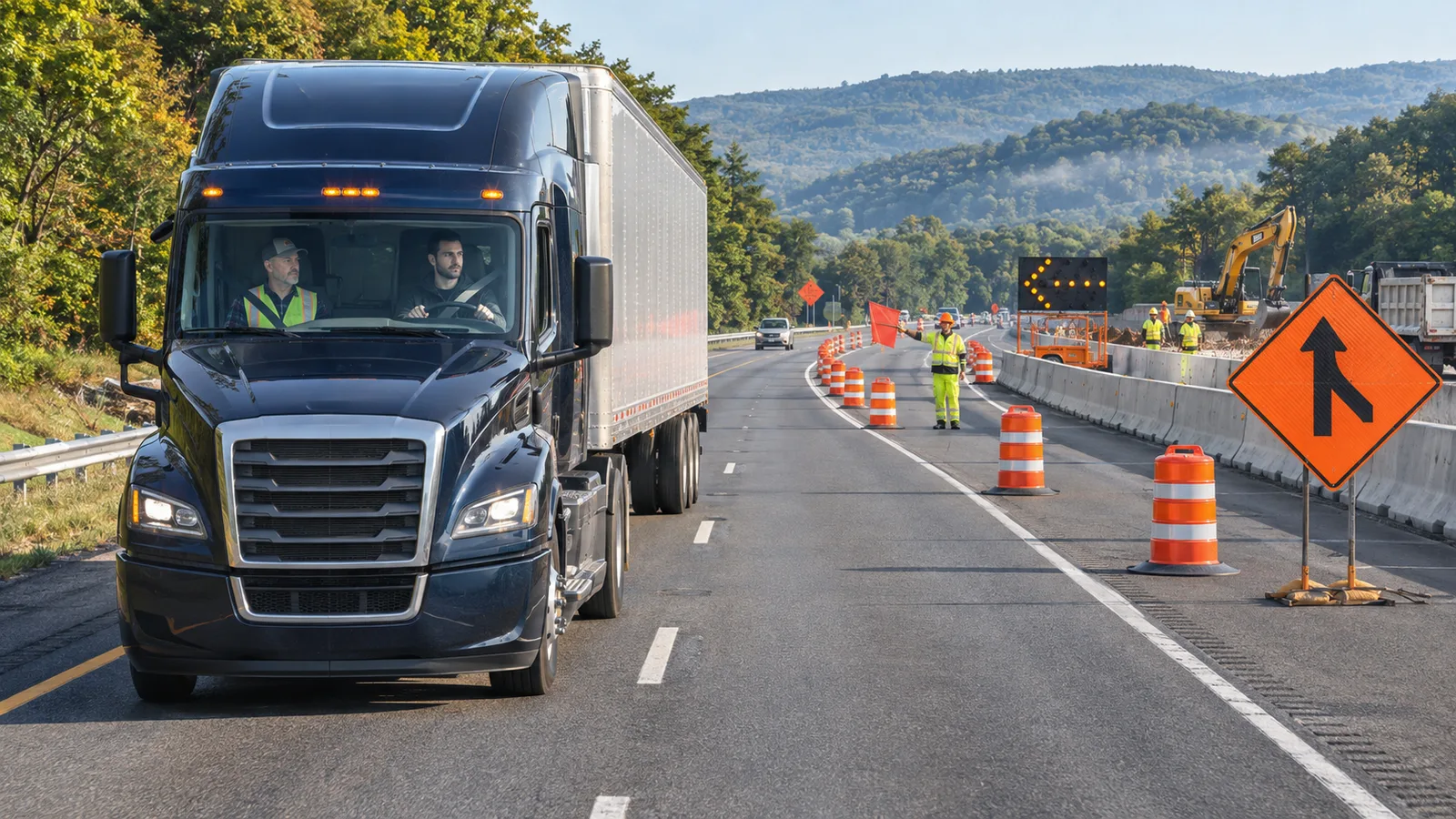
A highway work zone compresses several commercial-driving risks into one place: changing speed, a disappearing lane, narrow clearance, temporary markings, workers near traffic, equipment entering the road, and a queue that may be hidden beyond a curve. A tractor-trailer cannot wait until the first barrel to solve all of those problems. The safe plan starts at the first warning sign.
This guide converts current PennDOT and FMCSA work-zone guidance into a practical CDL routine. It separates legal requirements from driving technique, explains how to manage lane shifts and flaggers, and provides a worked scenario, action table, and checklist. It does not replace posted controls, a flagger's direction, state law, carrier policy, manufacturer instructions, or supervised training.
Contents
Know the legal and safety baseline
Federal and state rules work together. requires every commercial motor vehicle to be operated according to the laws, ordinances, and regulations of the jurisdiction where it is driven, unless an FMCSA rule imposes a higher standard of care. Temporary speed limits, lane restrictions, signals, pavement markings, and directions from authorized personnel therefore require the same disciplined attention as permanent controls.
Signed and active work zones are not identical
PennDOT distinguishes a posted work zone from an active work zone. A posted zone is identified by official work-zone signing. An active zone is marked to show that workers are present, including an “Active Work Zone When Flashing” control as described by PennDOT. Drivers should not wait to see people before responding: lane changes, barriers, rough pavement, and equipment can exist even when a crew is not visible.
Under , headlamps must be lighted on every vehicle traveling through a signed work zone. requires drivers to yield to authorized vehicles or pedestrians actually engaged in highway work within properly indicated construction or maintenance areas, and it provides doubled fines for listed violations in a properly posted active work zone. The safest operational rule is simpler than memorizing penalties: recognize the zone early, obey every control, and protect the people working beside traffic.
Research the route before departure
FMCSA's advise commercial drivers to research the route and, when practical, use an available detour. Route planning should include official traffic information, construction notices, weather, road restrictions, and realistic time for congestion. For Pennsylvania travel, is an official place to check current conditions.
Make the routing decision before the truck is committed
A detour is not automatically better for a commercial vehicle. Confirm height, weight, length, bridge, and truck-route restrictions before changing course. A passenger-car navigation app may suggest a road that is unsuitable for the combination. If the work zone remains the lawful route, plan for delay rather than trying to recover time inside it.
Prepare the vehicle for visibility and control
Complete the required pre-trip inspection, paying particular attention to brakes, tires, steering, mirrors, lamps, reflectors, windshield, and wipers. Work-zone signs and temporary markings must be seen early, and close barriers leave little room for a mechanical surprise. Review the lights and reflectors inspection plan and the clear-view inspection guide before a supervised road lesson.
Read the advance-warning area
Orange signs are normally used for work-area and construction warnings. They may announce road work, a reduced speed, a flagger, a lane closure, a shoulder closure, a detour, uneven pavement, or a temporary traffic pattern. A changeable message board, arrow panel, truck-mounted attenuator, or shadow vehicle may provide additional warning. Treat the first device as the start of the decision zone, not as roadside decoration.
Use a three-question scan
Ask: What is changing? Where must the truck be? What traffic conflict is developing? The answers may be “left lane closes,” “move right before the taper,” and “a passenger car is holding beside the trailer.” This quick structure converts signs into actions while there is still time for smooth braking and a safe lane change.
Look beyond the barrels
Scan for brake lights, workers, equipment booms, trucks entering from the construction area, narrowed shoulders, concrete barrier offsets, and temporary signals. The most urgent hazard may be the queue before the actual work. A driver who looks only at cones can miss stopped traffic directly ahead.
Turn on lights and make the full combination visible
In Pennsylvania, the headlamp requirement applies to every signed work zone, including daylight. Daytime running lights may illuminate only the front and may leave the taillights off. Use the normal headlight control so that the tractor and trailer are easier for workers and other drivers to identify. Confirm the lamps are working before departure; a dashboard symbol is not a substitute for an exterior inspection.
Manage glare without losing information
At night, reflective devices and work lighting can produce glare. Keep the windshield clean, reduce unnecessary cab brightness, and look through the intended path rather than staring at a light source. Do not use high beams when they would interfere with workers, flaggers, equipment operators, or oncoming traffic. The night-driving visibility plan provides a broader routine for darkness and glare.
Reduce speed early and build stopping space
FMCSA advises drivers to slow down, follow posted signs, and maintain extra space in work zones. PennDOT also advises drivers not to use cruise control. A CMV driver should reduce speed before reaching the taper or queue, using mirrors to understand how following traffic is reacting. Sudden late braking can create a second hazard behind the trailer.
Control speed actively
Work-zone speed is not chosen once and forgotten. It must respond to the posted limit, sight distance, traffic flow, lane width, surface condition, workers, equipment, and stopping demand. The posted number is a maximum, not a promise that it is safe under every condition. If the open lane is narrow or the queue is unstable, a lower lawful speed may be necessary.
Increase the time available to stop
Leave more room than on an ordinary open highway. The space protects against a flagger's stop signal, a vehicle entering from the closed lane, a rough surface, or a queue that compresses suddenly. Do not let a passenger vehicle that fills the gap erase the plan; smoothly rebuild space. The following-distance and space-cushion guide explains how to measure and restore a usable interval.
Handle lane closures and merges without a last-second gamble
FMCSA guidance says to move into the open lane as soon as possible when approaching a lane closure. Local signs or authorized personnel may establish a different merge pattern, so follow the traffic control actually present. For a tractor-trailer, “move early” does not mean force an unsafe gap. It means begin the lane-change process while distance and options remain.
Complete the full lane-change routine
Read the closure sign, identify the open lane, check mirrors, check the relevant blind area, signal early, match a safe gap, move smoothly, and confirm the trailer has cleared before canceling the signal. Continue checking for vehicles that try to pass along the closing lane. Review the controlled lane-change and merge plan for the complete sequence.
Do not race another vehicle to the taper
A work-zone merge is not a contest for position. Accelerating to block a car or closing a gap increases risk and reduces the room available for braking. Hold a predictable path, cooperate with the posted merge pattern, and keep an escape option. Once solid temporary lines or channelizing devices define the lane, stay within the intended path unless directed otherwise.
Control the truck through narrow lanes and temporary markings
Concrete barriers, barrels, uneven lanes, temporary shoulders, and shifted markings make lane position more demanding. Look far enough ahead to create smooth steering inputs. If the driver stares at the barrier beside the cab, the truck may drift toward it. Use both mirrors to monitor clearance, but return attention to the path ahead instead of fixating on one side.
Account for the trailer
The trailer does not follow exactly in the tractor's tire path, especially through sharp shifts. Reduce speed before the bend, place the tractor deliberately, and monitor the trailer without making abrupt corrections. Avoid traveling beside another large vehicle where a lane narrows. Wind, pavement edge drops, and barrier proximity can all reduce the usable margin.
Expect the surface to change
Fresh paving transitions, steel plates, milled pavement, uneven lanes, loose material, and temporary drainage can affect steering and braking. Keep both hands ready, avoid unnecessary lane changes, and reduce speed before the change. Do not make a sudden avoidance move unless it is necessary to prevent a more serious conflict.
Respond correctly to flaggers, workers, and equipment
A flagger may stop traffic, release one direction at a time, or guide vehicles around equipment. PennDOT instructs drivers to obey flaggers and notes that their authority overrides conventional traffic-control devices. Slow enough to understand the instruction, stop where directed, and wait for an unmistakable release. Do not treat a hand motion from an unauthorized bystander as traffic control.
Yield to people and authorized work vehicles
Pennsylvania law requires drivers to yield to authorized vehicles or pedestrians actually engaged in highway work within an indicated construction or maintenance area. Watch for dump trucks, pavers, sweepers, and maintenance vehicles entering or crossing the lane. Eye contact can help, but it never replaces a clear right-of-way instruction.
Do not stop to ask a worker for directions
Keep moving at the controlled safe speed unless traffic control requires a stop. Stopping unexpectedly to watch the work or ask questions can block the narrow lane and surprise following traffic. If route guidance is needed, continue to a lawful safe stopping location outside the zone.
Recognize moving operations and shadow vehicles
Line painting, mowing, crack sealing, sweeping, and similar operations may move along the roadway. PennDOT explains that a shadow vehicle can warn motorists and protect the crew. The operation may not resemble a fixed construction site, yet it still changes lane use and speed.
Do not pass a moving operation unless directed. Read the arrow board or signs, reduce speed, and give the protective vehicle and workers room. Paint trucks and maintenance vehicles may stop or change position. A truck driver should never assume that a short opening beside the equipment is an invitation to pass.
Prepare for a queue before you can see its end
A hill, curve, bridge, or large vehicle can hide stopped traffic. Begin scanning for brake lights as soon as work-zone warnings appear. If a queue is likely, release the accelerator, cover the brake as appropriate, check mirrors, and create a gradual slowdown. Use warning flashers when required or appropriate under applicable law and carrier procedure, but do not rely on flashers to fix inadequate following distance.
Leave a recovery space when stopped
Stop far enough behind the vehicle ahead to preserve room for a small adjustment if traffic behind approaches too fast. Keep monitoring mirrors until a protective queue forms. Do not use the shoulder or closed lane as an ordinary bypass; workers, equipment, or a drop-off may occupy the space.
Work-zone action table
| What the driver sees | Immediate action | Next confirmation | Main risk controlled |
|---|---|---|---|
| First orange warning sign | Increase visual lead and release cruise control | Identify speed, lane, and route changes | Late reaction |
| Signed Pennsylvania work zone | Turn on normal headlights | Confirm full lighting and trailer visibility | Low conspicuity |
| Lane closed ahead | Begin a safe move toward the open lane | Mirror, blind spot, signal, gap, trailer clearance | Last-second merge |
| Brake lights beyond the taper | Slow gradually and expand space | Check mirrors for following traffic | Rear-end collision |
| Flagger displaying stop | Stop at the directed point | Wait for a clear release | Worker or opposing-traffic conflict |
| Narrow shifted lane | Reduce speed and use smooth steering | Monitor tractor and trailer clearance | Barrier strike or lane departure |
| Moving maintenance operation | Hold back and follow its traffic control | Pass only when directed | Worker/equipment conflict |
Worked CDL training scenario
A student and instructor approach a daytime interstate work zone in a loaded tractor-trailer. A message board announces that the left lane closes in two miles. Traffic is moderate, and a passenger car is traveling beside the trailer. Farther ahead, an arrow panel directs traffic right and a queue is forming beyond a curve.
Step 1: convert the first message into a plan
The student turns on the normal headlights, confirms the right lane is the destination, disengages cruise control, and begins scanning farther ahead. The student does not accelerate to pass the car beside the trailer. Instead, the driver adjusts speed to create a safe gap behind it.
Step 2: complete the merge before the taper
With a suitable gap available, the student checks mirrors and the right-side blind area, signals, moves smoothly into the open lane, and confirms the trailer is clear. The signal is canceled only after the full combination is established. Space ahead is rebuilt because another car has entered the gap.
Step 3: respond to the hidden queue
The student sees intermittent brake lights beyond the curve, releases the accelerator, checks mirrors, and begins a gradual slowdown. The truck reaches the back of the queue without a hard stop. The driver leaves recovery space ahead and continues monitoring traffic behind.
Step 4: follow the temporary lane shift
After the queue moves, the lane narrows between a concrete barrier and barrels. The student looks through the shift, reduces speed before the bend, uses small steering inputs, and checks both mirrors without staring at either barrier. A flagger ahead stops traffic for equipment crossing. The student stops at the directed point and proceeds only after the flagger clearly releases the lane.
The successful result comes from sequence, not luck: recognize, light, slow, create space, merge, scan for the queue, control the narrow path, and obey the flagger.
Practical CDL work-zone checklist
- Check official construction, traffic, weather, and detour information.
- Confirm any alternate route is legal for the commercial vehicle.
- Inspect brakes, tires, steering, mirrors, lamps, windshield, and wipers.
- Plan enough time that delay does not create pressure to speed.
- Treat the first orange sign as the start of the decision area.
- Turn on normal headlights in every signed Pennsylvania work zone.
- Disengage cruise control.
- Read every temporary sign, signal, arrow panel, and pavement marking.
- Reduce speed before reaching the taper or stopped queue.
- Increase following distance and preserve a forward escape space.
- Check mirrors for traffic reacting behind the trailer.
- Identify the open lane early.
- Use the full mirror, blind-spot, signal, gap, and clearance routine.
- Follow the posted merge pattern; never force a gap.
- Stay within channelizing devices and solid temporary lines.
- Look through lane shifts instead of staring at a nearby barrier.
- Reduce speed before narrow curves and surface transitions.
- Watch for equipment entering or crossing the lane.
- Yield to authorized workers and work vehicles.
- Obey flaggers and stop where directed.
- Do not pass a moving operation unless directed.
- Expect a queue beyond hills, curves, and large vehicles.
- Do not use the shoulder or closed lane as a bypass.
- Continue normal scanning until completely beyond the end-work-zone control.
Practice the full sequence in training
Work-zone skill should be taught as a chain of decisions. In the classroom, a student can identify signs, explain Pennsylvania headlamp requirements, and describe how a flagger changes the normal traffic sequence. In the yard, the student can practice narrow-lane placement using cones set with an appropriate safety margin. On the road, a qualified instructor can evaluate early recognition, speed control, mirror use, lane-change timing, following space, and compliance with temporary controls.
Debrief what happened before the narrow lane
Most errors inside the work zone begin earlier. Ask when the student first saw the closure, when cruise control was disengaged, when headlights were selected, how the merge gap was built, and where the queue was first detected. A student who reaches the taper in the wrong lane has already missed several earlier decisions. Training should repair the first missed cue, not only the final steering correction.
Patriot CDL provides hands-on Class A and Class B training at 7800 Bristol Pike, Levittown, PA 19057. To discuss supervised road training and current course availability, call . Training builds skill and judgment; it does not guarantee a license, test result, or job.
Official sources used
- .
- .
- , updated April 20, 2026.
- .
- .
- .
Frequently asked questions
Are headlights required in Pennsylvania work zones during daylight?
Yes. Pennsylvania law requires headlamps to be lighted on every vehicle traveling through a signed work zone. Daytime running lights may not activate the taillights, so the driver should use the normal headlight control to make the complete vehicle visible.
Should a CDL driver use cruise control in a work zone?
No. PennDOT advises drivers not to use cruise control in work zones. The driver should actively manage speed because queues, lane shifts, workers, equipment, surface changes, and temporary traffic controls can require an immediate adjustment.
When should a commercial driver move into the open lane for a work-zone closure?
Follow the posted merge instructions and any authorized direction. FMCSA guidance says to move into the open lane as soon as possible, but the move still requires a safe gap, complete mirror and blind-spot checks, a timely signal, and confirmation that the trailer is clear.
Does a work-zone flagger's direction override ordinary traffic-control devices?
Yes. Drivers must obey an authorized flagger controlling traffic in the work zone, even when that direction differs from the ordinary signal or sign sequence. Approach slowly, stop where directed, and do not proceed until the instruction is clear.