


A tractor-trailer can weigh less than the overall gross limit and still be overweight on one axle group. That is why a commercial driver cannot stop at the bottom line of a scale ticket. The steer axle, drive tandem, trailer tandem, total gross weight, axle spacing, equipment ratings, route limits, and cargo securement all matter. A legal gross total does not cancel an overloaded tandem, and a legal scale ticket does not make an unsafe load distribution acceptable.
This guide gives CDL students and newer drivers a practical sequence: know the controlling limits, obtain an accurate weight, read every line of the ticket, diagnose where the weight sits, make only an authorized adjustment, inspect the load again, and reweigh before continuing. It uses the common federal Interstate limits as a teaching reference while emphasizing that state rules, posted roads and bridges, permits, vehicle ratings, and company procedures may be more restrictive.
Know which weight limits control
Drivers often hear three numbers—20,000 pounds on a single axle, 34,000 pounds on a tandem axle, and 80,000 pounds gross. FHWA identifies those as the general federal maximum standards for commercial vehicles on the Interstate Highway System, together with Federal Bridge Formula requirements. They are not a universal promise that every vehicle, axle, road, bridge, state, or load may operate at those values.
Legal limits depend on the route and operation
Federal Interstate standards coexist with state laws, grandfathered provisions, posted bridge limits, local road restrictions, axle-spacing requirements, and permit conditions. Off the Interstate System, states may establish their own commercial-vehicle weight standards. An oversize or overweight permit is not issued by the federal government; permits are a state function. Before moving a heavy or unusual load, the carrier and driver must identify the legal route and any permit terms rather than treating the common federal figures as the whole answer.
The Bridge Formula evaluates axle groups and spacing
The Federal Bridge Formula protects bridges by limiting the weight carried on groups of two or more consecutive axles according to the number of axles and the distance between the outer axles in the group. A combination may be below 80,000 pounds and below the separate tandem figures yet still fail an applicable group calculation. Drivers do not need to improvise the formula at the scale lane; they need the carrier’s compliant configuration, accurate axle spacing, route information, and a verified weight.
Equipment ratings can be lower than road-law maximums
The Pennsylvania Commercial Driver’s Manual identifies axle weight, GVWR, GCWR, tire load, suspension capacity, and coupling-device capacity as separate concepts. The lowest applicable limit still matters. A legal-road maximum cannot override a manufacturer’s rating for the steer axle, tires, wheels, suspension, fifth wheel, or other component. Our GVWR guide explains why ratings and measured weight must not be confused.
Posted bridges and roads require another check
A route that accepts the vehicle under general limits may contain a bridge or road with a lower posted capacity. Route planning must include those restrictions before departure. If a sign conflicts with the planned route or the driver is unsure whether the loaded combination is allowed, stop in a legal place and obtain authorized routing help. Never enter a restricted structure based on a guess.
Read every line of the scale ticket
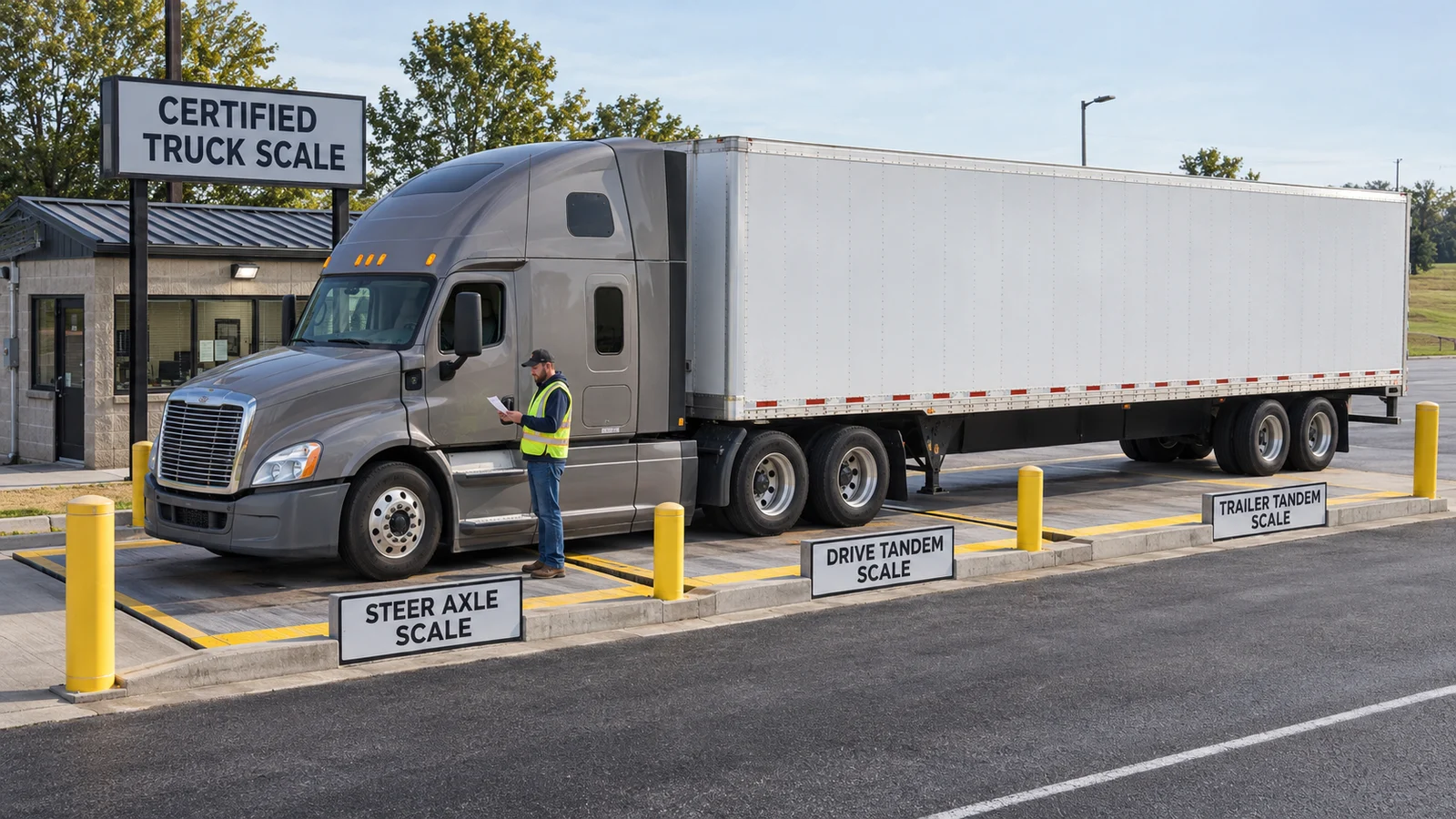
A common five-axle tractor-semitrailer ticket separates the load into steer axle, drive tandem, trailer tandem, and gross weight. Some configurations produce additional axle or group lines. The driver should match the ticket to the actual vehicle rather than assuming every ticket follows the same layout.
Steer axle weight
The steer line represents the weight carried through the front steering axle. Its allowable weight depends on applicable law and the ratings of the axle, tires, wheels, and suspension. Too much weight can overload components and affect steering effort. Too little steer weight can also reduce safe directional control. A driver should not use the federal 20,000-pound single-axle maximum as an automatic steer-axle target; the actual equipment rating may be much lower.
Drive tandem weight
The drive line usually represents the tractor’s paired drive axles. On a conventional fifth-wheel setup, cargo position, trailer-tandem position, fifth-wheel position, tractor fuel, and installed equipment can affect this group. A drive tandem over its controlling limit is not cured merely because the trailer tandem is light or the gross total remains below 80,000 pounds.
Trailer tandem weight
The trailer line represents the weight carried by the trailer axle group. Cargo placed too far rearward or a tandem positioned too far forward can add weight to this group. The tandem’s legal position also matters: axle-spacing and state trailer-tandem placement rules may restrict how far it can be moved. Securement and load stability must be reassessed after any adjustment.
Gross weight
Gross is the sum of the measured axle groups. It is a necessary check, not the only check. Confirm the arithmetic and compare the total with the applicable legal, permitted, GVWR, and GCWR limits. If the scale ticket does not match the expected load, investigate rather than assuming the scale or paperwork is wrong.
Understand weight distribution
Weight distribution affects more than compliance. The PennDOT commercial manual warns that poor balance can make steering, braking, traction, and vehicle handling unsafe. Cargo should be kept as low and balanced as practical for the load and vehicle. A high center of gravity increases rollover risk, especially in curves or during sudden steering.
Front-to-rear balance
Cargo concentrated forward can add load to the tractor and drive group; cargo concentrated rearward can overload the trailer group and reduce effective loading on the tractor. The exact effect depends on cargo position, trailer dimensions, axle placement, and fifth-wheel geometry. Do not rely on visual appearance alone. Measure the completed combination.
Side-to-side balance
A ticket that reports only axle-group totals may not reveal a severe left-right imbalance. Uneven loading can affect tire loads, suspension, braking, and cornering. Follow loading diagrams and shipper or carrier procedures, inspect how the cargo is placed, and use equipment capable of individual-wheel or side measurements when the operation requires it.
Center of gravity and cargo height
A load may be legal by weight but still be top-heavy. Keep heavy cargo low when the loading plan allows, avoid unnecessary stacking height, and secure every article for the forces it may experience. Review the relationship among load height, curves, and smooth control in our truck rollover-prevention guide.
Fuel and operating changes
Fuel adds weight to the tractor and usually affects the steer and drive groups rather than the trailer tandem. Auxiliary equipment, tools, passengers, snow or ice accumulation, and cargo changes can also alter the total. A combination that has almost no legal margin at the scale may not remain within limits after a planned fuel stop. Account for expected operating changes instead of treating the first ticket as permanent.
Prepare for an accurate scale reading
Follow the facility’s signs, lights, intercom instructions, and posted procedure. Approach slowly, keep the combination straight, and place each axle group fully on its assigned platform. Set the brakes or remain stopped as directed. Do not exit the cab in an active lane unless the facility instructs you to do so and it is safe.
Weigh the vehicle in its real operating condition
For a meaningful departure check, the combination should reflect the load, fuel, equipment, and occupants that will travel. Confirm doors are closed, cargo work is finished, and no forklift or loading device remains connected. If the configuration changes after weighing, decide whether a new weight is necessary.
Check vehicle identity and ticket details
Before acting on the numbers, confirm the ticket belongs to the correct tractor and trailer and that the axle groups correspond to the configuration. Keep the ticket according to carrier procedure. A photo or electronic copy can help with communication, but it does not replace any required original document or inspection.
Inspect before and after the scale
Scaling does not replace a pre-trip or cargo inspection. Check tires, wheels, suspension, coupling, doors, securement, and visible load condition. Our commercial-truck tire inspection, steering and suspension inspection, and cargo recheck guide address those separate duties.
Correct an axle imbalance safely
Do not leave the scale area on a public route while knowingly overweight. Park in an authorized location, notify dispatch or the responsible supervisor, and follow carrier, shipper, equipment, and facility procedures. The available correction depends on the cargo, trailer, sliding equipment, route, permit, and legal tandem position.
Move cargo when the loading plan requires it
Some loads must be returned to the dock for redistribution or partial unloading. The driver should not enter a trailer during active loading or move cargo without training, authorization, suitable equipment, and a safe loading environment. After cargo is changed, inspect securement and condition again before reweighing.
Adjust trailer tandems only when authorized
On a typical sliding-tandem trailer, moving the tandem rearward generally transfers some load from the trailer tandem toward the tractor drives; moving it forward generally transfers some load from the drives toward the trailer tandem. The amount per hole is not universal. Trailer length, hole spacing, cargo position, and suspension geometry matter. Follow the equipment procedure, secure the vehicle against movement, verify the locking pins are fully engaged, respect legal tandem-position limits, and reweigh.
Adjust the fifth wheel only under the proper procedure
A sliding fifth wheel may redistribute weight between the steer axle and drive tandem. Moving it forward generally transfers some drive weight toward the steer axle; moving it rearward generally does the reverse. It does not directly solve every trailer-tandem problem, and it can create cab-to-trailer or landing-gear clearance issues. Use only an approved procedure, verify locking, test the connection as directed, and measure again.
Reinspect and reweigh
No adjustment is complete until the locking mechanism, air and electrical lines, clearances, cargo securement, and axle weights are confirmed. A driver’s estimate that “one hole should do it” is not proof. The new ticket must show every measured group and the gross total within the applicable limits with appropriate operating margin.
Worked scenario: legal gross, heavy drive tandem
A driver scales a loaded five-axle tractor-trailer before entering the Interstate. The ticket shows 12,100 pounds on the steer axle, 34,700 on the drive tandem, and 32,600 on the trailer tandem. Gross weight is 79,400 pounds. The route and equipment use the ordinary federal Interstate reference limits, and no permit or special exception applies.
Step 1: check every group
The gross total is below 80,000 pounds, but the drive tandem is 700 pounds above the 34,000-pound federal tandem reference. The trailer tandem has unused capacity, subject to all other limits. The driver does not depart based on the legal gross total.
Step 2: choose an authorized correction
The driver parks in the scale facility’s designated adjustment area and contacts the carrier. Cargo does not need to be unloaded, and the trailer is equipped with sliding tandems. Following the approved procedure, the driver moves the trailer tandems forward a small amount to transfer some load from the tractor drives toward the trailer group. No fixed pounds-per-hole assumption is used.
Step 3: verify the mechanism and load
The driver confirms the tandem pins are fully seated, checks the air lines and clearances, and reinspects the cargo and doors. Because the tandem position changed, the driver also verifies that its placement is legal for the route and that the combination still satisfies applicable axle-spacing requirements.
Step 4: reweigh and read the whole ticket
The second measured ticket shows 12,100 pounds steer, 33,900 pounds drives, 33,400 pounds trailer, and the same 79,400-pound gross. Those figures are an illustrative result, not a promise about how far a real tandem must move. The driver compares them with legal and equipment limits, accounts for the planned fuel stop, retains the ticket under carrier procedure, and departs only after all checks pass.
Weight clue-and-action table
| Scale or inspection clue | What it may mean | Next controlled action |
|---|---|---|
| Gross below 80,000 but one tandem above its limit | The combination is still overweight on that group | Park, correct the distribution under procedure, and reweigh |
| Steer weight near the equipment rating | A fifth-wheel or cargo position may leave insufficient margin | Compare law and all component ratings; obtain authorized guidance |
| Drive tandem heavy, trailer tandem light | Too much load is being carried through the tractor | Evaluate cargo, trailer-tandem, and fifth-wheel options; do not guess |
| Trailer tandem heavy, drives light | Cargo or tandem position may place too much load at the rear | Use the approved redistribution method and verify legal tandem position |
| Axle groups legal but load visibly high or unbalanced | The combination may be unstable despite legal totals | Return for safe cargo correction and securement inspection |
| Ticket differs greatly from shipping documents | Cargo, fuel, configuration, or paperwork may be wrong | Stop and reconcile the discrepancy with the responsible party |
| Route includes a lower posted bridge limit | General axle and gross limits do not authorize the crossing | Use an approved alternate route or required permit process |
Axle-weight verification checklist
- Identify the exact tractor, trailer, axle configuration, load, and route.
- Confirm applicable federal, state, local, posted, and permit limits.
- Check GVWR, GCWR, GAWR, tire, wheel, suspension, and coupling ratings.
- Review axle-spacing and legal trailer-tandem position requirements.
- Finish loading and secure the cargo before the departure weight.
- Account for fuel, occupants, tools, auxiliary equipment, and planned changes.
- Follow scale signs and staff instructions.
- Place every axle group fully on the proper platform.
- Confirm the ticket belongs to the correct tractor and trailer.
- Read steer, drive, trailer, other axle groups, and gross separately.
- Verify the arithmetic and compare every line with its controlling limit.
- Do not treat a legal gross total as proof that each axle group is legal.
- Inspect cargo placement, height, side balance, and securement.
- If correction is needed, park only in an authorized safe area.
- Contact the responsible supervisor, carrier, or shipper.
- Use only trained and authorized adjustment procedures.
- Verify tandem or fifth-wheel locking pins after any slide.
- Recheck air lines, clearances, coupling, doors, and cargo.
- Reweigh after any material adjustment or load change.
- Retain the final ticket and documents according to procedure.
Common mistakes to avoid
Checking only the gross total
This is the most basic ticket-reading error. Every axle and axle group must comply with its own controlling limit, and Bridge Formula requirements may still apply. Read from the steer line through the gross line every time.
Using 34,000 pounds as an equipment rating
The federal tandem figure is a legal-road reference, not proof that the tires, suspension, axle, or vehicle manufacturer allows that load. Compare both law and equipment ratings and use the more restrictive applicable limit.
Assuming a fixed pounds-per-hole value
Online rules of thumb cannot account for every trailer, cargo position, hole spacing, suspension, or fifth-wheel setup. Make a controlled adjustment under the correct procedure and measure the actual result.
Forgetting that a correction changes clearances
Sliding tandems affects turning and rear-swing geometry. Moving a fifth wheel affects cab-to-trailer and landing-gear clearance. After the weight is corrected, the physical configuration still must be safe and legal. Use the planning habits in our trailer-clearance guide.
Skipping the second inspection
Moving cargo or sliding equipment can change securement tension, hose position, locks, and door condition. Reinspect before reweighing and again before entering traffic. Weight compliance does not replace the broader readiness checks in our roadside-inspection readiness guide.
Frequently asked questions
Is a truck legal if its gross weight is under 80,000 pounds?
Not necessarily. Each axle and axle group must meet its controlling limit, the combination may need to satisfy the Federal Bridge Formula, equipment ratings may be lower, and state, route, bridge, permit, or local restrictions may apply. A truck can be under 80,000 pounds gross and still be overweight or otherwise unsafe.
What do steer, drive, and trailer weights mean on a scale ticket?
Steer weight is carried by the front steering axle, drive weight by the tractor’s drive axle group, and trailer weight by the trailer axle group. Gross is their combined measured total. Other vehicle configurations may show additional axle or group lines, so the driver must match the ticket to the actual combination.
How can a driver move weight between axle groups?
Depending on the vehicle and load, authorized options may include redistributing or removing cargo, moving a sliding trailer tandem, or adjusting a sliding fifth wheel. Each method affects different axle groups and clearances. Follow the carrier and equipment procedure, verify every lock and clearance, and reweigh instead of relying on a pounds-per-hole estimate.
Does a scale ticket prove the load is safe and legal for the whole trip?
No. A scale ticket records the measured weights at that time. The driver must also consider equipment ratings, axle spacing, route and bridge restrictions, permits, cargo balance and securement, fuel or load changes, and any later movement of the cargo. Reinspect and reweigh when a material change makes the original measurement unreliable.
Official sources and scope
This article uses the Federal Highway Administration’s , its , and the current . Exact compliance depends on the vehicle, load, route, jurisdiction, equipment ratings, permits, and current law. The procedures here are training guidance and do not authorize an overweight movement.
Practice the full verification sequence
Scale-ticket reading is a CDL skill because safe loading connects law, vehicle ratings, cargo placement, inspection, and handling. Patriot CDL helps students build that complete decision process rather than memorize one gross-weight number. To discuss CDL training, call or visit Patriot CDL at 7800 Bristol Pike, Levittown, PA 19057.