


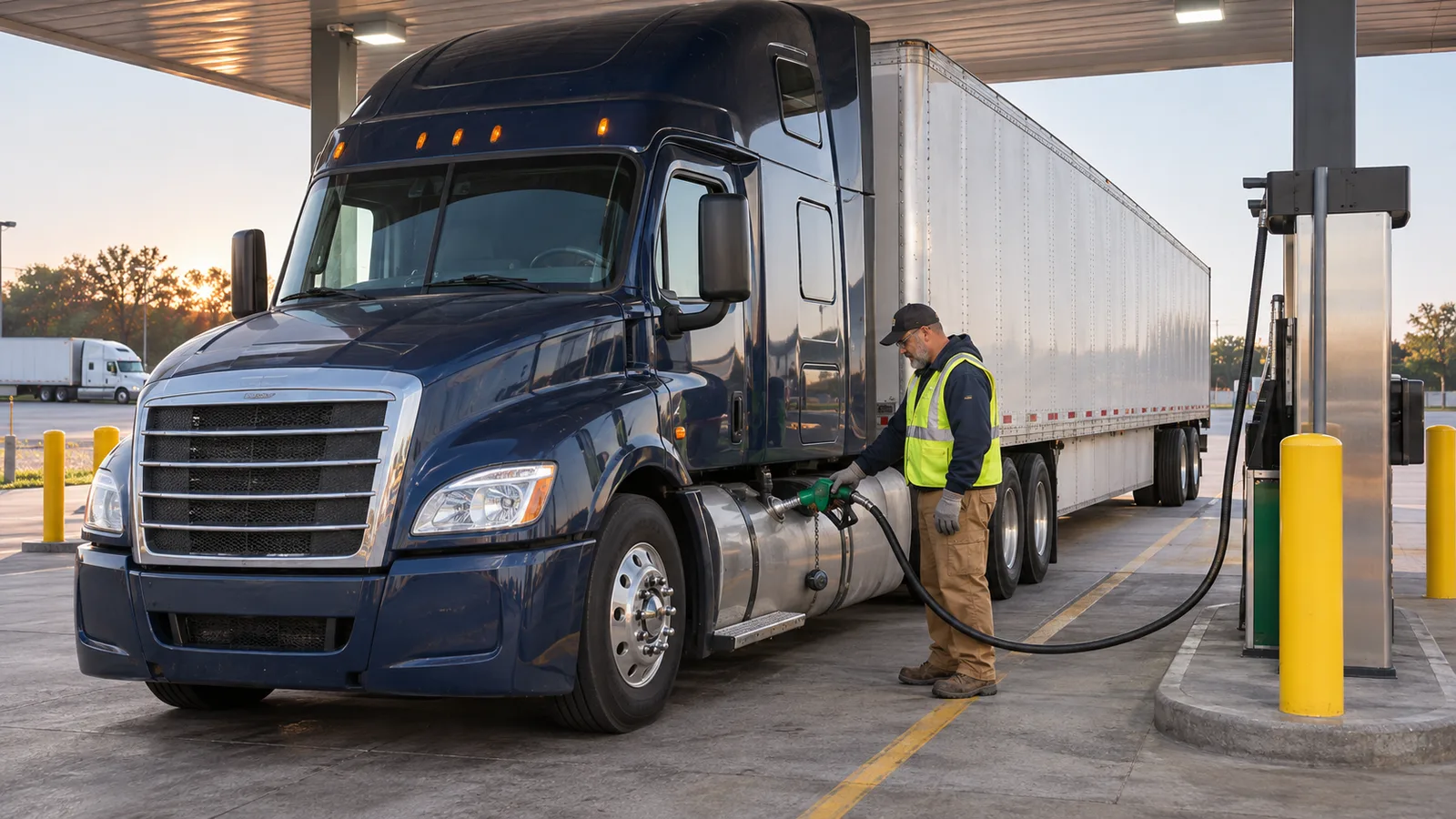
A commercial truck fuel stop looks routine only when every step is controlled. A tractor may arrive with hot exhaust components, several hundred miles of road grime, traffic moving on both sides, and a schedule that tempts the driver to hurry. Add a high-flow nozzle, two fuel tanks, diesel exhaust fluid (DEF), and a crowded truck stop, and the fuel island becomes a workplace where positioning and attention matter.
This guide turns the stop into a repeatable CDL-driver routine: plan the approach, secure the combination, inspect the fuel system, control the nozzle, separate diesel from DEF, and know what to do if fuel escapes. It focuses on ordinary diesel commercial motor vehicle fueling. A driver hauling hazardous materials or operating specialized equipment must also follow the rules, shipping-paper instructions, carrier procedures, and facility controls that apply to that operation.
Why a fuel-island routine belongs in professional driving
Fueling is not a break from driving responsibility. The driver is still controlling a large combination in a narrow lane, working around combustible liquid, and deciding whether the vehicle is safe to return to service. A consistent routine reduces omissions because the same cues trigger the same actions at every stop. It also makes a defect easier to notice: a loose cap, fresh wetness on a tank, a chafed line, or a damaged step stands out when the driver knows what normal looks like.
The federal baseline is specific
states that a commercial motor vehicle generally may not be fueled while its engine is running. It also prohibits smoking or an open flame near the vehicle being fueled and requires the fuel-hose nozzle to remain continuously in contact with the tank intake pipe. Those are operating rules, not optional truck-stop etiquette.
The same rule requires the driver or other motor-carrier employee, so far as practicable, to prevent people near the fueling vehicle from doing something likely to cause a fire or explosion. A driver cannot control an entire property, but the driver can stop dispensing, warn someone nearby, and ask the facility for help rather than continuing through an unsafe condition.
Build the stop into the trip plan
Plan fuel before the gauge creates an emergency. Review approved fuel locations, access, weather, remaining driving time, parking availability, and the truck’s realistic range under its current load. A planned stop gives the driver room to reject a blocked or unsafe island. It also helps prevent the hours-of-service clock from turning a normal fueling task into a rushed decision. For a broader clock strategy, see the property-carrying driver trip plan.
Approach and position the combination before touching a pump
Slow down before entering the fuel plaza. Read signs for truck entrances, one-way lanes, height restrictions, DEF availability, and payment instructions. Scan for pedestrians, dropped hoses, damaged bollards, low canopies, tight turns, and trucks pulling away from adjacent pumps. A clean straight approach is preferable to forcing a sharp turn at the dispenser.
Use mirrors to center the tractor and protect the trailer
Align the tractor so the fuel-fill point is within the hose’s normal reach without stretching the hose across a step or under tension. Keep enough clearance for the driver’s door, steps, and adjacent traffic, but do not crowd the opposite lane. Check both mirrors as the trailer tracks into the island; the tractor can be centered while the trailer is still angled toward a bollard or another vehicle.
Stop where the tractor’s fill points are usable and the trailer is fully clear of the travel aisle. If the first attempt is poor, reset carefully. Do not drag a nozzle hose across the truck to compensate for bad placement. Avoid backing at an active fuel island when a safe pull-through correction or another lane is available. If a spotter is required by the carrier, agree on signals before moving.
Keep the lane a work area, not a parking space
Complete fueling and the immediate safety check in the island. Longer tasks—food, a shower, paperwork, or an extended inspection—belong in designated parking. Moving promptly after the transaction reduces congestion and keeps other drivers from attempting tight passes. However, lane courtesy never overrides safety: if a leak or other defect makes movement unsafe, notify the facility and carrier and keep the vehicle secured until a safe plan is established.
Secure the truck and remove ignition risks
Once correctly positioned, stop completely, place the transmission in the appropriate parked or neutral condition for the vehicle, set the parking brakes, shut off the engine, and take the key according to carrier procedure. Before leaving the cab, verify that the combination is not rolling and that the surrounding lane is clear. A reliable safe-start and secure-shutdown routine helps make those steps automatic.
Control obvious ignition sources
Do not smoke, light a flame, or continue fueling while another person is doing so near the truck. Obey every posted facility restriction. If someone introduces an ignition source or a vehicle collision creates an immediate hazard, release the nozzle trigger if safe, stop the pump using the normal or emergency control, move away from danger, and alert staff. Do not improvise with switches or equipment you do not understand.
Use the truck-stop dispenser as designed and follow the facility’s instructions for payment, grounding, pump activation, and emergency shutdown. A driver should not wedge the nozzle trigger with an object, defeat a shutoff, use an unapproved container, or attempt a repair on the dispenser.
Pause before climbing down
Use three points of contact and face the cab. Fuel islands can be slick from rain, diesel residue, ice, or spilled DEF. Look at the walking surface before committing weight to a step. High-visibility clothing, closed footwear with useful traction, and gloves selected under company policy can improve visibility and protect hands, but personal protective equipment does not make a spill safe to walk through.
Inspect the fuel area before opening the cap
Take a short visual and odor check around the tank and fill area. Look for fresh wetness, drips, a missing or damaged cap, a loose tank strap, unusual tank movement, bent steps, damaged guards, or a line rubbing against metal. Check underneath without crawling into traffic or beneath an unsecured vehicle. A strong fuel odor or growing wet spot deserves investigation before more fuel is added.
Know what the equipment rules are trying to prevent
addresses fuel-system installation, including secure tank attachment and protection of fuel lines against chafing, kinking, and mechanical damage. It also requires the system to be arranged so fuel spilled during filling does not contact the exhaust or electrical system. includes requirements for fill pipes, caps, vents, and overfill protection on applicable liquid fuel tanks.
A roadside inspection is not the first time to notice these problems. Build the tank, cap, straps, visible lines, and mounting area into the vehicle inspection. The fuel and exhaust inspection plan explains how those components fit into a broader walkaround.
Stop when the condition is outside the driver’s authority
Do not tighten a damaged fitting, patch a fuel line, or crawl beneath the combination merely to clear the island. Photograph the condition when company policy permits, record the location and time, and describe whether the leak is active. Contact dispatch or maintenance for a qualified decision. A commercial driver’s inspection duty includes recognizing and reporting a defect; it does not authorize untrained repair work.
Control diesel and DEF dispensing from start to finish
Confirm the product and fill point before removing a cap. On dual-tank tractors, know the carrier’s sequence and the approximate amount expected. Remove the cap carefully, keep it clean and secure, insert the nozzle fully as designed, and maintain control beside the dispenser. The nozzle must remain in continuous contact with the intake pipe during fueling, and the driver must be ready to stop the flow immediately.
Do not treat automatic shutoff as permission to walk away
An automatic latch does not monitor the truck. The nozzle can shift, foam can reach the fill neck, a hose can be struck, or a leak can appear elsewhere. Stay close enough to see and control the nozzle without leaning over it. Watch the tank, hose, pump display, adjacent lane, and ground. Never top off after the nozzle shuts off; extra fuel can expand, escape through the fill area, or defeat the space the system needs.
Keep diesel and DEF unmistakably separate
DEF is used by the emissions aftertreatment system; it is not diesel fuel. Identify the DEF cap and dispenser by the vehicle and facility markings rather than by color alone, because equipment configurations vary. Clean dirt away from the cap area, use only the correct nozzle, and replace each cap on its own fill point. A useful order is diesel first, cap and confirm, then DEF, cap and confirm.
If the wrong product enters either tank, stop. Do not start the engine or attempt to dilute the mistake with more fluid. Notify the carrier and obtain qualified service instructions. If the error is discovered after the engine has run, shut down only when it is safe and follow maintenance direction; do not assume the truck can complete the trip.
Action table for common fuel-island conditions
| Condition | Immediate action | Do not | Next communication |
|---|---|---|---|
| Nozzle shuts off normally | Release the trigger, let the flow stop, withdraw carefully, and secure the cap | Top off or shake fuel from the hose | None unless a defect is found |
| Fuel appears below the tank | Stop dispensing and keep the engine off | Move through pooled fuel or guess at the source | Facility staff, carrier, and maintenance |
| Wrong fluid enters a tank | Stop and leave the engine off | Dilute, drain, or start the truck | Carrier and qualified service provider |
| Ignition source appears nearby | Stop dispensing if safe and warn or seek facility help | Continue because the tank is nearly full | Facility staff; emergency services if danger is immediate |
| Smoke or fire is observed | Move people away and call emergency services | Drive the truck toward another pump or fight an unsafe fire | 911, facility, and carrier |
Finish the stop deliberately before returning to traffic
When dispensing ends, release the trigger and allow flow to stop before withdrawing the nozzle. Return it to the correct cradle without twisting or trapping the hose. Install each cap securely and visually confirm that it belongs to the correct opening. Look over the tank surface, fill neck, cap, step, and ground for fresh wetness. Check that no glove, receipt, or other item remains on the tank or frame.
Use a short post-fuel walkaround
Walk the accessible side of the tractor and glance beneath the tanks from a safe standing position. Confirm that the trailer and surrounding lane remain clear. If weather or darkness reduces visibility, use a light without stepping into moving traffic. This is also a sensible time to verify that required emergency equipment is present; the commercial-truck emergency-equipment plan provides a fuller routine.
Only after the caps are secure, no leak is visible, and the lane is clear should the driver enter the cab, buckle up, perform the safe-start check, and move to designated parking if more work is needed. Keep the receipt under the carrier’s process and record fuel quantity and mileage accurately. If a defect is found, create the required driver-vehicle inspection or maintenance report rather than relying on memory.
Respond to a leak, spill, or fire without creating a second hazard
A small visible release is a stop-work signal, not an invitation to finish the tank. Release the nozzle trigger and use the dispenser stop control if it is safe to do so. Keep the engine off, warn people away, and alert facility staff. Do not walk through pooled diesel, wash it into a drain, or spread absorbent unless the driver is trained, equipped, and directed under the response plan.
Escalate by hazard, not by guesswork
Call 911 for fire, injury, a rapidly growing release, dangerous traffic exposure, or another immediate threat. Notify the carrier promptly. Facility personnel may activate their spill plan, isolate the lane, protect drains, and arrange cleanup. The driver should provide clear facts: product, approximate amount if known, whether flow has stopped, nearby drains or water, injuries, and the equipment involved.
Federal oil-spill reporting depends on the amount, location, and environmental impact, and state or local rules may add separate duties. The explains when federal notification may apply and identifies the National Response Center at 1-800-424-8802. The driver should follow the carrier and facility response plan and make required calls rather than inventing a threshold at the pump.
Fire response has strict limits
Move away from fuel vapors and traffic, call emergency services, and follow facility alarms or evacuation directions. An extinguisher is for a small, controllable fire only when the driver is trained, has the correct extinguisher, has a clear escape path, and can act without entering smoke or fuel. The emphasizes knowing how to use the extinguisher and selecting the proper agent. If those conditions are not met, evacuate and wait for firefighters.
Worked scenario: a slow drip appears during a busy stop
Jordan enters a crowded truck stop with a loaded dry van. Instead of turning sharply into the first opening, Jordan circles to an aligned pull-through lane, centers the tractor using both mirrors, sets the brakes, shuts off the engine, and checks the ground. The left tank and cap look dry, so Jordan confirms the diesel product, inserts the nozzle, and stays next to it.
The observation changes the plan
After several gallons, Jordan sees a fresh drop forming under the inside edge of the tank. There is no flame or injury, but the wet spot is growing. Jordan releases the trigger, stops the dispenser, leaves the engine off, and tells the driver behind not to enter the lane. Jordan does not crawl under the tractor or move it out of courtesy.
The facility attendant isolates the pump and places response materials under the property’s spill plan. Jordan calls dispatch, describes the location and active drip, shares photographs under company policy, and asks for maintenance instructions. Because the release is contained and there is no immediate fire or injury, the facility and carrier coordinate qualified service and any required reporting. If the fuel had been flowing toward a drain or creating an immediate danger, Jordan would have called emergency services as well.
Why this response works
The driver’s priorities stayed in order: stop the source, keep ignition risk down, prevent people from entering the hazard, notify people who control the site and vehicle, and do not create a larger spill by starting or moving the truck. Jordan recorded facts without guessing at the failed component or promising that the truck was safe. That is the same disciplined approach expected in roadside inspection and out-of-service response.
Commercial truck fueling checklist
Adapt this checklist to the truck, carrier policy, and posted facility procedure. It is a memory aid, not a substitute for equipment instructions or an emergency response plan.
Before dispensing
- Plan an approved stop before fuel becomes critical.
- Read truck entrance, lane-direction, clearance, and product signs.
- Scan for pedestrians, hoses, bollards, spills, and moving trucks.
- Align the tractor’s fill point without stretching the hose.
- Confirm the trailer is straight and clear of the travel aisle.
- Set the parking brakes and secure the transmission.
- Shut off the engine and control the key.
- Check the tank, cap, straps, visible lines, steps, and ground.
- Confirm the correct diesel or DEF product and fill point.
While dispensing
- Keep smoking, flames, and other ignition risks away.
- Keep the nozzle in continuous contact with the intake pipe.
- Stay beside the nozzle and maintain control of the flow.
- Watch the hose, tank, pump, adjacent lane, and ground.
- Stop immediately if a leak, wrong product, or unsafe condition appears.
- Do not top off after automatic shutoff.
Before departure
- Let flow stop before withdrawing and returning the nozzle.
- Secure the correct caps on the diesel and DEF fill points.
- Check the tank and ground again for fresh wetness.
- Confirm hoses, tools, and personal items are clear.
- Report and document any defect under carrier procedure.
- Start only after the vehicle, lane, and surroundings are safe.
- Move promptly to designated parking for longer tasks.
Frequently asked questions
May a commercial truck’s engine run while the vehicle is being fueled?
Generally, no. Under 49 CFR 392.50, a driver or motor-carrier employee may not fuel a commercial motor vehicle with the engine running unless it is necessary to run the engine to fuel that vehicle. The ordinary safe routine is to secure the truck and shut the engine off before dispensing fuel.
Can a driver leave the fuel nozzle unattended?
A driver should remain in control of the fueling process and follow the posted facility and carrier procedure. Federal rules require the fuel-hose nozzle to remain continuously in contact with the tank’s intake pipe during fueling. Staying beside the nozzle also lets the driver stop the flow immediately if the nozzle shifts, the tank nears full, or a leak appears.
What should a driver do after discovering a diesel spill at the fuel island?
Stop the fuel flow if that can be done safely, keep ignition sources away, and alert the facility immediately. Do not start or move the truck through pooled fuel. Notify the carrier and emergency services when there is an immediate hazard, and follow facility, state, local, and federal reporting instructions. Spill-reporting duties depend on the amount, location, and environmental impact.
Why should diesel fuel and DEF equipment be kept separate?
Diesel fuel and diesel exhaust fluid serve different systems and must not be mixed. Use the correctly labeled fill point and nozzle, keep caps clean, and follow the vehicle and carrier procedure. If the wrong fluid enters either tank, do not start the engine; report the mistake and obtain qualified service instructions.
Official references and next step
The operating requirements in this guide were checked against the current electronic Code of Federal Regulations, EPA emergency-response guidance, and the Pennsylvania Commercial Driver’s Manual on November 17, 2026. Rules and facility procedures can change, so drivers should verify the current source and follow the stricter applicable instruction.