


A DOT test refusal is not limited to saying “no.” A CDL driver can be found to have refused by failing to appear, leaving before the process is complete, declining required observation, not cooperating with collection instructions, failing to complete a required medical evaluation, or adulterating or substituting a specimen. The exact decision depends on the conduct, the test type, and who has regulatory authority to make the determination.
This guide explains the federal refusal rules from the driver’s point of view: what conduct counts, which pre-employment situations are different, how “shy bladder” or insufficient-breath procedures work, who makes the final decision, and what happens to safety-sensitive work and Clearinghouse status afterward.

What Is a DOT Test Refusal?
A refusal is a violation of the federal drug and alcohol testing rules. Under , specified conduct during a DOT drug test can be treated as a refusal. provides the corresponding alcohol-test rules. FMCSA explains that a refusal is generally equivalent to a positive test for purposes of removal from safety-sensitive functions and the required return-to-duty process.
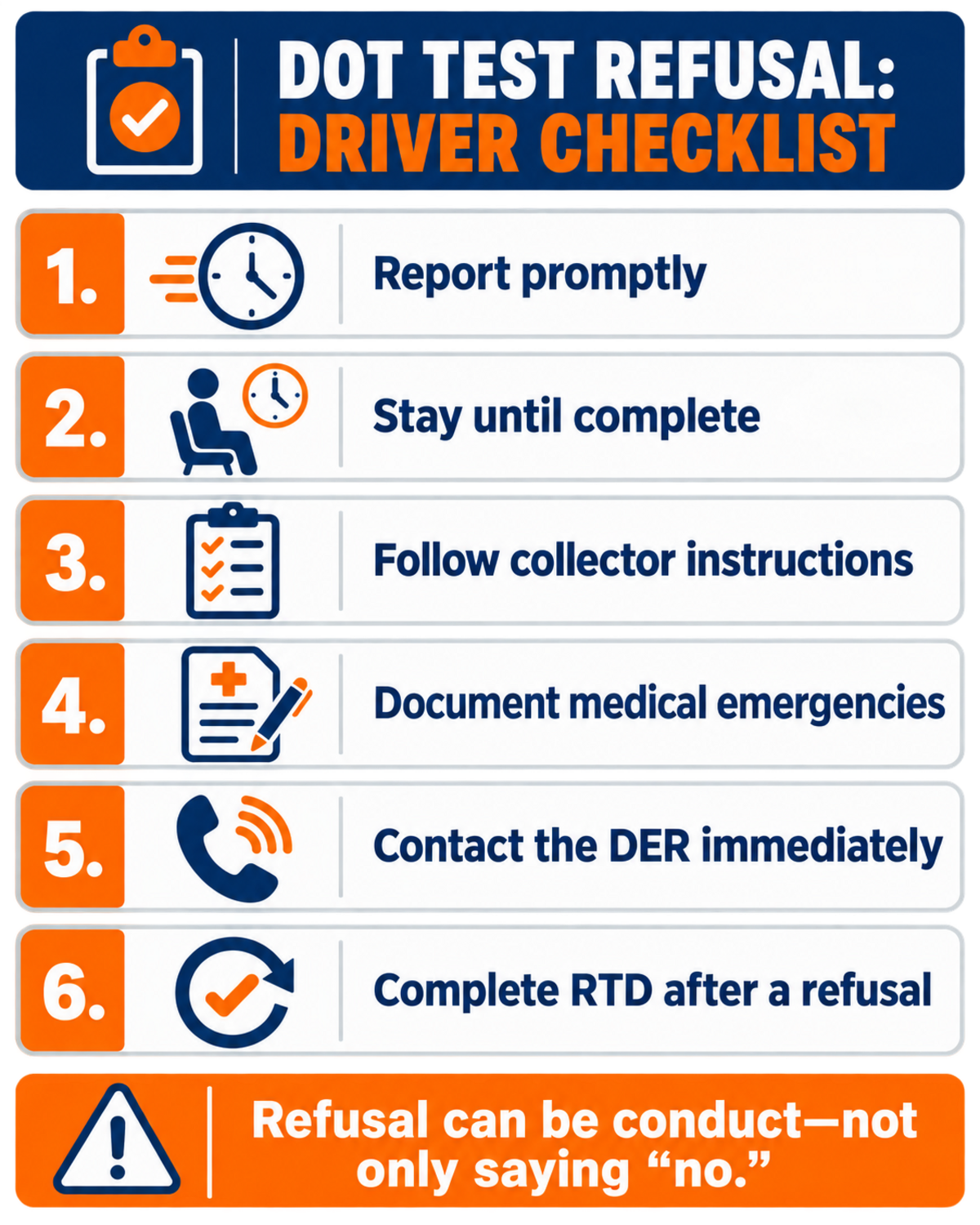
The word “refusal” can be misleading because several listed events do not involve an express verbal refusal. A driver may intend to cooperate but still create a refusal issue by leaving early, delaying without a legitimate reason, failing to follow an observed-collection instruction, or missing a required medical evaluation. The practical rule is simple: report promptly, listen carefully, remain at the site, communicate any genuine problem immediately, and do not improvise a different procedure.
| Situation | Possible DOT outcome | Best immediate action |
|---|---|---|
| Driver says “I will not test” | Refusal | Understand that declining a required test has violation consequences |
| Driver leaves before completion | Employer may determine a refusal, subject to the pre-employment exception | Stay until the collector says the process is complete |
| Driver cannot provide enough specimen | Not automatically a refusal; regulated insufficient-specimen procedures apply | Follow the wait, retry, and medical-evaluation directions |
| Specimen is verified adulterated or substituted | MRO reports a refusal | Respond promptly to the MRO and use the split-specimen rights provided by Part 40 |
| Driver refuses a non-DOT test or non-DOT form | Not a DOT refusal | Confirm whether the collection and form are DOT or company-policy materials |
Conduct That Can Count as a Drug-Test Refusal
Failing to appear within a reasonable time
For a required test other than the specific pre-employment exception, failing to report within a reasonable time after the employer’s direction can be a refusal. “Reasonable time” is not one universal number for every location and circumstance. The employer makes the timing decision consistently with the applicable DOT agency rule. Once notified, the driver should proceed immediately and safely, without unnecessary stops or detours.
If the driver receives an order based on a supervisor’s observations, the separate reasonable-suspicion testing guide explains that trigger. A disagreement with the reason for testing does not authorize a no-show. U.S. DOT’s employee guidance recommends the practical approach “comply, then complain.”
Leaving before the collection is complete
A driver should not assume that providing a specimen ends the process. The collector may need to check temperature, complete the custody and control form, arrange an observed recollection, or give further instructions. Leaving before the collector releases the driver can create a refusal determination. The collector is not required to warn the driver that leaving will be considered a refusal.
Failing to provide a required specimen
Simply being unable to provide enough specimen on the first attempt is not automatically a refusal. Refusing to make another required attempt, leaving during the regulated waiting period, or failing to attend a directed medical evaluation can become a refusal. A legitimate inability must be handled through the Part 40 procedure—not by going home, visiting a personal doctor independently, or bringing a specimen from somewhere else.
Not permitting direct observation or monitoring
Some DOT drug collections must be directly observed or monitored. Return-to-duty and follow-up drug tests are directly observed, and other circumstances can require an observed recollection. Refusing to permit required observation, failing to follow the observer’s clothing and device-check instructions for urine collection, or possessing a device intended to interfere with collection can be a refusal.
Failing to cooperate
Part 40 lists examples such as refusing to empty pockets, failing to wash hands when directed, refusing an oral-cavity inspection or rinse when applicable, or behaving in a confrontational way that disrupts collection. A driver may ask a calm clarifying question, but should not obstruct the procedure, threaten personnel, handle collection materials without permission, or ignore repeated lawful instructions.
Adulterated or substituted results
If the Medical Review Officer verifies an adulterated or substituted specimen, the result is a refusal. The employer must remove the driver from safety-sensitive duties on the initial report and must not wait for a written report or split-specimen testing before acting. A driver contacted by the MRO should respond promptly, provide relevant legitimate information securely, and follow the formal split-specimen process rather than trying to replace the DOT result with a private test.
| Refusal category | Typical evidence | Decision pathway |
|---|---|---|
| No-show or unreasonable delay | Notification time, directions, arrival records, communications | Employer evaluates the facts |
| Leaving or failure to cooperate | Collector remarks, CCF or ATF, witness and driver information | Employer generally makes the final refusal decision |
| No adequate medical basis for insufficient specimen | Referral-physician evaluation and MRO review | MRO reports the applicable refusal determination |
| Verified adulterated or substituted specimen | Laboratory result and MRO verification | MRO reports a refusal |
| Alcohol-testing conduct | ATF remarks, BAT or STT report, medical evaluation when applicable | Role depends on the event; the employer decides specified conduct-based cases |
Who Decides Whether a CDL Driver Refused?
The collector documents what happened but does not make every final refusal decision. Under , determining whether collection-site conduct constitutes a refusal is generally a non-delegable duty of the actual employer. The employer should review the form, collector information, service-agent advice, and relevant information supplied by the driver, then document the decision and its reasoning.
The MRO has specific responsibilities for drug-test refusals involving verified adulterated or substituted results and insufficient-specimen medical determinations. Alcohol technicians and evaluating physicians document and report the events assigned to them, but the employer retains the final decision for specified conduct-based alcohol cases. A C/TPA may advise the employer; limited exceptions apply when it schedules a test for an owner-operator or another self-employed individual.
Important distinction: a collector can document conduct that may constitute a refusal without being the person who makes the final regulatory determination. Drivers and employers should identify the exact refusal basis and decision-maker instead of relying on an informal label.
Pre-Employment Testing Has Narrow Exceptions
Part 40 does not treat failure to appear for a pre-employment test as a DOT refusal. It also provides that leaving before the collection process commences is not a refusal in the specified pre-employment situation. An employer can still decline to hire the applicant under its lawful hiring policy; the distinction is that the event is not automatically recorded as a DOT refusal.
Once a pre-employment collection has commenced, leaving before completion can create a refusal issue. A directed medical evaluation tied to a pre-employment test can also result in a refusal when the test followed a contingent offer of employment. Drivers comparing the onboarding stage can review the DOT pre-employment drug-test checklist.
| Pre-employment event | DOT refusal? | Employment impact |
|---|---|---|
| Applicant never appears for the pre-employment test | Not a Part 40 refusal on that basis | Employer may stop the hiring process |
| Applicant leaves before the collection process commences | Not a refusal under the stated Part 40 exception | Employer may still decline employment |
| Applicant leaves after collection has commenced | Can support a refusal determination | Employer evaluates the regulatory facts and hiring status |
| Applicant fails a directed medical evaluation after a contingent offer | Can be a refusal under the applicable procedure | Safety-sensitive work remains prohibited if a refusal is established |
“Shy Bladder,” Dry Mouth, and Insufficient Breath
Insufficient urine or oral fluid
requires another opportunity when the employee does not initially provide enough specimen. For a continuing urine collection, the collector urges up to 40 ounces of fluid distributed reasonably over up to three hours; declining the fluid itself is not a refusal. The employee must remain at the site and make the required attempt. For a continuing oral-fluid collection, the rule provides a monitored wait process of up to one hour and permits up to eight ounces of fluid in the specified circumstances.
If the final authorized collection method still produces an insufficient specimen, the DER—after consulting the MRO—directs the driver to obtain an evaluation from an acceptable licensed physician within five days. The physician evaluates whether a qualifying medical condition could have prevented sufficient specimen production. Unsupported “situational anxiety” or dehydration alone is not the medical basis described in the rule.
Insufficient breath for an alcohol test
The alcohol technician gives the employee another opportunity and explains the proper technique. If attempts remain insufficient, the employer directs the required physician evaluation. Refusing to make the attempt or failing to attend the evaluation can be a refusal. A physician’s conclusion that there is no adequate medical explanation also leads to the prescribed refusal outcome.
What if There Is a Medical Emergency or Collection-Site Problem?
A real emergency matters, but silence and disappearance make the record harder to evaluate. If illness, injury, police involvement, a family emergency, a vehicle breakdown, or another serious event prevents arrival or completion, the driver should contact the DER immediately, follow the safest instruction available, and preserve objective records such as EMS, hospital, police, towing, dispatch, or timestamped communication documents.
U.S. DOT’s refusal Q&A instructs employers to consider supporting information supplied by the employee when reviewing a possible collection-site refusal. This does not guarantee the employer will find a legitimate reason, but it shows why timely, accurate documentation is more useful than an unsupported explanation days later.
For procedural concerns, the driver should avoid signing any inaccurate narrative as if it were true, but should not obstruct the test. Note the concern on the appropriate employee copy when possible, identify witnesses, contact the DER, and complete the procedure unless a qualified testing professional gives different instructions. A negative private test cannot overturn or replace a valid DOT refusal determination.
What Happens After a DOT Refusal?
FMCSA requires immediate removal from safety-sensitive functions. The driver may not operate a CMV or perform other covered duties until completing the DOT return-to-duty requirements. The employer must provide information about qualified Substance Abuse Professional services, even if the company terminates the driver.
For an FMCSA-regulated CDL or CLP holder, reportable refusals appear in the Drug and Alcohol Clearinghouse and produce prohibited status. The record can exist even if the driver never registered for a Clearinghouse account. Since November 18, 2024, state licensing agencies use Clearinghouse status in specified CDL and CLP actions, including downgrading commercial driving privileges while a driver remains prohibited.
The next regulated pathway is explained in the separate DOT return-to-duty guide: qualified SAP evaluation, prescribed education or treatment, follow-up SAP evaluation, the directly observed RTD test, and an unannounced follow-up testing plan. Completion creates eligibility to resume safety-sensitive work; it does not require an employer to rehire or reinstate the driver.
| After a confirmed refusal | Required action | Not a valid substitute |
|---|---|---|
| Safety-sensitive duties | Stop immediately | Driving for another carrier while prohibited |
| SAP process | Use a qualified DOT SAP and complete the prescribed steps | General counseling without the regulated SAP process |
| RTD test | Employer-authorized, directly observed DOT test after SAP eligibility | Home test, private lab result, or ordinary pre-employment test |
| Clearinghouse | Verify accurate reporting and later RTD status | Paying someone to delete or fabricate a record |
| Future work | Meet employer, qualification, and follow-up requirements | Assuming a negative RTD result guarantees a job |
How Drivers Should Respond to a Possible Refusal
- Stop safety-sensitive work if directed. Do not continue driving while the employer evaluates or reports a confirmed violation.
- Ask for the exact basis. Identify whether the issue is no-show, delay, leaving, insufficient specimen, failure to cooperate, observation, adulteration, substitution, or alcohol-test conduct.
- Identify the decision-maker. Determine whether the employer, MRO, BAT/STT, physician, or limited C/TPA exception applies.
- Preserve contemporaneous records. Keep the employee form copy, messages, call logs, medical or emergency documents, location records, and names of relevant personnel.
- Respond quickly and factually. Give the DER or MRO accurate information without exaggeration, threats, or social-media posts.
- Review the Clearinghouse record. A driver can use the formal Clearinghouse process to view reported information and submit a DataQs request when appropriate.
- Begin RTD promptly if the refusal stands. Do not pay a third party for a promised deletion, fake negative result, or guaranteed clearance.
DOT Test Refusal Prevention Checklist for CDL Drivers
- □ I will confirm the employer, DOT agency, and reason for the test
- □ I will report immediately and safely after notification
- □ I will tell the DER promptly about any genuine delay or emergency
- □ I will bring valid identification and follow collection-site directions
- □ I will remain at the site until the collector releases me
- □ I will cooperate with required pocket, handwashing, oral-cavity, and form procedures
- □ I will follow lawful direct-observation or monitoring instructions
- □ I will not bring or use any device or substance intended to affect the specimen
- □ I will complete every required second attempt or medical evaluation
- □ I will keep my employee copy and document unusual events immediately
- □ I will answer legitimate MRO contact promptly and securely
- □ I understand that a non-DOT test cannot replace or reverse a DOT result
- □ I will stop safety-sensitive work if a refusal is confirmed
- □ I will use only a qualified SAP and the regulated RTD process
Frequently Asked Questions
Is being unable to urinate automatically a DOT drug-test refusal?
No. An initial insufficient specimen triggers the regulated procedure, including another opportunity and, if still insufficient, a directed medical evaluation. Refusing the required attempt, leaving early, missing the evaluation, or having no adequate medical explanation can lead to a refusal.
Who decides that leaving a DOT collection site was a refusal?
The collector documents the event, but the actual employer generally has the non-delegable duty to decide whether collection-site conduct constitutes a refusal. Limited exceptions apply, and the MRO decides specified medical, adulterated, or substituted drug-test matters.
Is missing a pre-employment DOT drug test a refusal?
Failure to appear for a pre-employment test is not a Part 40 refusal on that basis. The employer may still end the hiring process. Leaving after the collection begins or failing certain post-offer medical-evaluation requirements can create a different refusal issue.
Can a negative private drug test remove a DOT refusal?
No. A private or non-DOT test does not change a DOT refusal. If the refusal stands, the driver must complete the qualified SAP and return-to-duty process before resuming DOT safety-sensitive functions.
Educational information only, not legal, medical, or employment advice. Testing methods, employer procedures, and agency guidance can change. Official U.S. DOT and FMCSA sources reviewed August 20, 2026; the U.S. DOT Part 40 index was updated May 15, 2026.