

CDL drivers can request their own DOT drug and alcohol testing records, but the right source depends on the document. An employer may hold test-result and program records, an MRO or other service agent may hold detailed test files, and the FMCSA Clearinghouse holds specified violation and return-to-duty information. These systems overlap, but they are not interchangeable.
This guide explains where to request records, what a useful written request should include, how federal retention periods work, which information remains confidential, and how to respond when a document or Clearinghouse entry appears inaccurate.

Can a CDL Driver Get Copies of DOT Testing Records?
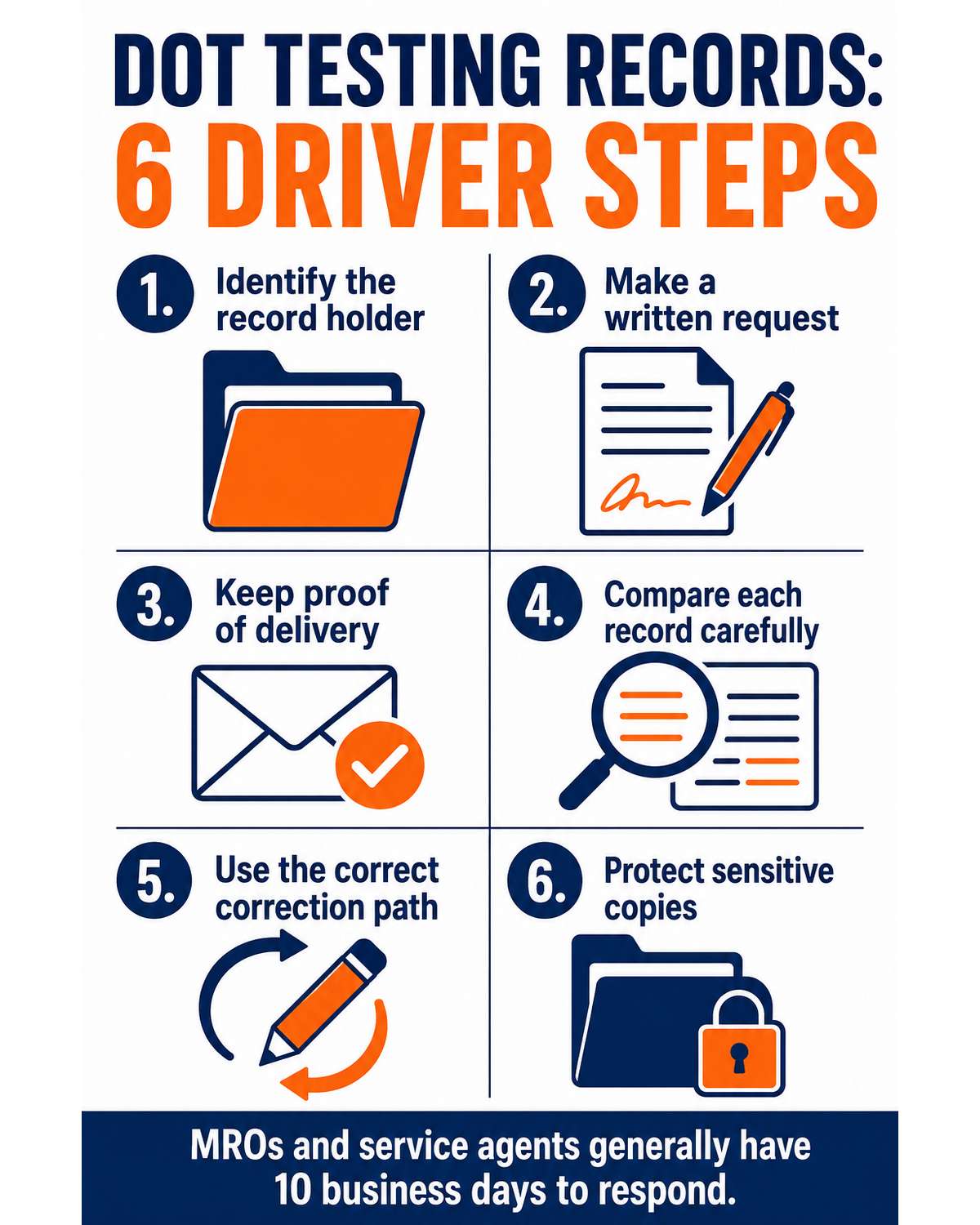
Yes. requires MROs and other service agents to provide an employee, within 10 business days after a written request, copies of records concerning that employee's alcohol or drug use, including DOT-mandated test records. A laboratory must provide the employee's drug-test laboratory report and data package through the MRO. A SAP must provide the employee's SAP reports on request, but must redact follow-up testing information before release.
An employer also has employee-access obligations under the FMCSA rules and Part 40. The practical first step is not to send one vague message to every organization. Identify the record, identify who created or retains it, and send a specific written request to that party.
| Record holder | Records commonly available | How the driver requests them |
|---|---|---|
| Current or former employer / DER | Employer copy of results, test reason, notices, refusal documentation, SAP and follow-up records held by the employer | Written request identifying the driver, dates, test type, and requested documents |
| Medical Review Officer | CCF-related records, laboratory result, verification materials, MRO notes and communications that may be released | Written request directly to the MRO |
| Laboratory | Laboratory report and supporting data package for the employee's drug test | Written request made through the MRO |
| Substance Abuse Professional | SAP evaluation and compliance reports | Request the reports from the SAP; follow-up schedule details are redacted |
| FMCSA Clearinghouse | Reported violations, RTD status information, follow-up completion, and query history available to the driver | Register, verify CDL information, and open the driver's own record online |
Important: a Clearinghouse screen is not the complete test file. It does not replace the CCF, MRO documentation, laboratory data, employer notices, or SAP reports.
Understand the Record Map Before You Request Anything
DOT testing produces documents at several stages. The collector creates and distributes the Federal Drug Testing Custody and Control Form for a drug test or the Alcohol Testing Form for an alcohol test. The laboratory analyzes a drug specimen. The MRO reviews and verifies drug results. The employer receives the result it is authorized to receive and makes specified workplace decisions. A SAP creates reports only if a violation leads into the return-to-duty process.
The FMCSA Clearinghouse is a reporting database for CDL and CLP holders covered by Part 382. It contains specified violations and RTD milestones, not every negative test or every page created during collection. Drivers comparing a pre-hire test with a records query can review the separate DOT pre-employment testing guide.
DOT records are different from MVR and PSP data
A state motor vehicle record concerns licensing actions and convictions. An FMCSA PSP report concerns specified crash and roadside inspection history. A DOT drug-and-alcohol test file concerns workplace testing under Part 40 and the applicable DOT agency rule. A Clearinghouse record concerns FMCSA-reportable drug-and-alcohol violations and RTD status. Ordering one does not produce the others.
DOT and company-policy tests must remain separate
An employer may maintain a non-DOT testing policy in addition to its federal program. Part 40 requires separation between DOT and non-DOT testing. A driver reviewing a file should confirm the test authority, reason for test, form used, employer, collection date, and specimen type instead of assuming every workplace test belongs in the federal record.
How to Request Your DOT Drug or Alcohol Testing Records
A short, precise written request is usually more effective than a phone call. It creates a dated trail, helps the recipient locate the right file, and reduces the risk that the driver receives only a summary when the underlying documents were requested.
Step 1: identify the test and record holder
Write down the employer name, approximate collection date, testing location, test reason, specimen or alcohol-test type, and the MRO or service agent if known. If several tests occurred, list each date or date range separately. Do not send full identity documents to an unverified email address.
Step 2: make a specific written request
State that you are requesting records pertaining to your own DOT-mandated drug or alcohol test. Name the documents you want, provide enough identifying information to locate them, and give a secure delivery method. Ask the recipient to confirm receipt. Keep the message, delivery confirmation, and response together.
Step 3: use the correct route for laboratory data
Under Section 40.329, the laboratory data request goes through the MRO. The MRO or service agent may charge no more than the cost of preparation and reproduction. A driver should ask about any copying charge and secure delivery method before sending payment or sensitive information.
Step 4: track the 10-business-day service-agent deadline
MROs and other service agents must provide covered records within 10 business days after receiving the written request. The same timeframe applies to a laboratory request made through the MRO. Record the delivery date rather than counting from the day the message was drafted.
| Include in the request | Why it helps | Avoid |
|---|---|---|
| Full legal name used for the test | Connects the request to the correct file | Sending a Social Security number through ordinary email |
| Employer and approximate test date | Narrows the search | Writing only “send all my records” |
| Test reason and specimen type, if known | Distinguishes pre-employment, random, post-accident, RTD, or follow-up records | Guessing when the test authority is uncertain |
| Exact document list | Clarifies whether you want a result, CCF, notes, report, or data package | Assuming a Clearinghouse printout contains the full file |
| Secure contact and delivery method | Protects confidential information | Posting records or identifiers publicly |
| Dated signature when required | Authenticates the request or consent | Signing a broad release without identifying the recipient and purpose |
Which Documents Should a CDL Driver Request?
The right list depends on the issue. A driver confirming a negative pre-employment result may need only the employer or MRO result record. A driver reviewing a refusal determination may need the CCF or ATF remarks, collector or technician documentation, employer decision record, MRO materials, and any medical-evaluation documents permitted for release. The DOT test-refusal guide explains how the decision-maker changes with the event.
| Question the driver is trying to answer | Useful records | Likely source |
|---|---|---|
| Was the correct test and reason recorded? | CCF or ATF, employer order, result notice | Employer, collector, MRO, or alcohol-testing service |
| How was a drug result verified? | Laboratory report, MRO verification record, permitted notes or communications | MRO; laboratory package through the MRO |
| Why was conduct treated as a refusal? | Form remarks, incident documentation, employer decision, MRO or physician materials when applicable | Employer, MRO, collector, or evaluating physician as assigned by the rule |
| What did the SAP report? | Initial and follow-up SAP reports | SAP, with follow-up schedule details redacted from the employee copy |
| What is in the federal CDL database? | Driver's Clearinghouse record and query history | FMCSA Clearinghouse account |
| Has the follow-up plan been reported complete? | Employer completion record and Clearinghouse status | Employer or C/TPA and Clearinghouse |
Request the smallest complete set that answers the question. Collecting every available page can create noise and increase privacy risk. At the same time, a one-line result notice may be insufficient when the dispute concerns identity, test reason, dates, collection remarks, or the basis for a refusal.
How Long Are DOT Testing Records Retained?
sets employer retention periods for core DOT testing records. Additional FMCSA-specific requirements can apply, and a lawful investigation or proceeding may require preservation beyond the ordinary schedule. Drivers should request needed records promptly instead of waiting until the shortest retention period is nearly over.
| Part 40 record category | Minimum employer retention | Examples |
|---|---|---|
| Serious result and RTD records | 5 years | Alcohol results of 0.02 or greater, verified positive drug results, refusals, SAP reports, follow-up tests and schedules |
| Prior-employer information obtained under Section 40.25 | 3 years | Required testing history received for a new safety-sensitive employee |
| EBT inspection, maintenance, and calibration records | 2 years | Records supporting evidential breath-testing equipment |
| Negative or cancelled drug results and alcohol results below 0.02 | 1 year | Routine negative, cancelled, and sub-0.02 result records |
A retention period tells the employer how long a covered record must be kept; it does not tell a driver that every document will automatically be mailed, that all records are stored by one party, or that the Clearinghouse will remove a reported violation on the same date.
Clearinghouse retention uses a separate rule
FMCSA states that a CDL driver violation record remains available in the Clearinghouse for five years from the violation determination or until the driver successfully completes the RTD process and follow-up testing plan, whichever is later. The database can therefore retain an unresolved violation longer than five years.
Who Can Receive DOT Testing Information?
DOT testing information is confidential, but confidentiality does not mean the records can never be released. requires release in specified circumstances, including when an employee gives specific written consent identifying the recipient. Employers and service agents must also provide records to authorized DOT representatives and in other situations defined by federal rules.
A new FMCSA-regulated employer uses the Clearinghouse for the required FMCSA drug-and-alcohol history query. Detailed Clearinghouse information requires the applicable driver consent. Other DOT-mode history may still use the Part 40 prior-employer process. A driver who refuses required consent cannot be permitted to begin the covered safety-sensitive functions addressed by that investigation.
Use a narrow, specific consent
A useful consent identifies the records, the person or organization authorized to release them, the identified recipient, and the purpose or applicable period. It should not be an open-ended permission to post or redistribute sensitive information. Drivers should retain the signed consent and the records actually released.
How to Review and Correct a Clearinghouse Record
Registered drivers can access their own Clearinghouse record electronically at no cost after verifying CDL or CLP information. The record may show reported violations, SAP milestones, a negative RTD result, and completion of a follow-up plan. The separate FMCSA Clearinghouse guide explains registration, employer queries, consent, and prohibited status.
Compare the displayed record with the underlying documents. Check the driver identity, CDL number and issuing state, employer or reporting party, violation category, date, RTD milestones, and follow-up completion. A mismatch should be documented with screenshots or downloads stored securely and the source records that support the correct value.
Accuracy challenge versus test-result dispute
FMCSA's current FAQ distinguishes these paths. A petition under 49 CFR 382.717 may challenge the accuracy of information reported to the Clearinghouse. It is not the process for relitigating the scientific accuracy or validity of a test result or refusal. FMCSA also describes Privacy Act procedures for drivers seeking correction of test-result, refusal, or other violation information. The applicable route depends on what is allegedly wrong.
Examples of report-accuracy issues can include the wrong driver identity, an incorrect date, duplicate reporting, a violation reported by a party without the required basis, or an RTD milestone that was completed but not recorded. A disagreement with a verified laboratory result is different and may involve time-sensitive Part 40 procedures, such as MRO review and split-specimen rights. A private test taken later does not automatically invalidate the DOT result.
A Practical Process When Records Do Not Match
- Define the discrepancy. Write one factual sentence: which field, document, date, or status appears wrong.
- Preserve the current record. Save the document, screenshot, correspondence, and date accessed.
- Request the underlying file. Obtain the employer, MRO, laboratory-through-MRO, SAP, or service-agent record needed to verify the fact.
- Build a short timeline. List notification, collection, MRO contact, result, employer action, SAP activity, RTD test, and follow-up completion dates that apply.
- Identify the correct correction channel. A typo, missing RTD milestone, refusal decision, and laboratory-result challenge are not handled the same way.
- Submit evidence, not conclusions. Attach the smallest set of documents that proves the requested correction and keep proof of submission.
- Recheck the record. Confirm that the correction appears and that no duplicate or new mismatch was introduced.
Do not edit forms, create replacement test paperwork, or ask an unauthorized person to change a federal database entry. False records can create additional legal and employment consequences. If the issue affects current work eligibility, a deadline, or litigation, obtain advice from a qualified professional familiar with DOT testing law.
CDL Driver Testing-Records Checklist
- □ I identified whether I need an employer, MRO, laboratory, SAP, service-agent, or Clearinghouse record
- □ I listed the employer, approximate date, test reason, and specimen type
- □ I made the request in writing and named the exact documents
- □ I used the MRO route for a laboratory report or data package
- □ I kept proof showing when the recipient received my request
- □ I tracked the 10-business-day deadline when Section 40.329 applies
- □ I used a secure delivery method for confidential records
- □ I separated DOT records from company-policy test records
- □ I compared identity, dates, employer, test reason, and outcome across documents
- □ I reviewed my own Clearinghouse record and query history
- □ I distinguished a factual reporting error from a test-result or refusal dispute
- □ I preserved screenshots, correspondence, and supporting documents
- □ I used the correction route that matches the disputed information
- □ I stored the final records securely and limited unnecessary sharing
Prepare for the Road with Patriot CDL
Accurate records support compliance, but safe commercial driving also requires vehicle knowledge and hands-on practice. Patriot CDL provides focused Class A and Class B instruction for eligible students preparing to build inspection, backing, road-driving, and job-ready skills. Contact Patriot CDL to discuss enrollment and available training options.
Frequently Asked Questions
How long does an MRO have to provide a CDL driver’s DOT testing records?
Under 49 CFR 40.329, an MRO or other service agent must provide covered records within 10 business days after receiving the employee's written request. Laboratory records are requested through the MRO.
Can a CDL driver see personal Clearinghouse information for free?
Yes. A registered driver who verifies CDL or CLP information can access the driver's own Clearinghouse record electronically at no cost.
How long are negative DOT drug-test results retained?
Part 40 requires an employer to retain negative and cancelled drug-test results for at least one year. Other related records or legal preservation duties may have different periods.
Can a driver remove an incorrect Clearinghouse violation?
A driver can seek correction, but the process depends on the issue. A Section 382.717 petition challenges accuracy of reported information, not the scientific accuracy or validity of a test result or refusal. FMCSA provides separate Privacy Act correction guidance for those disputes.
Educational information only, not legal, medical, or employment advice. Record rights, retention requirements, and correction procedures can change. Official U.S. DOT and FMCSA Clearinghouse sources reviewed August 22, 2026.