

Ready to hit the road as a professional driver? Getting your CDL isn't just a single test; it's a journey with a few key milestones. You'll start with the basics, prove your knowledge to get a learner's permit, get some real-world practice behind the wheel, and then pass a final skills test.
This whole process is designed to make sure you're not just a driver, but a safe and knowledgeable professional. Let's break down what that journey looks like.
Your Roadmap to a Commercial Driver's License
Think of getting your CDL as a multi-stage adventure. It all begins with ticking a few boxes to make sure you're eligible. Before you can even think about turning a key, you'll need to meet the basic requirements.
This means being the right age, holding a standard driver's license, and having a driving record that's in good shape. The first major hurdle for many is passing the Department of Transportation (DOT) physical exam. This is a mandatory medical check-up to ensure you're fit for the job—it's a critical first step that every single aspiring driver has to clear.
The Major Milestones on Your CDL Journey
Once the initial paperwork and physical are out of the way, your real training begins. The first stop is getting your Commercial Learner's Permit (CLP). To do this, you'll head to your local DMV and take a few written exams.
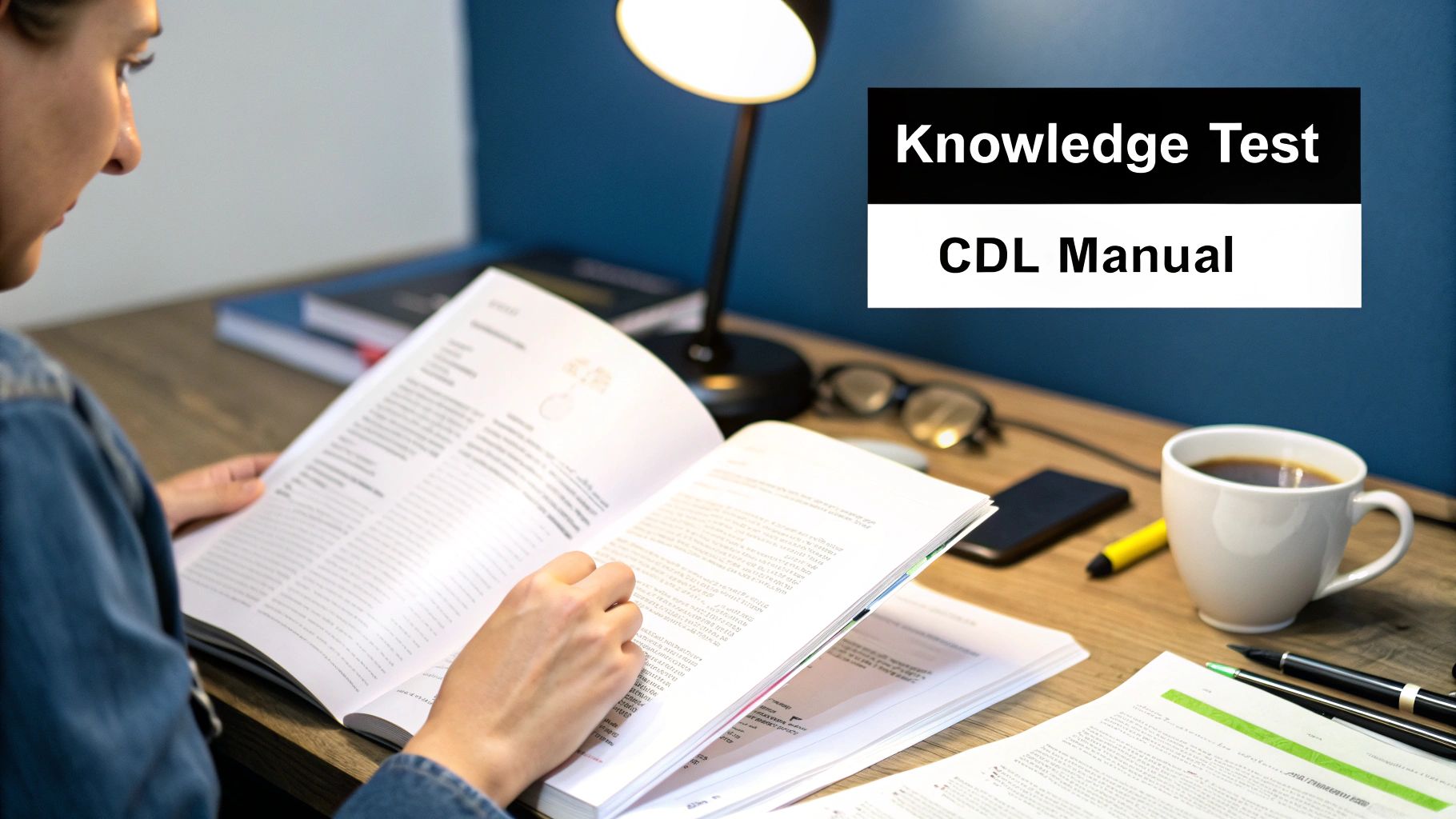
These tests cover the essentials: general knowledge about trucking, how air brakes work, and—if you're going for a Class A CDL—the specifics of combination vehicles. My best advice? Treat your state's CDL manual like your bible. It has everything you need to pass.
After you have that CLP in your pocket, you can finally get behind the wheel for your hands-on training, as long as a licensed CDL holder is in the passenger seat. This is where it all comes together—you'll learn how to actually maneuver the truck, conduct a proper pre-trip inspection, and handle the vehicle on the road.
Each step on this path is there for a reason. You build from foundational knowledge in the manual to practical skills on the road, ensuring you're fully prepared and confident when it's time for your final test.
Before we dive deeper, it helps to know which license you're even aiming for.
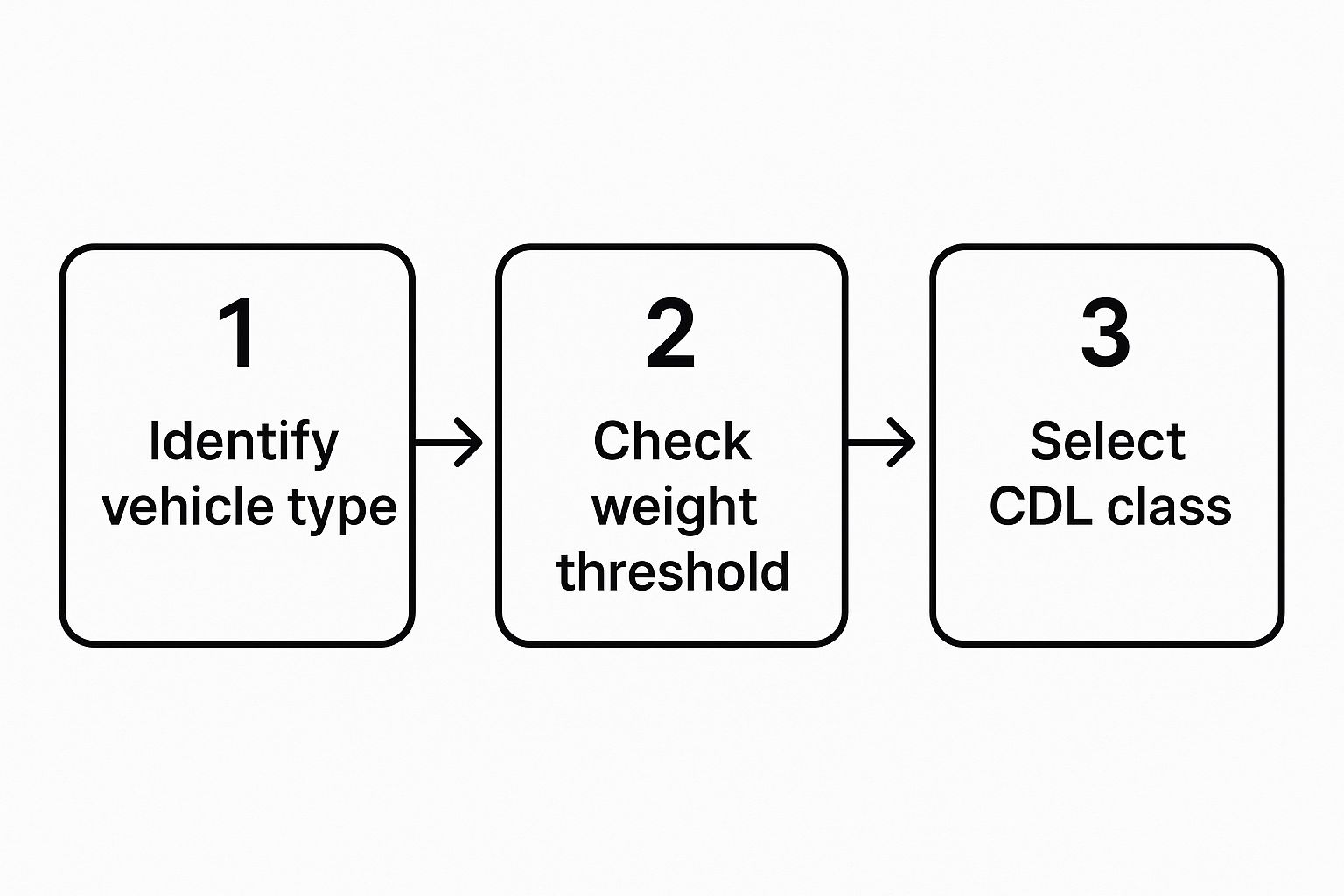
As you can see, it really comes down to the type of vehicle and its weight. This decision determines whether you'll need a Class A, B, or C license and shapes your entire training path.
CDL License Classifications and What They Mean
The world of commercial driving isn't one-size-fits-all. The type of license you get dictates the kind of rig you can operate. Understanding these classifications is the first step in aligning your career goals with the right credentials.
| CDL Class | Vehicle Type (GVWR) | Common Examples |
|---|---|---|
| Class A | Any combination of vehicles with a GVWR of 26,001 lbs. or more, where the towed vehicle is over 10,000 lbs. | Tractor-trailers (semis), tanker trucks, flatbeds, livestock carriers. |
| Class B | A single vehicle with a GVWR of 26,001 lbs. or more, or towing a vehicle not in excess of 10,000 lbs. | Straight trucks, large buses (school, city, tour), dump trucks, garbage trucks. |
| Class C | A single vehicle with a GVWR of less than 26,001 lbs. or a vehicle towing another vehicle not in excess of 10,000 lbs. | Passenger vans (16+ passengers), small HazMat vehicles, shuttle buses. |
Choosing the right class is fundamental. A Class A license, for instance, is the most versatile and allows you to operate Class B and C vehicles as well, giving you the widest range of job opportunities.
After all the training, it comes down to the final exam. This is a three-part skills test where you'll have to perform a full pre-trip vehicle inspection, nail some basic control skills (like backing up), and finally, pass an on-road driving test.
Getting Your Ducks in a Row: The First CDL Hurdles
Before you even crack open a CDL manual or start thinking about the written test, there are some essential boxes you have to check. These aren't just suggestions; they're the non-negotiable requirements set by federal and state law. Getting this initial paperwork and screening out of the way first saves you from frustrating dead ends later on.
It all starts with your regular driver's license. You’ll need a valid, non-commercial driver's license from your home state to even begin the process. This just shows you have a baseline understanding of the rules of the road.
Your driving record also needs to be in decent shape. A minor speeding ticket from five years ago probably won't be an issue, but recent, major violations—think DUIs, reckless driving, or a license suspension—can stop you in your tracks before you even start.
Age and Identity: The First Gatekeepers
The first thing the DMV will look at is your age. The rules here are pretty black and white, and they hinge entirely on where you plan to drive.
- Intrastate (In-State) Driving: If you only plan to operate a commercial vehicle within your state's borders, the federal minimum age is 18.
- Interstate (Crossing State Lines) Driving: To drive across state lines, which is what most over-the-road trucking jobs demand, you absolutely must be at least 21 years old.
This age difference is a big deal. If you get your CDL at 19, you’re stuck with local or regional jobs until your 21st birthday. For instance, a 20-year-old in Texas could legally drive a dump truck from Dallas to Houston, but they couldn't take that same truck on a run to Shreveport, Louisiana.
You'll also need to prove your identity and your legal right to work in the U.S. This means bringing documents like your Social Security card and proof of citizenship or lawful residency—think a U.S. birth certificate, a valid passport, or a Green Card.
The Make-or-Break DOT Physical Exam
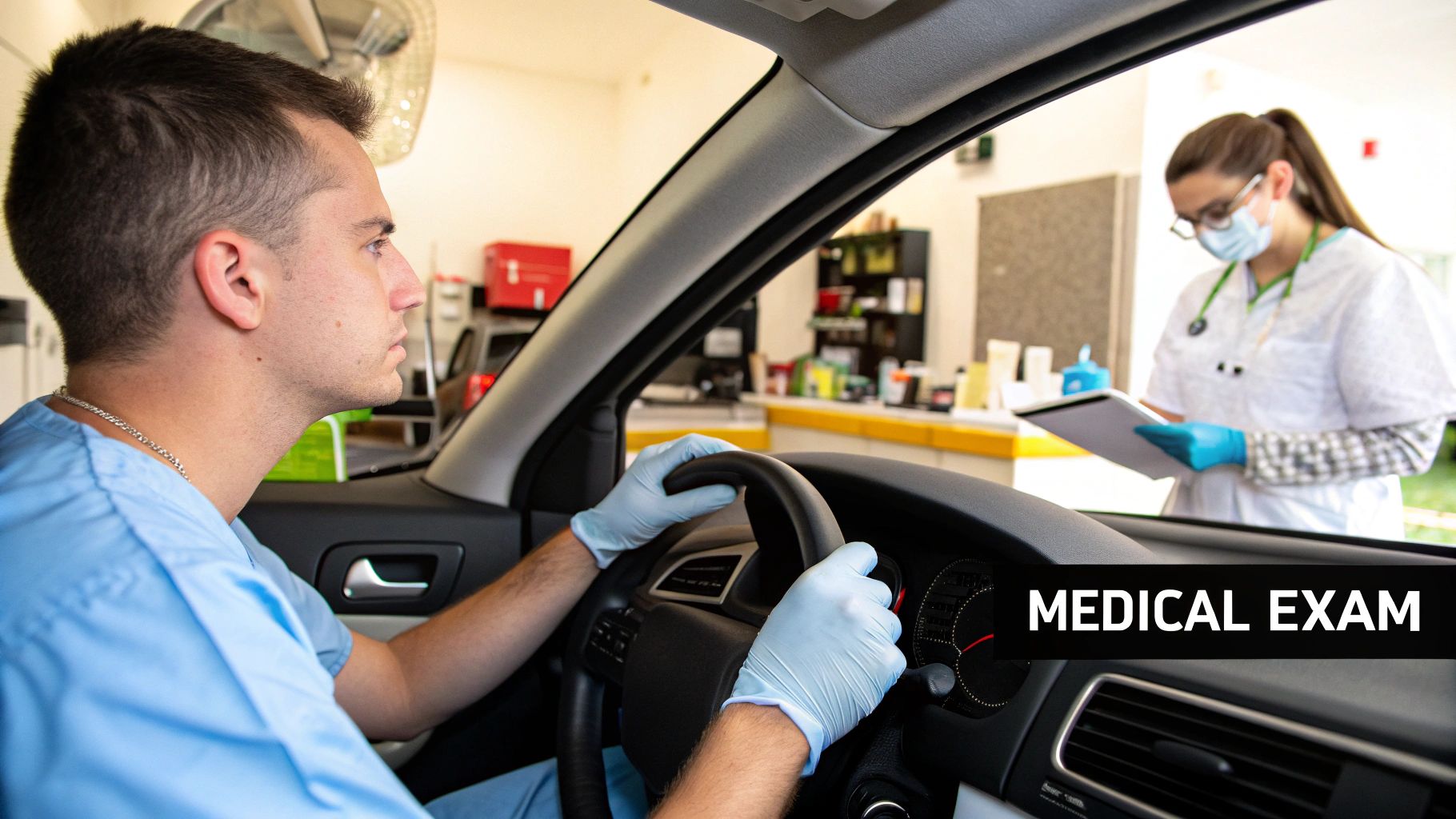
Here’s probably the biggest hurdle in this first phase: the Department of Transportation (DOT) physical. This isn't your typical annual check-up. It's a thorough medical exam performed by a certified medical examiner who is specifically listed on the FMCSA National Registry.
The whole point is to confirm you're medically fit to safely handle a big rig for long hours. The examiner will dig into several key areas of your health.
What to Expect in the DOT Physical
- Vision and Hearing: Your vision needs to be at least 20/40 in each eye (glasses or contacts are fine), and you have to pass a basic hearing test.
- Blood Pressure: The magic number is under 140/90. If your blood pressure is higher, you might get a shorter-term medical card or, if it's uncontrolled, you could be disqualified.
- Urinalysis: This isn't a drug test. They’re checking for underlying health problems, like diabetes, by looking for sugar or protein in your urine.
- Physical Exam: The doctor will check your overall physical condition, listening to your heart and lungs and checking your spine and reflexes.
Some medical conditions can be automatic disqualifiers, such as uncontrolled high blood pressure, epilepsy, certain heart conditions, or vision and hearing loss that can't be corrected to meet the federal standard. If you have something like sleep apnea, be prepared to show proof that you're treating it, like data from your CPAP machine.
Passing the DOT physical is non-negotiable. You cannot even apply for your Commercial Learner's Permit (CLP) until you have a valid Medical Examiner's Certificate, which most people just call a "DOT medical card."
Once you pass, the examiner will give you your certificate. It's usually good for up to 24 months. To get the full picture, you can check out the complete list of CDL requirements to make sure you've covered all your bases. Clearing these initial steps is your first real win on the road to getting your CDL.
Getting Your Commercial Learner's Permit
Alright, you’ve cleared the initial hurdles and have your medical card. Now comes the first real test of your knowledge: earning your Commercial Learner's Permit (CLP).
Think of the CLP as your key to starting the engine. It’s what legally allows you to get behind the wheel on public roads and start your hands-on training, as long as a licensed CDL holder is riding shotgun. But you don't just get one—you have to earn it by passing a series of written exams at the DMV.
Don't underestimate these tests. They're designed to make sure you have the foundational knowledge every professional driver needs before they even touch a truck. Your best resource, without a doubt, is your state's official CDL manual. It's not just a suggestion; it's the textbook for the exam. Every question comes directly from that book.
What to Expect From the Written Tests
Everyone, regardless of the license they want, has to pass the General Knowledge test. It's the big one, covering everything from pre-trip inspections and vehicle control to handling slick roads and managing your space in traffic. Most states require a score of 80% or higher to pass.
After that, the specific tests you take will depend on the truck you plan to drive.
-
Air Brakes: You absolutely want to pass this one. The overwhelming majority of commercial trucks use air brakes, and failing this test gets you an "L" restriction on your license. That's a dealbreaker for most trucking jobs. You'll need to know the system's components, how to inspect them, and how they operate.
-
Combination Vehicles: This is non-negotiable if you're going for a Class A CDL. It covers the unique physics of driving a tractor-trailer—things like the "crack-the-whip" effect, how to couple and uncouple safely, and just how different it is to manage that extra length and weight.
Feeling a bit overwhelmed? That’s normal. The best approach is to tackle the manual one section at a time. Take plenty of practice tests to see where you're struggling before you go to the DMV. For a deeper dive, check out our guide on what to expect from the CDL permit tests.
Your Trip to the DMV
Preparation is everything when you walk into the DMV. Make a checklist and double-check it. You'll need your driver's license, proof of residency, Social Security card, and—this is crucial—your DOT Medical Examiner's Certificate.
Once they've accepted your paperwork and you pass a quick vision screening, you'll pay the fees and head to a computer for the tests. My best advice? Take your time. Read every question twice. Some are worded to be tricky, so make sure you understand what's being asked.
Passing your permit exams on the first try is a huge confidence booster. More importantly, it saves you time and the extra cost of retesting fees. The secret isn't a secret at all: just live in that CDL manual until you know it backward and forward.
Once you’ve successfully passed your written tests, you'll be handed your CLP. Take a moment to appreciate it! This is a huge step forward. You've proven you have the book smarts, and now you’re officially ready to move from the classroom to the cab.
Choosing the Right CDL Training Program
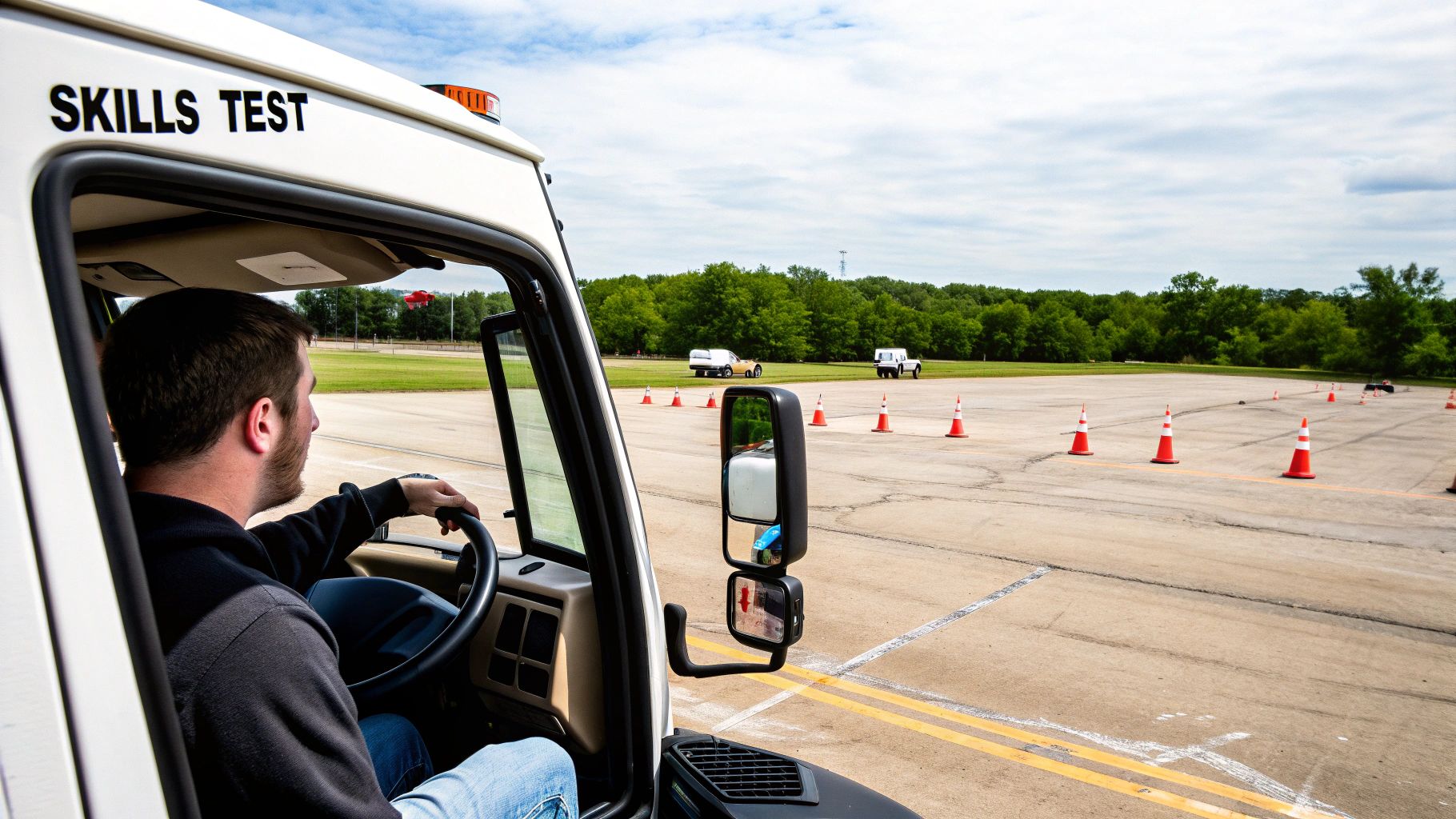
Alright, you’ve got your Commercial Learner's Permit. Congratulations. Now comes the big decision that will set the course for your entire trucking career: picking the right training program.
This isn't just about learning how to pass the test. It's an investment in your future. The right school will give you the skills and confidence to not just get a job, but to actually succeed in it. You'll see a lot of options out there—private truck driving schools, community college programs, and even trucking companies offering "free" training. Let's break down what each one really offers.
Comparing Your Training Options
At the end of the day, you've got three main roads you can go down. Each has its own set of pros and cons when it comes to cost, the time it takes, and what's expected of you.
- Professional Truck Driving Schools: These are the specialists. They're all-in on CDL training, and they move fast. You can often get licensed in just a few weeks, but this speed usually comes with a higher price tag.
- Community College Programs: A solid, often more affordable option. These programs are typically spread out over a full semester, which can be a lifesaver if you're trying to balance training with a job or family. Plus, financial aid might be available.
- Company-Sponsored Training: You’ve probably seen the ads. A carrier offers to pay for your training if you agree to work for them. It sounds great if you're short on cash, but you're signing a contract that locks you in. You really need to read the fine print on these deals.
The trucking industry is a massive part of our economy, projected to pull in $1.3 trillion in freight revenue in the U.S. by 2025. Yet, there's a huge driver shortage—we’re talking about 80,000 open positions nationwide as of early 2025. That's why so many companies are willing to sponsor training; they need to get drivers in seats.
Key Questions to Ask Any School
Before you sign on any dotted line, you need to do your homework. A good, honest school will have no problem answering your questions. Think of it as an interview—you’re interviewing them just as much as they’re sizing you up.
Start by asking about their instructor-to-student ratio. If it’s one instructor for every three or four students, you’ll get plenty of time behind the wheel. If it’s one instructor for a dozen students, you’ll spend most of your day waiting your turn.
Next, get a look at their equipment. Ask about the age and condition of their fleet. Are you learning on trucks that are actually on the road today, or are you stuck with a clunker from the 90s? The quality of their trucks often reflects the quality of their training.
Don't just find a program that teaches you how to pass the test. Find one that prepares you for the real world of trucking. Ask them what their curriculum covers beyond the basics. Do they teach you about logbooks, trip planning, and real-world defensive driving?
And finally, ask the big one: what are their job placement rates? Do they have real connections in the industry? A school worth its salt will be proud of where its graduates end up and should be able to tell you which companies regularly hire from their program.
A Closer Look at Company-Sponsored Training
The idea of getting your CDL for "free" is tempting, I get it. But let's be clear: nothing is truly free. Company-sponsored training is a recruitment strategy, plain and simple.
The biggest plus is obvious—you don't have to pay the $3,000 to $10,000 tuition that private schools charge. But there are always strings attached. You'll have to sign a contract to drive for that company for a year, maybe two. During that time, you'll likely earn a lower starting wage than a driver who walked in with their own CDL.
If you leave before your contract is up, guess what? You're on the hook for the full cost of the training, and sometimes they'll even tack on interest.
So, read every single word of that contract. Understand the pay, the kind of routes you'll be running, and exactly what happens if you break the agreement. It's a legitimate way to get into the industry, but it's a decision that dictates where you'll work for the first critical year of your career.
A top-notch school will make sure you're ready for every part of the skills test. The vehicle inspection is a huge piece of that puzzle, and you can get a head start by studying our complete guide to the CDL pre-trip inspection.
Passing the CDL Skills Test
Alright, this is the final hurdle: the three-part skills test. Everything you've learned in the classroom and behind the wheel comes down to this moment. It's easy to let nerves take over, but try to think of it as just showing the examiner what you already know. The whole point is to prove you can handle a commercial vehicle safely and confidently.
The entire test usually runs about two to two and a half hours. It's set up like a video game where you have to clear one level to get to the next. If you fail a section, the test stops right there, and you'll have to come back another day. The good news? If you pass a section, you get credit for it and won't have to do it again.
Nailing the Pre-Trip Inspection
The first part of the test is the pre-trip inspection, and honestly, this is where most people get tripped up. A shocking 8 out of 10 applicants who fail the skills test fail on this section. It’s not physically difficult, but it is a massive memory test performed under a lot of pressure.
You have to walk the examiner around the truck, pointing to, touching, and naming every critical part while explaining exactly what you're checking for. They aren't just looking for you to identify the alternator; they're listening for very specific phrases. For example, when checking hoses, you need to say they are “securely mounted, not cracked, cut, leaking, or bulging.” You’ll cover everything from the engine and coupling system to the full air brake assembly.
After the outside check, you'll jump inside for the In-Cab Inspection. This involves a safe start, a full sweep of your gauges, and the complete air brake system test. You have to prove you can check for leaks and that the low-pressure alarms and emergency brakes work as they should. Your school will give you a script for this—learn it by heart until you can recite it in your sleep.
Mastering Basic Control Skills
Once you get past the inspection, you'll move on to the basic control skills, which most people just call the yard maneuvers. This all happens in a closed-off area with cones and lines painted on the ground. Your job is to show you have complete control of the vehicle at slow speeds without touching a single cone.
The exact maneuvers can differ from state to state, but you can almost always count on these three:
- Straight-Line Backing: Sounds simple, right? But keeping a 53-foot trailer perfectly straight over 100 feet takes a ton of tiny, constant steering corrections.
- Offset Backing: Here, you’ll have to back your rig from one lane into an adjacent one, either to the left or right, staying within the lines the whole time.
- Alley Docking: This is the one that gives people the most trouble. It’s a 90-degree back where you have to put the trailer neatly into a space that simulates a real loading dock.
Examiners are watching how you judge your distance and whether you truly understand the trailer's pivot point. The secret is to go slow. Take your time and make small, deliberate moves. Remember, you’re allowed to get out and look (G.O.A.L.) a couple of times, so use those chances to your advantage.
Your performance on these maneuvers shows the examiner more than just your ability to park. It proves you understand the vehicle's dimensions and can place it exactly where it needs to go, which is a fundamental skill for any professional driver.
The On-Road Driving Test
Finally, it’s time for the on-road test. The examiner will join you in the cab and guide you through public roads and real-world traffic. This is your opportunity to show you can operate the truck safely and defensively when things are unpredictable. This is where all the book smarts you picked up early on come into play. If you need a quick refresher on those core principles, our guide on the CDL general knowledge test is a great resource.
During the drive, the examiner is scoring you on several key skills:
- Turns: They'll be watching to see if you can execute right and left turns correctly, getting into the proper lane and avoiding cutting corners or swinging out into oncoming traffic.
- Intersections: You’ll need to demonstrate how you approach and move through intersections, making sure you’re scanning for hazards and yielding when you’re supposed to.
- Lane Changes: Your ability to signal, check mirrors, and move the rig over smoothly without forcing other drivers to react is absolutely critical.
- Grades and Railroad Crossings: You'll have to show you can manage hills and follow the strict procedures required at all railroad crossings.
The best advice here is to stay calm and constantly check your mirrors. Use your signals to communicate your every move. It can even help to talk through what you're doing, like calling out a speed limit sign or pointing out a potential hazard. It shows the examiner you're aware and thinking ahead.
Your Top CDL Questions, Answered
Deciding to get your CDL is a big step, and it's natural to have questions. Thinking about the time commitment, the costs, and the rules of the road ahead of time can make the whole journey a lot less intimidating. Let's break down some of the most common things aspiring drivers ask.
How Long Does It Really Take to Get a CDL?
This is probably the number one question I hear. If you jump into a full-time training program, you could have your CDL in as little as three to seven weeks. These are intensive, immersive courses designed to get you from zero to road-ready, fast.
Of course, not everyone can commit to a full-time schedule. If you go the part-time route to juggle work or family, it'll naturally stretch out a bit. A good rule of thumb for the entire process—from cracking open the study guide for your permit to passing your final skills test—is about one to two months. That timeline gives you a realistic buffer for studying, logging your training hours, and getting on the DMV’s schedule for the final test.
What's the Average Cost to Get a CDL?
You'll see a pretty wide range here, typically from $3,000 to $10,000. The final number really boils down to the school you choose and where you live.
Here’s a quick breakdown of your options:
- Private Truck Driving Schools: These often land in the mid-to-upper end of that price range but are usually the fastest path to getting your license.
- Community College Programs: These can be a more budget-friendly option and might even be eligible for financial aid. The trade-off is they usually run on a slower, semester-based schedule.
- Company-Sponsored Training: Some carriers will train you for free (or very little) upfront, but you’ll sign a contract to work for them for a set period, usually one to two years.
Don't forget to factor in the extra fees. You'll have costs for your permit application, the license itself, any endorsement tests, and the required DOT medical exam. All told, these can add a few hundred dollars to your total.
Think of your CDL as an investment in your career. It pays for itself remarkably fast. With the driver shortage still going strong, many students have a job lined up before they even graduate, which means you can start earning back that initial cost almost immediately.
Can I Get a CDL with a Felony or a Bad Driving Record?
This is a sensitive but important question. The honest answer is, it depends. Some serious felonies, especially anything related to transportation, drug trafficking, or violence, can be a major roadblock. The rules vary quite a bit from state to state and from company to company, so your best bet is to be direct and check with your local DMV and potential employers.
A messy driving record is another serious hurdle. If you have a recent DUI, a reckless driving conviction, or a history of serious traffic offenses, you’ll have a tough time getting licensed and hired. A single speeding ticket from five years ago probably won't sink you, but a pattern of unsafe driving is a huge red flag.
What Are CDL Endorsements? Do I Need Them?
Think of endorsements as special qualifications you add to your CDL. They show you're certified to drive specific types of trucks or haul certain kinds of freight. Getting one means passing an extra written test.
The endorsements you need are 100% tied to the job you want. Want to drive a fuel tanker? You'll need the N (Tank Vehicle) and H (Hazardous Materials) endorsements. Planning on hauling multiple trailers? You'll need the T (Double/Triple Trailers) endorsement. It's all about matching your license to your career goals.
For instance, if you train in a truck with an automatic transmission but want to keep your options open for any job, you'll want to avoid getting stuck with a restricted license. You can learn more about the E restriction removal course to make sure you have maximum flexibility in the job market.
Ready to stop wondering and start driving? At Patriot CDL, we provide the expert training and hands-on experience you need to pass your tests with confidence.
Get Started with Patriot CDL Today