

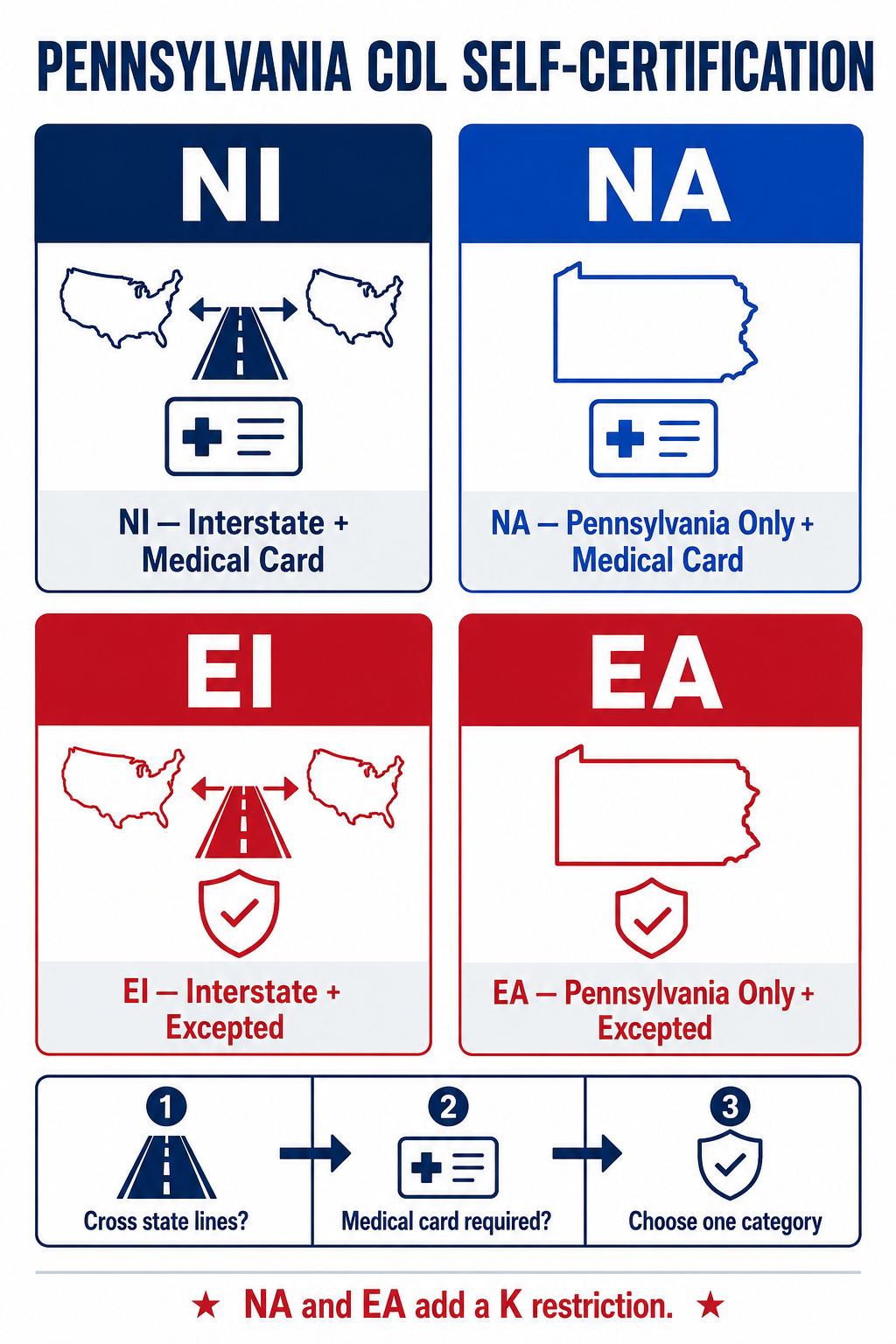
Every Pennsylvania CDL holder—and every driver applying for a commercial learner’s permit—must choose one self-certification category. The four codes look deceptively simple: NI, NA, EI, and EA. Choosing correctly requires two separate decisions: whether your commercial work is interstate or intrastate, and whether the operation is non-excepted or excepted from the usual medical-certification rules.
This guide translates the PennDOT DL-11CD form into plain English, shows how the categories affect your medical-card record and K restriction, and explains what to do when your work changes. It reflects official PennDOT and FMCSA information reviewed July 31, 2026.

Pennsylvania CDL Self-Certification at a Glance
PennDOT’s current uses these four codes:
| Code | Official category | Where you operate | Medical card tied to CDL? | K restriction? |
|---|---|---|---|---|
| NI | Non-excepted interstate | Interstate commerce | Yes | No |
| NA | Non-excepted intrastate | Pennsylvania only | Yes | Yes |
| EI | Excepted interstate | Interstate commerce | Generally no | No |
| EA | Excepted intrastate | Pennsylvania only | Generally no | Yes |
Typical new-driver choice: A driver age 21 or older who wants to haul ordinary freight across state lines usually selects NI. A driver who will operate only within Pennsylvania in ordinary non-excepted commerce usually selects NA and receives a K restriction. Your actual work—not the job title alone—controls the answer.
Self-certification is only one part of becoming eligible to drive. Review the broader Pennsylvania CDL requirements before submitting a permit or upgrade application.
The Two Decisions Behind NI, NA, EI, and EA
Decision 1: Interstate or intrastate commerce?
Interstate commerce is broader than “I personally cross a state line.” as trade, traffic, or transportation:
- between a place in Pennsylvania and a place outside Pennsylvania;
- between two places in one state when the route passes through another state; or
- between two Pennsylvania locations when the movement is part of transportation that originates or ends outside the state or the United States.
That third situation is easy to miss. A driver may stay inside Pennsylvania while moving freight that is part of a larger interstate shipment. Ask the employer or shipper where the freight’s transportation begins and ends; do not decide solely from your daily route map.
Intrastate commerce means the transportation does not meet the interstate definition. For self-certification, NA and EA are Pennsylvania-only categories, and PennDOT adds a K restriction that limits commercial operation to intrastate driving.
Decision 2: Non-excepted or excepted operation?
Non-excepted means the operation is subject to the applicable federal or Pennsylvania physical-qualification requirements. In practical terms, NI and NA drivers need a current Medical Examiner’s Certificate associated with their commercial driving record.
Excepted does not mean “any driver who would rather avoid a DOT physical.” It applies only when the operation falls into a defined federal or state exception. PennDOT examples include certain government drivers, specified school-bus operations, emergency-response work, some farm and custom-harvesting activity, beekeepers, and limited non-business transportation. The exact exception and conditions matter.
An exception from having a medical certificate tied to the CDL also does not erase every other medical rule. For example, Pennsylvania school-bus drivers remain subject to the state’s school-bus physical requirements. PennDOT’s chart also notes situations in which a driver may still need to carry a medical certificate even though it is not attached to the commercial license record.
What Each Pennsylvania Self-Certification Category Means
NI: Non-Excepted Interstate
Choose NI when you operate or expect to operate in interstate commerce and the operation is subject to the standard federal medical-qualification rules in 49 CFR Part 391. This is the most flexible category for many over-the-road, regional, and freight drivers.
- You must be at least 21 to operate a commercial vehicle in non-excepted interstate transportation.
- A valid Medical Examiner’s Certificate must reach PennDOT through the National Registry process.
- No K restriction is added solely because of this category.
- Federal medical variances or Skills Performance Evaluation information may also be transmitted to the state record.
NI is usually the correct choice when a driver wants ordinary interstate employment and meets the medical requirements. that a driver who performs both excepted and non-excepted interstate work should certify as non-excepted interstate so the record supports both types.
NA: Non-Excepted Intrastate
Choose NA when you operate only in Pennsylvania, your work is not an excepted activity, and the state medical-qualification rules apply. Examples include many local Class A, Class B, and Class C commercial drivers who transport goods, provide services, haul placarded hazardous materials, or move personal property for compensation entirely within Pennsylvania.
- A current Medical Examiner’s Certificate is required.
- PennDOT adds a K restriction, limiting commercial driving to intrastate operation.
- Crossing a state line or taking work that qualifies as interstate commerce requires a status review before the trip.
NA is not simply a temporary version of NI. It is a statement about the commerce you operate in or expect to operate in. A future employer offering interstate routes may require you to change to NI and satisfy the federal age and medical requirements first.
EI: Excepted Interstate
Choose EI only when your interstate operation falls exclusively within an exception from all or part of the standard federal driver-qualification rules. PennDOT’s examples include qualifying government operations, specified school-bus movements, certain emergency vehicles, some farm-related work, and other narrowly described activities.
- The CDL record generally does not require a Medical Examiner’s Certificate for the excepted activity.
- No K restriction is added because interstate operation is included.
- The driver must remain within the exception’s scope.
If one job duty is excepted but another is ordinary non-excepted interstate commerce, EI is too narrow. PennDOT directs drivers who work in both non-excepted and excepted occupations to select the non-excepted category and maintain the required medical certification.
EA: Excepted Intrastate
Choose EA when you operate only in Pennsylvania and every commercial operation you perform falls within a recognized intrastate exception. PennDOT examples include qualifying government work, specified in-state school-bus transportation, inspection mechanics conducting limited road tests, some emergency operations, and qualifying farm or apiarian activity.
- The CDL record generally does not require a Medical Examiner’s Certificate for the excepted activity.
- PennDOT adds a K restriction because the category is Pennsylvania-only.
- The driver cannot use EA as a blanket exemption for unrelated commercial work.
The DL-11CD form also addresses CDL holders who are not currently working as commercial drivers. It says they may select EA or EI to keep the CDL without a current medical card. Before returning to work that requires a medical card, the driver must submit a new self-certification and ensure the medical result reaches PennDOT.
How to Choose Your Category Step by Step
- Describe the actual transportation. List the vehicles, passengers or freight, employer, customer, route, and origin and final destination of the movement.
- Ask whether the commerce is interstate. Include shipments that enter a wider interstate transportation chain even when your own route stays in Pennsylvania.
- Identify the legal exception, if any. Do not infer one from a job title. Match the operation to PennDOT’s current DL-11CD chart and the relevant federal or state rule.
- Choose non-excepted when work is mixed. If you perform both excepted and non-excepted work, the non-excepted status is the safer and required classification described by PennDOT.
- Confirm medical and age eligibility. NI drivers must meet interstate qualifications, including the federal minimum age for non-excepted interstate commercial driving.
- Confirm the license consequence. NA and EA place a K restriction on the Pennsylvania CDL.
| Your answer | Non-excepted operation | Excepted operation only |
|---|---|---|
| Interstate commerce | NI | EI |
| Pennsylvania-only intrastate commerce | NA | EA |
When the answer is unclear, ask PennDOT about the licensing classification and ask the motor carrier to document the nature of the transportation. A school can explain the process, but it cannot make a binding classification for an employer’s routes or a driver’s individual legal situation.
How Medical-Card Reporting Works in Pennsylvania in 2026
Since June 23, 2025, certified medical examiners report CDL and CLP examination results electronically to FMCSA’s National Registry, which transmits the information to PennDOT. says it no longer accepts Medical Examiner’s Certificates in person or by email. Drivers should verify that the examiner used the correct license information and should follow up with the examiner if the state record does not update.
The process and current transition rules are explained in more detail in Patriot CDL’s Pennsylvania DOT physical guide.
Temporary federal paper-certificate protection
effective April 11 through October 11, 2026. During that period, interstate CDL and CLP holders and motor carriers may rely on a paper Medical Examiner’s Certificate as proof of medical certification for up to 60 days after the certificate is issued. FMCSA also recommends that medical examiners continue giving drivers a paper MCSA-5876 while submitting results electronically.
The paper copy is a short-term safeguard for processing delays; it does not cancel the examiner’s electronic reporting duty or the driver’s responsibility to resolve a missing record. Keep the paper certificate, the examiner’s contact information, and any PennDOT receipt while confirming that the electronic record is correct.
What happens if certification expires?
that a state licensing agency may notify a non-excepted driver that the driver is no longer medically certified and then downgrade the CDL privileges. PennDOT similarly states that missing electronic certification can cause a driver to be marked not certified and potentially have the CDL downgraded to a non-commercial license.
Do not wait until the last day. PennDOT recommends renewing a certificate that expires within six months when circumstances allow. After the exam, confirm the medical examiner submitted the result and retain proof while the record updates.
How to Change Your Pennsylvania CDL Self-Certification
Use a new DL-11CD when the category you previously reported no longer matches your work. The form includes a box for changing a previously reported self-certification. Common triggers include:
- accepting an interstate driving job after operating only in Pennsylvania;
- moving from an excepted government or school-bus role to ordinary commercial freight;
- stopping commercial work but keeping the CDL;
- returning to non-excepted driving after a period of inactivity;
- adding duties that no longer fit the exception you relied on; or
- changing from interstate to Pennsylvania-only work and accepting a K restriction.
Before changing to NI or NA, complete the required medical examination early enough for the National Registry result to reach PennDOT. Before changing to an interstate category, confirm that you meet the applicable age and qualification rules. Follow the current submission instructions printed on PennDOT’s form, and retain the receipt PennDOT sends after processing.
If you are still preparing for your first permit, use the Pennsylvania CLP application checklist to coordinate the DL-11CD, permit application, identification, medical exam, and testing steps.
Common Self-Certification Mistakes
| Mistake | Why it causes trouble | Better approach |
|---|---|---|
| Choosing intrastate because the truck stays in PA | The shipment may still be part of interstate commerce | Check the freight’s transportation origin and final destination |
| Choosing excepted to avoid a physical | Exceptions apply to defined operations, not preference | Identify the specific exception and all conditions |
| Ignoring mixed job duties | One non-excepted duty can make an excepted category too narrow | Use the applicable non-excepted category |
| Forgetting the K restriction | NA and EA do not authorize interstate commercial operation | Change status before accepting interstate work |
| Assuming a paper medical card updates PennDOT | Pennsylvania receives MEC data electronically through NRII | Verify examiner submission and state processing |
| Letting the medical certificate expire | Commercial privileges may be downgraded | Renew early and confirm the record |
Final checklist before you submit DL-11CD
- □ I described the transportation, not just the employer or job title
- □ I checked whether the freight or passengers are part of interstate commerce
- □ I identified a specific exception before choosing EI or EA
- □ I selected non-excepted if my duties include both categories
- □ I understand that NA or EA adds a K restriction
- □ My medical exam is current if I selected NI or NA
- □ The examiner has my correct Pennsylvania license information
- □ I saved the paper certificate and processing receipt
- □ I will submit a new DL-11CD before my driving type changes
Frequently Asked Questions
Which Pennsylvania CDL self-certification category do most interstate truck drivers use?
Most drivers who haul ordinary freight or provide commercial services in interstate commerce use NI, non-excepted interstate. They must meet the applicable federal medical requirements and be at least 21 for non-excepted interstate commercial driving.
What is the difference between NI and NA?
Both are non-excepted categories that require a current medical certificate. NI covers interstate commerce and does not add an intrastate-only restriction. NA covers Pennsylvania-only commerce and adds a K restriction to the CDL.
Can I keep my Pennsylvania CDL if I am not currently driving?
PennDOT’s DL-11CD says a person who is not currently working as a commercial driver may select EA or EI to keep the CDL without a current medical card. Before returning to work that requires a medical card, submit a new self-certification and ensure the medical result reaches PennDOT.
Do I send my paper DOT medical card to PennDOT?
PennDOT says it no longer accepts Medical Examiner’s Certificates in person or by email; certified examiners submit results electronically through the National Registry. Keep the paper copy for your records and for the temporary federal transition protection, and contact the examiner if the state record is missing.
Educational information only; not legal advice or an individual classification. Verify the current DL-11CD form and your situation with PennDOT, FMCSA, and the motor carrier. Official sources reviewed July 31, 2026.