You're probably here because the idea has gotten real.
Maybe you've been driving the Turnpike, watching tractor-trailers hold a steady lane through Newark traffic, and thinking that the person in that seat has a skill that pays. Maybe you're tired of hourly work that tops out fast. Maybe you want a trade that doesn't require a college degree, but does reward discipline, patience, and a strong work ethic.
A lot of people stall out right there because the process looks confusing from the outside. CLP. ELDT. MVC. Medical card. Pre-trip. Endorsements. The acronyms pile up, and before long it feels harder than it is.
The process is simpler than often assumed. New Jersey has a clear path. It also has a few hard gates that trip people up when they try to rush, guess, or piece things together on their own. If you understand the order, bring the right paperwork, and train with purpose, the process becomes manageable.
Your Roadmap to a New Career on the Open Road
A lot of new drivers hit the same moment. They decide they want better pay, steadier work, or a real trade, then they start looking into a CDL and run straight into a wall of steps, fees, and acronyms.
The fix is not more guesswork. It is getting the order right.
The sequence is important because how to get a CDL in NJ changed after the federal Entry-Level Driver Training (ELDT) rule took effect on February 7, 2022. If you are applying for a new Class A or Class B CDL and your Commercial Learner's Permit is issued on or after that date, you must complete training with a registered provider before you can take the skills test. You also have to hold the permit for at least 14 days before that test.
That one change affects your timeline and your budget. A delay at the permit stage can push back training. A failed written test, a missed document, or a retest on the skills side can add costs that many first-time applicants never planned for. That is where people get frustrated. They assume they are paying for one test and one course, when the actual process may include permit fees, physical exam costs, training tuition, time off work, and retest fees if they show up unprepared.
At good schools, including Patriot CDL, we spend a lot of time clearing up that confusion early. The goal is simple. No surprises on paperwork, no wasted trips to MVC, and no false sense that you can cram your way through the road test without proper training.
A practical roadmap looks like this. First, confirm you qualify and get your documents in order. Next, handle your DOT physical early so a medical issue does not stall you later. If you need a clear explanation of that step, review this guide to getting your CDL medical card in New Jersey. Then earn the permit, complete ELDT with a registered provider, and train specifically for the vehicle class and endorsements you plan to hold.
Students who move through this process well are usually not the ones with the most confidence on day one. They are the ones who respect the sequence, budget for the full process, and take each gate seriously. That is how you turn a confusing checklist into a workable plan and a new career.
First Gear Eligibility Documents and Your Medical Card
Before you study a single air brake question, make sure you can legally start the process.
To get a CDL in New Jersey, you must hold a valid Basic New Jersey driver's license (Class D) and be at least 18 years old. If you want to drive across state lines or haul hazardous materials, the federal age requirement is 21. Most applicants also need to pass a DOT physical and obtain a Medical Examiner's Certificate, as outlined by the New Jersey MVC CDL requirements.

Start with the non-negotiables
A lot of new students think the permit test is the first real hurdle. It isn't. The first hurdle is proving who you are, where you live, and that you're medically qualified.
New Jersey uses a 6 Points of ID system. If your documents don't add up correctly, you don't move forward. That's why experienced instructors push people to organize paperwork before they ever schedule the MVC appointment.
Use this checklist mindset:
- Basic license first: Your regular New Jersey driver's license has to be valid before anything else happens.
- Identity documents ready: Bring original documents that satisfy the 6-point requirement.
- Social Security proof: Don't assume a number memorized in your head is enough.
- Proof of address: Use current documents that match what MVC expects.
- Medical qualification: Get the DOT physical handled early, not at the last minute.
How the 6-point system trips people up
Unprepared applicants often lose time. New Jersey doesn't grade effort. It grades documents.
One verified breakdown of the process notes that the MVC requires original documents totaling 6 points, and examples include a U.S. passport counting for 5 points and a state-issued driver's license counting for 3 points. It also notes that relying too heavily on low-value secondary documents can lead to denial at the counter.
Here's the practical lesson. Don't build your whole appointment around weak paperwork. Bring stronger documents than you think you'll need. If you have a passport, use it. If you have multiple proof-of-address documents, bring them. If your name appears differently across records, straighten that out before the appointment.
Practical rule: Overprepare your document folder. Nobody has ever regretted bringing too much paperwork to MVC.
Get the medical card early
The DOT physical isn't a formality. It's one of the gates that determines whether you can move through the CDL pipeline without delays.
The exam must be done by a certified medical examiner, and you need the Medical Examiner's Certificate. If you want a deeper walkthrough on timing, paperwork, and common questions, this guide on the medical card for CDL is useful.
A simple way to stay organized is to gather the following before your MVC visit:
| Item | Why it matters |
|---|---|
| Valid NJ Class D license | Proves baseline driving eligibility |
| 6-point ID documents | Required for identity verification |
| Social Security proof | Part of your application file |
| Proof of NJ address | Confirms residency |
| DOT Medical Examiner's Certificate | Confirms medical qualification |
Students often treat the medical card like an extra errand. It's not. It belongs at the front of the process because if it's missing, outdated, or incomplete, everything behind it starts slipping.
Securing Your Commercial Learners Permit
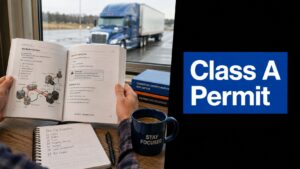
Once your documents and medical card are in order, the next target is your Commercial Learner's Permit, or CLP. This is what gives you the legal footing to begin the CDL path in a serious way.
The first cost that matters here is the Commercial Examination Test Receipt, which is $125 and non-refundable, as described in this overview of the New Jersey CDL permit process. That same breakdown also notes that applicants need 6 Points of ID, and that the CDL license itself costs $42 for a 4-year license, with small added fees for endorsements.

What you're really doing at this stage
Think of the CLP stage as two jobs.
First, you're handling administration. That means the fee, the appointment, and the paperwork.
Second, you're proving you understand the written side of commercial driving well enough to begin training. For a Class A path in New Jersey, the knowledge testing sequence includes General Knowledge with 50 questions and an 80% passing score, plus Air Brakes with 25 questions and Combination Vehicles with 25 questions, according to this walkthrough on the New Jersey CLP testing process.
How to study so you don't waste time
Most permit failures come from one of two problems. People either underestimate the test because it's “just written,” or they bounce between random study materials and never lock in the actual topics.
A better approach looks like this:
- General Knowledge first: This is the foundation. If you can't explain basic safety, vehicle operation, and CDL rules, the other material won't stick.
- Air Brakes next: A lot of students memorize terms without understanding the system. Learn what the parts do and why a check matters.
- Combination Vehicles last: This section makes more sense once you already understand basic control and safety.
If you want a practical overview of what to bring and how to think through the permit stage, this guide to the CDL learner's permit helps frame it clearly.
After you've studied the right material, it helps to see the permit process in motion:
What works at MVC and what doesn't
What works is showing up with your folder organized, fee ready, and test prep already done. What doesn't work is arriving “to see how it goes.”
I tell students to treat the permit day like a job interview. Be early. Have originals. Know what test you're taking. Don't improvise at the counter.
If your permit appointment feels casual to you, you're probably underprepared.
That CLP is more than a slip of paper. It starts the clock on your training and gets you into the part of the process that builds skill.
Navigating ELDT and Choosing Your Training Path
You get your permit, price out a few schools, and assume the fastest class is the cheapest path. Then the full picture emerges. ELDT, road time, missed work, retest fees if you are not ready, and delays when a school cannot move you through training cleanly. That is where a lot of new drivers lose time and money.
Since February 7, 2022, first-time Class A and Class B applicants with a CLP issued on or after that date must complete Entry-Level Driver Training through a provider listed on the Training Provider Registry before they can take the skills test. Your permit also has to age long enough before you can test, so the calendar matters from day one.

ELDT changes your timeline, not just your paperwork
Students sometimes treat ELDT like an online module they need to finish so MVC will let them test. That mindset causes problems. ELDT is a federal training requirement with two parts: theory and behind-the-wheel instruction. A registered provider has to report your completion electronically before you are eligible for the skills test.
That reporting step matters more than people expect.
If your school is disorganized, your whole schedule slips. I have seen students finish training but still wait because paperwork was not submitted promptly or their practice did not line up with the vehicle class they planned to test in. The rule is straightforward. The execution is where people get stuck.
What a good program actually saves you
A school should do more than get your name into the registry. It should shorten the path between permit and passing score.
Look for training that builds four things at the same time:
- A repeatable pre-trip routine: You need a sequence you can perform under pressure, not a script you barely remember.
- Backing control: Straight-line, offset, and alley dock expose hesitation, bad setup, and oversteering fast.
- Road habits: Mirror use, lane position, speed control, and turns have to become automatic.
- Test readiness: The best programs coach the paperwork, the pace of the day, and the common mistakes that lead to retests.
Federal guidance on the commercial driver's license process through FMCSA explains that first-time applicants covered by ELDT must complete required training through a provider listed on the Training Provider Registry before the skills test.
Choosing a school without paying twice
The lowest tuition number can cost more in the end. That is the part many applicants miss.
A cheap program that gives you limited seat time often leads to extra practice, extra days off work, and retest fees after a failed exam. A school with poor scheduling can stretch a short program into a long one. A school that trains everyone the same way can also be a bad fit if you need evening availability, faster pacing, or more backing repetition before test day.
Ask direct questions:
- How much behind-the-wheel time is included?
- How are pre-trip and backing taught?
- How far out are training and test dates being scheduled?
- What costs are separate from tuition?
- What happens if I need more practice or have to retest?
Those answers tell you a lot. Clear pricing and a realistic training calendar usually signal a school that understands how New Jersey students move through the process.
One example is Patriot CDL, which offers accelerated Class A and B training, hands-on instruction, permit guidance, and scheduling built for students who want a direct route into testing. If you want a plain-English breakdown of what schools are required to teach, review this guide to truck driver education requirements.
Training should leave you more certain each week. If you are still confused about pre-trip, backing setup, or what happens on test day, the program is not doing enough.
The right school helps you meet the ELDT rule, stay on schedule, and avoid the expensive mistake of testing before you are ready. That is how you protect your timeline and your budget at the same time.
Mastering the Skills Test and Adding Endorsements
This is the checkpoint everyone talks about, and for good reason. The skills test is where paperwork stops carrying you and actual performance takes over.
The final step is passing a three-part skills test made up of the Vehicle Inspection Test, Basic Controls Test, and Road Test. Applicants must bring their valid CLP, original driver's license, DOT Medical Examiner's Certificate, proof of appointment, and a test-ready commercial motor vehicle that matches the CDL class being tested. After passing, the CDL is issued for 4 years at $42, plus $2 for each endorsement added, according to this breakdown of the New Jersey CDL skills test requirements.

Where people lose points
Each segment tests a different kind of discipline.
Vehicle Inspection Test
Students usually struggle here because they memorize words without building a sequence. The fix is to inspect the same way every time. Same path. Same language. Same touch points. If your routine changes each run, nerves will expose it.
Basic Controls Test
Setup matters more than bravado. Alley dock, straight-line backing, and offset backing punish rushed steering. Most mistakes happen before the truck even starts moving because the setup angle was poor.
Road Test
The road portion exposes habits. Wide turns, mirror neglect, late braking, sign awareness, and lane drift all show up quickly. Students who stay calm and drive predictably usually do better than students trying to look impressive.
What to bring on test day
Don't rely on memory the morning of the exam. Use a checklist.
- Your CLP: It must be valid.
- Your NJ driver's license: Bring the original.
- Medical certificate: Have the DOT Medical Examiner's Certificate with you.
- Appointment proof: Bring the confirmation or receipt tied to the road test.
- Correct vehicle: The truck must match the class of license you're testing for.
The examiner isn't there to guess what you meant to bring. Either you're test-ready when you arrive, or you're not.
Endorsements that can expand your options
Once the base license is in hand, endorsements can make you more versatile. Common ones people ask about include HazMat, Tanker, and Passenger. They matter because they qualify you for more specialized work than a general CDL alone.
The right endorsement depends on the job you want. A driver focused on freight won't make the same choices as someone considering tank work or passenger transport. If you want a practical overview of those add-ons, this guide to CDL Class A endorsements lays them out clearly.
The key is timing. Get the base license first. Build competence first. Then add endorsements that match a real job path instead of collecting them just to collect them.
Your NJ CDL Is Just the Beginning
A lot of new drivers expect the hard part to end when the examiner says they passed. Real life starts the week after that, when the license has to turn into steady work, a clean driving record, and a paycheck that justifies what you spent to get here.
Money is where people get surprised. The permit fee is only one line item. The bigger risk is testing before you are ready. One failed skills test can mean another test fee, more time off work, and another truck rental if your school or sponsor does not include a retest vehicle. I've seen applicants burn through hundreds of extra dollars because they rushed the last step instead of fixing the problem first.
Treat a failed test like a diagnosis, not a verdict.
If you miss a section, get specific fast:
- Pin down the exact mistake: Pre-trip wording, straight-line backing, offset backing, parallel, turns, or lane control.
- Practice the failed skill, not everything at once: Targeted repetition saves more time than another full day of random driving.
- Ask what the retest really costs: Fee, truck use, instructor time, and lost work hours all count.
- Retest only after the weak spot is corrected: Hope is expensive.
That cost piece matters when you choose a school. Low upfront pricing can turn into a higher final bill if support is thin, scheduling is slow, or the truck is not available when you need another attempt. If budget is the main concern, this guide on free CDL training in NJ is a smart place to compare options before you sign anything.
The post-2022 process also changed the way new drivers should think about training. You cannot treat ELDT like a box to check and assume the rest will sort itself out. The right program should show you the full path in order: permit, ELDT completion, yard skills, road work, test scheduling, and what happens if you need extra practice. That is the difference between a short plan and a workable one.
After you get the license, keep building on it. Some drivers go straight into company jobs. Others work toward endorsements, local routes, or owner-operator plans. If you eventually run under your own authority, learn how to protect your trucking business before one claim wipes out early progress.
A CDL gives you access to the trade. What you do next determines whether it becomes a stable career.
If you want a direct path from permit prep to road test readiness, Patriot CDL offers New Jersey CDL training built around the actual process students have to clear. That includes help with the permit stage, hands-on skills preparation, and practical support for getting test-ready without guessing your way through it.