

Your journey into the trucking industry starts with one crucial first step: getting your CDL learner's permit. This isn't just another piece of paper; it’s your green light to get behind the wheel and start your hands-on training with a licensed instructor.
Your Starting Point for a Career in Trucking
Think of your Commercial Learner's Permit (CLP) as the bridge between reading about driving a truck and actually doing it. Before you can even think about hitting the road for training, you need this permit. It’s the law, and it's there to make sure you have the foundational knowledge down cold before you start maneuvering an 80,000-pound vehicle.
Getting your CLP proves you've done your homework and understand the rules of the road, basic vehicle controls, and critical safety procedures. It unlocks the door to real-world practice on public highways, which is where the real learning begins.
Why the Permit Matters More Than Ever
Let's be honest, there has never been a better time to get into trucking. With e-commerce booming and a generation of drivers heading into retirement, the demand for qualified, professional drivers is through the roof.
The numbers don't lie. The U.S. driving school industry has been growing at a rate of 5.3% every year between 2020 and 2025, swelling to a $2.0 billion market. That growth is a direct response to the industry's need for new talent. Your CLP is your ticket into this high-demand field.
A Commercial Learner's Permit is more than just a license to learn; it's a commitment to a new profession. It signals that you've mastered the essential knowledge and are ready to take on the responsibility of operating a large vehicle safely.
Setting the Stage for Success
Nailing your permit test on the first try does more than just get you into a truck faster—it builds your confidence. It shows training schools and future employers that you’re serious about this career and have what it takes to succeed. Once you have that permit in hand, you can enroll in a quality training program and start logging the hours you need.
The path from getting your permit to earning your full CDL is pretty straightforward. It breaks down into a few key phases:
- Passing the Written Knowledge Tests: You'll need to pass exams covering general knowledge, air brakes, and combination vehicles.
- Behind-the-Wheel Training: This is where you'll put theory into practice. With your CLP, you’ll learn pre-trip inspections, complex backing maneuvers, and how to handle the truck in traffic.
- Passing the Skills Test: Your final exam involves a three-part road test to prove you can safely operate the vehicle.
Each step is built on the one before it, and it all starts with the CLP. Understanding how the permit fits into a full CDL training program helps you see the bigger picture. This guide will walk you through the entire process, step-by-step, so you know exactly what to expect on your way to a rewarding career.
Getting Your Ducks in a Row: Core Eligibility Requirements
Before you can even crack open a study guide for the written tests, you need to make sure you meet the baseline requirements for a CDL learner's permit. These are the non-negotiables, the absolute must-haves that form the foundation of your application.
Think of it as the pre-trip inspection for your career. Getting this part right from the get-go will save you from the frustration of being turned away at the DMV.
Age and Residency: The First Hurdles
First up are the simple but crucial details: your age and where you live. While they seem straightforward, there’s a key distinction between driving within your home state and crossing state lines that you need to understand.
- To operate a commercial vehicle only within your state (intrastate), you typically need to be at least 18 years old.
- To haul freight across state lines (interstate), federal law mandates that you must be at least 21 years old.
This is a big deal when you're just starting out. If you're under 21, you can absolutely get your permit and start building experience, but your job options will be limited to in-state routes until you hit that federal minimum age.
Your Paperwork: Don't Walk In Unprepared
Showing up at the DMV without the right documents is a classic rookie mistake and a guaranteed recipe for a wasted day. You’ll need a specific set of original documents—no photocopies!—to prove who you are and where you live.
While every state has its own little quirks, here's a rundown of what you'll almost certainly need to bring:
- Your current, valid non-commercial driver's license.
- Your Social Security card (or another official proof of your number).
- Proof of U.S. citizenship or lawful permanent residency (think birth certificate, passport, or green card).
- Two documents showing proof of state residency, like recent utility bills or a rental agreement in your name.
My best piece of advice? Call your local DMV or double-check their website the day before your appointment. Seriously. Rules and required documents can change, and a five-minute call can save you a massive headache and a second trip.
The road to getting a CDL has evolved quite a bit. What started with a 1982 law, fully implemented by 1992, created a national standard for these written exams. More recently, the Infrastructure Act of November 15, 2021, kicked off a pilot program that opens the door for drivers aged 18-20 to get into interstate trucking, provided they complete 400 hours of supervised training after getting their permit.
The All-Important DOT Medical Exam
This is arguably the most critical step before you even think about applying. You must pass a Department of Transportation (DOT) medical exam. This isn't your average check-up; it's a specific physical performed by a certified medical examiner who is listed on the FMCSA's National Registry.
The whole point is to make sure you're medically fit for the rigors of driving a commercial vehicle. The examiner will look closely at any health conditions that could be a problem on the road, including:
- Vision and Hearing: You have to meet strict minimum standards.
- Blood Pressure: Needs to be under control.
- Heart Health: A history of serious heart conditions will get a close look.
- Diabetes: Especially if it's insulin-treated, as there are specific rules you'll need to meet.
- Sleep Apnea: This is a big one. Untreated sleep apnea is an automatic disqualifier because of the risk of dozing off behind the wheel.
Once you pass, the examiner gives you a Medical Examiner's Certificate (MEC), which most people just call a DOT medical card. You absolutely must have this certificate with you when you go to the DMV to apply for your permit.
Before diving into the application process, it's helpful to have a clear picture of what you need. This checklist breaks down the essential documents and qualifications.
CDL Learner's Permit Eligibility Checklist
| Requirement Category | Specifics and Key Details | Pro Tip |
|---|---|---|
| Age & Residency | 18+ for intrastate (in-state only). 21+ for interstate (across state lines). Must be a legal resident of the state where you're applying. | If you're under 21, focus on local or regional jobs to build experience until you're eligible for interstate routes. |
| Identity & Citizenship | Original, valid U.S. Birth Certificate, Passport, or Permanent Resident Card. | Don't bring photocopies! The DMV will reject them. Make sure your documents aren't expired. |
| Social Security | Your original Social Security card or an official document from the SSA displaying your full number. | Can't find your card? Request a replacement from the Social Security Administration well in advance. |
| State Residency | Two separate documents with your name and current address, like a utility bill, bank statement, or lease agreement. | Make sure the name and address on these documents perfectly match what's on your driver's license. |
| Medical Fitness | A valid Medical Examiner's Certificate (MEC) from a DOT-certified examiner on the FMCSA National Registry. | Your MEC is typically valid for up to 24 months. Don't let it expire during your training process! |
Having all these items in order shows the DMV you're serious and prepared, which can make the entire process go much more smoothly.
The journey starts with your permit, moves into training, and ends with you earning your license. It's a clear, three-phase process.
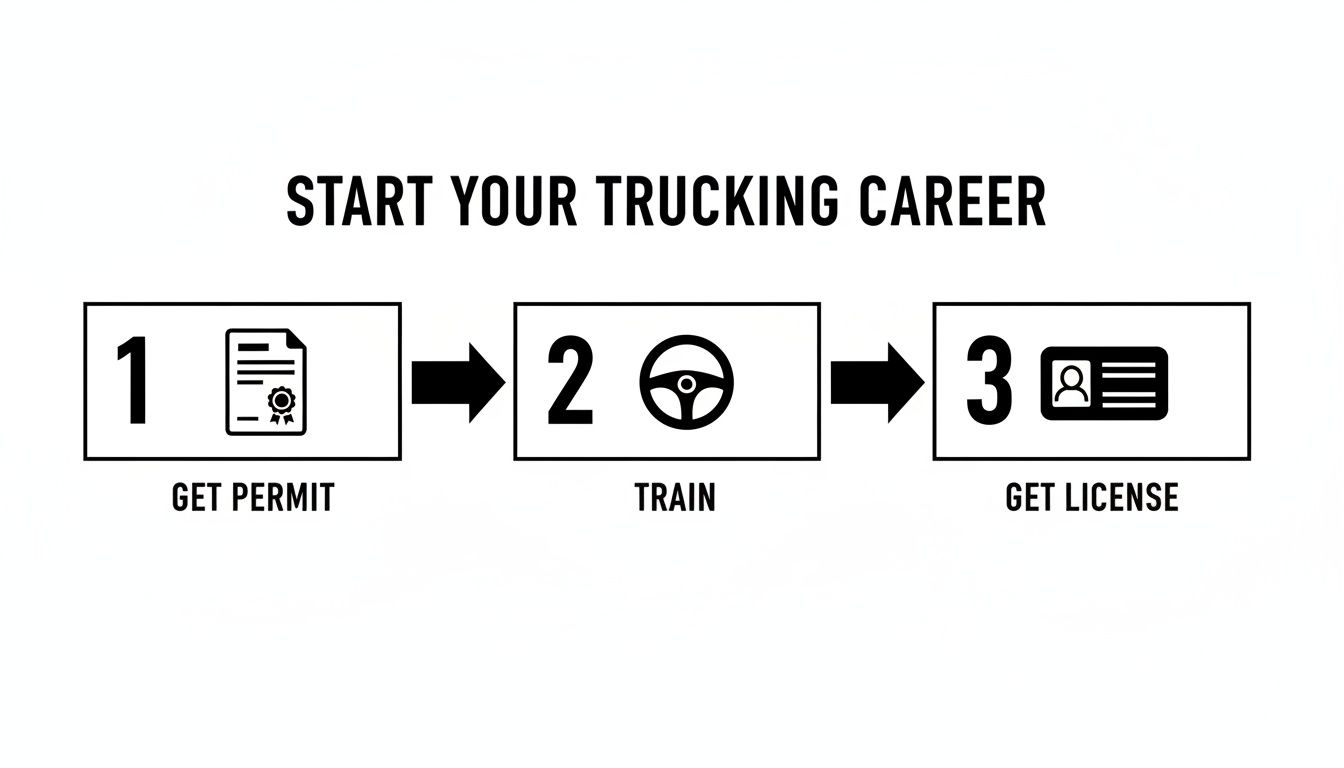
This simple flow really drives home the point: getting your permit is the critical first step. You can't legally start any behind-the-wheel training without it. Ensuring you meet all these preliminary CDL requirements is your ticket to the next phase: hitting the books to pass your knowledge tests.
Passing Your CDL Knowledge Tests
Alright, you've confirmed you're eligible and you have that fresh DOT medical card in your wallet. Now comes the part that trips up a lot of aspiring drivers: the written knowledge tests.
Think of these exams as the gatekeeper to getting behind the wheel. Passing them is how you prove you have the critical knowledge to operate a big rig safely before you ever turn the key. This isn't just about memorizing a few road signs; you'll be tested on complex vehicle systems, federal regulations, and split-second safety decisions.
How you approach studying is everything. It's the difference between walking out with a permit and walking out with a retest date.
The Core Exam: General Knowledge
The General Knowledge test is the foundation. Every single person trying to get a CDL has to pass this one, no matter what they plan on driving. It's a wide-ranging exam that covers the universal principles of commercial driving.
You’ll see questions pop up about things like:
- Basic Vehicle Control: How a truck's weight, height, and length drastically change how you drive.
- Safe Driving Practices: Properly managing your speed, space, and sightlines in all kinds of conditions.
- Inspections: The nitty-gritty of a proper pre-trip, en-route, and post-trip inspection.
- Emergency Procedures: What to do when things go wrong—accidents, fires, you name it.
- Hazardous Materials Rules: A baseline understanding of hazmat, even if you never plan to haul it.
Most states demand you get 40 out of 50 questions right to pass. That’s a tough 80% benchmark, leaving very little room for error. Focused study isn't just a good idea; it's a must. If you need some help, you can find a ton of info to help you nail the General Knowledge test and get your career moving.
The Essential Endorsements You'll Need
Besides the General Knowledge test, you'll almost certainly need to pass at least two more endorsement tests for a standard Class A permit: Combination Vehicles and Air Brakes. For anyone who wants to drive a tractor-trailer, these aren't optional.
Combination Vehicles (T Endorsement)
This test is all about the unique physics and challenges of driving a "combination" vehicle—like a tractor pulling a semi-trailer. It gets into the details of coupling and uncoupling, connecting air and electrical lines, and avoiding the dangerous "crack-the-whip" effect on a sharp turn.
Air Brakes (L Endorsement)
Your car uses hydraulic brakes. A big rig uses air brakes, and they are a completely different animal. This exam makes sure you understand all the components, know how to perform a full air brake system check, and can use them properly to prevent brake fade on a long, steep downgrade.
Getting these endorsements isn't just about checking a box. It's an investment in your own safety. Understanding why an air compressor cuts out at 125 psi or recognizing the dangerous braking characteristics of a "bobtail" tractor will serve you every single day of your career.
Don't underestimate these exams. Globally, pass rates for commercial driving knowledge tests have been slipping. For example, in Europe, the pass rate for truck license theory tests dropped from 62.3% in 2019 to 59% in 2022. That mirrors what we see here in the U.S., where that 80% passing score requires real preparation.
Proven Strategies for Test Day Success
Just reading the CDL manual cover-to-cover and hoping the information sticks is a recipe for failure. You need an active study plan to really absorb this dense material.
Forget about passive reading. It’s time to engage with the content.
Here are a few practical study tips I've seen work time and time again:
- Use Practice Tests the Right Way: Don't just take them to get a score. When you get a question wrong, stop. Go back to the manual and read the entire section on that topic. This turns every mistake into a genuine learning moment.
- Make Your Own Flashcards: Write down the tough stuff, especially multi-step procedures like the full air brake system test. The physical act of writing helps lock it in your brain. Keep them in your pocket and review them whenever you have five minutes to spare.
- Focus on the "Why": Don't just memorize that you need to test your trailer brakes by gently pulling against them with the hand valve (the "trolley" valve). Understand why. Knowing this confirms your connection is solid and the brakes are actually working makes the step impossible to forget.
- Teach Someone Else: Try explaining a concept to a friend or family member, like how to execute a perfect wide turn without running over the curb. If you can teach it clearly, you know you've truly mastered it.
By using active study habits like these, you move beyond rote memorization. You start building a deep, practical foundation in safe commercial driving—which is exactly what the tests are designed to measure. This approach won't just get you a permit; it will make you a safer, more confident driver when you finally hit the road.
Navigating the DMV and State-Specific Rules
You've hit the books, aced the knowledge tests, and have a neat stack of documents ready to go. Now for the final boss of this stage: a trip to the DMV. This is where all your prep work comes together, turning that pile of paper and passing scores into a real, official Commercial Learner's Permit (CLP).
Knowing what to expect can be the difference between a smooth, quick visit and a frustrating ordeal. While the feds set the big-picture rules, every state's DMV has its own quirks—from the specific forms they use to the fees they collect.
What to Expect on Your Big Day
Once you get to the counter, you'll hand over your completed application and all the documents you gathered. This means your driver's license, proof of residency, Social Security card, and, of course, that all-important Medical Examiner's Certificate (MEC). A DMV employee will meticulously check every single piece to make sure it's all in order.
After the paperwork gets the green light, it's usually time for a quick vision test. It's a simple screening to confirm your eyesight meets the basic safety standards for anyone getting behind the wheel of a big rig. Pass that, pay the necessary application and permit fees, and you're on your way.
State Rules Aren't One-Size-Fits-All
This is a big one. The federal government lays down the foundation for the CDL process, but each state builds its own house on top of it. What flies in Texas might not work in New York, and these differences can seriously affect your plans.
Just look at a few real-world examples:
- How Much It Costs: In a state like Ohio, you might pay around $28.00 for your CLP. But head over to California, and the combined fees can be significantly steeper.
- The Waiting Game: Many states make you hold your CLP for at least 14 days before you can even think about taking your road test. Others might have different timelines.
- Renewing Your Permit: Federal rules say you can renew a CLP once within a year, but the exact process and costs are entirely up to your state.
Look, the internet is filled with advice, but your absolute best source of information is your state's official DMV website. Rules change, and relying on some forum post from two years ago is a classic mistake that will cost you time and maybe even an extra trip.
It's a common rookie error not to check local procedures. Imagine showing up only to find out your DMV is "by appointment only" for permit services. That's a whole day wasted. To see just how specific these guidelines can get, take a look at the process for getting a CDL in California.
The Rules of the Road with a Learner's Permit
Getting that CLP in your hand feels like a huge win, but remember—it’s not a license to drive solo. The law is incredibly strict here. Any time you operate a commercial vehicle with a permit, you absolutely must have a qualified, licensed CDL holder with you.
This supervising driver isn't just a passenger. They must:
- Hold a valid CDL for the same class of truck (or higher) that you're driving.
- Be in the front passenger seat right next to you.
- Remain alert and ready to take over if something goes wrong.
There are zero exceptions. Getting caught driving alone with a CLP is a massive violation. It can get you disqualified immediately and put your future CDL in serious jeopardy.
Don't forget that your permit is on a clock. It’s initially valid for 180 days. If you need more time, you can typically renew it once for another 180 days. But if that full year runs out, you're back to square one—retaking all the written tests and starting the entire process over. This built-in deadline is a powerful motivator to stick with your training and get that road test scheduled.
Turning Your Permit into Professional Skills
So you passed the written exams and have a brand-new Commercial Learner's Permit (CLP) in your hand. Congratulations! This is where the rubber really meets the road. The book knowledge is behind you, and it’s time to start the hands-on learning.
Your CLP is your key to get in the driver's seat of a big rig—legally, of course—with a certified instructor riding shotgun. You're about to start turning all that information from the CDL manual into pure muscle memory, and honestly, this is where the real fun begins.
From Book Smarts to Behind-the-Wheel Skills
With your cdl learner's permit, you’re ready for a structured training program that builds your skills from the ground up. Don't worry, they won't throw you onto the interstate on day one. You’ll start in a controlled space, like a practice yard, where you can get a feel for the truck without the pressure of live traffic.
Under an instructor's watchful eye, you’ll start mastering the essentials.
- Pre-Trip Inspection: You'll learn this critical safety check inside and out. It’s not just a routine; it’s a systematic, hands-on process of checking over 100 different components to make sure your truck is safe.
- Basic Vehicle Controls: This covers everything from setting your mirrors and seat just right to understanding the dashboard and simply managing the sheer size of the vehicle. It's a different world from a car.
- Shifting Techniques: Get ready to work with a manual transmission that has 10 or more gears. Mastering the clutch and learning how to shift smoothly is a fundamental skill for any professional driver.
- Backing and Docking: This is what makes most new drivers sweat. You’ll practice everything from straight-line backing and offset backing to that notoriously tricky 90-degree alley dock.
This is all about building a solid foundation of confidence before you head out onto public roads for more advanced training in city and highway driving.
Choosing the Right Training Ground
Your success hinges on the quality of your training. A great truck driving school does more than just teach you the answers for the test; it prepares you for a long-term career. When you're looking at schools, you need one that's all about hands-on experience and meets federal standards.
The most critical factor when choosing a school is making sure it's on the FMCSA's Training Provider Registry (TPR). If you don't get your training from a registered provider, you won't even be eligible to take the final CDL skills test.
Look for a program with a clear curriculum, instructors who have been there and done that, and trucks that are in good shape. New federal regulations, known as Entry-Level Driver Training (ELDT), ensure every new driver gets a consistent, high-quality level of instruction. If you want to dive deeper, you can learn all about the ELDT requirements and see how they shape your training path.
Connecting Your Training to the Final Test
Every single skill you learn behind the wheel is directly preparing you for the final hurdle: the CDL skills test. It’s no accident. Your training is specifically designed to get you ready for the three parts of this big exam.
- Vehicle Inspection Test: This is where you prove you know that pre-trip inspection by heart. You'll have to walk the examiner around the truck, point out different parts, and explain what you're checking.
- Basic Control Skills Test: All that time in the practice yard pays off here. You'll perform a series of slow-speed maneuvers, like those backing exercises, in a coned-off area.
- Road Test: Finally, you’ll take the truck out on the open road with the examiner. They'll be watching how you handle the truck in real traffic, grading your turns, lane changes, and overall situational awareness.
Think of your cdl learner's permit as your all-access pass to this crucial training period. It’s your time to ask a million questions, make mistakes in a safe environment, and build the rock-solid skills that will serve you for your entire career.
Got Questions About the CDL Permit? I've Heard Them All.
If you're gearing up for your CDL permit test, your head is probably swimming with questions. That's completely normal. I've worked with countless new drivers, and the same handful of concerns always seems to come up.
Let's clear the air and tackle those common questions head-on. Getting these answers straight will save you a ton of headaches down the road.
How Long is My CDL Permit Good For?
This is easily the most-asked question. Think of your permit as having a six-month fuse. It's valid for 180 days from the day they hand it to you. That timeline is no accident; it's designed to give you a solid window to get your hands-on training done and feel ready for the final road test.
What if life gets in the way and you need more time? The feds allow for a one-time renewal for another 180 days. But be warned: if that renewal expires, you’re back to square one. That means retaking all the written knowledge tests and paying the fees all over again.
What if I Bomb One of the Written Tests?
First off, don't panic. It happens more often than you think. Failing a test feels like a setback, but it's not a dead end. Every state has a system for retakes, though they won't let you try again the same day.
You'll face a mandatory waiting period—it could be a single business day or maybe a week, depending on your state. Use that time wisely. It’s a forced pit stop to help you figure out what went wrong. Go back to the manual, hit the practice tests, and really focus on the sections that tripped you up.
My advice? Don't just re-read the whole book. Zero in on your weak areas. Was it the pre-trip inspection for air brakes? The turning radius of a combination vehicle? Nail those specific topics before you go back for round two.
Can I Take the Truck for a Spin by Myself with a Permit?
Let me be crystal clear: absolutely not. This is a hard-and-fast federal rule, and it’s all about safety. When you’re driving on a Commercial Learner’s Permit (CLP), you are legally required to have a licensed CDL holder in the passenger seat next to you.
And not just any CDL holder—they must have a license valid for the type of truck you're driving. They need to be awake, alert, and ready to grab the wheel if things go south. Driving solo on a permit is a massive violation that will get you disqualified in a heartbeat and could kill your trucking career before it even starts.
Do I Need the Permit Before I Enroll in Truck Driving School?
Yes, you almost always need your permit before you can get behind the wheel at a training school. Think of the permit as your official entry ticket to the practical side of training. It's the piece of paper that legally allows you to operate a big rig on public roads, as long as you have an instructor with you.
Any good truck driving school will build this into their process. They'll expect you to have it and will often help you get there by providing study materials and guidance. Getting your permit is the first real milestone on your journey from the classroom to the cab.
Ready to move from questions to action? Patriot CDL specializes in the hands-on training that takes you from a fresh permit holder to a confident, career-ready driver. Check out our accelerated programs to see how we get you on the road faster.