


High wind can turn an ordinary commercial-vehicle trip into a continuous control problem. A tractor may feel stable while the broad side of a dry van, reefer, box truck, bus, or empty trailer catches a crosswind. The force may arrive as a steady push, a sudden gust at a bridge opening, or a sharp change when the vehicle leaves the shelter of a tree line or passes another truck.
A professional response begins before the wheels move. The driver checks the forecast and route, understands the vehicle and load, identifies exposed segments and safe parking, watches for real-time signs, reduces speed before control deteriorates, and stops when the combination can no longer be operated predictably. There is no substitute for a driver’s judgment at the wheel, and there is no schedule that makes an unstable vehicle safe.
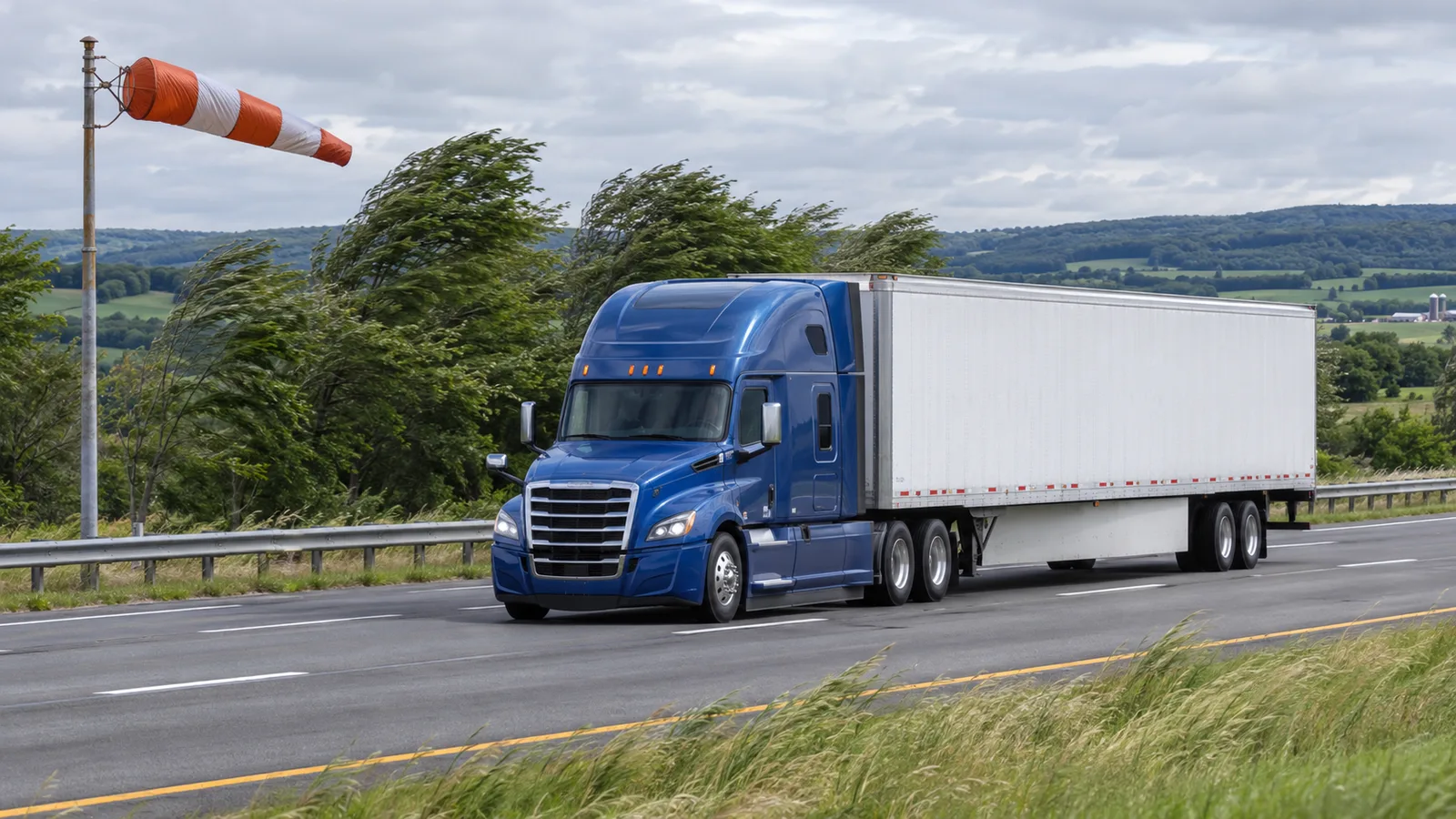
Understand why high-profile commercial vehicles react to wind
Wind acts on every exposed surface. A tall, long trailer gives a crosswind a large side area to push, and a gust can create both lateral movement and a rolling force. Vehicle weight, center of gravity, trailer length and height, cargo distribution, suspension, tire contact, road crown, and wind direction all influence the response. Two combinations on the same road may not react the same way.
Steady wind and gusts create different problems
A steady crosswind may require a small continuous steering input. A gust changes force rapidly, so the correction that was adequate a moment earlier may become too much or too little. The driver can also experience a sudden release of pressure when entering the wind shadow of a building, cut, or passing truck, followed by another push on exit. This alternating pattern encourages overcorrection if the driver reacts abruptly.
Light weight does not mean low risk
An empty or lightly loaded dry van still presents almost the same side profile as a loaded one, but it has less mass resisting lateral movement. That does not create a universal “empty trailer” cutoff; it does make load status an essential part of the decision. A high or uneven load may introduce another problem by raising the center of gravity. Review the rollover-prevention plan for the relationship among speed, cargo, curves, and smooth control.
Wind can combine with other hazards
Rain, snow, ice, dust, smoke, darkness, and construction can reduce traction or visibility while wind pushes the combination. A safe speed for dry pavement may be excessive when the steering tires have less grip. Blowing dust or snow can erase sight distance. The winter driving plan explains why a driver must judge the complete condition rather than one weather reading.
Build a wind-aware trip plan before departure
Review the National Weather Service forecast, watches, warnings, and local transportation alerts for the whole route—not just the terminal. Note when conditions are expected to strengthen or weaken and whether the route crosses open farmland, elevated highways, ridgelines, exposed bridge decks, or areas with loose construction material. Recheck conditions during a legal stop because timing and storm tracks change.
Do not turn a forecast number into a universal rule
Wind products and alert criteria can vary by location, and a reported speed may not represent the gust at a particular bridge or cut. More importantly, a number alone does not describe the vehicle. Carrier policy may establish equipment-specific limits, and highway agencies may restrict certain vehicles or close a road. Those instructions must be followed, but a driver may need to stop before a formal limit or closure if control is deteriorating.
The advises drivers caught in high winds to hold the wheel with both hands and slow down, and it specifically warns about high-profile vehicles. Treat that as public-safety guidance, then apply the more conservative carrier and vehicle-specific procedure.
Identify decision points and safe parking
Mark locations where the driver can reassess before entering an exposed segment: a truck stop before a long bridge, a rest area before a ridge, or an interchange ahead of an open plateau. A safe plan includes more than the preferred stop. Identify a backup that fits the combination and can be reached without turning through unsafe local streets. The older but useful truck-parking trip plan helps make stopping part of the route rather than a last-minute search.
Evaluate the tractor, trailer, cargo, and equipment
A wind decision starts with the actual combination. Record whether the trailer is empty, partially loaded, or loaded; whether cargo is centered and secured; and whether the body is a dry van, reefer, tanker, flatbed, doubles set, bus, or other profile. Confirm gross and axle weights through the carrier’s normal process. Never add ballast or alter cargo merely to “fight wind” unless a lawful, engineered, carrier-approved plan applies.
Inspect the components that preserve control
Check steering linkage, suspension, tires, wheels, coupling, lights, and mirrors. Correct tire inflation and sound steering components matter when the vehicle needs precise lane control. A loose suspension component or tire defect can turn wind movement into a larger handling problem. Use the detailed steering and suspension inspection and commercial-truck tire inspection before departure.
Secure cargo and exterior equipment
Confirm doors, latches, tarps, straps, liftgate components, spare equipment, and loose material are secured. A wind event is not the time to discover a partially latched door or flapping tarp. Cargo must remain contained and cannot shift enough to harm stability or maneuverability. For the driver’s inspection and recheck duties, follow the cargo inspection and securement plan.
Read real-time signals instead of waiting for a crisis
Forecasts support the decision, but the truck provides immediate feedback. Watch windsocks, flags, trees, grass, blowing dust, spray, snow, and debris. Observe other high-profile vehicles from a safe distance. Feel whether the steering correction is small and stable or frequent and growing. Note whether the trailer tracks steadily or appears to wander toward a lane line.
Use a personal escalation ladder
An early signal may be a mild steady push that remains easy to control. The next level is repeated gusts requiring noticeable corrections. More serious signs include lane-position difficulty, steering inputs that alternate rapidly, trailer movement visible in mirrors, airborne debris, reduced visibility, or nearby vehicles drifting. At each step, reduce exposure and prepare to exit before reaching loss of control.
Take bridge and roadside warnings seriously
Variable-message signs, vehicle restrictions, closed gates, police directions, and bridge wind warnings are operating controls, not suggestions. A driver should not assume a route is safe because passenger vehicles continue. If a restriction applies to high-profile vehicles, trailers, empty combinations, or commercial traffic, use the designated alternate route or stop.
Keep communications short and early
Notify dispatch before the problem becomes an emergency. State location, direction, vehicle and load status, observed gust effects, alert or closure, and intended safe stop. Avoid promising a departure time. The driver can update once conditions and the route are reassessed. Early communication gives the carrier time to adjust an appointment without pressuring an unsafe decision.
Use smooth speed, steering, and space management
Reduce speed before the exposed area, not while the strongest gust is already moving the trailer. Lower speed gives the driver more time to recognize movement and make a measured correction. It does not eliminate wind force or guarantee stability, so speed reduction must be paired with a stop decision when control remains uncertain.
Keep both hands available for steering
Sit correctly, wear the seat belt, and keep both hands on the wheel. Look far enough ahead to guide the vehicle along a stable path while continuing mirror checks. Use small, smooth steering inputs. Do not stare at the lane line or make a sharp counter-movement each time the trailer shifts slightly; that can create an oscillation larger than the original movement.
Avoid abrupt braking and acceleration
Ease off the accelerator and slow progressively while keeping the combination straight. Hard braking can transfer weight and reduce available control, especially when the road is wet or icy. Sudden acceleration can create another steering demand. Enter curves, ramps, and bridge approaches at a speed that does not require aggressive braking or steering.
Create an isolation zone
Increase following distance and avoid driving beside another vehicle. A gust may move either vehicle laterally, and the wind shadow of a truck or barrier can change the force suddenly. Leave space around the combination so a smooth correction does not become a sideswipe. The following-distance and space-cushion plan offers a repeatable scanning routine.
Manage bridges, gaps, cuts, and passing vehicles
Wind exposure often changes at boundaries. The truck may be sheltered by a hill, sound wall, building, or tree line and then enter open air. Bridge decks, elevated roadways, and ridge tops can remove surrounding shelter. Openings between buildings can funnel wind. Anticipate the transition and stabilize speed and lane position before reaching it.
Expect pressure changes while passing
When another large vehicle approaches or passes, the combination may first feel a push, then reduced pressure in the vehicle’s wind shadow, then another push as the vehicles separate. Do not race the pass or crowd the lane edge. Maintain space, a steady path, and a speed that allows the situation to finish without abrupt input.
Do not stop in the exposed travel lane
If conditions worsen, take a safe exit before the bridge or exposed segment when possible. Stopping on a travel lane creates a collision hazard and may leave the combination in the strongest wind. A shoulder is for emergencies, not routine weather waiting. Choose designated parking that supports the vehicle and does not place it beneath trees, utility lines, signs, or loose structures.
Connect the stop decision to current federal guidance
requires extreme caution and reduced speed when listed hazardous conditions adversely affect visibility or traction. It also requires CMV operation to be discontinued when conditions become sufficiently dangerous and not resumed until the vehicle can be safely operated. High winds may accompany or create visibility, traction, debris, and control hazards that demand the same conservative evaluation.
The driver makes the safe-operation decision
FMCSA’s official states that the driver is responsible for safe operation and the decision to cease operation because of hazardous conditions. Dispatch can provide information and support, but it cannot feel the steering wheel or observe a particular gust at the truck.
Stopping should itself be safe. If an immediate stop would increase danger, the driver should continue only as necessary to reach the nearest place where the danger can be eliminated, consistent with the rule and the circumstances. This is not permission to continue to a customer or preferred truck stop when a nearer safe location is available.
High-wind action table
| Condition | Driver response | Avoid | Reassess |
|---|---|---|---|
| Forecast indicates gusty conditions later | Review route exposure, load status, alerts, and parking before departure | Planning only from the terminal’s current weather | At legal stops and before exposed segments |
| Mild steady crosswind with stable tracking | Reduce speed, hold both hands on the wheel, and increase space | Cruise control if it prevents active speed management | Continuously through vehicle feedback |
| Repeated gusts require growing corrections | Take the next safe exit and prepare to stop | Waiting for a lane departure | In protected legal parking |
| Bridge restriction or high-profile closure | Obey the restriction and use the approved alternate or stop | Following passenger vehicles through | Only after the restriction changes |
| Debris, dust, snow, or rain reduces visibility | Slow substantially and discontinue operation if conditions are dangerous | Stopping in the traveled lane | At the nearest safe location |
| Vehicle cannot stay predictably in its lane | Exit or stop at the nearest safe opportunity | Abrupt braking or steering | After conditions improve and the vehicle is checked |
Make a deliberate stop-or-go decision
The stop decision should be based on controllability, not on whether another truck continues. Consider trailer profile and weight, cargo, road exposure, gust pattern, visibility, traction, traffic, driver fatigue, and the distance to safe parking. If maintaining the lane requires repeated large corrections, the operation is already beyond normal wind management.
Choose a safe waiting position
Park where the surface supports the full combination and traffic can circulate. Avoid isolated exposed edges, soft ground, flood areas, overhead lines, trees, billboards, construction material, and objects that may fall or blow. Set the parking brakes and follow the facility’s parking rules. If stopped roadside in an emergency, activate flashers and place warning devices as required; see the roadside warning-device plan.
Restart only after a fresh assessment
A forecast update by itself is not enough. Check alerts and road restrictions, inspect the tractor and trailer for damage or loose equipment, confirm cargo and doors, and observe other high-profile vehicles. Consider whether the remaining route is more exposed than the segment already traveled. Document the delay under carrier procedure and restart only when the combination can be operated safely.
Worked scenario: an empty trailer approaches an exposed bridge
Devin is pulling an empty dry van toward a long river crossing. Before departure, the forecast showed strengthening afternoon gusts, so Devin marked a truck stop two exits before the bridge as the decision point. The tractor and trailer passed inspection, doors were secured, and dispatch knew the route might require a weather delay.
Vehicle feedback changes the plan
Twenty miles from the bridge, the wind becomes a steady crosswind. Devin reduces speed, keeps both hands on the wheel, and increases space. After the highway leaves a tree line, two gusts move the trailer close to the lane line and require larger corrections. A message sign ahead advises high-profile vehicles of strong winds, although the road is not yet closed.
Devin does not wait for a formal closure. The truck exits at the planned stop, parks away from trees and power lines, sets the brakes, and informs dispatch with the location, empty-trailer status, observed movement, and bridge warning. Devin checks NWS updates and the transportation alert, then waits.
Resuming is a new decision
Later, the alert is lifted and nearby flags show less movement. Devin rechecks the trailer doors, tires, coupling, and exterior equipment, then reviews the remaining route. The trip resumes at a reduced speed with extra space. The key success was not predicting an exact gust; it was setting a decision point and acting before lane control was lost.
Commercial truck high-wind driving checklist
Use this checklist with carrier policy, equipment instructions, road restrictions, and current official weather information.
Before departure
- Review NWS forecasts, watches, warnings, and transportation alerts.
- Identify bridges, ridges, open farmland, elevated roads, and wind corridors.
- Record whether the trailer is empty, partial, or loaded.
- Confirm cargo distribution and securement.
- Inspect steering, suspension, tires, coupling, doors, tarps, and lights.
- Review carrier wind limits and equipment-specific restrictions.
- Choose decision points and at least two legal parking options.
- Tell dispatch where a weather delay may occur.
While driving
- Watch windsocks, flags, trees, spray, dust, snow, and debris.
- Keep the seat belt fastened and both hands on the wheel.
- Reduce speed before exposed sections.
- Use small, smooth steering corrections.
- Increase following and side space.
- Avoid traveling beside other high-profile vehicles.
- Expect pressure changes at bridges, gaps, cuts, and passing trucks.
- Exit early if corrections become frequent or lane position degrades.
When stopping and restarting
- Use designated parking that fits the full combination.
- Avoid trees, power lines, signs, soft shoulders, and loose material.
- Set the parking brakes and secure the vehicle.
- Give dispatch specific observations rather than a guessed restart time.
- Monitor official alerts without using a handheld phone while driving.
- Inspect the vehicle and cargo before restarting.
- Confirm restrictions are lifted and the remaining route is acceptable.
- Treat resumption as a new safety decision.
Frequently asked questions
Is there one federal wind-speed limit that tells every commercial driver when to stop?
No. Federal regulations do not set one universal wind-speed cutoff for every commercial vehicle and load. The driver must evaluate the actual vehicle, trailer profile, cargo, road exposure, gusts, visibility, traction, traffic, and available safe stopping places. Follow carrier limits and road closures, and stop when the vehicle cannot be operated safely.
Why can an empty or lightly loaded trailer be difficult to control in a crosswind?
A dry van or similar high-profile trailer presents a large side area to the wind. With less cargo weight, there is less mass resisting the lateral force, so gusts can produce quicker movement and a greater need for steering correction. Load distribution, trailer type, road surface, speed, and gust direction also affect the response.
How should a CDL driver respond when a sudden gust pushes the combination sideways?
Keep both hands on the wheel, look where the vehicle should travel, and make a smooth measured correction. Ease off speed without abrupt braking or steering, increase space, and avoid traveling beside another vehicle. If the combination cannot remain predictably within its lane, take the next safe exit or stopping opportunity and discontinue the trip until conditions improve.
Where should a commercial driver stop during dangerous high winds?
Use a designated parking area, truck stop, rest area, or other legal location that can accommodate the full combination. Avoid exposed bridge approaches, soft shoulders, trees, power lines, signs, and loose debris. If an emergency forces a roadside stop, get as far from the traveled lane as safely possible and follow the applicable warning-device requirements.
Official references and training next step
This guide was checked on November 19, 2026 against the current eCFR, FMCSA guidance and driver-safety materials, the National Weather Service high-wind safety page, and the current . Weather, road restrictions, vehicle limits, and carrier instructions must be checked again for each trip.