

Before you can even think about getting behind the wheel of a big rig, you have to get through the federal gatekeepers. The government sets a clear, non-negotiable baseline of requirements for anyone looking to earn a Commercial Driver's License (CDL).
At its core, this means you need to be at least 21 years old for interstate driving, pass a Department of Transportation (DOT) medical exam, and show proof of U.S. citizenship or lawful permanent residency. These aren't just suggestions; they're the foundational rules that ensure every commercial driver in the country starts from the same place when it comes to safety and legal standing.
The Federal Framework: Your Starting Line
Think of the federal standards as the main highway every aspiring truck driver has to travel. Before you get lost in the side roads of state-specific rules, you need to master this primary route. The Federal Motor Carrier Safety Administration (FMCSA) is the agency that lays down these rules, creating a unified system from coast to coast.
The first major checkpoint is your age and driving history. While some states will let an 18-year-old drive a commercial truck, it's strictly within that state's borders (intrastate). If you want to haul freight across state lines (interstate), you have to be at least 21. No exceptions. On top of that, you need a valid, non-commercial driver's license from your home state and a driving record that's not full of red flags.
To give you a quick overview, here are the absolute must-haves set by the federal government.
Federal CDL Eligibility at a Glance
This table breaks down the non-negotiable federal standards for anyone wanting to get a CDL.
| Requirement | Federal Minimum Standard |
|---|---|
| Minimum Age | 21 years old for interstate commerce. States may permit 18-20 year olds for intrastate only. |
| Medical Certification | Must pass a DOT physical and obtain a valid Medical Examiner's Certificate. |
| Legal Presence | Must provide proof of U.S. citizenship or lawful permanent residency. |
| Driving Record | Must have a valid non-commercial driver's license and a clean driving history. |
Meeting these requirements is just the first step, but it's the most important one.
The Three Classes of CDL
Once you've cleared the basic eligibility hurdles, it's time to decide what kind of vehicle you actually want to drive. The federal government sorts CDLs into three distinct classes, each tied to the weight and type of truck you'll be operating. Choosing the right class is like a mechanic picking the right tool—you need the one that fits the job.
-
Class A: This is the big one. A Class A license lets you operate combination vehicles—think tractor-trailers—with a gross combination weight rating (GCWR) of 26,001 lbs. or more, as long as the trailer you're towing is over 10,000 lbs. This is the license for long-haul trucking.
-
Class B: This license is for heavy single vehicles. We're talking straight trucks, dump trucks, and buses with a gross vehicle weight rating (GVWR) of 26,001 lbs. or more. With a Class B, you can still tow a trailer, but it has to weigh under 10,000 lbs.
-
Class C: This class is a bit different. It’s not about massive weight but about what—or who—you’re hauling. It covers vehicles designed to carry 16 or more passengers (including you) or any vehicle that needs a placard for hazardous materials (hazmat), provided it doesn't meet the weight requirements for a Class A or B.
Your journey into any of these classes starts with a crucial first step: the Commercial Learner's Permit (CLP). You'll need to pass a few written knowledge tests to get one. If you're ready to get that ball rolling, you can learn more about how to get your commercial learner's permit.
The infographic below lays out a simple roadmap for the whole CDL process.
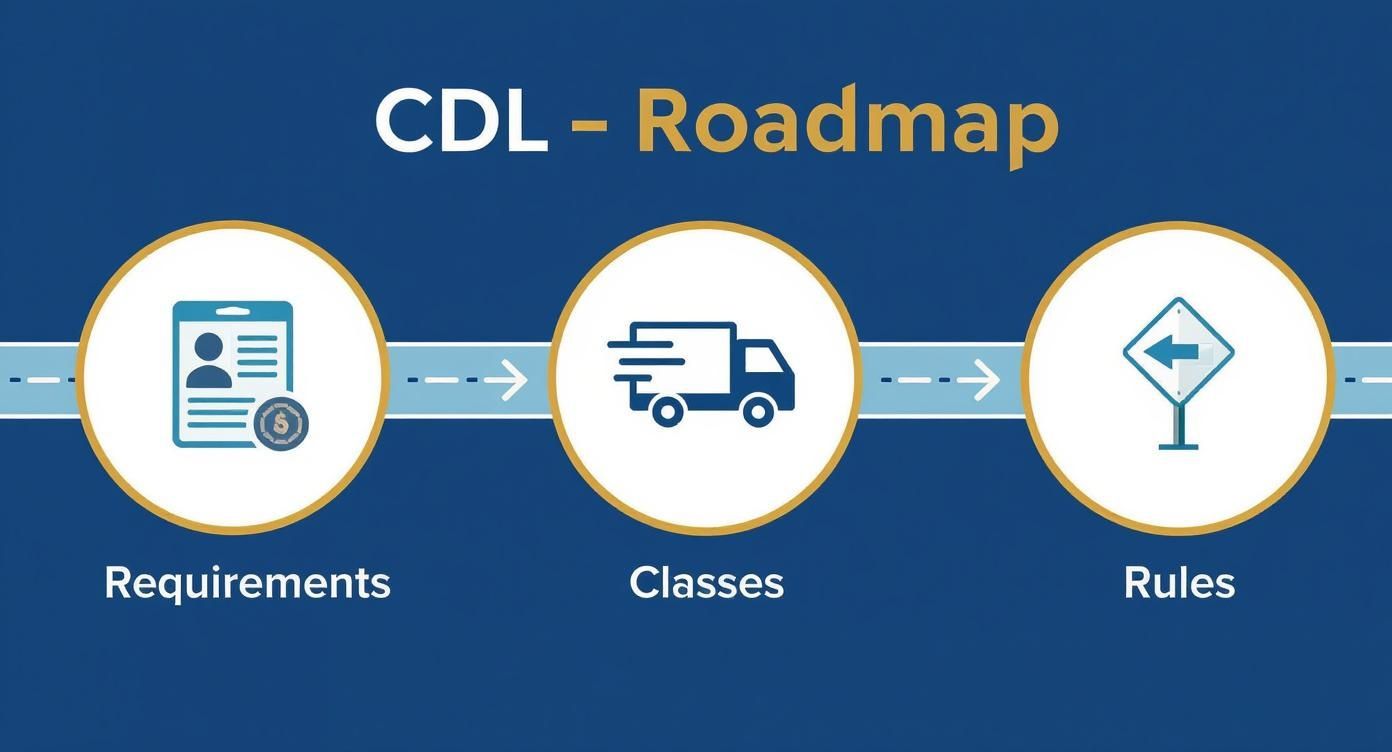
This visual gives you a bird's-eye view, breaking the journey down into meeting the initial requirements, picking the right license class, and finally, mastering the rules of the road.
How State Rules Shape Your CDL Journey
While federal regulations set the foundation for getting a CDL, think of them as the interstate highway system—the main route everyone has to follow. But once you get off the main highway, each state has its own local roads, unique speed limits, and specific traffic signs. That’s exactly how cdl license requirements work.
This means the path to earning your license in Florida won't be identical to the one in Ohio or Texas. Your state’s Department of Motor Vehicles (DMV) is in the driver's seat for handling applications, administering tests, and issuing your license. They have to follow all the federal minimums, but they’re free to add their own requirements on top.
For new drivers, these state-level differences can be a real headache. Showing up with the wrong documents or missing a small, state-specific step is an all-too-common pothole that can get your application rejected and force you to start the whole process over.
Common State-by-State Variations
So, what exactly changes from one state border to the next? The differences usually pop up in a few key areas that can directly affect how you apply. It's always best to check with your local DMV for the final word, but here are the most common things to watch out for.
-
Age for Intrastate Driving: The federal government says you have to be 21 to drive a commercial truck across state lines. But many states will issue a CDL to drivers as young as 18 for intrastate driving, meaning you can operate within that state's borders only.
-
Proof of Residency Documents: This is a big one. Every state has its own checklist for proving you're a resident. One state might be fine with a utility bill and a bank statement, while the one next door might demand a signed lease agreement or a recent property tax bill.
-
Background Checks and Medical Waivers: Some states dig a little deeper with background checks, especially if you're going for endorsements like a school bus (S) or hazardous materials (H). They also have their own procedures for granting medical waivers for certain health conditions.
The bottom line is this: Your local DMV has the final say. While a CDL from any state is valid across the country, you have to earn it by playing by your home state's rulebook.
Preparing for Your State's Process
The absolute best way to avoid delays is to prepare for your specific state's process. Don’t just read the federal guidelines and assume you’re good to go. For instance, getting licensed in a large state often comes with its own set of hurdles. If you're in the Golden State, you can see a detailed breakdown of the CDL requirements in California to get a feel for how it works there.
Before you ever set foot in the DMV, pull up their official website and make a checklist. If anything is unclear about what documents to bring or how much it'll cost, just give them a call. A few minutes of prep work upfront can save you hours of frustration and get your CDL journey started on the right foot.
Passing the Mandatory DOT Medical Exam
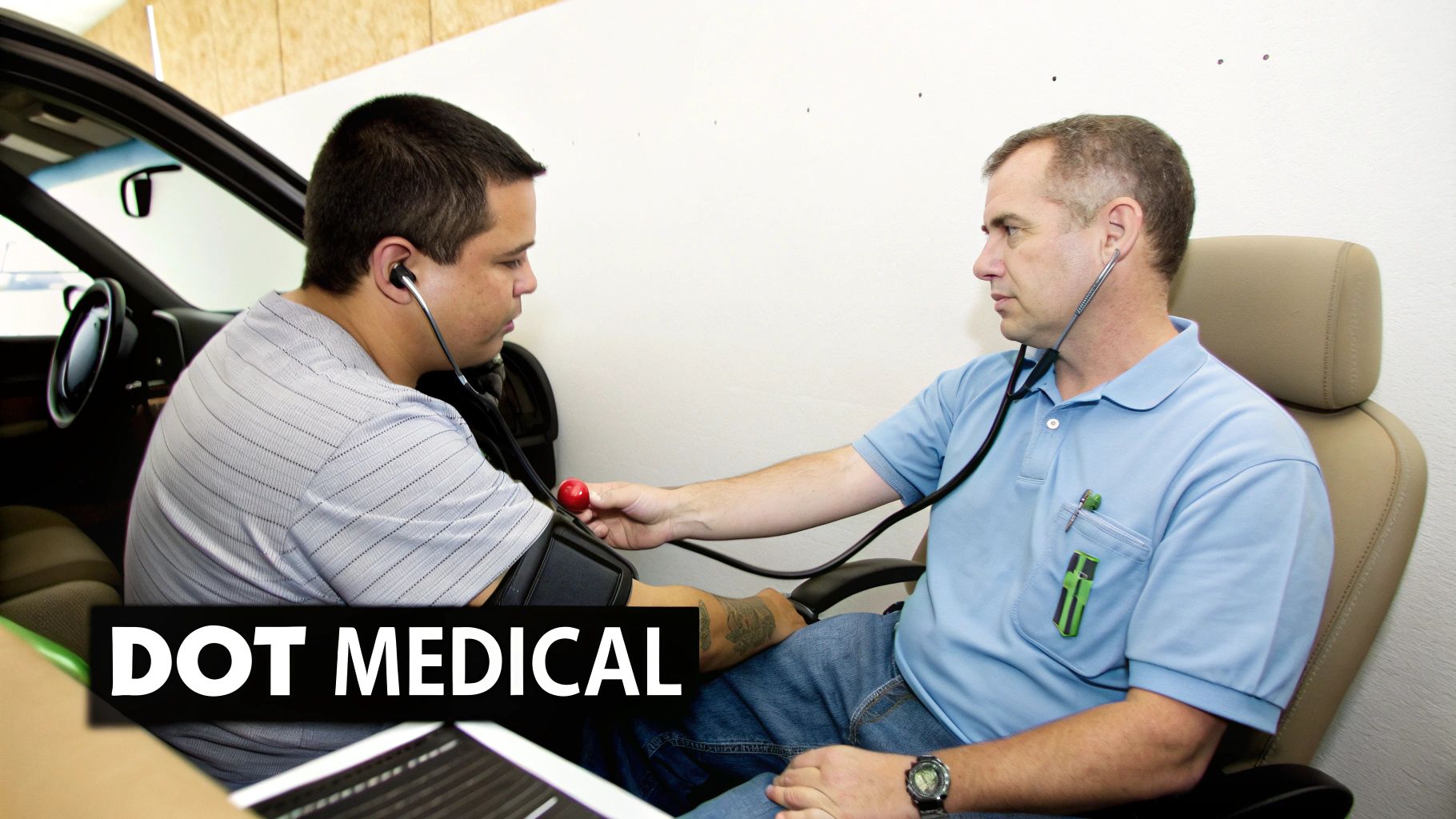
Before you can get behind the wheel of a big rig, you need to prove you're medically up to the task. Think of the Department of Transportation (DOT) medical exam like a pre-flight check for a pilot—it's a non-negotiable safety step to make sure you can handle the job without putting yourself or anyone else on the road at risk.
This isn't your average annual physical. It's a key piece of the cdl license requirements puzzle, specifically designed to ensure no physical or mental health issues could get in the way of you driving safely. Every single person wanting to drive a commercial vehicle has to pass this exam to get their Medical Examiner's Certificate, which most drivers just call a "med card."
What to Expect During the Examination
You won't be seeing just any doctor for this. The DOT physical has to be done by a Certified Medical Examiner (CME), someone who is specially trained and listed on the Federal Motor Carrier Safety Administration's (FMCSA) National Registry. They know exactly what to look for when it comes to the health of a commercial driver.
The exam itself is a head-to-toe evaluation focusing on the things that matter most for driving. Here’s a quick rundown of what they'll check:
- Vision and Hearing Tests: Your vision needs to be at least 20/40 in both eyes, with or without glasses. For hearing, you have to be able to hear a "forced whisper" from five feet away or pass a formal hearing test.
- Blood Pressure and Pulse Rate: The examiner will look for high blood pressure or an irregular heartbeat, as these conditions can be a real danger on the road.
- Urinalysis: This isn't a drug test for the DOT physical; it’s a simple screening for underlying problems like diabetes.
- Physical Examination: The CME will do a general wellness check—listening to your heart and lungs, checking your reflexes, and looking for any physical limitations that could make driving difficult.
The point of this exam isn't to "pass or fail" like a test in school. It's about making sure any health conditions you might have are under control, so they won't interfere with your ability to operate a commercial vehicle safely.
Preparing for a Successful Medical Exam
A little bit of prep work can make your DOT physical a much smoother, stress-free experience. Being proactive about your health and upfront with the examiner is the best way to avoid any hang-ups.
Here are a few tips to help you get through it without a hitch:
- Gather Your Medical History: Make a list of all medications you're taking, including dosages and who prescribed them. If you have a known condition like sleep apnea or a heart issue, bring along recent notes from your specialist.
- Avoid Stimulants: On the day of your appointment, try to skip the coffee, energy drinks, and cigarettes. These can temporarily raise your blood pressure and skew the results.
- Be Honest on Your Forms: When you fill out the medical history form, be completely truthful. Trying to hide a condition is a bad idea—it's dangerous and could get you disqualified down the line if it's discovered.
Getting your med card is a huge step. It proves you’re ready for the physical demands of the job and gets you that much closer to hitting the open road with your CDL.
Your Guide to CDL Training and Knowledge Tests
Getting your CDL is as much about what you know as what you can do. Before you even think about mastering the air brakes or backing up a 53-foot trailer, you have to build a solid foundation of knowledge. This is a non-negotiable part of meeting today's CDL license requirements and making sure you're a safe, responsible operator out on the road.
The first major step in this process is the federal Entry-Level Driver Training (ELDT) mandate. This isn't just a good idea—it's a mandatory curriculum for anyone wanting to get a Class A or Class B CDL for the first time. The whole point of the ELDT rule is to ensure every new driver starts with the same high-quality, standardized instruction.
Understanding the ELDT Mandate
Think of the ELDT mandate as the official playbook for becoming a professional driver. It breaks your education into two essential pieces: theory (what you learn in a classroom) and behind-the-wheel (BTW) training (what you do in the truck). You can’t just do this anywhere; you have to complete both parts with a school listed on the FMCSA’s official Training Provider Registry (TPR).
This rule was put in place to raise the bar for safety across the entire industry. The theory portion covers dozens of critical topics, from basic vehicle controls and defensive driving techniques to handling cargo and navigating complex regulations. You have to pass the theory exam with at least an 80% score before you're even allowed to move on to the hands-on driving portion.
If you want to dig into the nuts and bolts, our guide to ELDT training requirements breaks down exactly what this crucial training covers.
Preparing for Your Knowledge Tests
Once you've conquered your ELDT theory, your next stop is the DMV to take the written exams for your Commercial Learner's Permit (CLP). This permit is your ticket to legally practice driving a big rig on public roads, as long as you have a qualified CDL holder in the passenger seat.
To get that CLP, you’ll need to pass a few different knowledge tests. Which ones you take will depend on the license you’re going for.
- General Knowledge Test: This is the big one that every single applicant has to pass. It covers the fundamentals—vehicle inspection, basic control, accident procedures, and safe driving principles. Expect about 50 questions.
- Air Brakes Test: Since nearly all heavy-duty trucks use air brakes, this test is a must. If you don't pass it, you'll get an "L" restriction on your license, which basically means you can't drive most commercial trucks and your job prospects will be slim.
- Combination Vehicles Test: This one is just for the Class A hopefuls. It’s all about proving you know the right way to couple and uncouple trailers and handle the unique challenges of driving a combination vehicle.
Passing these written tests is your official entry into the world of commercial driving. They prove you have the foundational knowledge needed before you can safely get behind the wheel for your practical training.
Getting through these educational CDL license requirements is what sets you up for success. When you ace your ELDT and CLP exams, you build the confidence and competence you'll need to tackle the final challenge: the hands-on skills test.
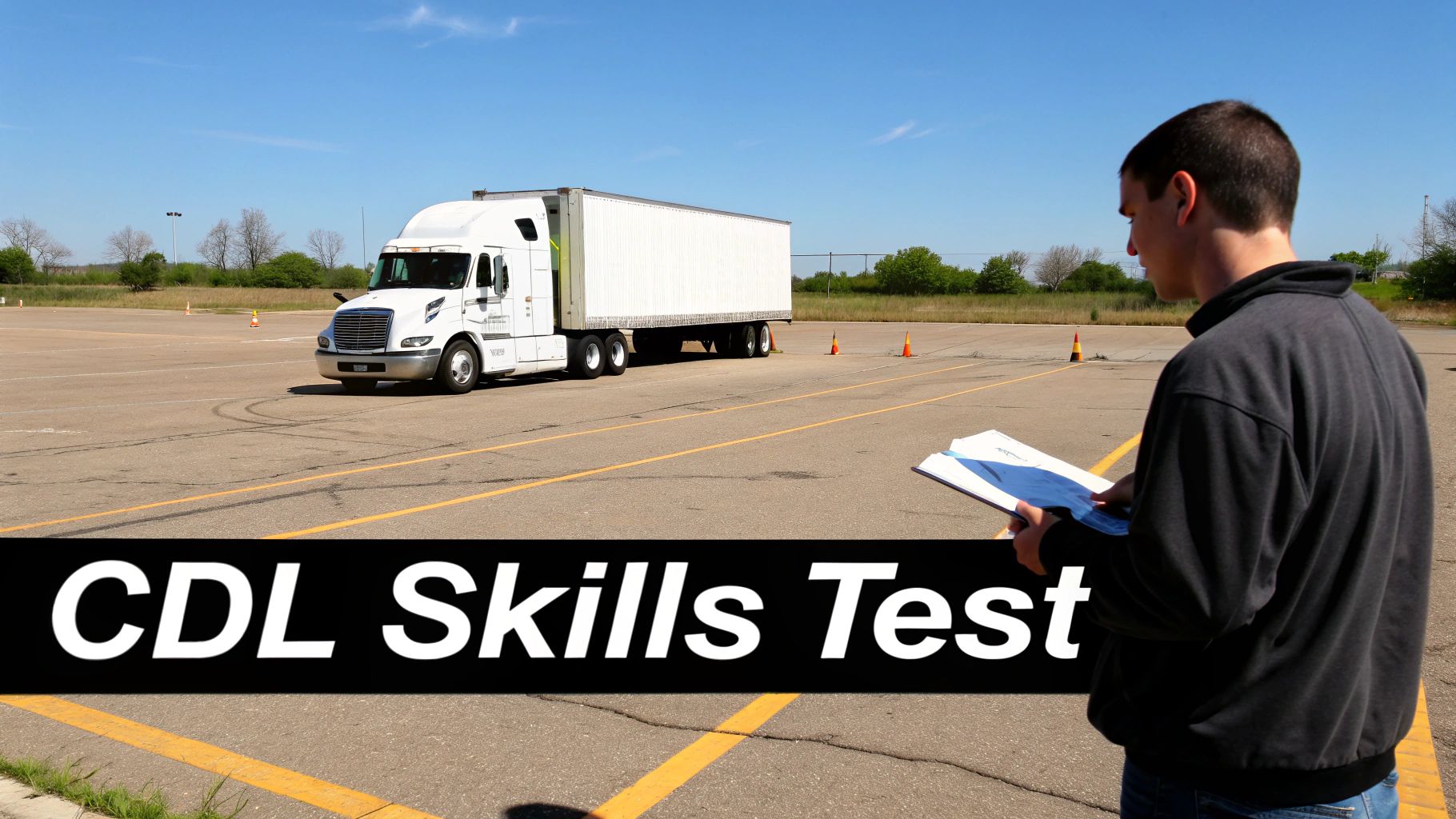
Mastering the Three-Part CDL Skills Test
So, you’ve put in the classroom time and passed your written knowledge tests. Now it’s time for the final challenge: the hands-on CDL skills test. This is where the rubber literally meets the road, and you get to prove you have what it takes to safely command a commercial vehicle.
Think of it as the big final exam, broken down into three distinct parts. You have to pass each one in order to move on to the next. If you stumble on any section, the test usually stops right there, and you'll have to come back another day. From start to finish, plan on the whole process taking about two to two-and-a-half hours.
Act One: The Vehicle Inspection
First up is the vehicle inspection, which most drivers know as the pre-trip inspection. Don't underestimate this part—it's arguably the toughest hurdle for most new drivers. In fact, a staggering 8 out of 10 test failures happen right here before the truck even starts rolling.
This is far more than just a quick walk-around. You'll need to guide the examiner around your truck, physically pointing to or touching key parts, naming them correctly, and explaining what you're looking for. You'll cover the works, from the engine compartment's belts and fluids to the air brake system and fifth-wheel connection.
The secret here is all about muscle memory and repetition. Examiners need to see that you have a systematic, memorized process for verifying your rig is road-worthy. For a step-by-step breakdown, our complete guide to the CDL pre-trip inspection covers everything you need to memorize.
Act Two: Basic Control Skills
Once you’ve aced the inspection, it's time to show off your maneuvering skills. This portion of the test happens on a closed course or in a yard, safely away from public streets. The entire point is to demonstrate that you can handle a big rig with precision in tight quarters.
You'll be asked to perform a series of low-speed backing maneuvers. While the exact set can differ from state to state, the goal is always the same: control.
You can almost always count on seeing these on the test:
- Straight Line Backing: Sounds simple, but keeping a 53-foot trailer perfectly straight while reversing takes practice.
- Offset Backing: This involves backing your rig into a lane that's just to the left or right of your current one.
- Alley Dock: This classic maneuver simulates backing your trailer into a loading dock from a 90-degree angle, just like you would in the real world.
Each exercise is set up within a space marked by cones or lines. If you hit a cone or cross a boundary, you lose points. Too many mistakes, and you fail this section.
Act Three: The On-Road Driving Test
The final piece of the puzzle is the road test. With the examiner in the passenger seat, you’ll head out onto public roads to show how you handle the truck in live traffic. This is your chance to prove you're a safe, competent professional.
This is where all your training—the classroom theory, the yard practice, and your instructor's advice—all comes together in a real-world setting.
The examiner will give you directions, guiding you through a variety of situations. They’ll be watching how you handle everything from intersections and lane changes to merging onto a busy highway and managing steep grades. They're also paying close attention to the little things: Are you constantly checking your mirrors? Are you leaving a safe following distance? Are you signaling every move? This is your final demonstration that you're ready for a career on the road.
Choosing the Right Endorsements for Your Career
Think of your basic Class A or Class B CDL as a general admission ticket. It gets you into the concert, but it doesn't get you backstage or into the VIP section. For that, you need special passes. In the trucking world, those passes are called endorsements.
Getting endorsements is one of the smartest things a driver can do. These special qualifications on your license prove you have the specific skills to handle certain kinds of cargo or vehicles. This directly opens up more job opportunities and can boost your annual pay by $13,000 to $23,000. Each endorsement unlocks a new niche, from hauling hazardous materials to driving a bus full of passengers.
Decoding the Most Common Endorsements
At first glance, the list of endorsements can look like a bunch of random letters. But each one represents a unique skill set and career path. To earn an endorsement, you'll need to pass an additional written knowledge test for that specific area.
Here are the heavy hitters you’ll want to consider:
- T – Double/Triple Trailers: This one lets you pull two or three trailers at once (where it's legal, of course). You'll need a Class A license to even test for it.
- P – Passenger: If you want to drive a bus or any vehicle built to carry 16 or more people, this is a must-have. It requires both a written exam and a road skills test in a passenger vehicle.
- N – Tanker Vehicles: This is your ticket to hauling liquids or gasses. The test proves you understand the "slosh factor" and the unique physics of managing liquid cargo on the move.
- H – Hazardous Materials (HazMat): For the brave souls hauling flammable, corrosive, or explosive materials. This one is a bigger deal, requiring a full TSA background check on top of the written test.
- X – Tanker/HazMat Combo: This is the two-for-one special. It’s for drivers hauling hazardous materials inside a tanker truck and is earned by passing both the N and H tests.
Understanding License Restrictions
While endorsements add privileges to your license, restrictions do the exact opposite—they take them away. These codes get stamped on your CDL and limit what kind of commercial vehicle you're legally allowed to drive. They usually pop up if you take your skills test in a truck that isn't equipped with certain features.
The most common restriction is the "L" for air brakes. If you have this on your license, you can't operate any truck with an air brake system, which knocks you out of the running for the vast majority of trucking jobs.
Another big one to watch out for is the E restriction. This code means you can't drive a truck with a manual transmission because you took your driving test in an automatic. Learning how to get this removed can seriously expand your job prospects. For drivers looking to upgrade, an E restriction removal course is the most direct way to unlock those opportunities.
The best strategy is to avoid restrictions from the start. Make sure the truck you train and test in has all the features you'll need for your career, like air brakes and a manual transmission. While we're focused on CDLs here, it's also helpful to know about the different types of driver's license endorsements that exist outside of trucking, like those for motorcycles.
Got Questions About CDL Requirements? We've Got Answers.
Jumping into the world of commercial driving brings up a lot of questions. It's completely normal. To help clear things up and get you on the right track, let's tackle some of the most common things people ask about CDL license requirements.
Do I Need a High School Diploma to Get a CDL?
Nope. You don't need a high school diploma or a GED to get your CDL. The main things regulators care about are your age, your driving record, and whether you can pass the medical exam and skills tests. This opens the door to a great career for people from all kinds of backgrounds.
What really matters in trucking is your skill behind the wheel, your commitment to safety, and your professionalism—not what's on a high school transcript. It's all about whether you can handle the rig safely and responsibly.
This creates a level playing field where practical ability is king.
Can I Do Any of My CDL Training Online?
Yes, but only a small part of it. The federal Entry-Level Driver Training (ELDT) mandate includes a classroom or "theory" section. This part covers the rules of the road, safety protocols, and how the truck's systems work. Many accredited schools now offer this theory portion as an online course, which is super convenient.
But let's be clear: you can't get a full CDL online. The hands-on, behind-the-wheel training is where you learn to actually drive the rig, and that has to be done in person, with a certified instructor, at a proper training facility. There's no substitute for real-world practice.
Do I Have to Speak English to Get a CDL?
Yes, a solid, basic understanding of English is a federal requirement. As a driver, you’ll need to communicate with law enforcement, read and understand road signs, and fill out reports or logs. You don't have to be a poet, but you need to speak and read English well enough to do your job safely and follow the rules.
While some states might offer the written permit test in different languages, the practical skills test—especially the all-important pre-trip inspection—is always conducted in English.
If I Fail My Test, How Long Do I Have to Wait to Retake It?
This really depends on your state, but a 14-day waiting period is a pretty common rule of thumb after failing a CDL skills test. This isn't a punishment; it’s designed to give you enough time to go back and practice the specific maneuvers or skills that gave you trouble.
It’s incredibly important to check with your local DMV for the exact rules. Some states have different waiting periods, and others might limit how many times you can retake the test within a year.
Ready to stop wondering and start driving? Patriot CDL gives you the expert, in-person training you need to master every CDL requirement and walk into your exam with confidence.
Get Started with Patriot CDL Today