


A pavement-edge drop-off can turn a small lane-position error into a major commercial-vehicle emergency. The right-side tires leave the pavement, the shoulder pulls differently from the travel lane, the trailer begins following the lower surface, and the driver feels pressure to steer back immediately. A sharp, panicked correction can make the tires scrub against the pavement edge, then climb suddenly and send the combination across the lane.
The safer plan begins before departure: recognize low-shoulder signs, manage speed before curves and work zones, keep a stable lane position, and avoid distractions. If the vehicle does leave the pavement, control matters more than an instant return. Hold the wheel, reduce power, avoid abrupt braking and steering, preserve stability, and use the clear shoulder to slow or stop whenever possible. Re-enter only after the vehicle, traffic, shoulder, and pavement edge support a controlled move.
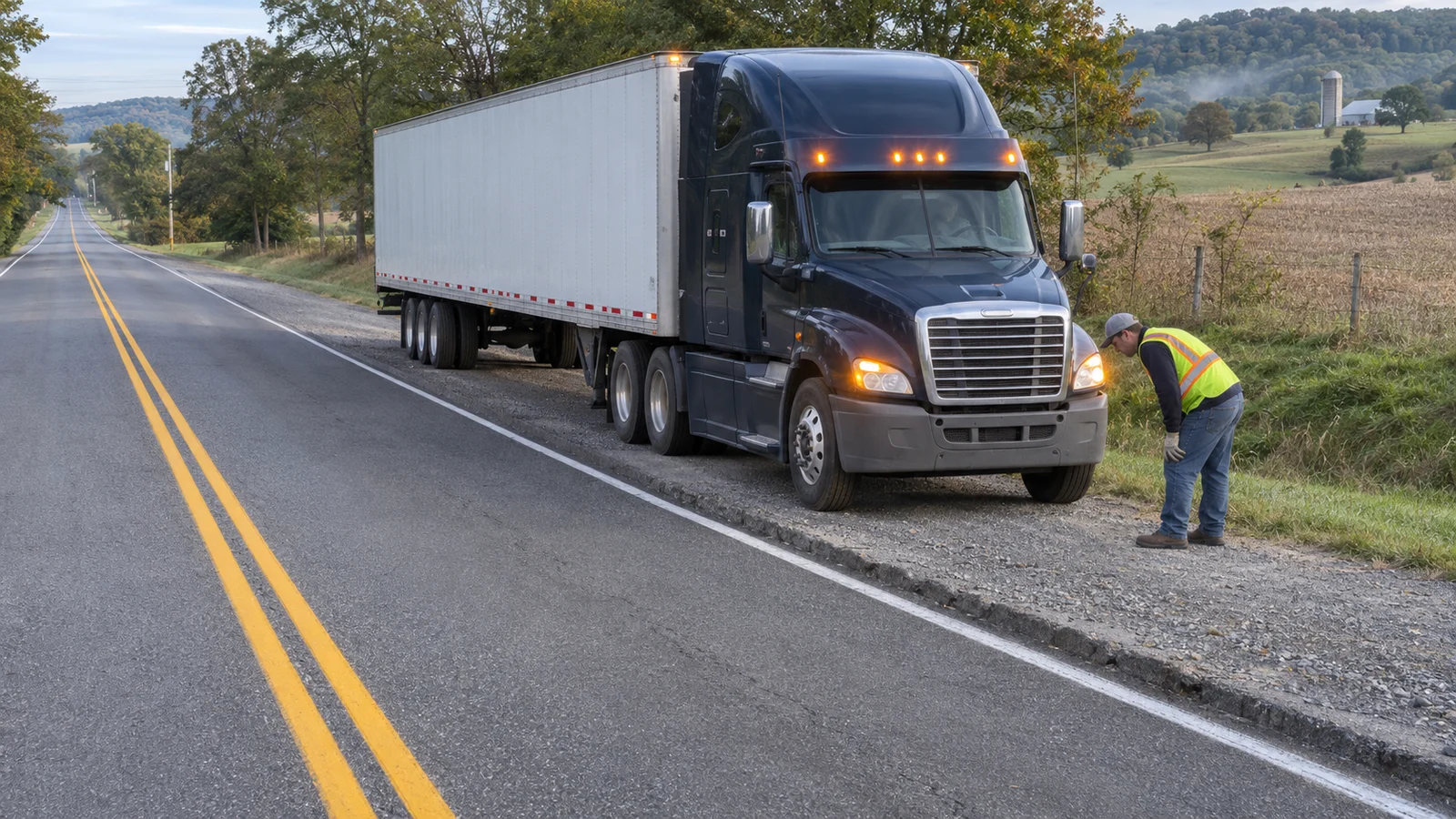
Understand the road-edge hazard
The Pennsylvania Commercial Driver’s Manual identifies a drop-off as pavement that falls sharply near the road edge. Driving too close can tilt a tall vehicle toward signs, branches, poles, or other roadside objects, and the edge can make steering difficult both while leaving and while returning. Drop-offs commonly appear on rural roads, resurfacing projects, narrow lanes, damaged shoulders, and locations where gravel has settled or eroded.
The pavement edge can resist the tire
When a tire presses against a vertical edge, the sidewall may scrub instead of climbing. If the driver keeps adding steering, the tire can suddenly mount the pavement with too much steering angle. FHWA describes this overcorrection sequence as a possible “slingshot” across the road. A tractor-trailer adds articulation, offtracking, cargo movement, and rollover exposure to that basic problem.
The trailer may be in a different condition from the tractor
The tractor’s steer tires may return to pavement while the drive and trailer axles remain on the lower shoulder. A driver who accelerates or unwinds the steering too soon can create a new pull or trailer swing. Recovery is complete only when the whole combination is stable, correctly positioned, and clear of roadside objects.
Prevent a shoulder departure
The best recovery is the one the driver never needs. A deliberate visual search provides time to see the road edge, warning signs, lane narrowing, work activity, oncoming width conflicts, curves, and shoulder condition. The search routine in our CDL hazard-perception guide helps turn those clues into early speed and position choices.
Read LOW SHOULDER and SHOULDER DROP-OFF signs
PennDOT uses shoulder warning signs where the shoulder is lower than the road, soft, or severely dropped. Treat the sign as an instruction to reassess speed, lane position, oncoming traffic, and escape space. Do not move left without checking traffic merely to create extra margin; use a legal, centered lane position and adjust speed for the available width and view.
Reduce speed before curves and narrow areas
The current Pennsylvania CDL manual tells skills-test applicants to reduce speed before entering a curve so further braking or shifting is not required in the curve. That habit also protects the road edge. Entering at a controlled speed reduces lateral pull and leaves time for small steering corrections. If the curve, work zone, or oncoming vehicle makes the lane feel too narrow, slow before the tight point rather than drifting onto the shoulder.
Keep both hands available for control
Good steering begins with a stable seating position and both hands ready. Do not reach for a phone, navigation device, drink, paperwork, or loose object. Avoid a long mirror stare when the lane edge is close. Our distracted-driving and cab-setup plan explains how to remove those tasks before moving.
Give the trailer enough lane margin
A long trailer may track close to the outside edge in a curve even when the tractor appears centered. Use mirrors to monitor the trailer without losing the forward view. Account for wind, road crown, lane width, oncoming vehicles, and cargo behavior. Avoid crowding either the centerline or the edge; the correct position is a controlled path within the lane.
Control the first seconds off the pavement
If the right wheels leave the pavement and the shoulder is open, resist the urge to snap the truck back. The Pennsylvania CDL manual’s leaving-the-road guidance emphasizes stability: avoid braking if possible until speed has dropped, keep one set of wheels on pavement if possible, and use the shoulder as an escape route when it is clear.
Hold the wheel firmly and look where the vehicle should go
Keep both hands on the wheel and make only the steering needed to remain parallel to the roadway. Look far enough ahead to identify a ditch, guardrail, sign, culvert, parked vehicle, soft area, or narrowing shoulder. A fixed stare at the pavement edge can hide the larger path.
Ease off the accelerator
Reduce power smoothly. Engine drag and rolling resistance can begin lowering speed without transferring weight abruptly. Do not accelerate in an attempt to “climb” the edge. Extra speed reduces recovery time and increases the force of any later correction.
Avoid abrupt braking
Hard braking with tires on different surfaces can pull or skid the vehicle, and braking while making a large steering correction can reduce stability further. The CDL manual advises avoiding brakes if possible until speed has fallen to about 20 mph, then braking very gently on a loose surface. Real conditions may require braking to avoid an immediate obstacle; use only the controlled braking needed to preserve direction and follow the vehicle manufacturer’s ABS guidance.
Keep one set of wheels on pavement if possible
When the combination is already straddling the edge, a stable parallel path with one side on pavement can help maintain directional reference and control. Do not scrape the tire sidewalls continuously against a sharp pavement edge. If the edge, shoulder, or roadside makes the path unsafe, the driver must choose the least hazardous available action based on the actual scene.
Use a clear shoulder to slow or stop
If the shoulder is firm, clear, and wide enough, the Pennsylvania CDL manual advises staying on it until the vehicle stops. Stopping removes the urgency of remounting the edge and creates time to check traffic, vehicle damage, cargo, and the path back. This is usually preferable to forcing a long combination onto the pavement while speed remains high.
Evaluate the whole shoulder
A shoulder that supports the steer axle may soften near the trailer, narrow at a bridge, or end at a guardrail. Scan well ahead and use mirrors. Keep the combination as straight as conditions allow. If the shoulder cannot support the load, avoid a sudden steering or braking input and use the most controlled path available toward a safe stopping point.
Communicate the stop
Activate four-way flashers and give following traffic early warning. Once stopped, follow applicable law and carrier procedure for emergency signals and warning devices. The practical placement sequence is covered in our commercial-vehicle roadside warning-device guide. Do not step into an active lane or stand where approaching traffic cannot see you.
Secure the vehicle before leaving the cab
Set the parking brakes, place the transmission as required, shut down or idle only under applicable procedure, and assess traffic before opening the door. Exit on the side away from traffic when possible and maintain three points of contact. A narrow or unsafe shoulder may make it safer to remain belted in the cab and request assistance.
Return to the roadway only when necessary and clear
There are two different situations. If the truck can stop on a clear shoulder, stop first, inspect, then make a normal signal-and-mirror re-entry when a safe gap exists. If the vehicle is forced to return before stopping because the shoulder ends or contains a greater hazard, use the commercial-manual procedure for a deliberate steer-and-countersteer. Do not mix the two plans.
Preferred plan: stop, inspect, then merge
After stopping, check the edge height, shoulder firmness, tire condition, traffic volume, sight distance, and acceleration space. Signal left, recheck both mirrors and the blind area, and wait for a gap that accommodates the entire combination. Enter at a shallow, controlled angle where the edge allows, then straighten and build speed without obstructing traffic. If the drop-off is too high or the shoulder too soft, request appropriate assistance rather than damaging the vehicle or losing control.
Forced return before stopping
The Pennsylvania CDL manual says that when a driver must return before stopping, the driver should hold the wheel tightly, make a steering input sufficient to get the front tires back onto pavement, and countersteer immediately after both front tires remount. The steer and countersteer are one coordinated action. This is not a reason to return at high speed or use more steering than necessary; reduce speed and stabilize first whenever the shoulder permits.
Continue until every axle is stable
Do not accelerate aggressively when only the steer axle has returned. The drive axles and trailer tandems may still be below the edge. Continue mirror checks, maintain a controlled path, and allow the remaining axle groups to remount without crowding the centerline or opposing lane. If the trailer begins to swing or the vehicle becomes unstable, prioritize directional control and avoid compounding the movement.
Inspect before continuing
A shoulder departure can damage components even when the driver feels no impact. Loose stone, a sharp pavement edge, a hidden object, or a soft rut can affect tires, rims, suspension, steering, brake lines, air lines, underbody parts, mudflaps, cargo, and trailer doors.
Tires and wheels
Look for sidewall cuts, bulges, exposed cord, abnormal marks, lost pressure, bent or cracked rims, loose or missing fasteners, damaged valve hardware, and material lodged between dual tires. Do not touch hot components or place yourself under an unsecured vehicle. Review the full process in our commercial-truck tire inspection guide.
Steering and suspension
Check for visible damage, shifted parts, air leaks, broken or displaced springs, damaged shocks, loose mounts, unusual lean, or fresh contact marks. Any steering pull, vibration, warning light, pressure loss, or abnormal sound after departure should be treated as a potential defect. Our steering and suspension inspection plan provides component context.
Cargo and trailer condition
The tilt, bump, or steering correction may shift cargo or loosen securement. Check doors, seals, straps, chains, blocking, bracing, and visible load condition as applicable. A sealed load or inaccessible cargo still requires the checks allowed by law and operating procedure. Use the cargo securement and recheck guide for a broader routine.
Do not continue with an unresolved defect
If the vehicle may be unsafe, keep it secured, use required warnings, notify the carrier, and obtain inspection or roadside service. A vehicle that can move is not automatically safe to operate. Document the condition under company and regulatory procedures.
Worked scenario: right wheels leave a rural road
A CDL student is driving a loaded tractor-trailer on a dry two-lane rural road with a gravel shoulder several inches below the pavement. The road curves gently right. An oncoming pickup drifts near the centerline, and the student moves slightly right. The tractor’s right steer and drive tires cross the white edge line onto the lower shoulder; the trailer’s right tires follow.
Step 1: stabilize instead of snapping back
The student holds the wheel firmly, looks down the clear shoulder, and keeps the combination parallel. The accelerator is released smoothly. The student does not brake hard or turn sharply toward the pavement. The oncoming pickup passes without contact.
Step 2: use the clear shoulder
The shoulder remains firm and wide for several hundred feet. The student keeps the left-side tires near the pavement edge, activates the flashers, and lets speed fall. After the truck is moving slowly, the student applies gentle braking and brings the combination to a complete, straight stop on the shoulder.
Step 3: secure and inspect
With the vehicle secured, the student and instructor assess traffic before exiting on the passenger side. They inspect the right tires and wheels, visible steering and suspension parts, brake and air lines, trailer underbody, doors, and cargo securement. They also inspect the pavement edge and find a lower point ahead that supports a controlled return. No defect is found.
Step 4: re-enter as a normal merge
The student returns to the cab, fastens the belt, signals left, checks both mirrors, and waits for a long gap. The combination accelerates gently on the shoulder, crosses the lower edge at the suitable point, and straightens within the lane. The student confirms the trailer has cleared, cancels the signal, checks the mirrors again, and resumes an appropriate speed. The lesson is not that every shoulder permits this plan; it is that control, inspection, and verified space replace panic.
Road-edge clue-and-action table
| Clue or condition | Primary risk | Controlled response | Avoid |
|---|---|---|---|
| LOW SHOULDER or SHOULDER DROP-OFF sign | Uneven edge, soft surface, reduced recovery space | Reduce speed, center the vehicle, scan the shoulder and oncoming traffic | Late move across the centerline |
| Right wheels leave pavement onto clear, firm shoulder | Traction difference and overcorrection | Hold steady, ease off power, stay parallel, slow progressively | Hard braking or snapping left |
| Tire scrubs along a vertical pavement edge | Sudden remount and cross-lane “slingshot” | Reduce speed, remove unnecessary steering pressure, choose a suitable return point | Adding more and more steering angle |
| Shoulder clear far ahead | Unnecessary forced re-entry at speed | Use the shoulder to slow or stop, then inspect and merge | Racing back onto pavement |
| Shoulder ends or obstacle is ahead | Collision or rollover off road | Stabilize, reduce speed, check traffic, use coordinated steer-countersteer if forced to return | Unplanned multiple steering corrections |
| Vehicle stops on shoulder | Secondary collision from passing traffic | Use flashers and required warning devices; exit only when safe | Standing in the travel lane |
| New vibration, pull, leak, warning, or tire damage | Hidden mechanical defect | Keep vehicle secured and obtain authorized inspection or service | Continuing because the truck still moves |
Shoulder-recovery checklist
- Scan early for curves, lane narrowing, edge damage, and shoulder signs.
- Reduce speed before the narrow or curved section.
- Keep both hands ready and remove cab distractions.
- Maintain a stable lane position without crowding the centerline or edge.
- If wheels leave pavement, look ahead and hold the vehicle parallel.
- Ease off the accelerator smoothly.
- Avoid abrupt braking and steering.
- Keep one set of wheels on pavement if possible and stable.
- Evaluate shoulder width, firmness, slope, objects, and where it ends.
- Use a clear shoulder to slow or stop when possible.
- Activate flashers and warn following traffic.
- Secure the vehicle before leaving the cab.
- Use required roadside warning devices when applicable.
- Inspect tires, wheels, steering, suspension, lines, and underbody.
- Recheck cargo, securement, doors, and trailer condition.
- Do not operate with an unresolved safety defect.
- Before re-entry, inspect the pavement edge and choose a suitable point.
- Signal, check mirrors, and wait for space for the whole combination.
- Use the correct stop-and-merge or forced-return procedure for the situation.
- Confirm every axle group is stable before accelerating normally.
Common mistakes to correct
Trying to return before controlling speed
Speed makes every steering input more powerful and leaves less time to countersteer. When the shoulder is usable, stabilize and slow or stop before returning. Do not let embarrassment or following traffic rush the decision.
Braking hard on split surfaces
Different traction under the left and right tires can pull or rotate the vehicle. Use progressive speed reduction and only the braking needed for the actual hazard. The traction concepts in our skid and jackknife prevention guide remain important.
Watching the tractor and forgetting the trailer
The trailer may offtrack toward a ditch, sign, guardrail, or soft area. Keep mirror checks in the scan through the stop and re-entry. A tractor fully on pavement does not mean the trailer is clear.
Assuming every shoulder supports a loaded truck
The surface may hide soft soil, a culvert, drainage opening, steep slope, or eroded edge. Read the shoulder continuously. If the surface cannot support the vehicle, choose the least hazardous available response and request assistance once stopped.
Skipping the post-event inspection
A short departure can cut a sidewall, bend a rim, displace a suspension part, damage a line, or shift cargo. Inspection is part of the recovery, not an optional extra after the truck returns to pavement.
Frequently asked questions
What should a CDL driver do first if the truck’s right wheels leave the pavement?
Hold the steering wheel firmly, look ahead along the available shoulder, keep the vehicle as parallel to the road as possible, and ease off the accelerator. Avoid a sudden brake or steering input. The immediate goal is stable directional control, not an instant return to the pavement.
Should a tractor-trailer steer back onto the road immediately after a shoulder drop-off?
Usually not when the shoulder is clear and can support the vehicle. The Pennsylvania CDL manual advises using a clear shoulder to slow or stop, then signaling and checking mirrors before returning. A stopped, inspected vehicle can make a normal re-entry with more time and less steering demand.
What if the commercial vehicle must return before it can stop?
Reduce speed and stabilize as much as the available shoulder permits. If the shoulder ends or a greater hazard forces a return, the Pennsylvania CDL manual calls for a firm grip, a deliberate steering input sufficient to remount the front tires, and immediate countersteering once they are on the pavement. Use no more steering than necessary and continue monitoring the remaining axles and trailer.
What should be inspected after a truck runs onto the shoulder?
Inspect tires, sidewalls, rims, valve hardware, dual-tire spacing, steering and suspension parts, brake and air lines, underbody components, mudflaps, doors, cargo, and securement as applicable. Investigate any new pull, vibration, leak, warning light, pressure loss, noise, or visible damage before operating the vehicle.
Official sources and scope
This article uses the current , particularly Sections 2.8 and 2.17; PennDOT’s ; and FHWA material on . Actual decisions depend on the vehicle, load, traffic, surface, roadside geometry, weather, and immediate hazards. Follow current law, vehicle instructions, carrier procedures, and qualified training.
Build calm recovery habits during CDL training
Road-edge recovery is not about memorizing one steering motion. It is a sequence: see the hazard early, protect lane position, stabilize the combination, use the shoulder intelligently, inspect, and re-enter only with verified space. Patriot CDL helps students connect that sequence with real commercial-vehicle dimensions during supervised training. Call or visit Patriot CDL at 7800 Bristol Pike, Levittown, PA 19057.