


A roundabout asks a commercial driver to complete several tasks in a compact space: read the destination signs, choose the correct lane, slow before the curve, yield to pedestrians and circulating traffic, allow for trailer offtracking, monitor nearby vehicles, and signal the exit. None of those tasks is unusual by itself. The challenge is doing them in the correct order before the truck reaches the yield line.
The safest roundabout maneuver usually looks uneventful. The driver recognizes the intersection early, finishes lane selection on the approach, creates a slow and stable entry, waits for a usable gap, keeps the tractor and trailer on a predictable path, and exits without a last-second correction. This guide gives CDL students a repeatable planning sequence for both single- and multilane roundabouts, with Pennsylvania-specific official guidance and a realistic worked example.
Understand the intersection before entering
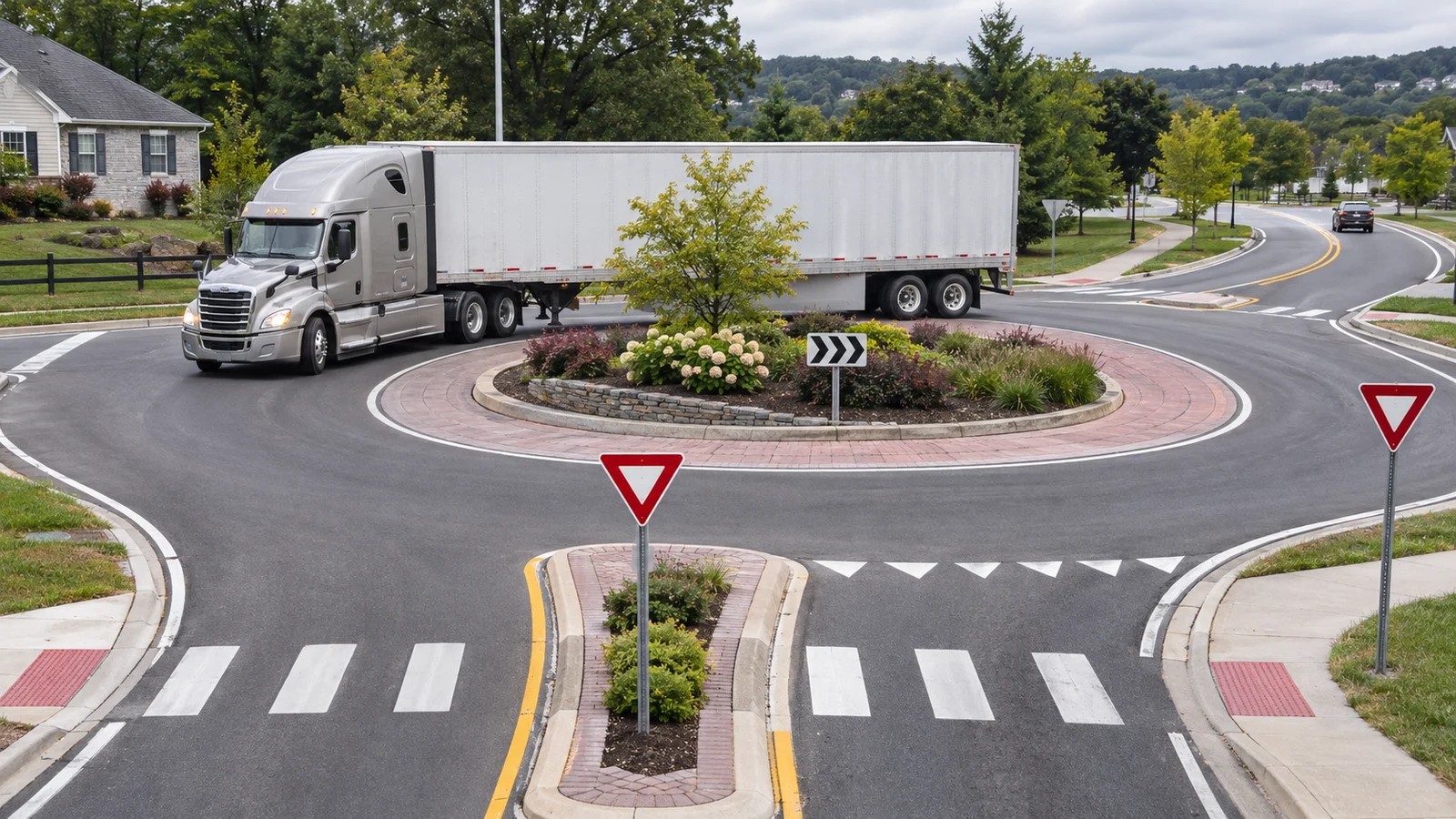
A modern roundabout is a circular intersection with curved approaches, yield control at entry, counterclockwise traffic flow, and a central island. PennDOT distinguishes it from a traffic circle, which may be larger, faster, and controlled differently. That distinction matters: do not rely on a memorized “circle” routine. Read the actual signs, lane arrows, yield markings, crosswalks, and roadway geometry at every location.
Entering traffic yields to circulating traffic
At a Pennsylvania roundabout, entering drivers slow down, yield to pedestrians, and yield to traffic already circulating. At a multilane entrance, PennDOT instructs drivers to yield to all circulating lanes and not assume a vehicle in the inside lane will remain there. A yield is not an automatic stop when the way is clear, but a commercial driver must be ready to stop and must not force another road user to brake or change course to create a gap.
The route is counterclockwise
Traffic moves around the central island counterclockwise. Once properly entered, continue in the selected lane and do not cut directly across the center island. A truck apron is a designed traversable area for large-vehicle offtracking; it is not a shortcut for ordinary vehicles and is different from the landscaped or raised center island itself.
Roundabout decisions begin before the yield line
The approach signs and pavement arrows tell drivers which lane serves each destination. Waiting until the truck is inside the roundabout to choose a path creates conflicts with vehicles beside the trailer. Treat lane selection as an approach task, much like the preparation described in our controlled lane-change and merging guide. If the correct lane cannot be reached safely, continue on a legal path and recover later rather than making an abrupt move.
Set up the approach early
A good approach turns a complex intersection into a short sequence. Search for the roundabout warning sign, destination sign, lane-use arrows, reduced advisory speed, crosswalks, and the back of any queue. Then identify the intended exit and the lane that serves it. The driver should know the plan before beginning the final speed reduction.
Reduce speed before the curve
Complete the main speed reduction while the truck is straight. Entering too fast can increase steering demand, trailer offtracking, load shift, and rollover risk. Select a gear that supports controlled movement through the roundabout without an unnecessary shift in the tightest part of the curve. The exact speed depends on the posted limit or advisory information, vehicle, load, surface, visibility, traffic, and geometry. “Slow” is not a universal number.
Search the crosswalk before the circulating lanes
Crosswalks are often set back from the yield line. Scan sidewalks, curb ramps, splitter islands, and both ends of the crossing. Be prepared to stop before the crosswalk for pedestrians. After the crossing is clear, move forward only as needed to gain a view of circulating traffic. Our commercial-vehicle guide to pedestrians and cyclists explains why a large vehicle must preserve stopping room even when another road user appears to be waiting.
Find a gap for the entire combination
A tractor-trailer needs more time and space than a passenger car to accelerate into the flow and clear the entry. Look left, judge traffic in every circulating lane, and wait for a gap that allows a slow, continuous entry. Do not let pressure from a following driver change the gap decision. The driver behind cannot see the same traffic, vehicle condition, or load behavior from the commercial driver’s seat.
Check the mirrors before committing
Know whether a car, motorcycle, or bicycle is beside the cab or trailer before entering. A nearby vehicle may try to move around the truck as the lane widens near the roundabout. A quick mirror scan also shows whether early braking has been recognized by following traffic. Keep the search moving between the crosswalk, the circulating roadway, the intended path, and the mirrors.
Manage offtracking and truck-apron space
Offtracking means the rear wheels follow a path inside the path of the steering axle. In a roundabout, the tractor may remain on the normal circulating pavement while the trailer tracks closer to the central island. PennDOT’s large-truck brochure explains that truck aprons around the central island are designed for trailer tracking and that some designs also provide outside aprons or striped buffer areas.
Use the apron only as the design and vehicle require
A raised truck apron can look like a curb or decorative ring, but it is constructed to accommodate large vehicles. Allowing trailer wheels to track over a provided apron may be the intended path. Do not steer the tractor onto the apron merely to shorten the turn, and never assume every raised surface is traversable. Observe signs, markings, curb design, and local restrictions. If a route presents uncertain clearance for a particular vehicle or oversize load, route planning and authorized guidance belong before the trip.
Protect the trailer’s inside path
The space beside the tractor is not the same as the space beside the trailer. A passenger vehicle may fit near the cab and then be squeezed as the trailer tracks inward. Keep checking the convex and flat mirrors for the trailer wheels, apron edge, adjacent traffic, and fixed objects. Avoid inviting another vehicle into a space the trailer needs. The broader fundamentals are covered in our truck turn-planning and trailer-clearance guide.
Do not create an unnecessary wide swing
Moving far left on a single-lane approach before turning right can encourage another driver to enter on the truck’s right. Use the roadway provided and the roundabout’s truck-accommodation features. PennDOT notes that a large truck may cautiously need adjacent-lane space in some multilane designs only when no other vehicles are nearby. That is a specific clearance judgment, not permission to disregard lane control or crowd occupied space.
Navigate a single-lane roundabout
A single-lane roundabout removes the adjacent circulating-lane decision, but it still requires disciplined pedestrian, gap, and trailer checks. Use this order:
- Identify the intended exit and read all truck-specific signs.
- Reduce speed on the straight approach and select a controlled gear.
- Search the crosswalk and stop before it if required.
- Look left and yield to all circulating traffic.
- Enter only when the gap supports the entire commercial vehicle.
- Follow the circulating lane counterclockwise without cutting across the center.
- Monitor the trailer in the mirrors and permit designed apron use as needed.
- Use the right turn signal to communicate the intended exit.
- Search and yield to pedestrians at the exit crosswalk.
- Straighten the combination gradually and confirm trailer clearance after exiting.
Keep moving predictably once inside
Do not stop in the circulating roadway merely because a vehicle is waiting at the next entrance; entering traffic is required to yield. An unexpected stop can surprise following traffic and may leave the trailer exposed across an entry. Continue at a controlled speed unless a pedestrian, traffic conflict, obstruction, or other condition requires a stop.
Signal the exit, not the entry
PennDOT advises using the right turn signal to indicate the exit. Activate it early enough to communicate but not so early that another driver could mistake the intended exit. Remember that a signal communicates intent; it does not establish clearance. Continue checking the right side and exit crosswalk.
Navigate a multilane roundabout
Multilane roundabouts add lane-use choices and the possibility of traffic beside the truck. Signs and arrows control which lanes serve right, through, and left movements. PennDOT notes that a left movement usually begins from the leftmost lane, while a through movement may be allowed from the right, left, or both; the actual markings at the intersection are controlling.
Choose the destination lane before entry
Read the diagram sign and pavement arrows early. Finish any lane change well before the crosswalk and yield line. Do not enter from one lane with a plan to cross another circulating lane at the exit. If two lanes serve the same destination, choose the one that provides the clearest legal path for the vehicle and traffic conditions.
Yield to every circulating lane
A driver waiting in the right approach lane may focus only on the nearest circulating lane. That is incomplete. A vehicle in the inner lane may continue around or move toward an exit. Wait for a gap across all lanes that could conflict with the truck’s entry and trailer path.
Hold the selected lane through the circle
Stay aligned with lane markings and avoid changing lanes within the roundabout. Use mirrors to monitor a vehicle that remains beside the truck. If the combination needs extra designed clearance, do not proceed alongside traffic that occupies that space. Waiting at entry is safer than trying to negotiate trailer clearance after both vehicles are committed.
Use mirrors and smooth vehicle control
Roundabouts reward low, stable speed and a moving visual scan. Look through the turn toward the intended path while making quick mirror checks to confirm the trailer’s position. Avoid staring only at the apron or only at the exit; either tunnel view can hide a pedestrian or adjacent vehicle.
Steer progressively
Use gradual steering inputs as the tractor enters, circulates, and unwinds toward the exit. Abrupt steering can increase lateral load transfer and cause the trailer to move across available space quickly. Smoothness is especially important for a high center of gravity, a partially loaded tank, or a load that can shift, but every combination benefits from controlled inputs. Review the related rollover-prevention guide for the wider relationship among speed, curves, cargo, and control.
Use speed to preserve options
A slow approach creates time to stop for a pedestrian, wait for a gap, recheck mirrors, and correct lane position before entry. Once inside, a stable low speed helps the driver see the intended exit and track the trailer without hard braking. Following distance still matters; do not enter closely behind a vehicle that may stop at the exit crosswalk. The principles in our following-distance guide remain applicable in compact intersections.
Worked scenario: multilane roundabout with a through movement
A CDL student is approaching a two-lane roundabout in a tractor with a 53-foot trailer. The route continues straight through. An advance diagram shows that both approach lanes can travel straight, but the right lane has a short queue and the left lane is open. A pedestrian is waiting near the entry crosswalk, and a passenger car is circulating in the inner lane.
Plan before the queue
The student reads the signs early and remains in the left lane rather than making a late move toward the right. Speed is reduced while the combination is straight, and the student chooses a gear that will support steady movement. Mirrors confirm that no vehicle is beside the trailer. The student does not assume the waiting pedestrian will remain on the curb.
Separate the pedestrian and traffic decisions
The student stops before the crosswalk when the pedestrian begins crossing. After the pedestrian clears, the truck moves slowly to the yield line and stops again because the circulating car creates a conflict. Treating those as two separate decision points prevents the driver from rolling through the crosswalk while looking left for a gap.
Wait for all lanes to clear
The inner-lane car continues past the truck’s intended entry. A second vehicle approaches in the outer lane, so the student waits. When both lanes provide a usable gap, the student enters the left circulating lane at low speed. The tractor follows the marked lane while the mirrors show the trailer tracking near the central apron.
Communicate and clear the exit
As the intended exit approaches, the student activates the right signal, checks the right mirror for vehicles and cyclists, and searches the exit crosswalk. The truck follows the lane markings without cutting across the right circulating lane. After the trailer clears the crosswalk and splitter island, the student straightens the vehicle, cancels the signal, checks the mirrors, and resumes an appropriate road speed. The maneuver succeeds because every major decision occurred before the truck needed it.
Roundabout clue-and-action table
| What the driver sees | What it means | Controlled action |
|---|---|---|
| Roundabout diagram and lane arrows | Destination lanes must be chosen before entry | Select the legal lane early; do not plan an inside lane change |
| Pedestrian at the approach crosswalk | The crosswalk decision comes before the traffic-gap decision | Reduce speed and be ready to stop before the crossing |
| Vehicle in any circulating lane | It may continue around or move toward the exit | Yield to every conflicting lane; do not predict its path from lane position alone |
| Raised, differently textured ring by the center island | It may be a designed truck apron | Follow signs and geometry; permit trailer tracking only as necessary |
| Car beside the trailer on a multilane approach | The truck may not have the clearance needed for offtracking | Keep a predictable lane, slow, and avoid entering alongside the car |
| Exit crosswalk partly hidden by the cab angle | A pedestrian or cyclist may be outside the direct forward view | Search the right side and mirror before committing to the exit |
| Truck-specific sign requiring full circulation | A direct right movement is restricted for the combination | Follow the posted truck path and complete the roundabout as directed |
Commercial-truck roundabout checklist
- Identify the roundabout and intended exit early.
- Read the diagram sign, lane arrows, and truck-specific instructions.
- Complete lane selection before the crosswalk and yield line.
- Reduce speed while the truck is straight.
- Select a gear that supports steady low-speed control.
- Check mirrors for vehicles beside the cab or trailer.
- Search sidewalks, curb ramps, splitter islands, and the entry crosswalk.
- Yield to pedestrians before advancing to the traffic decision point.
- Look left and yield to all conflicting circulating lanes.
- Wait for a gap that accommodates the entire combination.
- Enter counterclockwise and follow the selected lane.
- Use quick mirror checks to monitor trailer offtracking.
- Allow designed truck-apron use only as the vehicle and geometry require.
- Do not crowd or invite traffic into the trailer’s needed space.
- Avoid lane changes and abrupt steering within the roundabout.
- Use the right signal to indicate the intended exit.
- Search and yield at the exit crosswalk.
- Confirm the trailer has cleared the island, curb, and crosswalk.
- Cancel the signal and restart the normal road scan after exiting.
Common mistakes to correct
Choosing a lane from memory
Lane assignments vary. A through movement may be allowed from one lane or both, and truck-specific signs may prescribe a special path. Read each intersection instead of assuming it matches the last roundabout.
Watching left and forgetting the crosswalk
Drivers naturally look left for circulating traffic, but a pedestrian conflict may exist directly ahead or at the exit. Complete the crosswalk search first, then evaluate the traffic gap, and repeat the pedestrian search before exiting.
Entering beside another vehicle
A trailer may need the apron, striped buffer, or additional lane width. Entering alongside a car can remove that space. If the truck’s path cannot remain safely separated, wait until the adjacent area is open.
Driving onto the center island
A truck apron is designed to be traversable; a landscaped or raised central island generally is not. The driver must distinguish the surfaces and follow the marked path. When clearance is uncertain, stop before committing and use an authorized route solution rather than improvising.
Accelerating before the trailer clears
The tractor may be straight on the exit while the trailer is still curved around the island or crossing the apron. Maintain controlled speed until the mirrors confirm the trailer has cleared the curb, crosswalk, and splitter island.
Frequently asked questions
Do commercial trucks have to stop before every roundabout?
No. A roundabout entrance is yield-controlled, not automatically stop-controlled. The driver must slow, yield to pedestrians and conflicting circulating traffic, and stop when necessary. If the crosswalk and circulating lanes are clear and a safe gap exists, the truck may enter without a complete stop unless another sign, signal, officer, or condition requires one.
Can a tractor-trailer drive on the truck apron?
A truck apron is designed so large vehicles can use it when their offtracking path requires additional space. Usually the trailer wheels, rather than the tractor’s normal path, use the central apron, although PennDOT notes that some small roundabouts may require the cab to traverse an apron during a right turn. Drivers must follow the actual design, signs, markings, vehicle clearance, and local restrictions.
Which lane should a truck use at a multilane roundabout?
Use the lane assigned to the intended destination by the approach signs and pavement arrows. A left movement is often from the left lane, but through movements may be allowed from the right, left, or both. Because layouts vary, choose the legal destination lane early and hold it through the roundabout rather than relying on a generic rule.
Should a truck signal when leaving a roundabout?
PennDOT advises drivers to use the right turn signal to indicate their exit. Signal in time to communicate the intended exit, continue checking the right side and exit crosswalk, and remember that the signal does not create clearance or replace a mirror check.
Official sources and scope
This guide is based on PennDOT’s current , its official , the , and the Federal Highway Administration’s . Always follow posted signs, current law, route restrictions, vehicle-specific procedures, and qualified instruction. The planning techniques here are safety practice, not a substitute for legal requirements or site-specific engineering guidance.
Practice the sequence with qualified instruction
Roundabouts become manageable when lane choice, speed, yielding, mirrors, offtracking, and exit checks are practiced in the same order every time. Patriot CDL helps students connect those decisions with real commercial-vehicle dimensions during supervised training. To discuss CDL training, call or visit Patriot CDL at 7800 Bristol Pike, Levittown, PA 19057.