


A sudden stop in a commercial motor vehicle is not simply a harder version of a normal stop. A tractor-trailer, straight truck, or bus carries more mass, takes more space to slow, and may respond differently at the steering axle, drive axles, and trailer. Anti-lock braking systems—usually called ABS—help the driver keep wheels from locking during hard braking, but ABS cannot create traction that the road does not provide. A safe response still begins with early hazard recognition, enough following distance, a straight and stable vehicle, and deliberate control inputs.
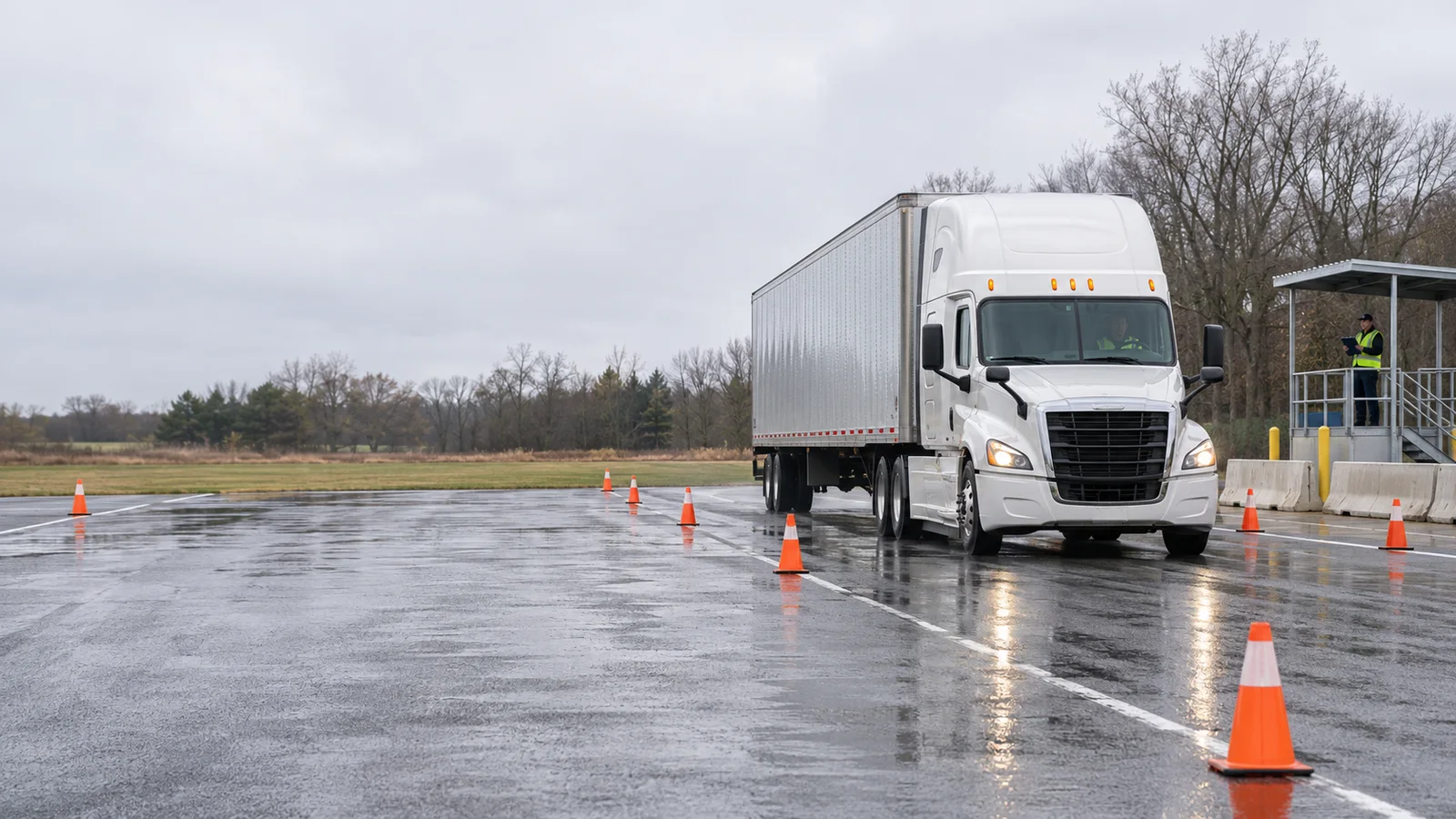
What ABS does—and does not do
ABS manages impending wheel lock
ABS uses wheel-speed information and an electronic control unit to reduce and restore brake pressure when a wheel is approaching lockup. The system reacts faster than a driver could manually cycle pressure at individual wheels. Keeping a wheel rolling rather than sliding helps preserve tire-road grip for directional control. In a hard stop, that can help a driver keep the vehicle pointed where intended and reduce the likelihood of a brake-induced skid.
The important phrase is helps preserve control. The Pennsylvania CDL Manual states that ABS may or may not shorten stopping distance. Its purpose is not to make an overloaded truck, worn tire, slick road, or excessive speed safe. If the available distance is shorter than the distance the vehicle needs, ABS cannot change that fact. Review the separate guide to following distance and space cushions because prevention gives the braking system room to work.
ABS is an addition to normal brakes
ABS does not replace the service brakes. Under ordinary braking, the vehicle stops through its normal brake system. ABS becomes active when the system senses that a wheel is about to lock because of braking. It also does not repair foundation-brake defects, compensate for poor adjustment, or correct contaminated linings. A student should connect ABS knowledge with a careful foundation-brake inspection.
ABS has clear limits
ABS cannot prevent every loss of control. It does not prevent a power skid caused by spinning drive wheels, a turning skid caused by excessive curve speed, a rollover caused by entering a ramp too fast, or a load shift caused by poor securement. It does not cancel brake lag in an air-brake system. It does not justify following closer, driving faster, or waiting longer to react. Think of ABS as a control aid inside a complete safety system, not permission to reduce the space around the vehicle.
Where ABS is required on commercial vehicles
Federal manufacturing-date requirements
Current 49 CFR §393.55 requires ABS on covered truck tractors manufactured on or after March 1, 1997. It requires ABS on other covered air-braked commercial vehicles—including trucks, buses, semitrailers, converter dollies, and full trailers—manufactured on or after March 1, 1998. Covered hydraulically braked trucks and buses manufactured on or after March 1, 1999 must also have ABS. The regulation contains specific exceptions and connects these requirements to the applicable federal motor vehicle safety standards.
These dates matter because a combination may contain units built in different years. Do not assume that a tractor and every trailer have identical equipment. Check the certification information and the vehicle-specific system. Older equipment may also have ABS installed even if its manufacturing date predates a requirement.
Read the ABS warning lamps before moving
Know the normal bulb check
Tractors, trucks, and buses equipped with ABS use a yellow malfunction lamp on the instrument panel. Trailers use a yellow ABS lamp on the left side, generally at a front or rear corner depending on design. On newer systems, the lamp normally illuminates at startup for a bulb check and then goes out. Some older systems may keep the lamp on until the vehicle moves above a low speed.
A lamp that never illuminates during its expected check may itself be defective. A lamp that stays on after the check, or illuminates while underway, can indicate the loss of ABS control at one or more wheels. Learn the exact lamp behavior from the vehicle documentation and instructor rather than memorizing one dashboard pattern for every truck.
Pair the lamp check with the service-brake check
At normal air pressure and in a safe area, the CDL pre-trip procedure includes moving forward slowly and applying the service brake firmly. Watch for pulling, delayed stopping, or an unusual feel. That low-speed functional check does not simulate an emergency stop, and it should never be turned into one. Its value is finding an obvious problem before entering traffic.
Build the stop before the emergency happens
Scan far enough ahead
Hard braking often begins several seconds before the pedal is pressed. A driver who notices a queue forming, a stale green light, a vehicle nosing from a driveway, or brake lights beyond a curve can ease off the accelerator and begin creating space. The earlier clue is more valuable than a perfect last-second technique. Use the routines in the hazard-perception guide to connect visual clues with a specific response.
Keep the vehicle straight and balanced
Whenever possible, complete heavy braking while the wheels are pointed straight and the vehicle is stable. Abrupt steering and maximum braking compete for limited tire grip. A combination already turning or changing lanes has less margin than one traveling straight. If steering is necessary to avoid a collision, use the smallest deliberate input that creates a clear path and continue monitoring the trailer.
Know the road and load
Rain, ice, loose gravel, polished pavement, poor tires, and uneven brake condition can change how each axle responds. A lightly loaded trailer may react differently from a heavily loaded one. Cargo with a high center of gravity adds another concern if the driver steers suddenly. Safe speed must be chosen for the actual surface, visibility, vehicle, and load—not merely the posted limit. For slippery conditions, connect this topic with the winter traction and stop-or-go plan.
A controlled emergency-braking sequence
1. Identify the hazard and choose the safest available path
Look where you need the vehicle to go, not only at the hazard. Decide whether the available lane can support a straight stop. Check the mirrors quickly for the trailer and surrounding traffic, but do not trade the forward view for a long mirror stare. Avoid a reflex lane change into an unverified space.
2. Apply the service brakes decisively
Use the braking force necessary to stop safely while maintaining control. In a straight truck or combination with working ABS on all axles, the Pennsylvania CDL Manual states that the driver can fully apply the brakes in an emergency stop. This is not the same as pumping the pedal. ABS needs a sustained driver command so it can modulate pressure at wheels approaching lockup. Follow the owner’s manual for the specific vehicle.
3. Keep steering inputs small
Hold the wheel securely and keep the vehicle straight unless a verified escape path requires steering. ABS can help preserve steering capability; it does not make abrupt steering safe. A large input can create a lane departure, load shift, trailer swing, or rollover risk even when the wheels remain rolling.
4. Monitor tractor and trailer behavior
Use fast mirror checks to confirm that the trailer remains aligned. If only the tractor has ABS and the trailer begins to swing, the CDL Manual advises backing off the brakes if it is safe to do so. If only the trailer has ABS but the driver loses steering control or a tractor jackknife begins, easing brake pressure—when safe—may help regain control. This is why configuration awareness matters before an emergency.
5. Finish the stop before changing tasks
Do not reach for the phone, transmission controls, radio, or hazard-light switch during the critical braking phase. First control the path and stop. Once stationary, secure the vehicle and evaluate whether it is safe to remain where it stopped or to move to a safer location. If the stop occurred in an active lane, the next action depends on traffic, vehicle condition, and the immediate risk.
How tractor, trailer, and mixed ABS configurations change monitoring
Working ABS on all axles
With working ABS across the straight truck or combination, the driver can make a firm emergency application while focusing on directional control and vehicle alignment. Pedal pulsation, valve cycling sounds, or other system feedback may occur. Do not interpret normal ABS activity as a command to pump or release the brakes. The owner’s manual remains the vehicle-specific authority.
ABS on the tractor only
The steering axle and tractor are less likely to experience brake-induced lockup, but the non-ABS trailer can still lock and move sideways. Keep the combination straight and watch the trailer. If it begins to swing, reduce brake pressure if doing so is safe and there is enough remaining space. Reapply controlled pressure as stability returns.
ABS on the trailer only
The trailer is less likely to swing from brake lock, but the tractor’s wheels can still lock. Loss of steering control or the beginning of a tractor jackknife is a signal to reduce brake pressure if safe, allow the wheels to roll, regain directional control, and resume controlled braking. The presence of a trailer ABS lamp does not prove the tractor has ABS.
ABS malfunction indication
A malfunction indication means the driver should not count on full ABS operation. Regular service brakes may remain, but braking technique and operating decisions must recognize the lost control aid. Slow down, increase space, avoid conditions that require aggressive braking, report the defect, and follow maintenance instructions. An ABS warning is not a substitute for a low-air-pressure response; those are different systems and warnings.
Do not confuse ABS braking, controlled braking, and stab braking
Braking with working ABS
With working ABS, use the braking force needed to stop and maintain control. Do not manually pump the pedal in an attempt to imitate ABS. For a vehicle with working ABS on all axles, the manual permits a full emergency application. Continue to monitor the combination and adjust only when necessary for control.
Controlled braking without relying on ABS
Controlled braking means applying the brakes as hard as possible without locking the wheels. Steering movements remain very small. If the wheels lock or a larger steering correction becomes necessary, release the brakes; reapply them as soon as possible after the wheels roll and control returns. This technique demands judgment and should be learned under qualified instruction.
Stab braking is not the working-ABS procedure
Stab braking is the sequence described for a non-ABS emergency: apply fully, release when the wheels lock, and reapply fully only after the wheels begin rolling. The CDL Manual specifically warns that reapplying before the wheels roll will not let the vehicle straighten. When ABS is working properly, do not use stab braking. Memorizing the label without knowing the vehicle’s equipment can produce the wrong response.
Worked scenario: traffic stops beyond a wet curve
A CDL trainee is driving a loaded tractor-trailer at a speed already reduced for steady rain. The tractor and trailer both have working ABS, and their yellow lamps completed the normal startup check. The trainee sees brake lights through a broad curve and notices that traffic is slowing much faster than expected.
Step 1: create a straight braking path
The trainee releases the accelerator, finishes the gentle curve, and centers the combination. A quick mirror check confirms that the adjacent lane is occupied, so an abrupt lane change is not an escape option. The trainee looks toward the clear stopping path ahead instead of fixating on the last vehicle in the queue.
Step 2: apply firm, sustained braking
With the combination aligned and ABS working on all axles, the trainee applies the service brake firmly and continuously. The trainee holds the steering wheel steady and does not pump the pedal. The system cycles pressure at wheels approaching lockup. The driver continues looking forward and uses brief mirror checks to confirm that the trailer stays in line.
Step 3: avoid unnecessary steering
The trailer remains aligned and the lane ahead is clear enough for a stop, so the trainee resists steering toward the shoulder. Moving onto the wet shoulder could introduce uneven traction, a pavement edge, or roadside obstacles. The best path is the verified straight path already available.
Step 4: secure and evaluate
The combination stops with space remaining. After traffic stabilizes, the trainee keeps control of the vehicle, checks the mirrors, and continues only when the lane moves. Later, the instructor reviews why the successful response began with reduced rain speed and early scanning—not merely the final brake application. If the stop had produced a pull, unusual sound, warning lamp, or possible contact, the correct next step would be to stop safely and inspect or obtain service.
Emergency-braking decision table
| Observation | What it may mean | Driver priority | Avoid |
|---|---|---|---|
| All ABS lamps complete their normal check | No fault is indicated at startup | Drive normally, maintain space, and use vehicle-specific braking instructions | Assuming ABS shortens every stop |
| Yellow ABS lamp stays on | ABS control may be lost at one or more wheels | Report the defect, increase margin, and arrange service | Ignoring or covering the lamp |
| Hard stop with working ABS on all axles | System can modulate impending wheel lock | Firm application, small steering inputs, monitor the combination | Pumping or stab braking |
| Trailer begins to swing with tractor-only ABS | Trailer wheels may have locked | Ease brake pressure if safe, regain alignment, resume controlled braking | Large countersteering movements |
| Steering control is lost with trailer-only ABS | Tractor wheel lock or jackknife may be developing | Reduce pressure if safe until wheels roll and control returns | Holding locked wheels in a skid |
| Low-air warning also activates | Available controlled braking may be decreasing | Stop and park safely as soon as possible while usable air remains | Treating it as only an ABS issue |
| Vehicle pulls or braking feels delayed | Possible brake-system defect or unequal braking | Stop safely, report, inspect, and repair before continued operation | Testing the problem again at road speed |
What to do after a hard stop
Secure the vehicle before diagnosing
Once stopped, evaluate the traffic position first. If the vehicle can be moved safely and the braking system appears functional, follow the carrier’s procedure for reaching a safer location. If it cannot move safely, activate warning systems and use required emergency equipment when conditions permit. The emergency-equipment readiness guide explains the planning that should happen before a roadside event.
Look for evidence, not reassurance
Check the instrument panel, note which lamp is illuminated, and report exactly what happened: road condition, speed range, brake feel, pulling, noises, smoke, odor, trailer movement, and whether the lamp was present before or after the event. Do not decide that the truck is safe only because it stopped once. A hot odor, smoke, air loss, damaged tire, or abnormal brake response deserves professional inspection.
CDL ABS and emergency-braking practice checklist
- Identify whether the training vehicle is a tractor-trailer, straight truck, or bus.
- Locate the tractor, truck, or bus ABS malfunction lamp.
- Locate the trailer ABS lamp when applicable.
- Describe the normal bulb-check behavior for that vehicle.
- Confirm which units and axles are equipped with ABS.
- Review the vehicle owner’s manual and school procedures.
- Complete the foundation-brake and air-system inspection.
- Perform the low-speed service-brake check in a safe area.
- Explain why ABS may not shorten stopping distance.
- Explain why ABS does not compensate for excessive speed.
- Practice scanning for queues, cross traffic, and stale signals.
- Name a verified escape path without making an abrupt move.
- Keep both hands ready for small, controlled steering inputs.
- Describe the correct working-ABS brake application.
- Describe controlled braking without relying on ABS.
- Explain why stab braking is not used with properly working ABS.
- State what to do if only the tractor has ABS and the trailer swings.
- State what to do if only the trailer has ABS and steering control is lost.
- Separate an ABS warning from a low-air-pressure warning.
- Know how to report a lamp, pull, delay, odor, smoke, or unusual sound.
- Never practice a maximum stop in traffic or without instructor control.
Common mistakes that make a hard stop worse
Treating ABS as extra stopping power
ABS manages wheel lock; it does not add tire grip or erase speed. A driver who follows closer because the vehicle has ABS removes the space the system needs. Continue using conservative speed and spacing.
Pumping working ABS
Repeatedly releasing the pedal interrupts the driver’s braking command and can lengthen the response. Apply the appropriate pressure and let a properly working ABS perform its function.
Making a panic lane change
A large steering input may trade a forward hazard for a side collision, rollover, or trailer swing. Verify the path and use the smallest necessary steering input. Sometimes a straight stop is safer than an unverified escape.
Frequently asked questions
What does ABS do during hard braking in a commercial vehicle?
ABS monitors wheel speed and adjusts brake pressure when a wheel is about to lock. Its main benefit is helping the driver retain directional control during hard braking; it does not guarantee a shorter stop or overcome poor tires, excessive speed, or bad brakes.
Should a CDL driver pump the brakes when ABS is working?
No. For a vehicle with working ABS, follow the vehicle manufacturer’s instructions and use the braking force needed to stop while keeping the vehicle under control. The Pennsylvania CDL Manual says that if a straight truck or combination has working ABS on all axles, the driver can fully apply the brakes in an emergency stop.
What should a driver do if the yellow ABS warning lamp stays on?
A lamp that remains on after the normal bulb check or comes on while driving may mean ABS control has been lost at one or more wheels. The regular brakes may still function, but the defect should be reported and serviced promptly under the carrier’s procedures.
Does ABS prevent every skid or jackknife?
No. ABS is designed to reduce brake-induced wheel lock, but it cannot prevent a skid caused by entering a curve too fast, spinning drive wheels, abrupt steering, poor traction, or an unstable load. Safe speed, space, inspection, and smooth steering remain essential. See the companion guide to skid and jackknife prevention.
Official sources
- , especially Sections 2.17, 2.18, 5.3, and 5.4.
- .
- , Section 2.18.